 DSTechnoverse company
CORSIA Carbon Credit Requirements: Eligibility, Rules and Compliance Guide
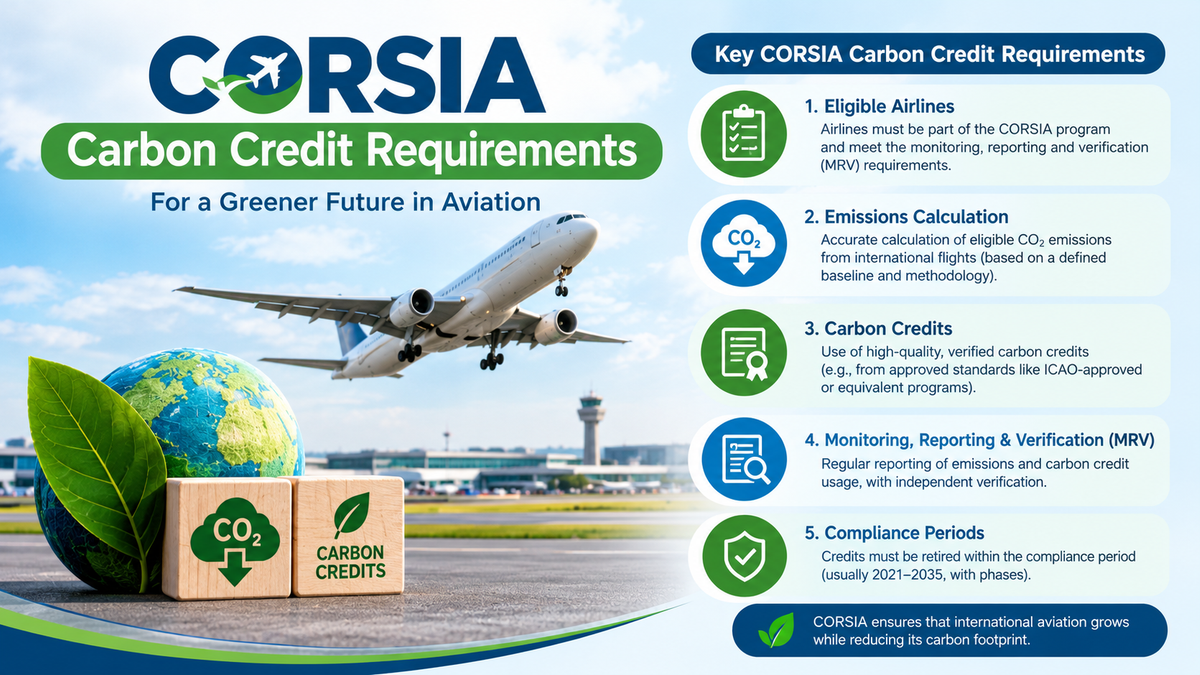
CORSIA carbon credit requirements are the conditions a carbon credit must meet before an airline can cancel it to meet its offsetting requirement under CORSIA, the Carbon Offsetting and Reduction Scheme for International Aviation. The International Civil Aviation Organization (ICAO) sets these conditions. They apply by compliance period and must be checked against current ICAO documents, not a seller’s description.
What Are CORSIA Carbon Credit Requirements?
Three different things are often mixed up, so it helps to separate them.
- A general-market carbon credit is a tradable unit issued by a crediting programme for a verified emission reduction or removal. It may be high quality and still not be usable for CORSIA.
- A CORSIA-eligible emissions unit is a unit that falls within the scope ICAO has approved for a given compliance period. ICAO calls these CORSIA Eligible Emissions Units (CEEUs).
- An airline’s CORSIA obligation is a separate matter. Operators must monitor, report and verify emissions from international flights. Where offsetting applies, they meet the final requirement by cancelling eligible units.
So the requirements for a unit are different from the duties of an airline. Eligibility also cannot be assumed from marketing language, a registry logo or a programme’s reputation. It must be confirmed against ICAO’s current document. CORSIA eligibility is also separate from approval under India’s Carbon Credit Trading Scheme or from any voluntary-market label. For background on the airline side, see this CORSIA explained for airlines guide.
Which Carbon Credits Are Eligible Under CORSIA?
The ICAO Council decides, after assessment by its Technical Advisory Body (TAB). Programmes are assessed against the CORSIA Emissions Unit Eligibility Criteria. The approved list is published in the ICAO document CORSIA Eligible Emissions Units, which only the Council can amend.
In the 14th edition (1 April 2026), the programmes approved for the first phase (2024–2026) are:
- American Carbon Registry (ACR)
- Architecture for REDD+ Transactions (ART)
- BioCarbon Fund Initiative for Sustainable Forest Landscapes (ISFL)
- Climate Action Reserve (CAR)
- Forest Carbon Partnership Facility (FCPF)
- Global Carbon Council (GCC)
- Gold Standard
- Isometric
- Premium Thailand Voluntary Emission Reduction Programme (Premium T-VER)
- Verra’s Verified Carbon Standard (VCS)
This list has changed several times, so treat it as a dated snapshot. For each programme, ICAO sets out an eligibility timeframe, eligible unit dates, a scope of eligibility and a designated registry.
Approval of a programme does not make every unit eligible. ICAO states that not all units from approved programmes qualify. For first-phase use, the document generally requires that:
- the activity started its first crediting period on or after 1 January 2016
- the emission reductions occurred between 1 January 2021 and 31 December 2026
- the host country has authorised the units for CORSIA through an attestation to avoid double-claiming
- the programme has verified that the corresponding adjustment has been applied, and/or the units are covered by a programme-approved guarantee
- the unit is issued and cancelled on the programme’s designated registry
Exclusions also apply and differ by programme. Examples include certain large REDD+ project-level activities, grid-connected renewable projects above 15 MW (for some programmes), some carbon-storage activities without suitable regulation, and units from projects that have not reported sustainable development co-benefits where the programme entry requires it. These are illustrations only. The programme’s own entry is what counts.
What Are the Main Eligibility Criteria for CORSIA Carbon Credits?
ICAO requires programmes to meet its Program Design Elements Criteria and Carbon Offset Credit Integrity Assessment Criteria. In plain terms, ICAO assesses concepts such as:
- Robust quantification: reductions or removals are quantified, monitored and reported against credible baselines.
- Independent validation and verification: a third party reviews the claims.
- Additionality: the reduction would not have happened without the carbon-credit incentive.
- Permanence and reversal risk: for relevant project types, such as forestry, there must be a way to handle reversals.
- Leakage: material leakage is assessed and mitigated.
- No double counting: units are counted only once towards a mitigation obligation.
- Identification and tracking: units have unique serial numbers and clear issuance and retirement procedures.
- Governance and safeguards: the programme has transparent rules and social and environmental protections.
These are criteria for assessing programmes, not a universal checklist every individual unit must separately pass. Some general quality principles (for example, a premium label from a voluntary standard) are good practice but are not CORSIA requirements. The exact conditions that apply to a unit depend on its programme entry and the rules for the compliance period.
What Documents and Verification Are Needed?
No official universal checklist applies to every transaction. It helps to separate documents used to assess a unit from records tied to formal compliance steps.
Records that help a buyer assess eligibility:
- programme and project identification, with the project’s first crediting period start date
- project design document and methodology
- validation and verification reports
- serial numbers and registry records showing issuance, vintage and current status
- evidence of host-country authorisation (letter of authorization) and of the corresponding adjustment or guarantee, where the programme entry requires it
- the programme’s CORSIA label or flag on the unit, where the registry provides one
Records tied to compliance:
- registry evidence that units were cancelled for CORSIA by the operator
- whatever cancellation and reporting information your State authority requires for the compliance period
ICAO’s standards set information requirements for the registries that hold CORSIA units. Because reporting formats and evidence rules are defined by the State and ICAO, confirm them with your authority rather than relying on a seller’s template. The site’s quality and registries guides explain registry records and serial numbers in more detail.
How Do CORSIA Requirements Differ Across Compliance Phases?
CORSIA has a pilot phase (2021–2023), a first phase (2024–2026) and a second phase (2027–2035). Participation in the first two phases is voluntary for States. The second phase applies to all ICAO Member States except those exempt, such as least developed countries, small island developing states and landlocked developing countries. Offsetting is route-based in the early phases, covering routes between participating States.
Unit eligibility follows compliance periods, which are different from airline obligations:
- Pilot (2021–2023): eligible reductions run to 2023 for some programmes and to 2020 for others, with different rules on host-country attestation.
- First phase (2024–2026): reductions from 2021 to 2026, plus the conditions described above.
- 2027–2029: ICAO’s April 2026 edition lists four programmes (ACR, ART, Gold Standard and VCS), with additional exclusions, including a requirement to demonstrate baselines set below business-as-usual. TAB has also invited programmes to apply in its 2026 assessment cycle, so this may change.
Requirements change over time. Not every airline has the same obligations, because they depend on routes and the participating States. Monitoring and reporting duties differ from unit eligibility rules. A credit that looks suitable in a general marketplace must still be checked against the rules for its intended use. To see how coverage works, use this self-check on whether your airline is covered by CORSIA.
How to Check CORSIA Carbon Credit Eligibility Before Buying
A careful review reduces the risk of buying units that cannot be used for their intended purpose. A practical process:
- Identify the compliance period the units are meant for.
- Consult the current ICAO document CORSIA Eligible Emissions Units and its programme summary table.
- Confirm the programme and unit category listed for that period.
- Check the project, methodology, vintage and exclusions against the programme’s scope entry.
- Review registry records and traceability: serial numbers, issuance, vintage, status and designated registry.
- Confirm documentation with the seller or programme, including host-country authorisation and corresponding adjustment status where required.
- Seek qualified compliance advice if the rules are unclear for your case.
Readers researching CORSIA-related carbon credits can use the eligible units checklist on CORSIA Carbon Credit as a plain-language aid, then verify each point against ICAO’s documents. No website, supplier or checklist can guarantee compliance, and CORSIA Carbon Credit is an independent resource, not an ICAO-endorsed body. Understanding CORSIA carbon credit requirements before you buy is the most reliable way to avoid surprises later.
Frequently Asked Questions (FAQs)
1. What are the requirements for CORSIA carbon credits? A unit must come from a programme the ICAO Council has approved for the relevant compliance period, and must fall within that programme’s listed scope, dates and exclusions. For the first phase, this generally includes reductions from 2021–2026, host-country authorisation, and corresponding adjustment or guarantee conditions.
2. Are all voluntary carbon credits eligible under CORSIA? No. Many voluntary credits are not eligible. Even credits from approved programmes qualify only if they meet the programme’s entry in ICAO’s document.
3. How can I verify whether a carbon credit is CORSIA-eligible? Check the ICAO document CORSIA Eligible Emissions Units for the compliance period, then confirm the unit’s programme, project, methodology, vintage and registry record. Ask for authorisation and adjustment evidence where required. If unsure, ask a qualified adviser or your State authority.
4. Does CORSIA carbon credit eligibility depend on the vintage? Yes. Each programme entry has “eligible unit dates”. For the first phase (2024–2026), the reductions generally must have occurred between 1 January 2021 and 31 December 2026, and the activity must meet the crediting-start condition.
5. Which authority publishes CORSIA carbon credit eligibility requirements? ICAO. The Council approves the criteria and the list of eligible programmes, based on recommendations from its Technical Advisory Body, and publishes them on the ICAO CORSIA website.