 DSTechnoverse company
CORSIA Full Form: Meaning, Purpose and Working in Aviation
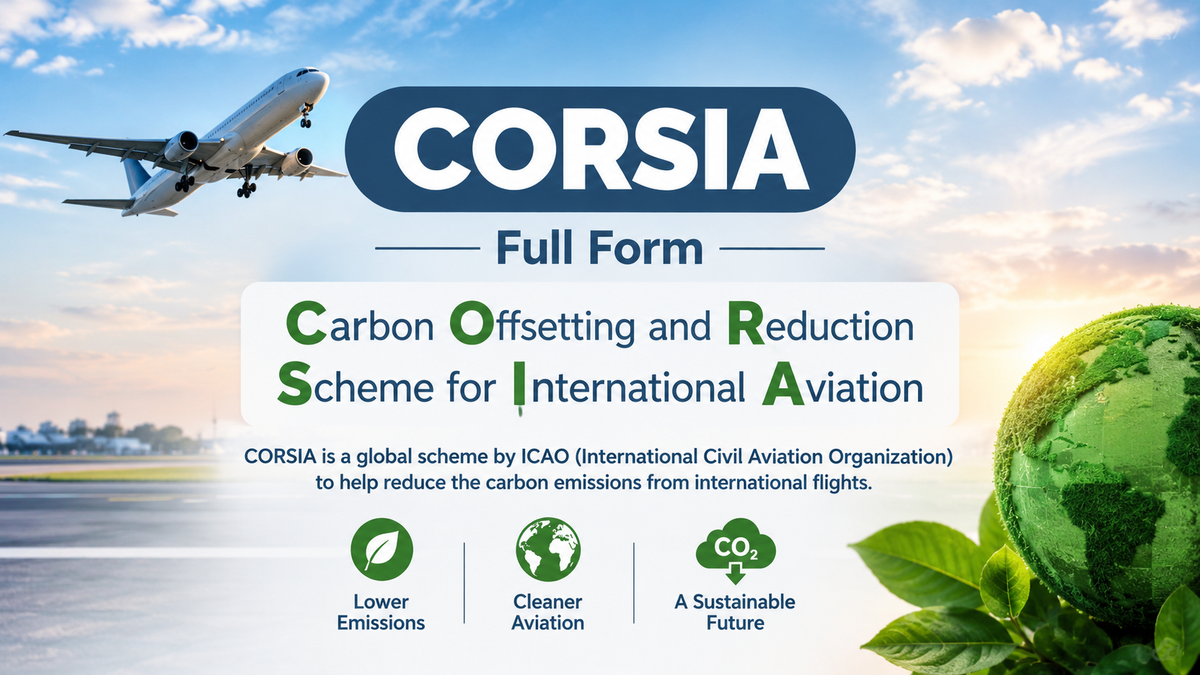
The CORSIA full form is Carbon Offsetting and Reduction Scheme for International Aviation. It is a global climate measure developed by the International Civil Aviation Organization (ICAO) to address CO₂ emissions from international flights. Airlines monitor, report and verify these emissions and, where the rules require, offset part of them using eligible emissions units.
This guide explains what CORSIA stands for, why it exists, how it works and what makes a carbon credit usable under the scheme.
What Is the CORSIA Full Form in Aviation?
CORSIA stands for Carbon Offsetting and Reduction Scheme for International Aviation. Each word in the name describes part of the scheme:
- Carbon Offsetting: emission reductions achieved elsewhere are used to balance part of an airline’s emissions growth.
- Reduction: the scheme sits alongside other measures that cut aviation emissions, such as better aircraft technology, operational efficiency and cleaner fuels.
- International Aviation: it focuses on international flights, not domestic ones.
ICAO is the United Nations agency for civil aviation. Its Assembly agreed to CORSIA in October 2016, and ICAO describes it as the only global market-based measure applying to CO₂ emissions from international aviation.
The term matters to several groups. Airlines and aircraft operators need it to understand their reporting and offsetting duties. Aviation professionals and regulators use it in compliance planning. Carbon-market participants and corporate buyers need it because CORSIA creates a specific kind of demand for carbon credits. For a plain-language overview aimed at airline management, see this CORSIA explained for airlines guide.
Why Was CORSIA Introduced by ICAO?
International flights cross borders, so their emissions do not fit neatly into any one country’s national climate accounts. ICAO estimates that international aviation accounts for roughly 1.3 per cent of global CO₂ emissions, based on 2015 fuel-use data. The sector is also growing, so a shared global approach was needed.
ICAO had already set a goal of carbon-neutral growth from 2020. CORSIA was created to help meet that goal by addressing the portion of emissions growth that other measures do not remove. In 2022, ICAO also adopted a long-term aspirational goal of net-zero carbon emissions from international aviation by 2050.
It is important to be clear about what CORSIA is not. It is not a replacement for other emissions-reduction measures. ICAO treats it as one part of a wider “basket of measures”:
- more efficient aircraft and engines
- better operations and air traffic management
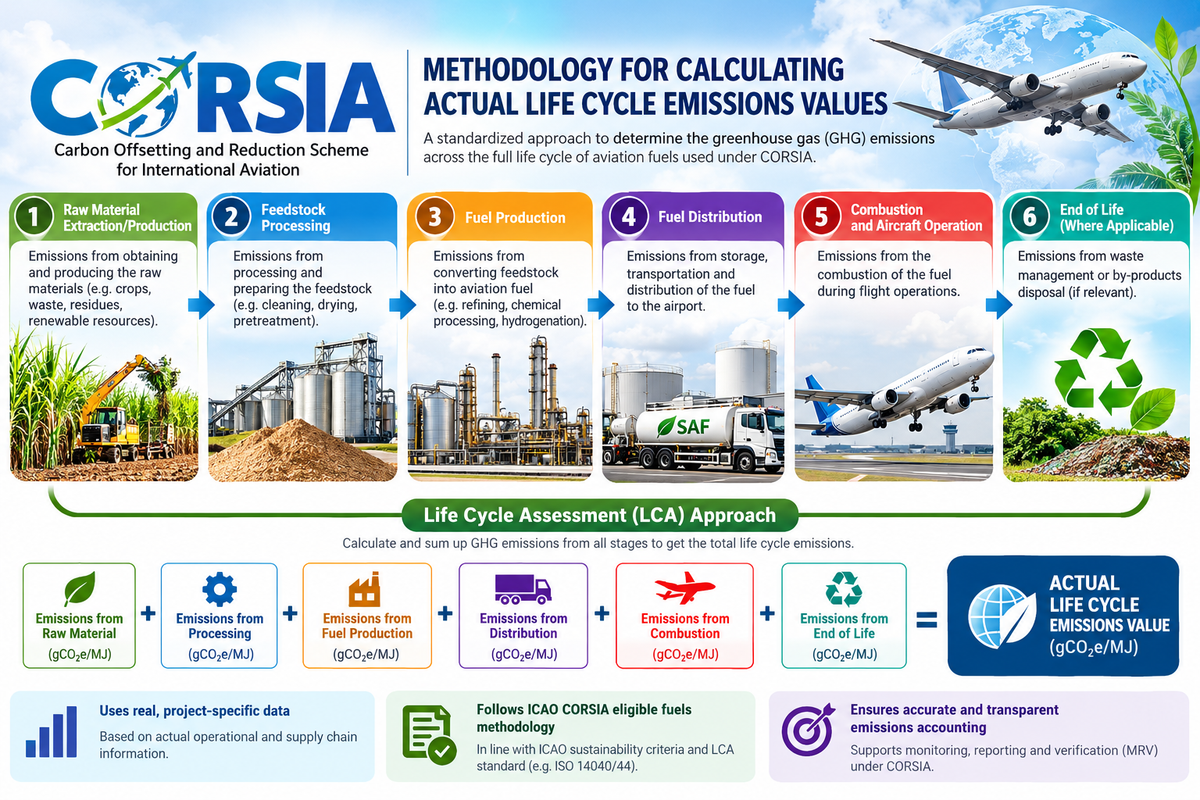
- sustainable aviation fuels (SAF) and other CORSIA eligible fuels
- market-based measures such as CORSIA, used for what remains
Eligible fuels can also reduce an operator’s offsetting requirements. Offsetting is meant to complement real reductions in the sector, not stand in for them.
How Does the CORSIA Scheme Work?
CORSIA follows a repeating cycle each year.
- Monitoring: operators track fuel use and CO₂ emissions on international flights under an approved monitoring plan.
- Reporting: operators submit annual emissions reports to the relevant State authority, which reports to ICAO.
- Verification: an independent, accredited verifier checks the report before it is accepted.
- Determining offsetting obligations: where offsetting applies, the requirement is calculated under ICAO rules. It is linked to emissions growth against a baseline tied to 2019 levels, and it is shaped by the sector’s overall growth. Eligible fuels can reduce it.
- Using eligible emissions units: operators buy and cancel CORSIA Eligible Emissions Units to meet the remaining requirement.
CORSIA phases and who participates
CORSIA is rolled out in phases:
- Pilot phase (2021–2023): voluntary for States.
- First phase (2024–2026): voluntary for States.
- Second phase (2027–2035): applies to all ICAO Member States, except those exempt, such as least developed countries, small island developing states, landlocked developing countries, and States with a very small share of international aviation activity, unless they choose to join.
During the pilot and first phases, offsetting is route-based. A route is covered only if both States connected by it participate. The duty to monitor, report and verify emissions is separate from the offsetting duty. Domestic flights are not covered, so do not assume that every flight automatically falls under CORSIA. Whether an operator has an offsetting obligation depends on its routes, the States involved, and the rules for that compliance period. To check how this works in practice, read this self-check on whether your airline is covered by CORSIA.
What Are CORSIA-Eligible Carbon Credits?
A carbon credit represents one tonne of CO₂-equivalent reduced or removed by a project, such as forest restoration or renewable energy. Credits are issued and tracked in a registry. Operators use CORSIA Eligible Emissions Units (CEEUs) to meet their offsetting requirements.
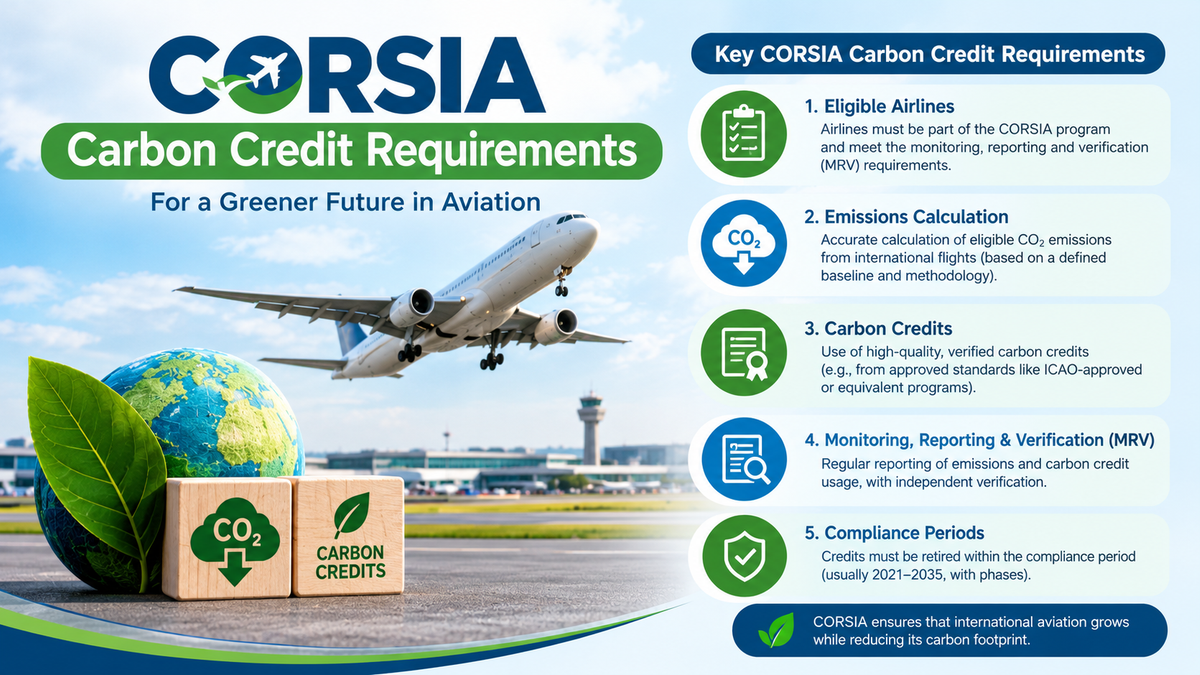
Not every carbon credit qualifies. A general voluntary carbon credit and a CORSIA-eligible unit are not the same thing. ICAO’s Council approves carbon-crediting programmes only after assessment against the CORSIA Emissions Unit Eligibility Criteria. These criteria cover areas such as:
- Programme eligibility: the unit must come from a programme approved by ICAO for the relevant compliance period.
- Approved unit types and scope: the project type, methodology and any exclusions in ICAO’s document must be met.
- Vintage: for the first phase, eligible reductions generally fall between 1 January 2021 and 31 December 2026, subject to ICAO’s conditions.
- Monitoring and verification: the underlying reductions must be measured and independently verified.
- Traceability: units must be uniquely serialised, tracked in a registry and cancelled when used.
- Avoiding double counting: for first-phase use, the host country must authorise the unit through a letter of authorization and apply a corresponding adjustment. This stops the same tonne being counted by both the host country and the airline.
Because approvals and supply change over time, the official ICAO document “CORSIA Eligible Emissions Units” is the reference to check. The site’s CORSIA-eligible units checklist gives a practical way to work through these tests.
How Can Airlines and Businesses Understand CORSIA Compliance?
CORSIA compliance involves several moving parts: emissions reporting, verification, offsetting calculations, unit eligibility and procurement. Mistakes in any of them can cause delays or rejected units, so a clear understanding early helps.
Practical steps include:
- Start with official guidance. ICAO’s CORSIA pages, State letters and the latest eligible-units document are the authoritative references. Your national aviation authority explains how the rules apply locally.
- Confirm your coverage. Check which of your routes fall under offsetting and which only require reporting.
- Confirm unit eligibility. Check the programme, vintage, project scope, label and host-country authorisation for every unit before buying.
- Review documentation. Registry records, serial numbers, verification reports and authorisation letters should all be checked line by line.
- Plan procurement. Eligible supply is limited and changes as programmes are approved and host countries issue authorisations, so timelines and costs are not fixed.
Readers researching CORSIA-related carbon-credit information can find explainers in the CORSIA Carbon Credit knowledge base. Remember that CORSIA is an ICAO scheme. Independent websites are not endorsed or certified by ICAO, and no source can guarantee compliance for you. Your airline’s own verification and regulator decide that.
In short, the CORSIA full form is more than a name. It points to a structured system of monitoring, reporting, verification and offsetting for international flights, and it works only alongside wider emissions-reduction efforts.
Frequently Asked Questions (FAQs)
1. What is the full form of CORSIA? CORSIA stands for Carbon Offsetting and Reduction Scheme for International Aviation. It is a global scheme set up by ICAO.
2. What does CORSIA mean in aviation? It is a framework that requires airlines to monitor, report and verify CO₂ emissions from international flights and, where applicable, offset part of their emissions growth using eligible emissions units.
3. Who developed the CORSIA scheme? The International Civil Aviation Organization (ICAO) developed it. Its Assembly agreed to the scheme in October 2016.
4. Are all carbon credits eligible under CORSIA? No. Only units from ICAO-approved programmes that meet the eligibility criteria on scope, vintage, traceability and host-country authorisation can be used. Many credits sold in the voluntary market do not qualify.
5. How does CORSIA help address international aviation emissions? It requires emissions to be tracked and verified and, where applicable, offsets emissions growth through eligible units. It works alongside efficiency gains and cleaner fuels, and does not remove all aviation emissions by itself.