 DSTechnoverse company
CORSIA Methodology for Calculating Actual Life Cycle Emissions Values: A Complete Guide
The CORSIA methodology for calculating actual life cycle emissions values is the ICAO-prescribed method a fuel producer uses to quantify the greenhouse gas intensity of its own CORSIA eligible fuel (CEF) supply chain, in grams of CO₂ equivalent per megajoule (gCO₂e/MJ). The result combines a producer-specific core life cycle assessment (core LCA) value with induced land use change (ILUC) emissions and, where applicable, emission credits. This guide explains how the calculation is structured, what evidence supports it, and how it feeds CORSIA’s emissions-reduction accounting. It is based on ICAO’s November 2025 edition of the methodology document and related official materials.
What Is the CORSIA Methodology for Calculating Actual Life Cycle Emissions Values?
In short: it is the set of rules in an ICAO document, referenced in Annex 16, Volume IV, that tells a producer how to calculate a pathway-specific life cycle emissions value for a CORSIA eligible fuel instead of using an ICAO default [1][3]. The value is expressed in gCO₂e/MJ on a lower-heating-value basis [1].
CORSIA eligible fuels include CORSIA sustainable aviation fuel (SAF) and CORSIA lower carbon aviation fuel (LCAF). Not every fuel, feedstock or pathway qualifies. Eligibility depends on meeting the CORSIA sustainability criteria, and a calculated value alone does not establish it [3]. The calculation must also follow ICAO’s methodology, not a generic life cycle assessment (LCA) method chosen independently. A general LCA does not automatically meet CORSIA requirements.
Life-cycle emissions versus combustion emissions
Burning jet fuel releases CO₂ at the engine whatever its origin. A life cycle approach instead accounts for emissions across the fuel’s supply chain, from feedstock production through conversion and distribution to use in the aircraft. This lets renewable or waste-derived fuels be compared with fossil jet fuel on the same basis. Under CORSIA, the fossil comparison value (LC) is 89 gCO₂e/MJ for jet fuel and 95 gCO₂e/MJ for aviation gasoline [1].
Why actual values differ between pathways
Feedstock type and origin, conversion technology, process energy, hydrogen source and transport distances can all change the result [5]. This pathway sensitivity is why ICAO allows producers to demonstrate an actual value where they can support it with technical data [3].
What Is the Difference Between Actual and Default Life Cycle Emissions Values?
ICAO uses two routes. Default life cycle emissions values are published in the ICAO document CORSIA Default Life Cycle Emissions Values for CORSIA Eligible Fuels, set by feedstock, conversion process and, for some pathways, region. They were derived using methodologies developed by ICAO’s Committee on Aviation Environmental Protection (CAEP) [2][3][4]. Actual life cycle emissions values are calculated by the producer using the ICAO actual-values methodology [1][3]. In both cases, the total value is built from core LCA plus ILUC, less emission credits where applicable [1][2].
Which Emissions Sources Are Included in the Life-Cycle Calculation?
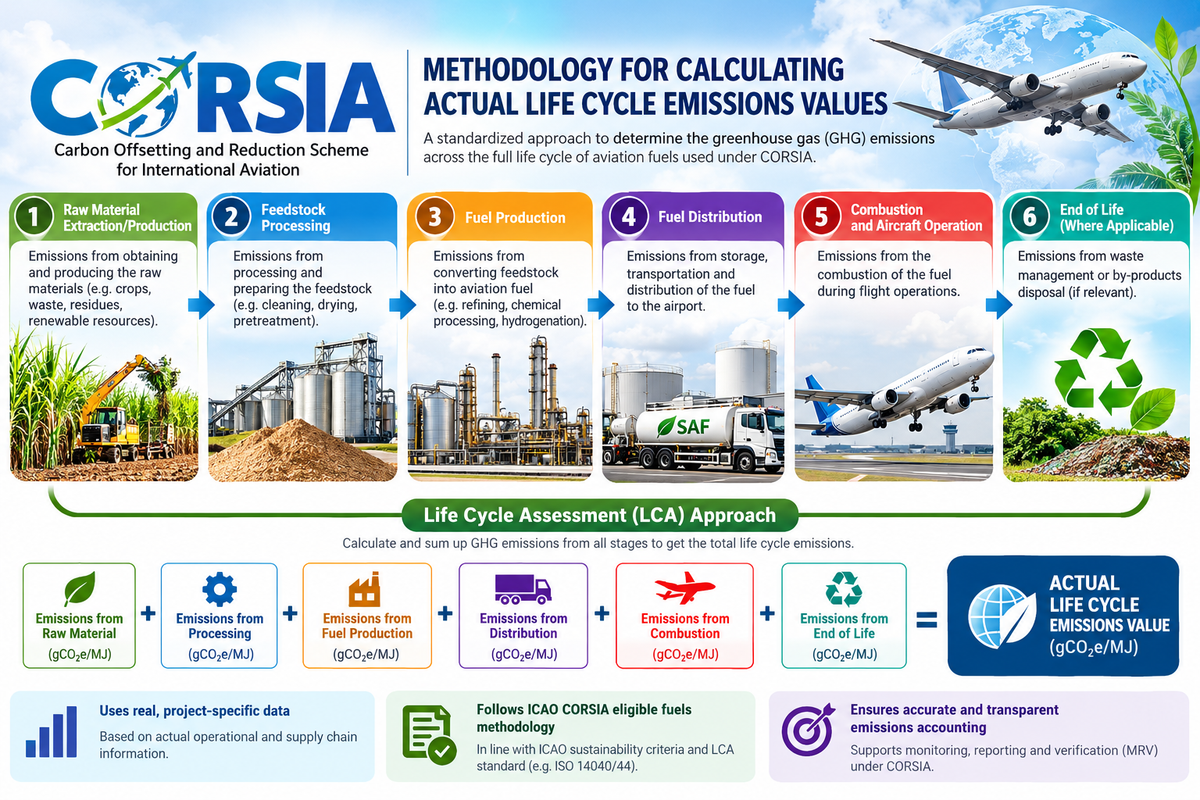
ICAO describes the core LCA as covering feedstock cultivation, harvesting, collection and recovery, feedstock processing and extraction, feedstock transport to processing and production facilities, feedstock-to-fuel conversion, fuel transport and distribution, and fuel combustion in an aircraft engine [3]. The numbering and treatment of downstream steps, such as transport after blending, differ between editions and scheme documents, so follow the current edition’s text [1][6]. Emissions of non-CO₂ gases are expressed as CO₂e using the conversion values the methodology prescribes [6].
Pathway-specific differences
Not every stage carries the same weight for every fuel:
- Wastes, residues and by-products: production at source (stage 1) is treated as zero-emission, while later stages are included [5]. ILUC applies to crops, not to these feedstock classes [8].
- Inputs: emissions linked to material and utility inputs such as chemicals and energy are included. Facility construction and equipment manufacturing are not considered [5].
- Municipal solid waste (MSW) fuels: optional credits for recycling and landfill avoidance may apply [3].
- Co-processing: the methodology contains specific provisions for co-processed fuels [1].
Induced and direct land use change
ILUC accounts for emissions from additional land use, including displacement of crops elsewhere [3]. For actual-value calculations, the ILUC value is taken from ICAO’s default-values document rather than calculated by the producer [6]. Separately, where land was converted after 1 January 2008, direct land use change (DLUC) emissions must be calculated, and if they exceed the default ILUC value, the DLUC value replaces it [3].
How to Calculate Actual Life Cycle Emissions Values Under CORSIA
The structure of the calculation is:
L_CEF = core LCA value + ILUC − emission credits [1][2]
- L_CEF: life cycle emissions value of the CORSIA eligible fuel, in gCO₂e/MJ. Annex 16 writes it as LS_f in the reduction formula [7].
- Core LCA value: for an actual value, calculated under the ICAO methodology, in gCO₂e/MJ.
- ILUC: induced land use change emissions, in gCO₂e/MJ, where applicable to the pathway.
- Emission credits: only where the methodology allows them (for example MSW-based fuels), in gCO₂e/MJ.
LCAF eligibility and crediting use separate equations in the same document, so check the relevant section for fossil-based fuels [1].
Step-by-step workflow
- Identify the pathway and feedstock, including feedstock class (crop, waste, residue or by-product).
- Confirm CORSIA coverage. Check that the pathway falls within the applicable CORSIA fuel and sustainability requirements.
- Collect primary data: production records, energy and material inputs, yields and transport data for each life cycle step within the certification scope [1].
- Fix methodology and boundaries, using the current ICAO edition (and noting its version).
- Quantify emissions for each required stage.
- Apply emission factors and prescribed rules, keeping units consistent (per MJ of fuel, lower-heating-value basis) [1].
- Add ILUC or DLUC where required, and credits only where permitted.
- Calculate L_CEF using the equation above.
- Check the result against the sustainability criteria and reporting requirements, including the 10% reduction criterion [3].
Illustrative example (hypothetical)
The numbers below are invented to demonstrate the arithmetic only. They are not ICAO values or a real pathway. Suppose a hypothetical pathway has a core LCA value of 20 gCO₂e/MJ, ILUC of 5 gCO₂e/MJ, and no credits. Then L_CEF = 20 + 5 − 0 = 25 gCO₂e/MJ.
What undermines reliability
Missing primary data, mixed units (mass, volume and energy bases), unsupported assumptions, or boundaries that omit required stages can produce a value a certification scheme will not accept. These are general good-practice warnings, and the formal acceptance test is the ICAO methodology as applied by the SCS.
What Data, Certification and Verification Are Required?
Formally required evidence
From the sources reviewed, the core requirements are LCA inventory data by life cycle step within the scope of certification, including energy and material inputs [1], and confirmation by an approved SCS that the ICAO methodology has been applied correctly [7]. The fuel itself must also be certified under an approved scheme, with the chain-of-custody and sustainability documentation that scheme requires. Exact document lists vary by scheme and edition, so confirm them with the scheme.
Good practice
These are recommended rather than universally prescribed:
- Traceability of feedstock origin
- Production process and energy records
- Transport distances and modes
- Supporting references for emission factors
- Mass-balance records where the scheme’s chain-of-custody approach uses them
- Calculation files recording the methodology edition used
Certification and verification
Not every certification scheme, certificate or audit is automatically acceptable for CORSIA. Only schemes approved by ICAO for the relevant period count, and the scheme’s scope must cover the fuel. Examples of scheme documents that implement the ICAO methodology include ISCC’s CORSIA life cycle document, which states it is based on ICAO’s third edition (June 2022) [6]. Separately, an operator’s claimed emissions reductions must be verified by an independent third party within the CORSIA reporting process [9].
How Are Actual Life Cycle Emissions Values Used Under CORSIA?
The life cycle value serves two purposes. First, it supports the eligibility test: a CORSIA eligible fuel must achieve net greenhouse gas reductions of at least 10% against the baseline, which for jet fuel is 89 gCO₂e/MJ [3][4]. By simple arithmetic, that implies a value of no more than 80.1 gCO₂e/MJ for jet fuel. Second, it drives the emissions-reduction calculation for an operator, set out in Annex 16, Volume IV:
ER_y = FCF × MS_f,y × (1 − LS_f / LC) [7]
- ER_y: emissions reductions claimed in year y, in tonnes of CO₂
- FCF: fuel conversion factor, 3.16 kg CO₂/kg for Jet-A/Jet-A1
- MS_f,y: mass of neat CORSIA eligible fuel claimed in year y, in tonnes
- LS_f: the fuel’s life cycle emissions value, in gCO₂e/MJ
- LC: baseline, 89 gCO₂e/MJ for jet fuel
Hypothetical continuation: with LS_f = 25 and 1,000 tonnes claimed, ER_y = 3.16 × 1,000 × (1 − 25/89) ≈ 2,272 tonnes of CO₂.
An actual life cycle emissions value is not an airline’s total emissions, its full offsetting obligation, or the eligibility of a standalone carbon credit. Fuel-based reductions are one deduction within the wider obligation. For that context, CORSIA Carbon Credit’s one-page brief on CORSIA for airline management explains how the cost is built up, and its checklist for CORSIA-eligible units covers the separate question of which carbon credits qualify. Its offsetting estimator can help with the wider obligation.
Conclusion. The CORSIA methodology for calculating actual life cycle emissions values gives producers a defined route to a pathway-specific figure, but the outcome depends on the pathway, the current ICAO edition and the evidence behind it. Keep auditable records, work from the latest ICAO documents, and consult qualified technical or certification professionals for a specific fuel. Operators needing wider compliance help can also look at CORSIA Carbon Credit’s CORSIA services. The site is independent of ICAO and does not certify fuels.
Frequently Asked Questions
1. What are actual life-cycle emissions values under CORSIA? They are producer-specific values, in gCO₂e/MJ, calculated for a CORSIA eligible fuel using ICAO’s actual-values methodology instead of a published default [1][3]. They combine core LCA, ILUC and, where allowed, emission credits.
2. How are actual life-cycle emissions values calculated? The structure is L_CEF = core LCA + ILUC − emission credits [1]. The producer collects data for each required life cycle step, quantifies emissions under ICAO’s rules, adds the ILUC or DLUC component where required, and has the application of the methodology confirmed by an approved SCS [1][7].
3. What is the difference between actual and default life-cycle emissions values? Default values are ICAO-published figures for listed pathways. Actual values are calculated from a producer’s own supply-chain data and may differ from the default [2][3]. Neither replaces the need to meet the sustainability criteria.
4. Which emissions sources are included in CORSIA life-cycle calculations? Feedstock cultivation or collection, feedstock processing, feedstock transport, fuel conversion, fuel distribution and combustion are covered, plus ILUC and, where applicable, credits [3]. Treatment varies by feedstock class. For example, wastes, residues and by-products carry zero emissions at the production-at-source stage [5].
5. How are actual life-cycle emissions values verified for CORSIA? An approved sustainability certification scheme must ensure the ICAO methodology has been applied correctly [7], and an operator’s claimed reductions are verified by a third party in the reporting process [9]. The exact requirements depend on the scheme and the current ICAO provisions.