 DSTechnoverse company
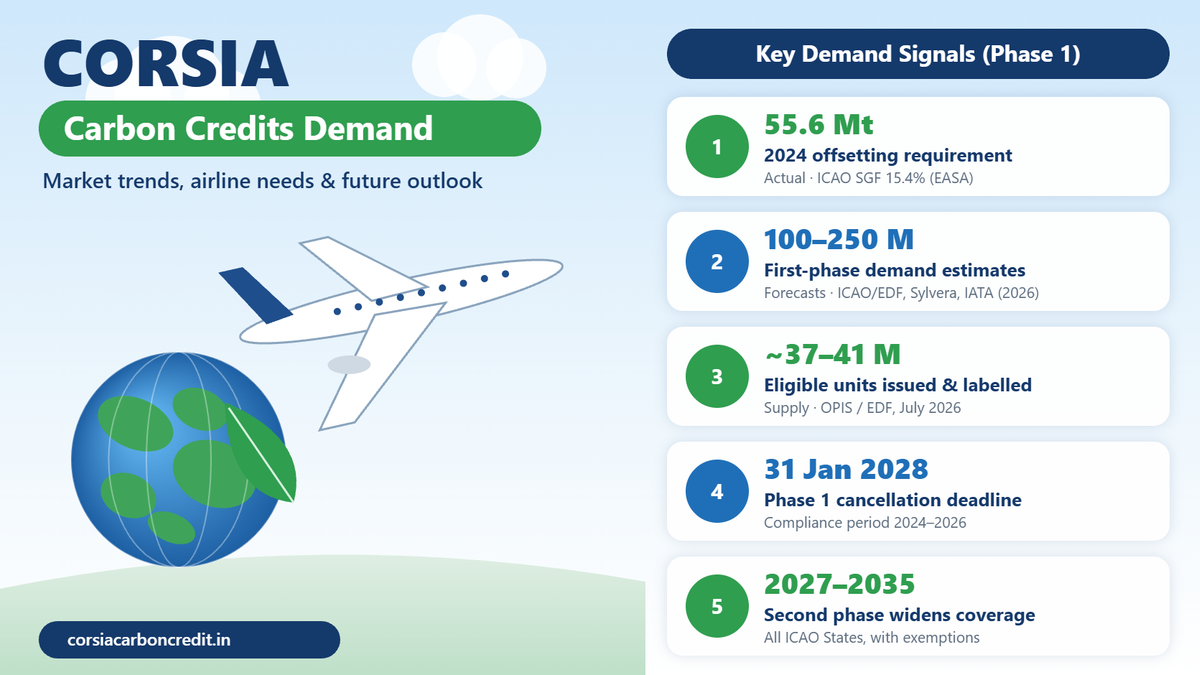
CORSIA carbon credits demand is the volume of ICAO-approved carbon credits that airlines must buy and cancel to cover growth in their international CO2 emissions under CORSIA, the Carbon Offsetting and Reduction Scheme for International Aviation. Because the obligation comes from international rules rather than corporate choice, it behaves differently from ordinary voluntary buying. 2024 was the first year airlines actually owed offsets, and the first compliance phase (2024–2026) closes at the end of this year.
This guide explains what drives that demand, how airline obligations are calculated, what the latest data shows, how supply shapes prices and what to watch next. Figures are labelled as actual, reported or forecast, with source and date.
What Is Driving Demand for CORSIA Carbon Credits?
ICAO member states adopted CORSIA in 2016. It applies to aeroplane operators that emit more than 10,000 tonnes of CO2 a year from international flights using aircraft above 5,700 kg maximum take-off mass. Those operators must monitor and report emissions every year. Offsetting, however, applies only to flights on routes where both the departure and destination States take part in the scheme.
Demand comes from one rule: covered international emissions above a baseline must be offset. For the 2021–2023 pilot phase the baseline was 2019 emissions, and because traffic had not recovered, airlines owed nothing. From 2024 to 2035 the baseline is 85% of 2019 emissions. The lower baseline plus the post-pandemic rebound pushed the sector above it in 2024, creating the first real obligation (EASA).
Airlines meet that obligation with CORSIA eligible emissions units (EEUs), or reduce it by claiming CORSIA eligible fuels. It helps to keep three ideas separate:
- General voluntary carbon credits are bought by choice, often for corporate climate claims. Most are not usable for CORSIA.
- CORSIA-eligible units come from ICAO-approved programmes and meet the vintage and host-country authorisation conditions for a specific compliance phase. Our guide to what a CORSIA carbon credit is covers the basics.
- Compliance-driven demand is the volume airlines must cancel to meet calculated obligations. It exists whatever the market mood.
How Do Airline Compliance Requirements Affect CORSIA Carbon Credit Demand?
Demand is built from each operator's verified emissions report. Since 1 January 2019, every in-scope operator has reported annual CO2 to the State it is attributed to, whether or not it has offsetting duties. This monitoring, reporting and verification (MRV) data underpins every obligation.
Each operator's annual obligation equals its CO2 on covered routes multiplied by the Sector's Growth Factor (SGF), which measures how far total covered emissions sit above the baseline. Until 2032 the calculation is 100% sectoral. For 2033–2035 it shifts to 85% sectoral and 15% based on each operator's own growth. You can test the arithmetic with our CORSIA offsetting requirement calculator.
For 2024, ICAO published an SGF of about 15.4% (revised edition, December 2025). EASA and IATA put the resulting sector-wide requirement at roughly 55.6 million tonnes of CO2. That is an actual obligation, not a forecast.
Obligations are not identical across airlines:
- Only routes between two participating States carry offsetting duties. Participation has grown from 88 States in 2021 to 130 in 2026 (EASA).
- New entrants and operators with very small obligations are exempt under the CORSIA standards.
- Least developed countries, small island developing States, landlocked developing countries and States with less than 0.5% of international traffic are exempt unless they volunteer (IATA).
- Claiming CORSIA eligible fuels reduces the number of units an airline must cancel.
Offsetting is settled per compliance period. For the 2024–2026 phase, units must be cancelled by 31 January 2028. Airlines can buy gradually, so visible retirements lag behind obligations.
What Factors Influence Demand for CORSIA-Eligible Carbon Credits?
No single variable sets demand. The main drivers are:
- Air traffic and emissions. Faster growth in international flying raises the SGF and every operator's obligation. Shocks work the other way.
- State participation. More participating States means more covered routes.
- Eligibility rules. Units must come from an approved programme, represent reductions within the phase's window (2021–2026 for the first phase) and carry host-country authorisation.
- Unit availability. An approved programme does not automatically create usable supply; a host country must authorise each batch.
- Price and procurement costs. Unit prices, due diligence, registry fees and insurance against a missing corresponding adjustment all shape when and how much airlines buy.
- Buyer preferences. Airlines also screen for integrity and traceability.
- Alternatives. Sustainable aviation fuel certified as a CORSIA eligible fuel lowers the offset requirement, though supply remains limited.
- Regional regulation. The EU applies its own rules to European carriers. The European Commission now expects to adopt its implementing act on usable credits in the first quarter of 2027 (Green Earth, October 2026).
These factors interact. Strong traffic growth raises obligations, but if authorised supply is thin, airlines may delay purchases, lean on eligible fuels or compete for the same small pool of units.
What Do Market Data and Trends Reveal About CORSIA Carbon Credit Demand?
CORSIA data is patchy, so sort figures by type.
Actual obligations (official). The 2024 requirement of about 55.6 Mt is so far the only full-year figure fixed by ICAO's published SGF. Under the CORSIA timeline, ICAO publishes each year's SGF by 31 October of the following year, so the 2025 figure is due imminently.
First-phase demand estimates (forecasts).
- ICAO range quoted by EDF (July 2026): 100–150 million tonnes.
- Sylvera base case (July 2026): about 163 million units.
- IATA (June 2026): 170–236 million units, updated to 200–250 million in September 2026.
The spread reflects different assumptions about 2025–2026 traffic, eligible fuel use, State participation, and whether figures count tonnes of obligation or units likely to be bought. None should be read as a certain outcome.
Reported activity (actual transactions). Visible buying is rising from a low base. ClimateTrade reports about 502,000 CORSIA retirements in the first half of 2026, against 14,000 in all of 2025. Japan Airlines announced the cancellation of about 180,000 units (IETA, May 2026). In October 2026, Malaysia Aviation Group retired around 70,000 credits, Trinity Airways made a first retirement of 20,000 tCO2e, and open interest in first-phase futures reached a record 2.5 million units (Green Earth).
Limitations. Airlines do not have to disclose purchases before cancellation, many hold units without retiring them yet, and forward contracts are rarely public. Today's low retirement numbers therefore understate procurement and say little about final demand.
How Can CORSIA Carbon Credit Supply Affect Market Demand and Prices?
Supply is the main constraint. ICAO has approved ten programmes to supply first-phase units (ICAO, September 2026). Each unit also needs a Letter of Authorization from its host country, plus a corresponding adjustment or an approved guarantee, so the same reduction is not also counted toward that country's climate target. These sovereign decisions move slowly.
- About 36.6–41 million units were issued and labelled as first-phase eligible by July 2026 (OPIS; EDF).
- IATA counted roughly 72 million units covered by 42 Letters of Authorization (August 2026 data).
- Sylvera estimated that of about 300 million potentially eligible credits, only around 38 million had cleared both the authorisation and adjustment hurdles (July 2026).
- Kenya's refusal of one developer's authorisation removed about 13 million tCO2e from expected supply.
Prices show that a supply gap does not translate neatly into rising prices. Indicative first-phase data points, in US dollars per tonne of CO2e:
- USD 21.70: IATA's first Phase 1 auction (Guyana ART TREES units), December 2024 (Carbon Pulse).
- USD 19.00: Fastmarkets spot assessment, 28 January 2026, as cheaper cookstove supply was labelled.
- USD 13.15: December 2026 contract assessment, mid-October 2026 (Green Earth).
Prices fell as new, lower-cost project types became deliverable, even while the overall gap remained. Price also depends on project type, vintage, authorisation status, delivery date and whether insurance covers adjustment risk. Our guide to CORSIA carbon credit pricing factors explains these in detail.
What Is the Future Outlook for CORSIA Carbon Credits Demand?
Some points are confirmed policy. The first phase ends on 31 December 2026. The second phase (2027–2035) applies to all ICAO Contracting States, with exemptions, and the 85% baseline continues (EASA). ICAO has approved four programmes for 2027–2029 units, with further applications under review.
Other points are forecasts. IATA has described cumulative requirements through 2035 as nearly 2 billion credits. Whether that happens depends on:
- traffic and emissions growth through the second phase;
- how many States participate and which remain exempt;
- the pace of Letters of Authorization and corresponding adjustments;
- uptake of eligible fuels, which cuts offset demand;
- ICAO periodic reviews and regional rules such as the EU's.
Demand and prices will not necessarily rise in a straight line, but obligations are now real and usable supply is the bottleneck.
Practical next steps for buyers and market participants:
- Track ICAO's annual SGF and CORSIA Central Registry publications.
- Verify each unit's programme, phase label, vintage, Letter of Authorization and adjustment status before buying. Our CORSIA carbon credit requirements guide sets out the checks.
- Decide early on a procurement mix: spot purchases, forward contracts, auctions or offtakes.
- Keep documentation ready for cancellation before 31 January 2028.
Readers who want support with sourcing or compliance can explore CORSIA Carbon Credit services as a starting point, then confirm every unit against ICAO's current documents.
Frequently Asked Questions (FAQs)
1. Why is demand for CORSIA carbon credits important?
It is compliance demand: airlines on covered international routes must cancel eligible units for emissions above the baseline. That creates a buyer that must act regardless of market sentiment, shapes prices for eligible units and directs finance to authorised projects. Its size each year depends on ICAO's published growth factor and which States participate.
2. What factors influence CORSIA carbon credit demand?
The main factors are air traffic and emissions growth, the number of participating States, programme and vintage rules, host-country authorisation, unit prices and transaction costs, buyer integrity preferences and the use of CORSIA eligible fuels. They interact, so demand estimates differ by assumption and should be revisited whenever ICAO publishes new data.
3. Are CORSIA-eligible carbon credits different from voluntary carbon credits?
Yes. Voluntary credits are bought by choice and follow only their programme's rules. CORSIA-eligible units must come from an ICAO-approved programme, fit the phase's vintage window and, for the first phase, carry host-country authorisation with a corresponding adjustment or approved guarantee. A credit can be high quality yet still not be CORSIA-eligible.
4. Will demand for CORSIA carbon credits increase in the future?
Current official data and most forecasts point to larger obligations in the second phase from 2027, when participation widens. Growth is not guaranteed, though. Traffic shocks, eligible fuel use, rule changes and the pace of host-country authorisations could all change the outcome, so treat forecasts as scenarios and check the latest ICAO publications.
5. How can airlines identify carbon credits eligible for CORSIA?
Start with ICAO's CORSIA Eligible Emissions Units document, which lists approved programmes and eligibility dates. Then confirm in the programme registry that the unit carries the correct phase label, a valid vintage, a Letter of Authorization and its adjustment status or guarantee. Rules change between editions, so check at purchase and again before cancellation
