 DSTechnoverse company

What Is CORSIA Carbon Credit? A Guide for Aviation
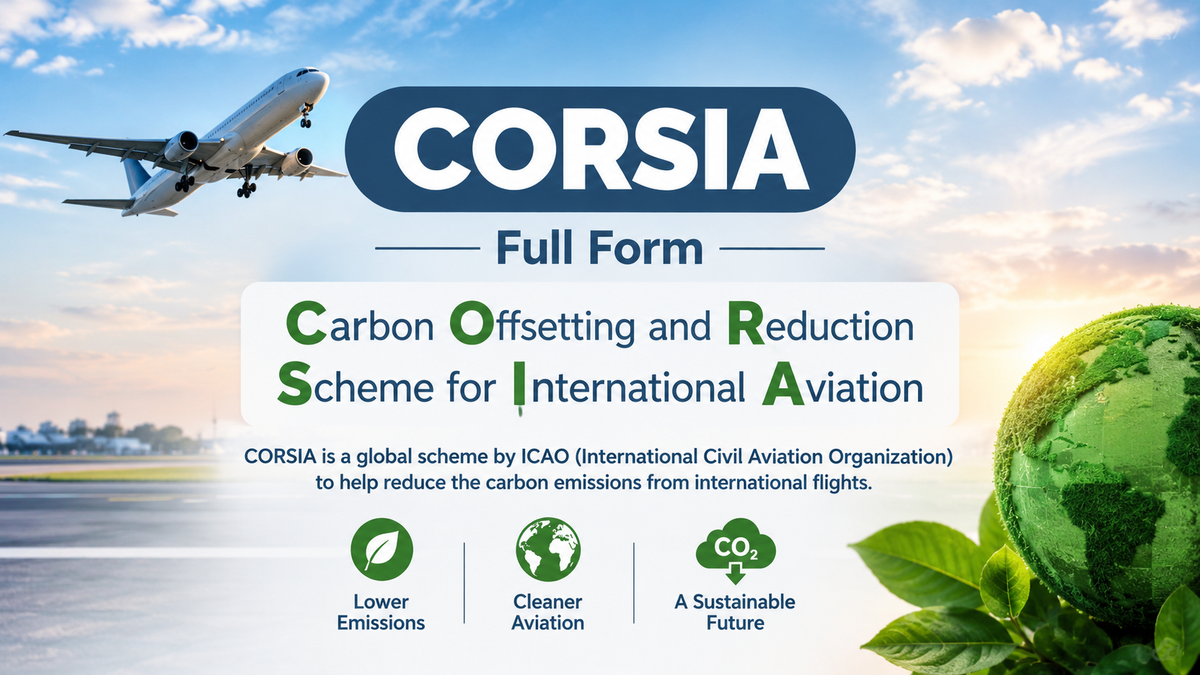
If you work in aviation or carbon markets, you will meet the question “what is CORSIA carbon credit?” sooner or later. A CORSIA carbon credit is an eligible emissions unit that an aircraft operator can use to meet offsetting requirements under CORSIA, the Carbon Offsetting and Reduction Scheme for International Aviation. The scheme was established by the International Civil Aviation Organization (ICAO) to address growth in CO₂ emissions from covered international flights. Not every carbon credit qualifies. A unit must meet ICAO’s eligibility rules for the relevant compliance period.
What Is CORSIA Carbon Credit and How Does ICAO CORSIA Work?
The basic definition
CORSIA is a global market-based measure for international aviation, developed under ICAO. It does not ask airlines to stop growing. It asks operators covered by the scheme to offset a portion of their CO₂ emissions above an agreed baseline by using eligible emissions units. Each unit represents one tonne of CO₂ equivalent that was reduced or avoided elsewhere.
Why offsetting is part of the picture
International aviation emissions are difficult to address through technology alone in the short term. Operational improvements, better aircraft and sustainable aviation fuels (SAF) all matter, but they take time to scale. CORSIA is meant to sit alongside those measures and cover emissions growth that other measures have not yet removed. Offsetting does not replace the need to cut emissions at source.
The compliance cycle in practice
The process rests on three connected parts:
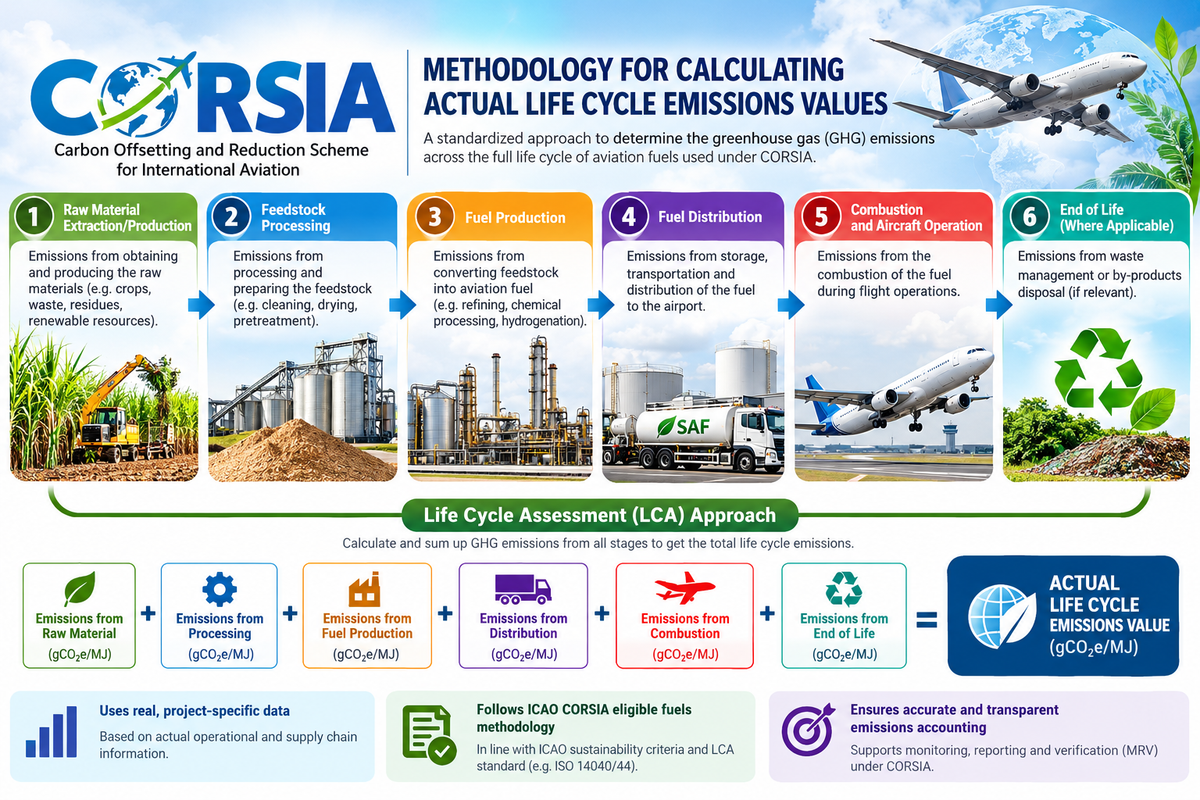
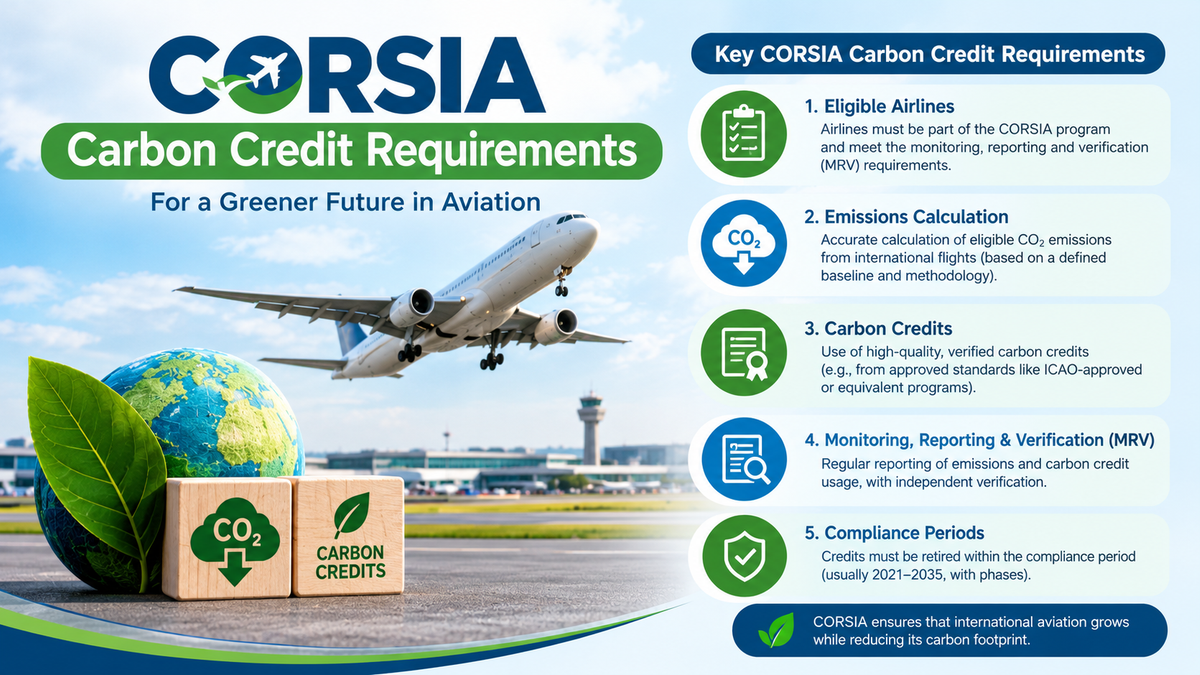
- Monitoring, reporting and verification (MRV): Operators monitor fuel use and emissions on covered flights, report them, and have the data verified.
- Offsetting requirements: Where the rules apply, the operator’s requirement is calculated from verified emissions and the relevant growth factors for that period.
- Cancellation of eligible units: The operator acquires eligible emissions units and has them cancelled in the registry system, so they cannot be used twice.
MRV and offsetting are separate obligations. An operator can have reporting duties without having an offsetting requirement in a given period.
CORSIA Compliance Phases and Who Is Covered
Pilot, first and second phases
CORSIA is rolled out in phases:
- Pilot phase (2021–2023): Participation was voluntary for States.
- First phase (2024–2026): Participation is also voluntary for States.
- Second phase (2027–2035): Participation is broader, with exemptions for certain States, such as least developed countries, small island developing States and landlocked developing countries, unless they choose to join.
Voluntary participation by a State is a different thing from an operator’s offsetting obligation. Once a State participates, its operators are subject to the scheme’s rules, and routes between participating States are the ones generally covered.
Not every airline has the same obligation
Obligations depend on the phase, the States on a route, and the operator’s circumstances. Certain small operators, small aircraft and specific flight types, such as humanitarian or medical flights, are generally excluded under the scheme’s rules. No two operators should assume they face the same offsetting volume, and no operator is required to offset all of its emissions. Compliance teams should check the current ICAO documents and their State’s implementation rules.
CORSIA Eligible Emissions Units and Eligible Carbon Credits
Why not every carbon credit qualifies
Most people searching for CORSIA eligible carbon credits assume any verified credit will do. It will not. Eligibility depends on several things:
- Whether the emissions unit program has been approved by ICAO for the relevant period
- The unit’s vintage (the year the emission reduction occurred) and its approved scope
- Whether it meets ICAO’s criteria, including requirements related to host-country authorization and avoiding double claiming
- Whether it meets any additional conditions for the compliance period in question
ICAO publishes the approved programs and conditions in its official CORSIA eligible emissions units documentation. Because that list can change, treat any list you find elsewhere, including a blog, as potentially out of date.
Project types that may be relevant
Units from renewable energy, methane reduction, forestry or other nature-based projects, and carbon removal can all exist in the wider carbon market. They are relevant to CORSIA only where the specific units meet the applicable eligibility requirements. A project category on its own tells you nothing about eligibility.
CORSIA versus voluntary carbon credits
Voluntary carbon credits are bought by companies for their own climate strategies, and buyers choose their own quality standards. CORSIA units must satisfy ICAO’s rules. A credit that is well regarded in the voluntary market is not automatically CORSIA eligible, and a CORSIA-eligible unit is not automatically suitable for every voluntary claim. Buyers should be clear about which purpose they are sourcing for.
Sourcing CORSIA Carbon Credits: Process, Prices, and Provider Checks
How airlines usually source units
A careful sourcing process normally follows these steps:
- Assess the compliance need: the phase, the period and the expected offsetting requirement.
- Confirm that the program and unit type are eligible for that period.
- Review program documentation and registry records.
- Check the vintage, project origin and any authorization or adjustment documentation.
- Review transaction terms, including delivery timing, ownership transfer and cancellation arrangements.
The final step is arranging cancellation of the units in line with the scheme’s procedures.
What affects CORSIA carbon credit prices
There is no single fixed price. Prices can be influenced by:
- The supply of eligible units
- Vintage and delivery period
- Project category and the program involved
- Market demand
- Transaction size and contract terms
Any quoted price should be treated as specific to a unit type and a point in time, and it should be confirmed directly with a seller.
Benefits and limitations
A defined framework gives airlines a consistent route for addressing emissions growth and a clear standard for what counts. The limits are also real. Credit quality, accounting integrity and the actual emissions reductions behind each unit still matter, and purchasing units does not by itself guarantee full regulatory compliance.
Evaluating a provider
When comparing providers, ask for eligibility documentation, registry records, evidence of program approval, unit traceability, clear ownership and delivery terms. Experience with aviation-related requirements is useful, but it should be demonstrated through documentation rather than assumed.
Why Choose CORSIA Carbon Credit
Before sourcing any units, a buyer should be clear about the intended use, the quantity required, the applicable compliance period and the eligibility criteria that apply. Reviewing supporting documentation and confirming that units meet the relevant ICAO requirements is just as important.
If you are exploring options, CORSIA carbon credit solutions can be a starting point for understanding what is available and what questions to ask. Availability and eligibility depend on the specific units, and no unit should be assumed eligible without checking it against current ICAO requirements. Final compliance decisions should always be made with reference to official ICAO guidance and your State’s rules.
To discuss your carbon credit requirements and confirm the availability and eligibility of relevant options, visit https://corsiacarboncredit.in/.
FAQs
1. What is a CORSIA carbon credit? It is an eligible emissions unit that an aircraft operator can use to meet offsetting requirements under CORSIA, ICAO’s scheme for international aviation. The unit must meet ICAO’s eligibility criteria for the relevant compliance period.
2. How does CORSIA carbon offsetting work? Operators monitor, report and verify their emissions on covered flights. Where an offsetting requirement applies, they acquire eligible emissions units and have them cancelled in the registry system. The requirement depends on the phase, the operator and the applicable rules.
3. Are all carbon credits eligible for CORSIA? No. Eligibility depends on ICAO-approved programs, unit vintage, scope, authorization requirements and the compliance period. A credit accepted in the voluntary market is not automatically eligible.
4. How much do CORSIA carbon credits cost? There is no single price. Costs vary with the eligible unit type, vintage, supply, demand and transaction terms, so prices should be confirmed directly with a supplier.
5. Who needs to comply with CORSIA requirements? It depends on ICAO rules, the compliance phase, the States involved on a route, and the operator’s circumstances. Certain operators and flight types are exempt. Operators should check current ICAO guidance and their State’s implementation.