 DSTechnoverse company
Carbon Credit vs REC: Key Differences, Uses and Environmental Benefits
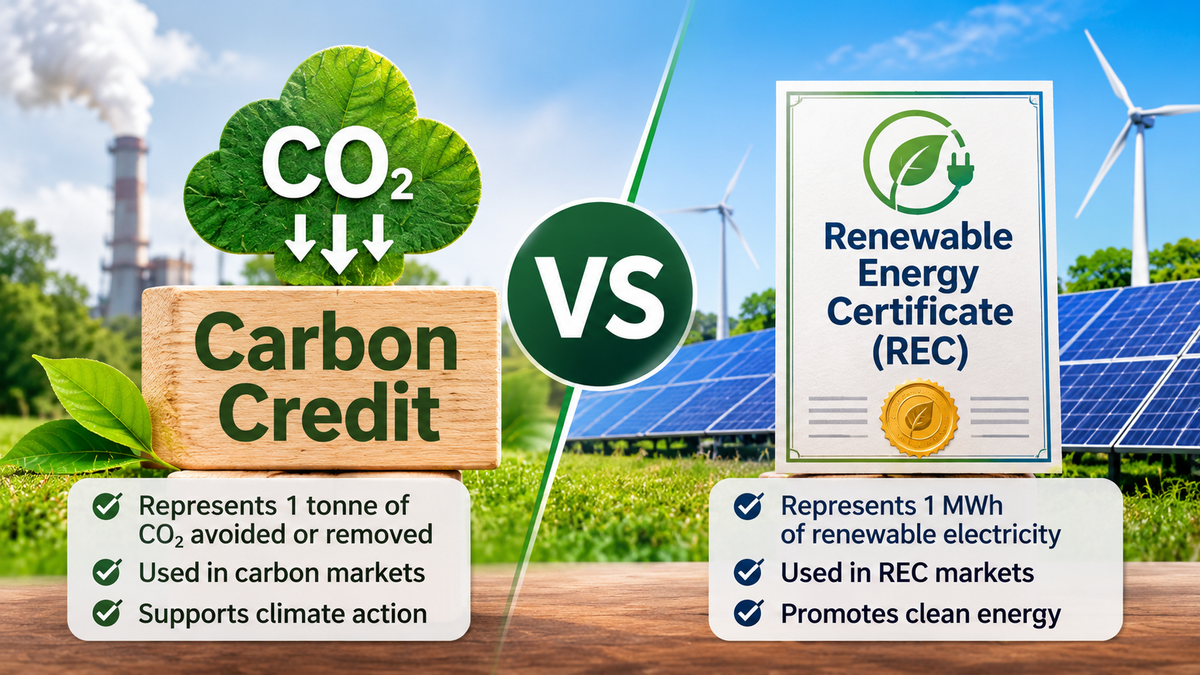
The carbon credit vs REC question comes down to what each instrument measures. A carbon credit generally represents one metric tonne of CO₂ equivalent (tCO₂e) that has been reduced, avoided, or removed. A Renewable Energy Certificate (REC) generally represents the environmental attributes of one megawatt-hour (MWh) of renewable electricity. The two are not interchangeable, and buying a REC does not automatically mean a company has offset one tonne of CO₂. This guide explains how each works, where they differ, and how businesses can use them responsibly.
What Is a Carbon Credit?
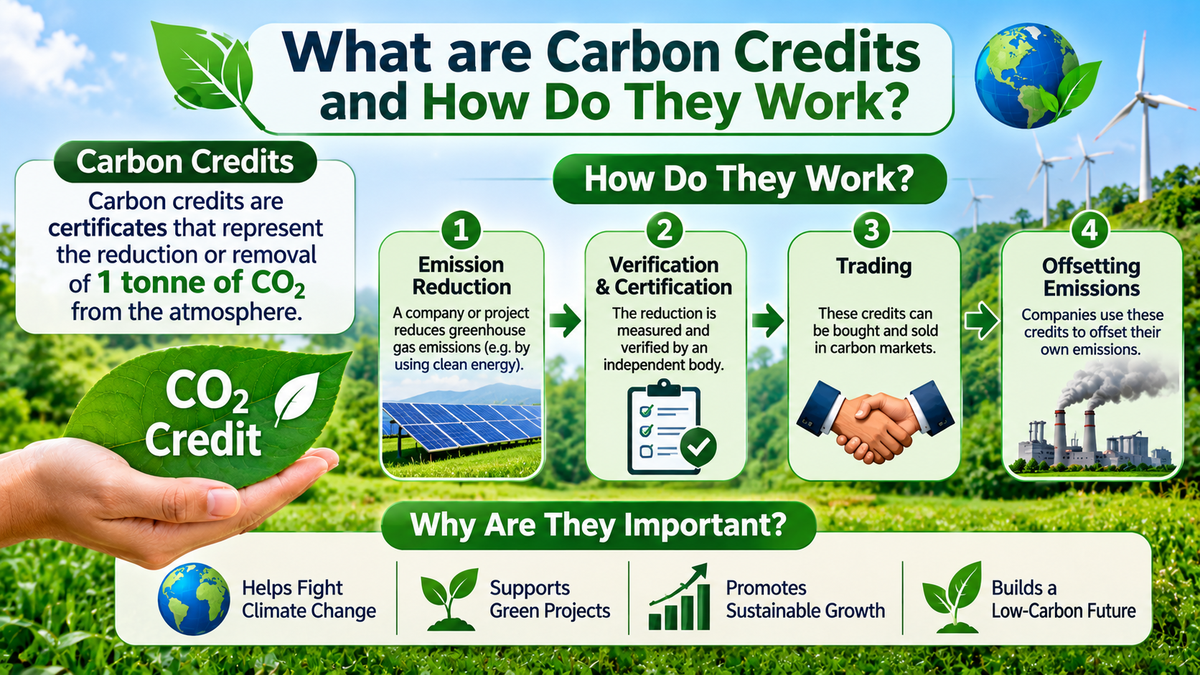
A carbon credit is a tradable unit issued under a carbon crediting programme. Each unit generally stands for one tonne of CO₂e reduced, avoided, or removed from the atmosphere, subject to the accounting rules of the programme that issued it.
Credits come from eligible projects. Typical examples include:
- Methane capture: Systems at landfills or livestock farms that capture methane, a powerful greenhouse gas, before it reaches the atmosphere.
- Forest conservation: Projects that protect forests that would otherwise be cleared, avoiding the emissions that clearing would cause.
- Carbon removal: Activities such as afforestation, soil carbon projects, or engineered technologies that pull CO₂ out of the air.
Before credits are issued, an independent auditor usually validates the project and verifies its results. The credits are then recorded in a registry with unique serial numbers. When a buyer uses a credit, it is retired, meaning it is permanently taken out of circulation and cannot be sold or claimed again.
Carbon credits trade in two broad types of market. Compliance markets are created by regulation, where governments or international bodies set rules and obligations. Voluntary markets allow companies and individuals to buy credits by choice, usually to support their own climate commitments.
Aviation is a good example of how credits are used for compliance. The International Civil Aviation Organization (ICAO) runs CORSIA, a scheme that asks airlines to address growth in international aviation emissions, and only emissions units that meet ICAO’s eligibility criteria can be used for this purpose. Readers who want background on this segment can explore CORSIA Carbon Credits and how eligible units fit into aviation-related offsetting.
In general corporate strategy, carbon credits are most often considered for residual emissions, meaning the emissions that remain after a company has cut what it realistically can.
What Is a Renewable Energy Certificate (REC)?
A Renewable Energy Certificate, also called a Renewable Energy Credit, is a market-based instrument that represents the environmental attributes of renewable electricity generation. In most systems, one certificate corresponds to one MWh of electricity generated from an eligible source such as solar, wind, hydro, or certain types of biomass.
When a renewable plant produces power, two things are created: the physical electricity that flows into the grid, and the environmental attributes that come with it. A certificate packages those attributes so they can be tracked and traded separately from the electricity itself.
Certificates are issued and tracked through a registry or tracking system. A buyer who purchases and retires a REC can generally claim use of that renewable electricity, within the rules of the relevant programme. Retirement ensures no one else can claim the same certificate.
Businesses use RECs as one route to renewable electricity procurement, especially when on-site generation or a direct power purchase agreement is not practical. In the United States, Green-e certifies RECs against published standards. Internationally, the I-REC Standard issues certificates in many countries. Definitions, ownership, tracking, and permitted claims differ across jurisdictions and programmes, so there is no single rulebook that applies everywhere.
Carbon Credit vs REC: What Are the Main Differences?
The simplest way to see the difference is to compare them point by point.
What each instrument represents
- Carbon credit: Greenhouse gas emissions reduced, avoided, or removed.
- REC: The environmental attributes of renewable electricity that was generated.
Measurement unit
- Carbon credit: Generally one tonne of CO₂e.
- REC: Generally one MWh of electricity.
Main environmental purpose
- Carbon credit: To reduce, avoid, or remove greenhouse gases and to channel finance into such activities.
- REC: To support renewable generation and let buyers account for renewable electricity use.
How each is generated
- Carbon credit: Through eligible projects such as methane capture, forest conservation, or carbon removal.
- REC: Through electricity generated at a registered renewable facility.
Verification and tracking
- Carbon credit: Project validation, independent verification, and registry serial numbers.
- REC: Metered generation data, with issuance and tracking in a certificate registry.
Common buyers
- Carbon credit: Corporations, airlines, governments, and entities with compliance obligations.
- REC: Businesses, utilities, and institutions buying renewable electricity.
Typical applications
- Carbon credit: Addressing eligible residual emissions and meeting compliance obligations.
- REC: Renewable electricity claims and Scope 2 market-based accounting.
Retirement or cancellation
- Carbon credit: Retired or cancelled in a registry once used.
- REC: Retired on behalf of the buyer to prevent reuse.
A simple business example: Consider a textile manufacturer in India. It buys RECs equal to the electricity its factory uses in a year, which supports a renewable electricity claim and affects how it reports electricity-related emissions. Its delivery trucks still run on diesel, so it also buys carbon credits from a verified methane capture project to address part of those emissions. The RECs relate to electricity attributes. The carbon credits relate to emissions from a different source. Neither one replaces the other.
How Do Carbon Credits and RECs Work in Corporate Sustainability?
Most organisations follow a similar path when building an emissions strategy.
- Measure emissions. Companies calculate their footprint across Scope 1 (direct emissions), Scope 2 (purchased electricity), and Scope 3 (value chain), commonly using the GHG Protocol.
- Reduce operational emissions. Efficiency upgrades, electrification, and fuel switching come first because they cut emissions at the source.
- Procure renewable electricity. Options include on-site solar, power purchase agreements, green tariffs, and RECs.
- Account for Scope 2. Under GHG Protocol Scope 2 guidance, market-based reporting can reflect contractual instruments such as RECs, while location-based reporting reflects the average grid mix. Many companies report both.
- Address residual emissions. Once reductions are made, remaining eligible emissions may be addressed with high-quality carbon credits, depending on the company’s targets and the standards it follows.
- Report and communicate. Environmental claims should be precise, consistent with the relevant standard, and backed by retirement records.
Renewable electricity procurement and carbon offsetting address different parts of an emissions strategy. RECs relate mainly to electricity consumption, while carbon credits can relate to a wider range of emissions, including fuel use, industrial processes, and travel.
Can Businesses Use Both Carbon Credits and RECs Together?
Yes. Because the two instruments do different jobs, many businesses use both as part of one broader strategy.
Hypothetical example: A logistics company operates offices, warehouses, and a vehicle fleet. It starts by improving energy efficiency in its buildings. It then buys RECs to match its warehouse electricity use and reflects this in its market-based Scope 2 figures. Fleet and air freight emissions are harder to eliminate quickly, so after setting reduction targets, the company buys and retires verified carbon credits for a portion of those residual emissions. In its report, it describes each instrument separately and states exactly what each one covers.
Three practices matter most when combining them:
- Avoid double counting. A certificate or credit should be claimed by one party only and retired after use. Do not count the same renewable electricity in two different ways.
- Check certificate ownership. Confirm that the seller actually holds the rights to the environmental attributes. In some markets, subsidies or mandates can affect who is entitled to claim them.
- Make accurate environmental claims. Say precisely what was done. A statement like “we matched our electricity use with retired RECs” is accurate. A statement like “we offset our emissions with RECs” generally is not.
Which Is Better for Your Business: Carbon Credits or RECs?
Neither is better in every case. The right choice depends on your objective.
- Renewable electricity goals: If you want to procure and claim renewable power, RECs are the relevant instrument.
- Greenhouse gas reduction targets: If you need to address emissions beyond electricity, carbon credits may play a role after reductions are made.
- Scope 2 accounting: RECs often matter here, since market-based reporting can recognise contractual instruments that meet the quality criteria of the applicable standard.
- Residual emissions management: Carbon credits are generally considered for emissions that cannot yet be avoided.
- Reporting standards and regulations: Check the framework you report under, such as the GHG Protocol, CDP, SBTi guidance, or national rules.
- Certificate quality and transparency: Prefer instruments from recognised programmes with public registries, independent verification, and visible retirement records.
The key takeaway from the carbon credit vs REC comparison is that they are complementary instruments, not direct substitutes. A credible strategy usually begins with measurement and reductions, then uses RECs for renewable electricity and carbon credits for eligible residual emissions.
Frequently Asked Questions
1. What is the main difference between a carbon credit and a REC? A carbon credit generally represents one tonne of CO₂e reduced, avoided, or removed. A REC generally represents the environmental attributes of one MWh of renewable electricity. One tracks emissions outcomes, while the other tracks renewable power generation.
2. Does one REC equal one carbon credit? No. A REC is measured in MWh and a carbon credit in tonnes of CO₂e. The emissions linked to a MWh vary by grid and context, so there is no fixed conversion, and the two cannot be exchanged one-for-one.
3. Can businesses purchase both carbon credits and RECs? Yes. Many businesses buy RECs for renewable electricity claims and carbon credits for eligible residual emissions. Each instrument should be tracked, reported, and retired separately to avoid double counting.
4. Do RECs offset carbon emissions? Not automatically. RECs represent the attributes of renewable electricity and are generally used for renewable electricity claims and Scope 2 market-based accounting. They are different from carbon offsets, and a REC purchase should not be described as offsetting one tonne of CO₂.
5. Are Renewable Energy Certificates eligible under CORSIA? RECs should not be assumed to be CORSIA-eligible. CORSIA accepts only emissions units that meet ICAO’s eligibility requirements and are approved through the ICAO process. RECs should not be confused with ICAO-approved CORSIA-eligible emissions units, so always check ICAO’s latest published requirements.