 DSTechnoverse company
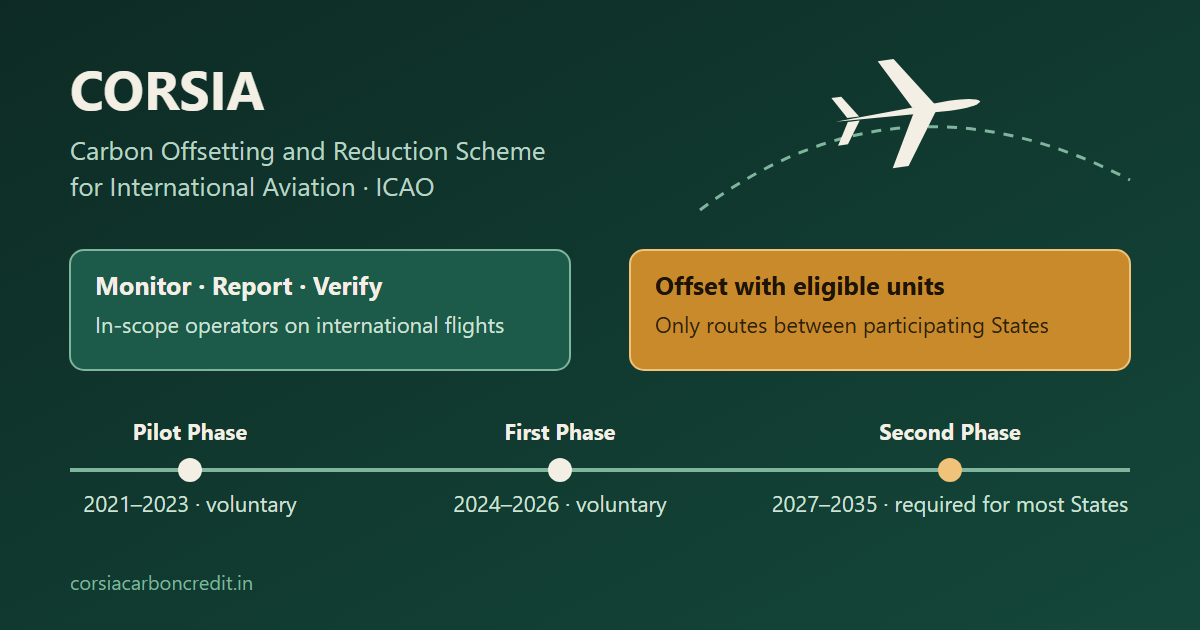
Air travel connects more people and more trade every year, and most of the sector's fuel is burned on flights between countries. Those flights produce carbon dioxide that is hard to cut quickly, because aircraft last for decades and cleaner fuels are still scarce. The CORSIA Carbon Offsetting and Reduction Scheme is the global framework that the International Civil Aviation Organization (ICAO) created to deal with this. Airlines measure and report the CO₂ from their international flights. Where the rules apply, they offset emissions growth using approved emissions units.
The scheme now affects route planning, budgets and carbon-credit purchasing. From 1 January 2027, it also becomes required for most large aviation States. Airline teams, sustainability consultants and carbon market participants need to know which obligations apply, when they apply and which units actually count.
What Is CORSIA? Understanding the Carbon Offsetting and Reduction Scheme for International Aviation
CORSIA stands for Carbon Offsetting and Reduction Scheme for International Aviation. ICAO Member States agreed to establish it at the 39th ICAO Assembly in 2016. Its detailed rules are ICAO Standards and Recommended Practices (SARPs), set out in Annex 16, Volume IV to the Chicago Convention. Monitoring under those rules began on 1 January 2019.
In simple terms, CORSIA works in three stages:
- It sets a baseline for CO₂ emissions from international aviation.
- It tracks each aeroplane operator's emissions every year.
- When emissions on covered routes grow above the baseline, operators compensate for their share of that growth by cancelling emissions units that represent reductions or removals achieved elsewhere.
CORSIA covers international flights only, meaning flights that depart from one country and land in another. Domestic aviation is counted in each country's national climate commitments under the Paris Agreement.
CORSIA is also not a voluntary offset programme. It is a set of rules that ICAO Member States put into national law, and each State oversees the airlines attributed to it.
Why Was CORSIA Introduced in the Aviation Industry?
According to the International Energy Agency, aviation accounts for roughly 2–3% of global energy-related CO₂ emissions, and demand for flying keeps growing. Cutting those emissions directly is difficult:
- Fuel: jet aircraft depend on energy-dense liquid fuel, and sustainable aviation fuel (SAF) is still a small, expensive share of supply.
- Fleet turnover: aircraft stay in service for 20 years or more, so efficiency gains take time to spread through fleets.
- New technology: hydrogen and electric aircraft are not yet ready for long-haul flying.
International flights also raise a jurisdiction problem. Emissions over oceans and between States don't belong neatly to any one country. Without a shared approach, airlines could face overlapping national charges on the same flight.
ICAO, the UN agency for civil aviation, gave its Member States a forum to agree on one global market-based measure. CORSIA sits inside ICAO's wider "basket of measures": aircraft technology, operational improvements and cleaner fuels. Its job is to complement those measures by addressing the emissions they cannot yet remove. It is not meant to replace them.
How Does the CORSIA Carbon Offsetting and Reduction Scheme Work?
CORSIA combines a yearly cycle of monitoring, reporting and verification (MRV) with offsetting over three-year compliance periods. The steps run in this order:
- Identify applicable operators and flights. MRV applies to aeroplane operators that emit more than 10,000 tonnes of CO₂ a year from international flights using aeroplanes above 5,700 kg maximum take-off mass. Humanitarian, medical and firefighting flights are excluded.
- Prepare an Emissions Monitoring Plan that sets out how fuel use will be measured. The State approves it.
- Monitor fuel consumption on each international flight.
- Calculate and report CO₂. Fuel burned is converted to CO₂ using ICAO's fuel-specific factors, and the result goes into an annual Emissions Report to the State.
- Verify the report independently through an accredited verification body.
- Determine offsetting requirements. The State calculates the operator's obligation for flights between participating States.
- Acquire eligible emissions units that meet ICAO's criteria for that compliance period.
- Cancel the units and report the cancellation, which completes the compliance cycle.
Reporting and offsetting are separate duties. MRV applies to every in-scope operator's international flights, whether or not the States involved take part in offsetting. Offsetting applies only to routes between two participating States.
Table 3: CORSIA Compliance Process
| Process Stage | Activity | Purpose |
|---|---|---|
| Applicability check | Test the emissions threshold, aircraft mass and route coverage | Confirms which duties apply |
| Emissions Monitoring Plan | Document fuel measurement methods and data flows | Makes monitoring consistent and auditable |
| Fuel monitoring | Record fuel use for each international flight | Provides the raw data for CO₂ calculation |
| Emissions reporting | Convert fuel to CO₂ and file the annual report | Gives the State an accurate emissions record |
| Verification | Independent review by an accredited verifier | Builds confidence that the data is correct |
| Offsetting calculation | The State applies ICAO's growth factors to covered routes | Sets the number of units owed |
| Unit acquisition | Buy units that meet CORSIA eligibility rules | Prepares the operator to meet its obligation |
| Cancellation and reporting | Cancel units in the registry and report to the State | Shows compliance for the period |
What Are the Different Phases of CORSIA Implementation?
CORSIA runs from 2021 to 2035.
Table 1: CORSIA Implementation Phases
| Implementation Phase | Period | Main Characteristics |
|---|---|---|
| Pilot Phase | 2021–2023 | Voluntary participation by States. The baseline used 2019 emissions after COVID-19 disrupted traffic |
| First Phase | 2024–2026 | Still voluntary. The baseline is 85% of 2019 emissions. 126 States took part in 2024, rising to 130 States in 2026 |
| Second Phase | 2027–2035 | Required for States above ICAO's aviation-activity thresholds, with exemptions for some developing States. 134 States are listed for 2027 |
Who must join from 2027. A State is required to participate if its share of international revenue tonne-kilometres (RTK) in 2018 was above 0.5% of the world total, or if it is among the States that together make up 90% of total RTKs. Least developed countries, small island developing States and landlocked developing countries are exempt unless they volunteer.
What changed between phases. The pandemic forced the main change. ICAO first moved the pilot-phase baseline to 2019 alone. The 41st ICAO Assembly in 2022 then set the baseline from 2024 onwards at 85% of 2019 emissions. Unit eligibility rules have also tightened for each phase, as the carbon credits section below explains.
Which routes are covered. Each year ICAO publishes the CORSIA States for Chapter 3 State Pairs document, listing the State pairs subject to offsetting. If you want to check how this applies to your own operation, use our five-test check of whether your airline is covered by CORSIA.
What Are the CORSIA Compliance Requirements for Airlines?
An aeroplane operator's duties under CORSIA usually include:
- An Emissions Monitoring Plan, approved by the State the operator is attributed to.
- Fuel consumption monitoring using an approved method. Smaller emitters can use ICAO's CORSIA CO₂ Estimation and Reporting Tool (CERT).
- An annual Emissions Report covering all in-scope international flights.
- Independent verification of that report before it is submitted.
- Reporting to the appropriate authority, which in India is the Directorate General of Civil Aviation (DGCA).
- Offsetting obligations for routes between participating States, calculated by the State for each compliance period.
- Cancellation of eligible emissions units, followed by an Emissions Unit Cancellation Report.
Actual obligations depend on the operator's emissions, fleet, routes, attributed State and the compliance period. ICAO's rules and the national authority set the submission deadlines, and ICAO can adjust them. Our CORSIA compliance calendar shows how these tasks fit into one year and across a three-year period.
What Role Do Carbon Credits Play in CORSIA?
In CORSIA language, carbon credits are called CORSIA Eligible Emissions Units. Operators cancel them to meet whatever offsetting requirement remains after any reduction claimed for CORSIA-eligible fuels.
Eligibility works at several levels:
- Programmes. ICAO's Technical Advisory Body (TAB) assesses carbon-crediting programmes against the CORSIA Emissions Unit Criteria, and the ICAO Council approves them for specific compliance periods. ICAO's 2026 lists show ten programmes approved for the First Phase, including the American Carbon Registry, ART, Climate Action Reserve and Global Carbon Council.
- Methodologies and activities. Each approval has a defined scope, and some activity types or methodologies are excluded.
- Vintage. First Phase units generally have to come from activities that started on or after 1 January 2016, with emission reductions occurring from 2021 to 2026.
- Host-country authorisation. First Phase units need a Letter of Authorization from the host country and a corresponding adjustment, so the same reduction is not counted twice.
- Registry tracking. Units must be issued and labelled as CORSIA eligible in the programme's designated registry.
- Cancellation records. Units are cancelled for CORSIA purposes, and the serial numbers are reported to the State.
Programme approval does not make every unit eligible. A credit from an approved standard can still fail on vintage, scope, missing authorisation or labelling. Each unit has to be checked. ICAO does not run a central carbon exchange. Units are bought through bilateral deals, brokers or marketplaces and are tracked in programme registries.
Table 2: General Voluntary Carbon Credits vs CORSIA-Eligible Emissions Units
| Comparison Factor | General Voluntary Carbon Credits | CORSIA-Eligible Emissions Units |
|---|---|---|
| Main use | Voluntary corporate or personal climate claims | Meeting airline offsetting obligations |
| Who decides eligibility | The issuing standard and the buyer's own policy | ICAO Council, on TAB recommendations |
| Programme approval | Not needed | Programme must be approved for that compliance period |
| Vintage rules | Set by the buyer's preference | Fixed date windows for each phase |
| Host-country authorisation | Often not required | Required for First Phase units, with corresponding adjustment |
| Registry status | Standard issuance | Must be labelled CORSIA eligible |
| Final step | Retired for a voluntary claim | Cancelled for CORSIA and reported to the State |
Why CORSIA Carbon Credits Matter for the Aviation Carbon Market
Understanding CORSIA Carbon Credits affects more than paperwork:
- Compliance planning. Offsetting costs fall due at the end of each compliance period, so they need to be forecast years ahead.
- Eligibility. A unit bought without the right authorisation or label may be useless for compliance.
- Quality and integrity. Strong methodologies and corresponding adjustments protect the credibility of an airline's claims.
- Supply and demand. Authorised supply for the First Phase has been limited compared with expected airline demand.
- Registry transparency. Serial numbers, labels and cancellation records are the airline's evidence of compliance.
- Due diligence. Buyers should check documents for each unit, not rely only on the programme's name.
Our buyer's checklist for CORSIA-eligible units sets out these checks step by step. Our explainer on how carbon credit prices are quoted covers what affects the cost of eligible units.
What Is the Future of CORSIA and Sustainable Aviation?
Confirmed developments
- In 2022, ICAO adopted a long-term global aspirational goal (LTAG) of net-zero carbon emissions from international aviation by 2050.
- In 2023, ICAO's CAAF/3 conference agreed to aim for a 5% reduction in the carbon intensity of international aviation fuel by 2030, through SAF, lower-carbon aviation fuels and other cleaner energy.
- In 2025, the 42nd ICAO Assembly adopted Resolution A42-22. It reaffirmed CORSIA as the only global market-based measure for international aviation and took note of the 2025 periodic review of supply, demand and prices for eligible fuels and units.
- The Second Phase begins on 1 January 2027, with participation required for most large aviation States.
Industry expectations and projections
- IATA's member airlines committed in 2021 to net-zero carbon emissions by 2050. The industry expects SAF to deliver the largest share, with new aircraft, efficiency gains and better air traffic management also contributing.
- ICAO and IATA expect demand for eligible units to rise sharply. Many analysts see authorised supply as the main bottleneck.
- Whether CORSIA continues after 2035 is still to be decided in future ICAO reviews.
Frequently Asked Questions about CORSIA
What is the full form of CORSIA?
CORSIA stands for Carbon Offsetting and Reduction Scheme for International Aviation. It is a global framework developed by the International Civil Aviation Organization (ICAO).
What is the main purpose of the Carbon Offsetting and Reduction Scheme for International Aviation?
It addresses growth in CO₂ emissions from international flights above an agreed baseline. Aeroplane operators offset that growth using eligible emissions units, alongside cleaner fuels, new technology and operational improvements.
Which airlines need to comply with CORSIA?
Operators emitting more than 10,000 tonnes of CO₂ a year from international flights with aeroplanes above 5,700 kg maximum take-off mass must monitor, report and verify their emissions. Offsetting applies only to their flights between participating States.
How does the CORSIA carbon offsetting process work?
The State calculates an operator's offsetting requirement from its verified emissions on covered routes. The operator then buys CORSIA-eligible emissions units, cancels them in an approved registry and reports the cancellation to its State.
What types of carbon credits are eligible under CORSIA?
Only units from ICAO-approved programmes count. They must also fall within the approved scope and vintage window, carry any required host-country authorisation and be labelled CORSIA eligible in the registry. Not every voluntary carbon credit qualifies.
Is CORSIA mandatory for all international flights?
No. Monitoring and reporting apply to in-scope operators' international flights. Offsetting applies only to routes between participating States. From 2027, participation is required for most large aviation States, and some developing States are exempt unless they volunteer.
Key Takeaways on the CORSIA Carbon Offsetting and Reduction Scheme
The CORSIA Carbon Offsetting and Reduction Scheme gives international aviation one ICAO-backed system for measuring CO₂ and offsetting emissions growth. Every in-scope operator monitors fuel, reports emissions and has them verified each year. Offsetting applies only to routes between participating States and is settled by cancelling CORSIA-eligible emissions units. Eligibility is checked unit by unit, not just by programme.
With the Second Phase starting in 2027, airlines and carbon market participants need to plan early, check unit documentation carefully and follow current ICAO updates. CORSIA does not replace cleaner fuels and aircraft. It is one part of aviation's path to net zero.
To learn more about eligible units and airline compliance, explore our resources on CORSIA Carbon Credits.
Sources
- ICAO – CORSIA news and updates
- ICAO – CORSIA Eligible Emissions Units
- ICAO – CORSIA States for Chapter 3 State Pairs
- ICAO – CORSIA Newsletter, January 2026 (participating States)
- ICAO – Expansion of approved emissions unit programmes
- IATA – CORSIA fact sheet
- IATA – ICAO 42nd Assembly: key environment-related outcomes
- IEA – Aviation