 DSTechnoverse company
What Are Carbon Credits and How Do They Work? A Complete Beginner’s Guide
A carbon credit is a tradable unit that generally represents one metric tonne of carbon dioxide equivalent (CO₂e) reduced, avoided, or removed, depending on the programme and methodology that issues it. Credits are created when a project proves its climate impact through measurement and independent verification, then recorded in a registry and retired when used. This guide answers “what are carbon credits and how do they work” step by step, from project design to retirement, including their role in aviation.
What Are Carbon Credits and Why Are They Important?
Greenhouse gases such as carbon dioxide, methane, and nitrous oxide trap heat in the atmosphere. Each gas warms the planet differently, so emissions are converted into a common unit called carbon dioxide equivalent (CO₂e). This makes it possible to compare and add up different gases.
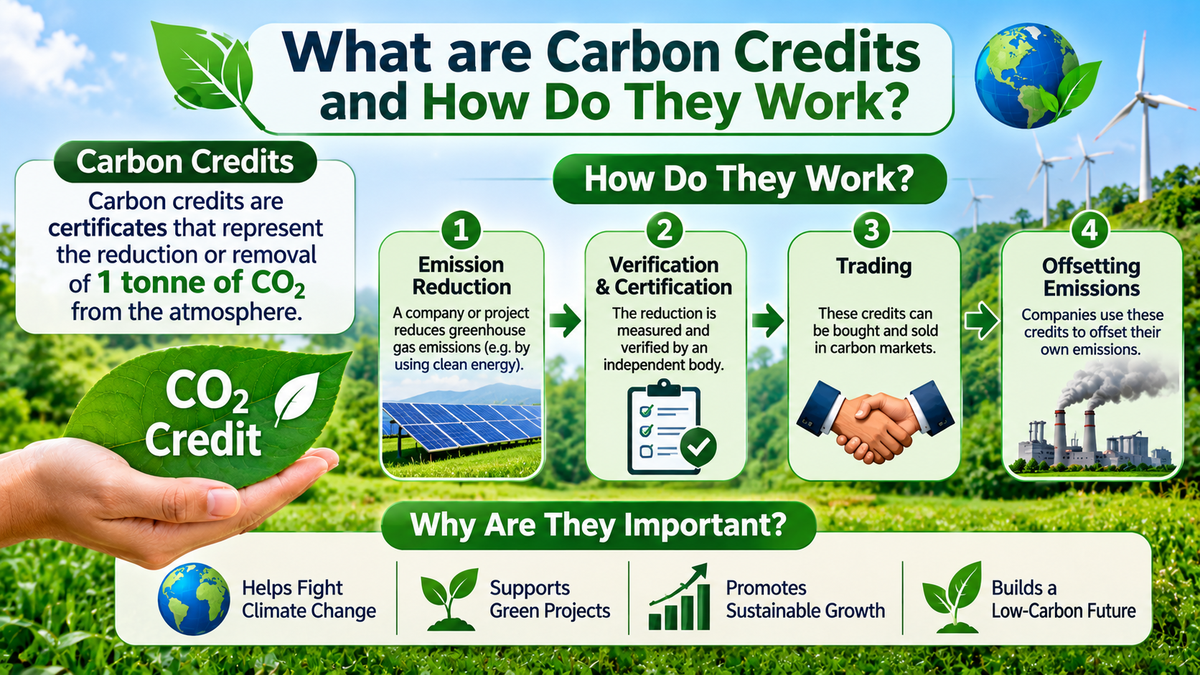
A carbon credit represents a quantified climate outcome in that unit. Generally, one credit equals one tonne of CO₂e that was reduced, avoided, or removed, subject to the applicable programme’s rules.
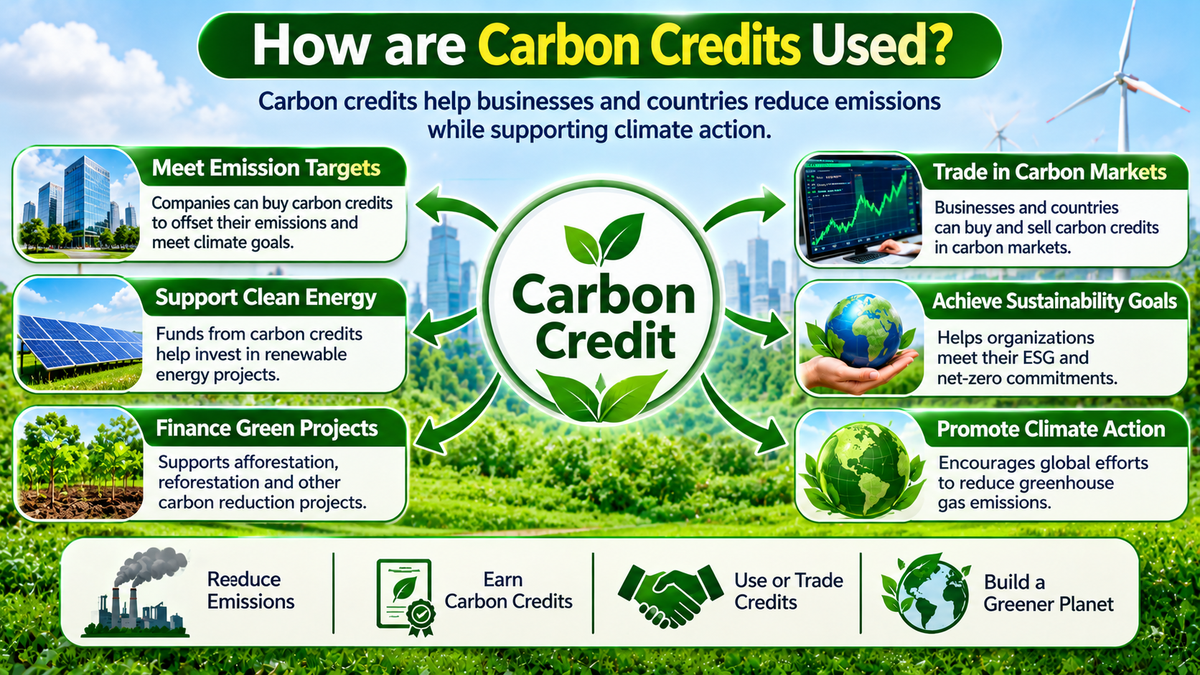
Credits exist to channel finance into projects that cut or remove emissions. Developers earn revenue that can make projects viable, and buyers gain a way to support climate action or address emissions they cannot yet eliminate. This exchange is the foundation of carbon markets.
A simple example: A rice-growing cooperative adopts a new water management method that lowers methane emissions compared with its usual practice. Specialists measure the difference using an approved methodology, an independent auditor checks the results, and the programme issues credits equal to the verified reduction. A company then buys and retires some of those credits.
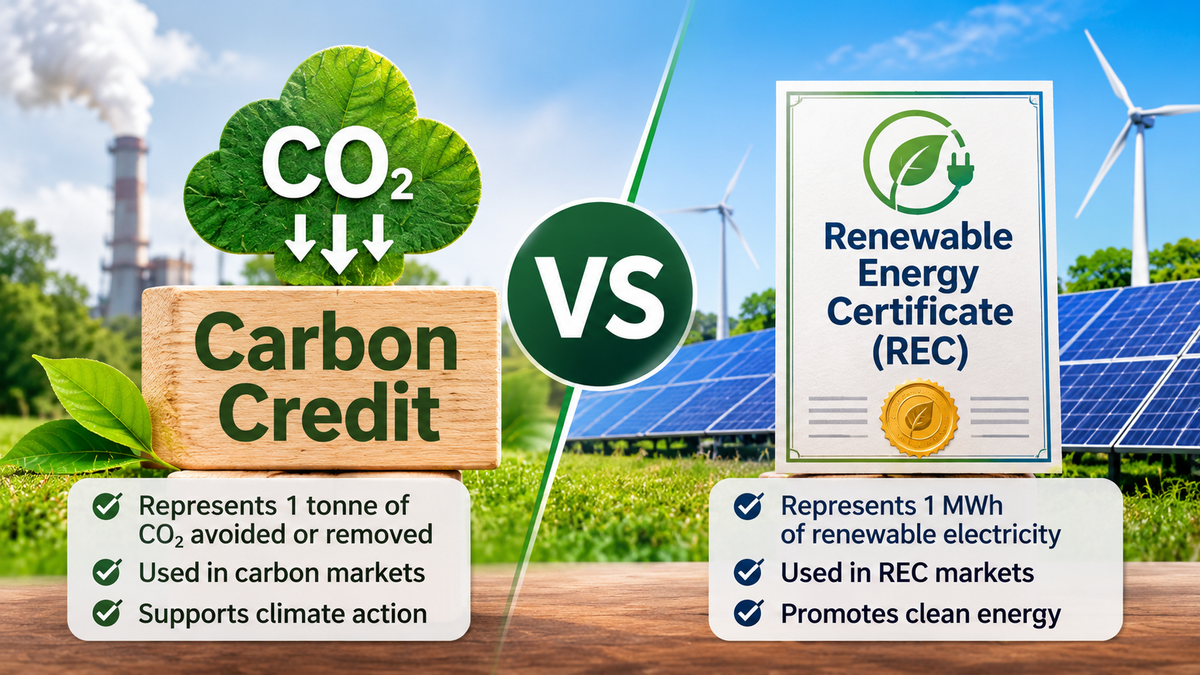
Two clarifications help avoid confusion. Carbon credits are not the same as carbon allowances, which are regulator-issued permits to emit within a cap-and-trade system. They are also not Renewable Energy Certificates (RECs), which represent the attributes of one megawatt-hour of renewable electricity. Finally, buying a credit does not automatically remove emissions from the atmosphere. The climate benefit depends on the quality of the underlying project.
How Do Carbon Credits Work Step by Step?
The carbon credit system follows a lifecycle. Details differ between programmes, but most credits pass through these eight stages.
Stage 1: Project identification
- What happens: A developer identifies an activity that can reduce, avoid, or remove emissions, such as capturing landfill gas or restoring degraded forest.
- Why it matters: It defines the project’s scope and whether it could qualify under any programme.
Stage 2: Methodology selection
- What happens: The developer selects an approved methodology that sets out eligibility rules and calculation methods.
- Why it matters: Methodologies keep quantification consistent and transparent.
Stage 3: Baseline scenario
- What happens: The project estimates what emissions would have been without it.
- Why it matters: Credits are based on the difference between this baseline and actual project results, so a weak baseline leads to unreliable credits.
Stage 4: Measurement and monitoring
- What happens: Project activities and emissions data are measured and recorded over time.
- Why it matters: Reliable data is the evidence behind every credit.
Stage 5: Validation and verification
- What happens: An independent body reviews the project design (validation) and checks reported results (verification).
- Why it matters: Third-party checks reduce the risk of overstated claims.
Stage 6: Issuance
- What happens: The programme issues credits and records them in a registry with unique serial numbers.
- Why it matters: Serial numbers make each unit traceable.
Stage 7: Purchase and transfer
- What happens: Buyers acquire credits directly, through brokers, or on trading platforms, and ownership is recorded.
- Why it matters: Clear ownership records prevent disputes and duplicate sales.
Stage 8: Retirement or cancellation
- What happens: The credit is permanently removed from circulation when used for a claim or compliance purpose.
- Why it matters: Retirement ensures the same credit cannot be used twice.
Documentation matters at every stage. Project design documents, monitoring reports, verification statements, and registry records let others check how a credit was created and whether it was used.
How Are Carbon Credits Generated Through Different Projects?
Credits are often grouped by project category. The category describes the activity, while the methodology decides how credits are calculated, monitored, and verified.
- Renewable energy: Solar, wind, or hydro projects that displace more carbon-intensive electricity, where a methodology allows it. Example: a wind farm replacing grid power.
- Afforestation and reforestation: Planting or restoring forest so that carbon is stored as trees grow. Example: restoring native forest on degraded land.
- Forest conservation: Protecting forests at credible risk of clearing to avoid emissions. Example: community-managed forest protection.
- Methane capture and destruction: Capturing methane from landfills, farms, or waste and destroying or using it. Methane is a potent greenhouse gas, so this can have a large climate effect.
- Energy efficiency: Reducing energy use through better equipment or cleaner cooking. Example: efficient cookstoves replacing open fires.
- Industrial emissions reduction: Process changes or abatement technology at industrial sites.
- Nature-based removal: Soil carbon, mangrove restoration, or improved land management that stores carbon in ecosystems.
- Technology-based removal: Engineered approaches such as direct air capture with permanent storage.
Not all credits are equal in quality. Outcomes depend on methodology, monitoring rigour, verification, and risks such as reversal of stored carbon.
How Are Carbon Credits Verified, Issued and Tracked?
Behind every credit sits a technical and administrative process designed to build trust.
Validation and baseline assessment. An independent body reviews whether the project design follows the methodology and whether its baseline is reasonable.
Additionality. The project must show that the reduction would not have happened without carbon finance. If it would have occurred anyway, issuing credits adds no climate benefit.
Monitoring and verification. Emissions data is collected during the crediting period. A verifier then checks that reported reductions or removals are accurate. Programmes also look at related risks such as permanence (will stored carbon stay stored?) and leakage (does emission-causing activity simply move elsewhere?).
Registry issuance, serial numbers and ownership. Once approved, credits are issued in a registry. Each carries a unique serial number, and the registry records who holds it.
Transfer and retirement. Registries log transfers between accounts and mark credits as retired when used.
Double-counting prevention. Registry records, retirement rules, and, in some contexts, government-level accounting help ensure that one reduction is claimed only once.
Before buying, review the project documentation and registry entries. Check the methodology, verification reports, vintage, status of the credits, and whether any claims have already been made against them.
How Are Carbon Credits Bought, Sold and Used?
Credits move through a market made up of project developers, buyers, brokers, intermediaries, and registries. Developers generate credits. Corporate buyers and other purchasers acquire them, sometimes through brokers or trading platforms. Registries record issuance, transfer, and retirement.
Prices vary and depend on factors such as project type, methodology, vintage, location, co-benefits, verification, perceived quality, and supply and demand. Because prices change, always check current market sources rather than relying on a fixed figure.
Voluntary and compliance markets work differently. Here is how they compare.
Purpose
- Voluntary: Organisations buy credits by choice to support climate goals.
- Compliance: Regulated entities use eligible units to meet legal obligations.
Participants
- Voluntary: Companies, institutions, individuals, developers, brokers, standards bodies.
- Compliance: Regulated entities, regulators, and scheme administrators.
Rules
- Voluntary: Set mainly by independent programmes and standards.
- Compliance: Set by law or international agreement.
Use of credits
- Voluntary: Retired to support a claim or address residual emissions.
- Compliance: Surrendered or cancelled to meet a specific requirement.
Eligibility
- Voluntary: Wide range of projects, with buyers assessing quality.
- Compliance: Only units that meet the scheme’s criteria are accepted.
One point deserves emphasis: buying carbon credits and reducing emissions inside your own operations are different activities. Reductions at the source, through efficiency, electrification, and cleaner energy, come first. Credits are generally considered for eligible residual emissions afterwards, and claims should describe exactly what was done.
How Do Carbon Credits Support Aviation and CORSIA?
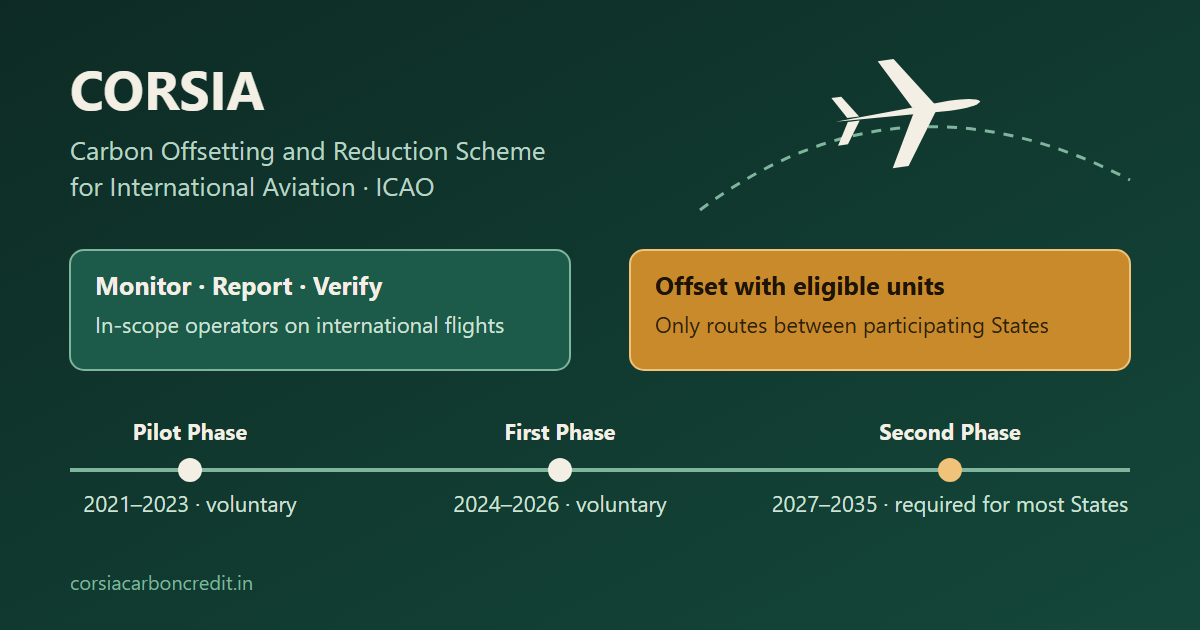
International aviation is difficult to decarbonise quickly because alternatives such as sustainable fuels and new aircraft technologies are still scaling up. To address emissions growth in the sector, the International Civil Aviation Organization (ICAO) developed CORSIA, the Carbon Offsetting and Reduction Scheme for International Aviation.
Under CORSIA, airlines monitor and report their international flight emissions each year, with verification of those reports. Offsetting requirements apply according to the scheme’s rules, and operators meet them by cancelling eligible emissions units. Readers who want additional context on this segment can learn more about CORSIA Carbon Credits and how eligible units are positioned in aviation offsetting.
CORSIA has its own eligibility requirements. Units must come from programmes approved by ICAO, and conditions such as vintage restrictions for each compliance phase and requirements on avoiding double claiming apply. Registry documentation and cancellation records are essential to demonstrate compliance. This means ordinary voluntary carbon credits cannot automatically be used for CORSIA compliance. Always check ICAO’s latest published requirements.
In short, understanding what carbon credits are and how they work means seeing the whole chain: a measured outcome, independent verification, registry tracking, and retirement. Used carefully alongside real emission reductions, high-quality credits can play a useful supporting role.
Frequently Asked Questions
1. What are carbon credits in simple words? A carbon credit is a tradable unit that represents a measured amount of greenhouse gas emissions reduced, avoided, or removed, generally one tonne of CO₂e. Organisations can buy and retire credits to support climate projects or address emissions they cannot yet eliminate.
2. How does the carbon credit system work? A project follows an approved methodology, measures its results, and has them independently verified. The programme then issues credits in a registry, buyers purchase them, and the credits are retired when used for a claim or compliance purpose.
3. How is one carbon credit generated? A credit is generated when a project demonstrates a verified reduction, avoidance, or removal of one tonne of CO₂e compared with a baseline, under an approved methodology. After verification, the programme issues the credit with a unique serial number.
4. How do companies buy and sell carbon credits? Project developers sell credits directly to buyers or through brokers and trading platforms. Buyers hold them in registry accounts and retire them when making a claim. In compliance markets, only units that meet the scheme’s rules can be used.
5. Are all carbon credits eligible under CORSIA? No. CORSIA accepts only emissions units that meet ICAO’s eligibility requirements. Ordinary voluntary carbon credits are not automatically eligible, so check ICAO’s current guidance before assuming a credit qualifies.