 DSTechnoverse company
What Are Carbon Credits? Meaning, Types, Working Process and Benefits
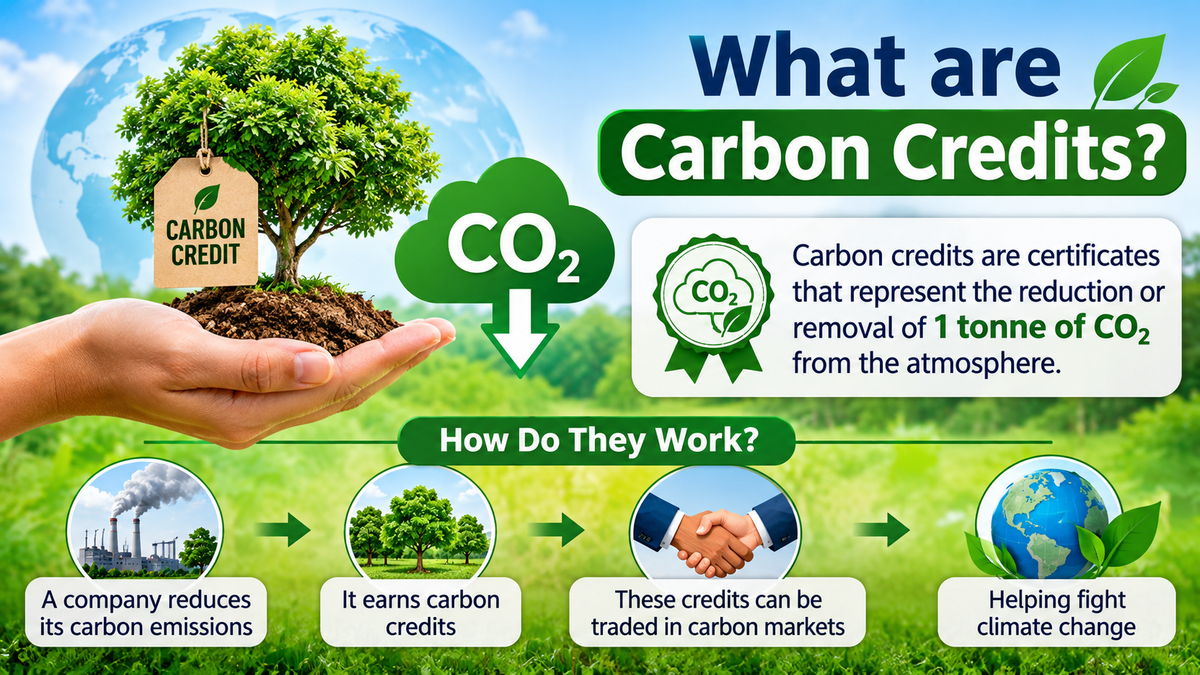
A carbon credit is a tradable unit that generally represents one metric tonne of carbon dioxide equivalent (CO₂e) that has been reduced, avoided, or removed from the atmosphere. Credits are issued under a specific programme’s rules and are recorded in a registry so they can be tracked and retired. This guide explains what carbon credits are, how they work, the main project types, the difference between voluntary and compliance markets, and how businesses and the aviation sector use them.
What Are Carbon Credits and What Do They Represent?
Greenhouse gases such as carbon dioxide, methane, and nitrous oxide trap heat in the atmosphere. Because each gas warms the planet to a different degree, emissions are converted into a common unit called carbon dioxide equivalent (CO₂e). This lets different gases be compared and added together.
A carbon credit represents a measured climate outcome in that unit. Generally, one credit equals one tonne of CO₂e reduced, avoided, or removed, subject to the applicable programme’s rules.
Carbon credits exist to direct finance towards projects that cut or remove emissions. They give project developers a revenue stream, and they give buyers a way to support climate action or address emissions they cannot yet eliminate. Together they form the basis of the carbon credit system and carbon credit trading.
A simple example: A farm installs a system that captures methane from livestock manure. Without the system, the methane would have escaped into the air. An independent auditor checks the results, and the programme issues credits for the verified emissions avoided. A company then buys and retires some of those credits to support its climate strategy.
It is also worth separating carbon credits from two similar-sounding instruments:
- Carbon allowances are permits issued by a regulator under a cap-and-trade system, allowing an entity to emit a set amount.
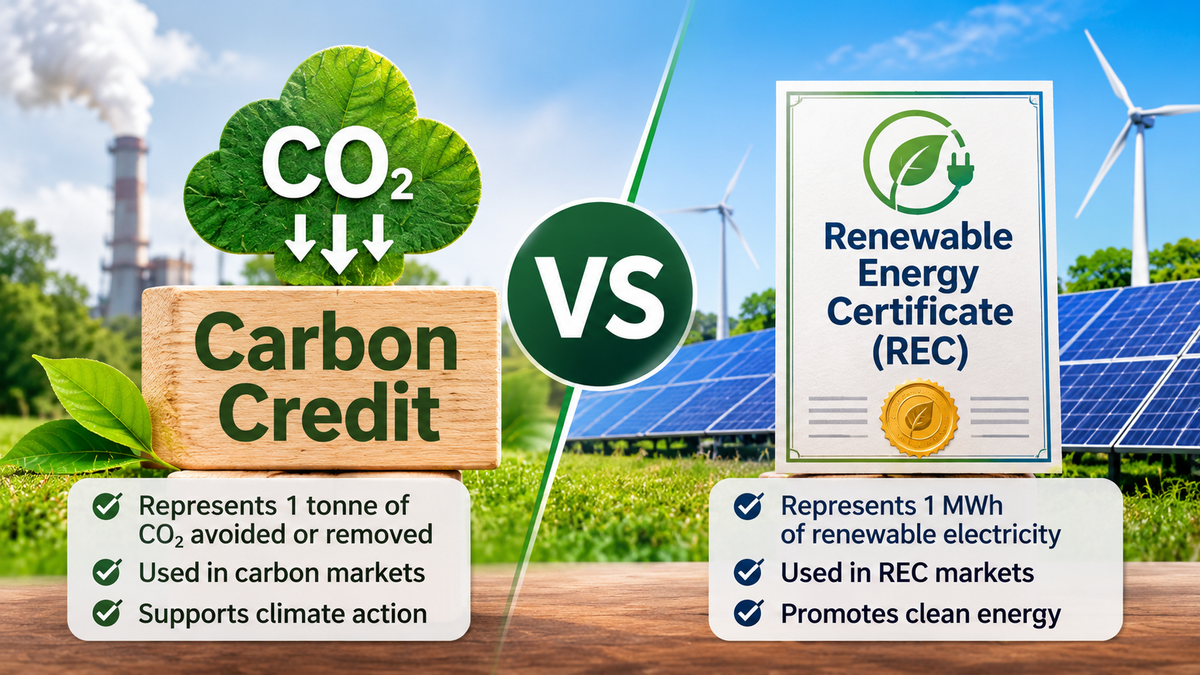
- Renewable Energy Certificates (RECs) represent the environmental attributes of one megawatt-hour of renewable electricity, not a tonne of CO₂e.
How Do Carbon Credits Work?
Most carbon credits follow a similar lifecycle, although details differ between programmes.
- Opportunity identified. A project developer identifies an activity that can reduce, avoid, or remove emissions.
- Methodology applied. The project follows an approved methodology that sets out how emissions are measured and credits calculated.
- Monitoring. Emissions reductions or removals are measured and recorded over time.
- Validation and verification. An independent body reviews the project design and, where applicable, checks the reported results.
- Issuance. The programme issues credits and records them in a registry, each with a unique serial number.
- Purchase. Buyers acquire credits directly, through brokers, or through trading platforms.
- Retirement. When credits are used for a claim or compliance purpose, they are retired or cancelled so they cannot be used again.
Registry records and transparent documentation matter because they show who owns a credit, whether it has been used, and which project it came from. Without this, the same credit could be claimed twice, which would undermine trust in the whole system.
What Are the Different Types of Carbon Credits?
Carbon credits are usually grouped by project category. These categories describe the kind of activity involved, while the applicable methodology determines how credits are actually quantified and issued.
- Renewable energy projects: Solar, wind, and hydro projects that displace more carbon-intensive electricity, where the methodology allows.
- Afforestation and reforestation: Planting trees on land that was not recently forested, or restoring forest cover, so that carbon is stored as the trees grow.
- Forest conservation: Protecting existing forests that face a credible risk of clearing, to avoid the associated emissions.
- Methane capture: Capturing methane from landfills, agriculture, or waste, and destroying or using it.
- Energy efficiency: Projects that reduce energy use, such as efficient cookstoves, lighting, or industrial equipment.
- Industrial emissions reduction: Process changes or abatement technology that cut emissions from industrial facilities.
- Nature-based carbon removal: Approaches such as soil carbon, mangrove restoration, or improved land management that draw CO₂ out of the air and store it in ecosystems.
- Technology-based carbon removal: Engineered methods such as direct air capture with permanent storage.
Not every credit has the same environmental quality. Quality depends on the project, the methodology, the verification process, and the risks involved.
What Is the Difference Between Voluntary and Compliance Carbon Credits?
Carbon credits are used in two broad market contexts. Here is how they compare.
Purpose
- Voluntary: To let organisations and individuals support climate action by choice, often as part of their own targets.
- Compliance: To help regulated entities meet legal obligations under a mandatory scheme.
Buyers and participants
- Voluntary: Companies, institutions, individuals, project developers, brokers, and standards bodies.
- Compliance: Regulated entities such as covered facilities or airlines, along with regulators and scheme administrators.
Regulatory framework
- Voluntary: Governed mainly by independent programmes, standards, and registries, with some government oversight emerging in certain countries.
- Compliance: Set by law or international agreement, with defined rules on which units are eligible.
How credits are used
- Voluntary: Retired to support a company’s climate claim or to address residual emissions.
- Compliance: Surrendered or cancelled to meet a specific legal requirement.
Project and programme considerations
- Voluntary: Wide range of project types, and buyers need to assess quality themselves.
- Compliance: Eligibility is restricted to units that meet the scheme’s criteria, so many voluntary credits will not qualify.
In the voluntary carbon market, a company decides to buy credits, selects a project, and retires the credits against a claim it wishes to make. In a compliance carbon market, a regulated entity may use eligible instruments to meet specific obligations, and only units that satisfy the scheme’s rules can be used.
What Are the Benefits and Challenges of Carbon Credits?
Potential benefits
- Supporting emissions reduction projects that might not otherwise go ahead.
- Financing climate-related initiatives, particularly in regions that need investment.
- Encouraging innovation, including newer removal technologies.
- Supporting sustainable development, since some projects also bring local jobs, health, or biodiversity benefits.
- Helping organisations address eligible residual emissions that remain after reductions.
Key challenges
- Additionality: Would the reduction have happened anyway without carbon finance? Credits should only be issued for activity that is genuinely additional.
- Permanence: Stored carbon can be released again through fire, disease, or land-use change, so the durability of storage matters.
- Leakage: Protecting one area can shift emission-causing activity to another, reducing the net benefit.
- Verification quality: Results depend on sound methodologies and rigorous independent checks.
- Double counting: The same reduction must not be claimed by more than one party or counted twice.
- Greenwashing: Vague or overstated claims can mislead stakeholders and damage trust.
A balanced view is that carbon credits can be useful when they are high quality and used alongside real emission cuts, but they are not a substitute for reducing emissions directly.
How Are Carbon Credits Used in Business and Aviation?
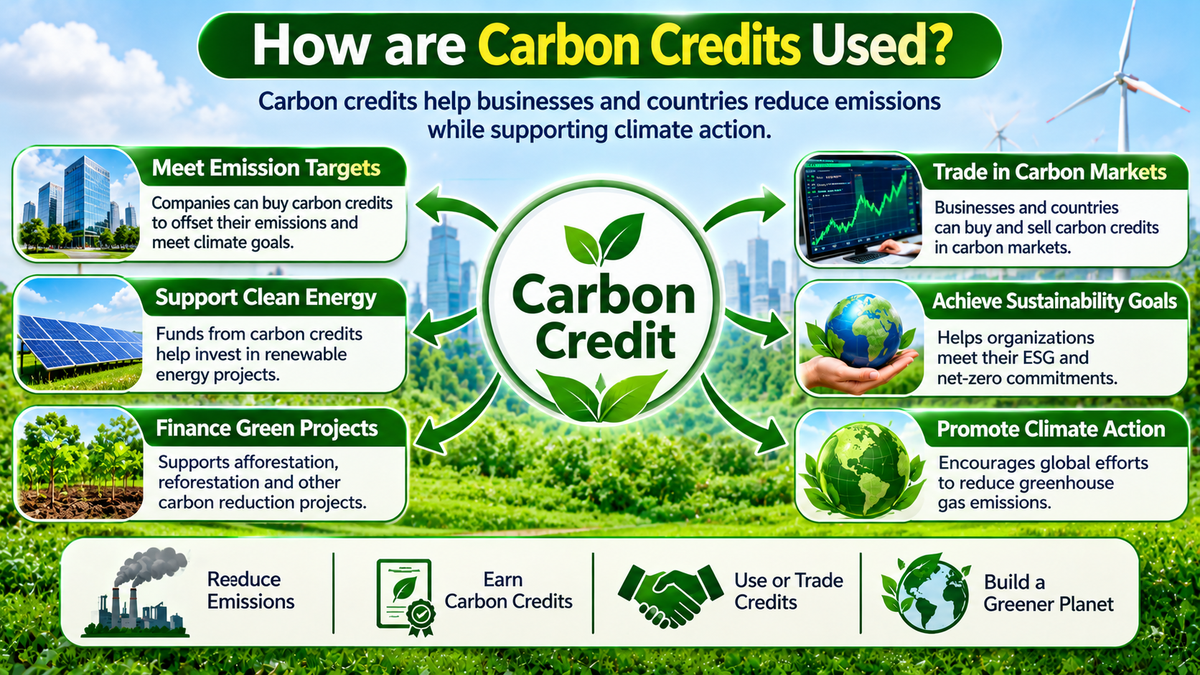
Corporate climate strategies. Most organisations start by measuring their emissions and reducing what they can through efficiency, electrification, and cleaner energy. Carbon credits may then be considered for eligible residual emissions. They are generally seen as a complement to reductions, not a replacement.
Voluntary and regulated participation. Some companies buy credits voluntarily to support climate commitments. Others, in regulated sectors or jurisdictions, may use eligible instruments to meet specific legal obligations.
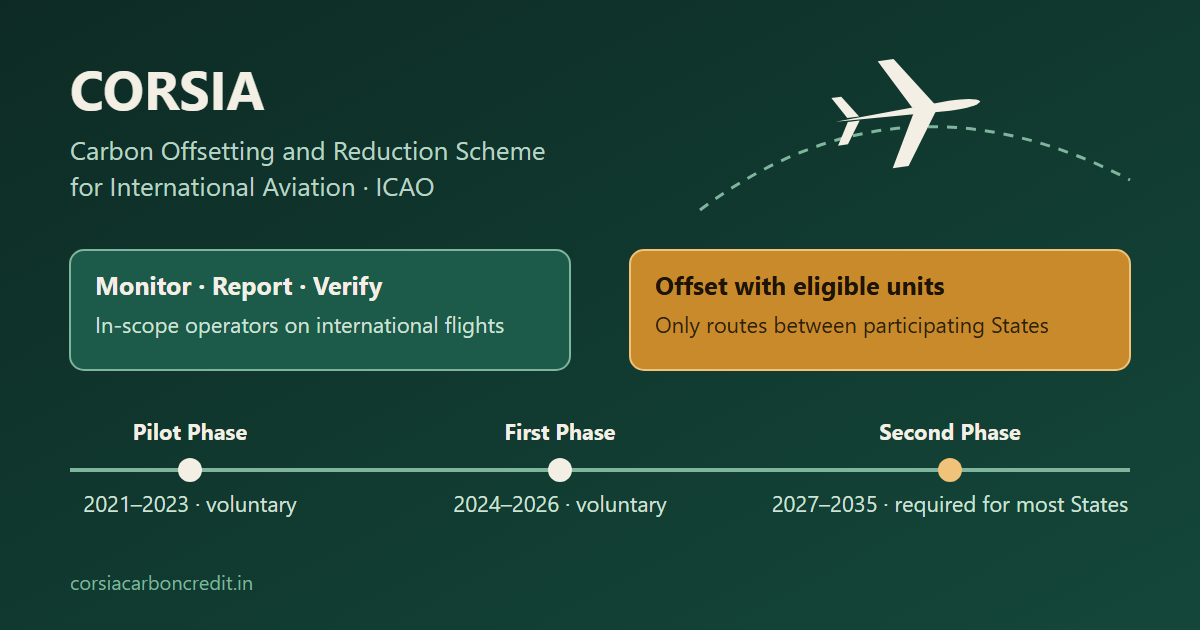
Aviation. Aviation is hard to decarbonise quickly, so it is one of the sectors where carbon credits play a visible role. The International Civil Aviation Organization (ICAO) created CORSIA, the Carbon Offsetting and Reduction Scheme for International Aviation, to address growth in international aviation emissions above a baseline. Airlines covered by the scheme must cancel eligible emissions units to meet their offsetting requirements. Readers who want to explore how this segment works can learn more about CORSIA Carbon Credits and how eligible units fit into aviation offsetting.
It is important to understand that CORSIA applies its own eligibility requirements. Emissions units must meet criteria set through ICAO, and ordinary voluntary carbon credits are not automatically eligible. Anyone working on aviation offsetting should always check ICAO’s current published requirements.
Frequently Asked Questions
1. What is a carbon credit in simple words? A carbon credit is a certificate that represents a measured amount of greenhouse gas emissions that was reduced, avoided, or removed. It can be bought by organisations that want to support climate projects or address emissions they cannot yet eliminate.
2. How much CO₂ does one carbon credit represent? Generally, one carbon credit represents one metric tonne of CO₂ equivalent. The exact accounting depends on the rules of the programme that issues the credit.
3. Who can buy and sell carbon credits? Project developers generate and sell credits, and buyers include companies, institutions, governments, and individuals. Brokers and trading platforms also take part. In compliance markets, participation is limited by the rules of the scheme.
4. What is the difference between a carbon credit and a carbon offset? The terms are often used interchangeably. Strictly, a carbon credit is the tradable unit, while a carbon offset describes the act of using a credit to compensate for emissions elsewhere. Once a credit is retired for that purpose, it is typically called an offset.
5. Can all carbon credits be used under CORSIA? No. CORSIA only accepts emissions units that meet ICAO’s eligibility requirements. Ordinary voluntary carbon credits are not automatically eligible, so always check the latest ICAO guidance.