 DSTechnoverse company
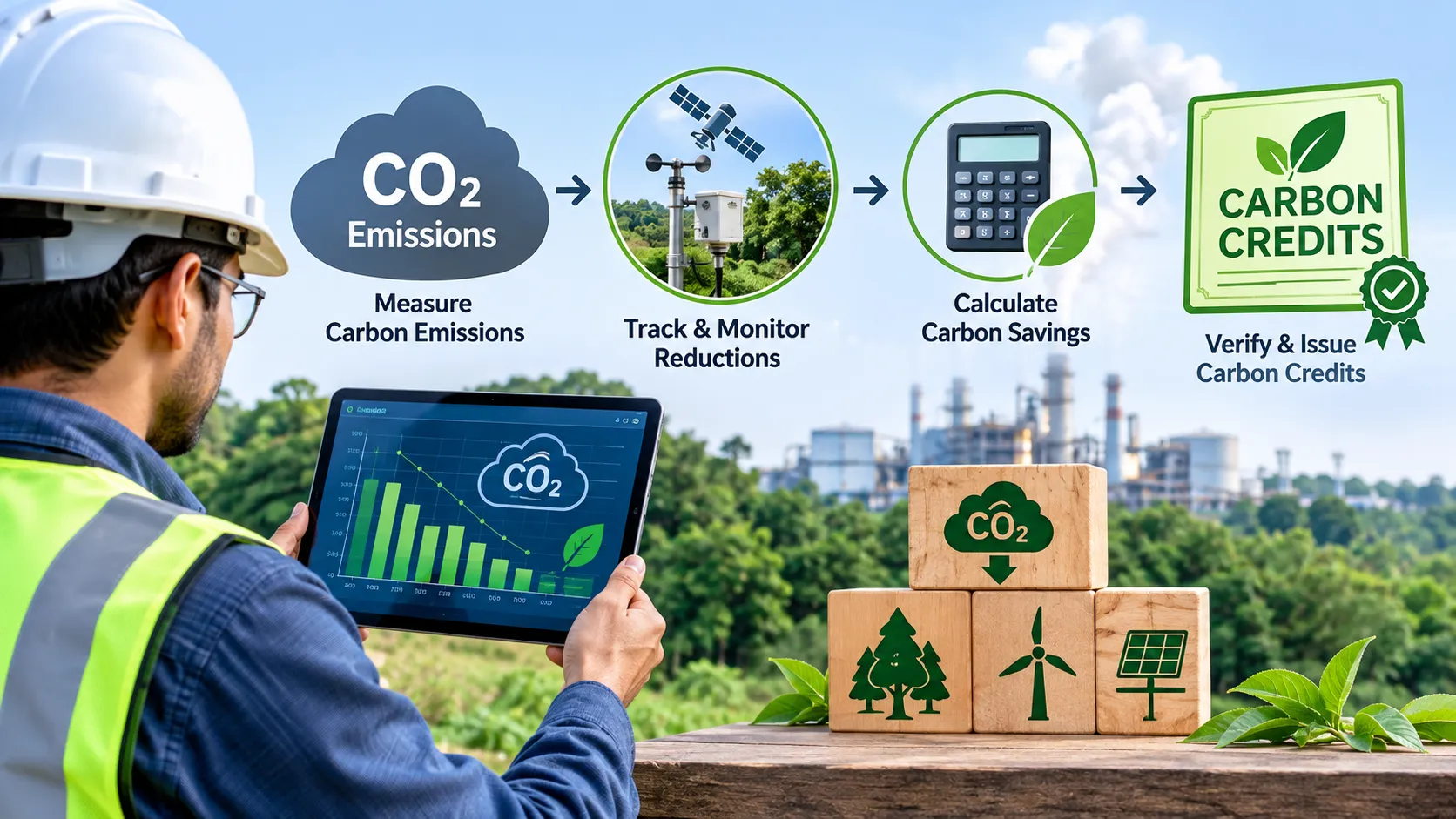
How do you measure carbon credits? You compare what a project actually emits with a baseline, meaning what would have been emitted without the project. Then you subtract leakage and any deductions the methodology requires, and express the result in tonnes of CO₂ equivalent (tCO₂e). Removal projects instead measure how much CO₂ they take out of the air and store. After independent verification, a programme issues credits, with one carbon credit generally equal to 1 tCO₂e. For more on how credits are used in aviation, see our CORSIA Carbon Credits resources.
This guide explains each step in simple terms, with worked examples, and shows how measurement quality affects whether a credit can be trusted.
What Does It Mean to Measure Carbon Credits?
A carbon credit is a unit, issued by a carbon-crediting programme, that represents a verified reduction or removal of greenhouse gases. Measuring carbon credits means working out exactly how many tonnes of greenhouse gas a project has reduced or removed during a defined period, using an approved method.
A greenhouse gas (GHG) emission is the release of a gas that traps heat in the atmosphere, such as carbon dioxide from burning fuel or methane from rotting waste. Different gases warm the planet by different amounts. To compare them, they are converted into carbon dioxide equivalent (CO₂e), the amount of CO₂ that would have the same warming effect. That is why credits are counted in tCO₂e.
Under most programme rules, one carbon credit represents one metric tonne of CO₂e. Accurate measurement is the foundation of carbon market integrity. If tonnes are overestimated, buyers pay for reductions that never happened, and climate claims built on those credits are false.
Measuring carbon credits is not the same as measuring a company's carbon footprint:
- A footprint counts what an organisation emits.
- Carbon credit measurement counts the reduction or removal a specific project achieves compared with its baseline.
How Are Carbon Emissions Measured?
Before calculating a reduction, you need to quantify emissions. The main greenhouse gases are:
- Carbon dioxide (CO₂): from burning fossil fuels and from land clearing
- Methane (CH₄): from landfills, livestock, rice paddies and oil and gas leaks
- Nitrous oxide (N₂O): from fertilisers and some industrial processes
- Other gases, such as fluorinated gases used in refrigeration and industry
Each gas has a global warming potential (GWP), which measures its warming effect over a set period, usually 100 years, compared with CO₂. For example, the IPCC's Fifth Assessment Report gives 100-year GWPs of 28 for methane and 265 for nitrous oxide. Each methodology specifies which GWP values to use.
Most emissions are calculated rather than measured directly at a chimney:
GHG emissions = Activity data × Applicable emission factor
- Activity data measures the activity, such as litres of diesel burned, megawatt-hours of electricity used or tonnes of waste landfilled.
- An emission factor converts the activity into emissions, such as tonnes of CO₂ per MWh of grid electricity.
Direct emissions come from sources the project controls, such as fuel burned on site. Indirect emissions come from elsewhere because of the project, such as the power station that supplies its electricity.
Real methodologies also define system boundaries, gas-specific conversions and other adjustments. The formula above shows the core idea only.
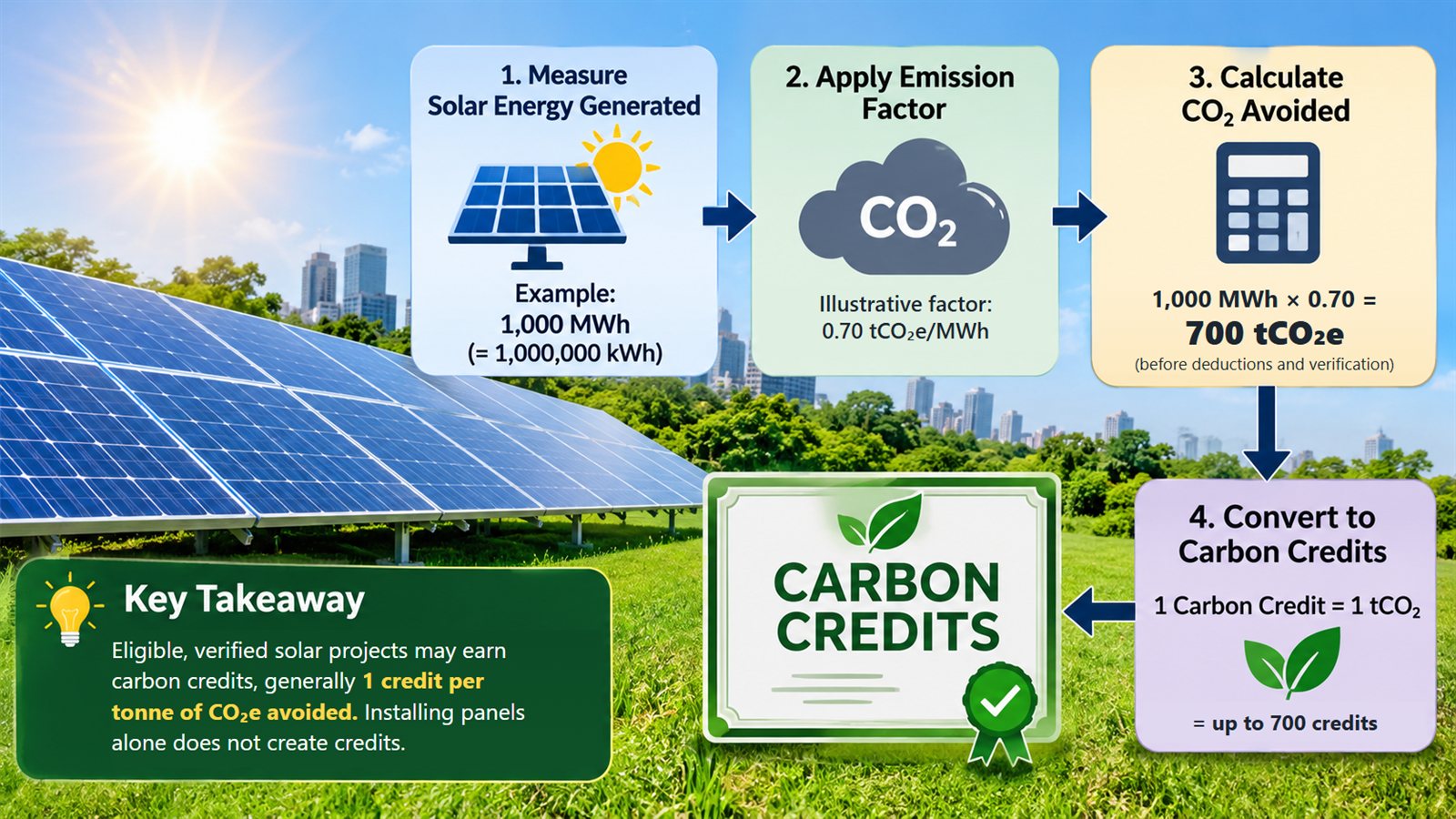
Illustrative example (hypothetical)
These figures are hypothetical and are not official emission factors. A factory uses 1,000 MWh of grid electricity in a year. If the applicable grid emission factor were 0.7 tCO₂ per MWh:
1,000 MWh × 0.7 tCO₂/MWh = 700 tCO₂ from electricity use.
How Is the Baseline Used to Calculate Carbon Credits?
The baseline scenario describes what would most likely have happened without the carbon project. Baseline emissions are the emissions under that scenario.
Baselines are built from:
- historical data, such as a landfill's past methane releases or a region's past deforestation rate
- reference scenarios, such as the grid electricity a new wind farm will displace
- project boundaries, which set the sites, gases and sources that are counted
- assumptions that the methodology permits, documented and justified
Baseline emissions are then compared with the project's actual emissions. The difference is the core of the reduction.
Realistic baselines matter more than anything else. If a baseline assumes more emissions than would really have occurred, the project receives credits for reductions that did not happen. Developers cannot pick a baseline to maximise credits. They must follow the approved methodology, and independent auditors check the choice. This links closely to additionality, the test that the project would not have happened anyway without carbon finance.
How Do You Calculate Carbon Credits From Emission Reductions?
A simplified version of the calculation is:
Net emission reductions = Baseline emissions − Project emissions − Leakage − Applicable adjustments
- Baseline emissions: emissions in the without-project scenario
- Project emissions: emissions the project itself causes, such as fuel used to run equipment
- Leakage: emissions that increase elsewhere because of the project, such as logging moving to a neighbouring forest
- Applicable adjustments: deductions the methodology requires, such as uncertainty discounts
Results are calculated for a defined monitoring period, often one year, and expressed in tCO₂e. This is a general illustration, not a universal formula. Each approved methodology has its own equations, parameters and deductions.
Worked example (hypothetical)
All figures are illustrative and are not official programme values.
| Item | tCO₂e |
|---|---|
| Baseline emissions | 10,000 |
| Project emissions | 3,000 |
| Leakage | 500 |
| Other applicable adjustments | 500 |
Step by step:
- 10,000 − 3,000 = 7,000
- 7,000 − 500 (leakage) = 6,500
- 6,500 − 500 (adjustments) = 6,000 tCO₂e
That is 6,000 tonnes of potential net emission reductions. It is not 6,000 credits yet. The result still has to be verified and approved by the programme, and some programmes take further deductions, such as buffer contributions, before credits are issued.
How Are Carbon Removal Projects Measured?
Emission reduction projects prevent emissions that would otherwise occur. Carbon removal projects take CO₂ out of the atmosphere and store it. Removal methods include:
- Reforestation and afforestation: trees store carbon as they grow. Projects measure tree diameter and height in sample plots, convert those measurements to biomass using equations, and track the change over time, often supported by satellite imagery.
- Soil carbon sequestration: soil samples and models estimate changes in soil organic carbon from new farming practices.
- Direct air capture (DAC): machines capture CO₂, which is metered as it is injected into geological storage, after subtracting the energy-related emissions of running the plant.
- Biochar: the carbon in biochar added to soil is measured, with deductions for the share expected to break down over time.
The main measurement issues for removals are:
- Change over time: stored carbon is measured repeatedly, not once.
- MRV: sampling plans, models and lab tests must be documented and verified.
- Permanence and reversal risk: fires, pests or land-use change can release stored carbon. Programmes often hold back credits in a buffer pool to cover this.
- Leakage: for example, farming displaced by new forest.
- Uncertainty: where measurement is imprecise, methodologies apply conservative assumptions and deductions.
Because these approaches are so different, each needs its own measurement method.
What Is the Role of Monitoring, Reporting and Verification (MRV)?
MRV is the system that turns project activity into trustworthy numbers.
Monitoring
- collect activity data, such as meter readings, fuel records, survey plots and lab samples
- measure emissions and removals using the methodology's procedures
- keep regular, time-stamped records
- run data quality checks, such as meter calibration and cross-checks
Reporting
- prepare a monitoring report for each period
- document the calculation methods and parameters used
- report the measured reductions or removals
- keep supporting evidence, such as invoices, logbooks, photos and lab certificates
Verification
- an accredited, independent validation and verification body (VVB) reviews the report, where the programme requires it
- the VVB checks monitoring data and methodology compliance
- it recalculates results and examines the evidence, often during a site visit
- it issues findings that must be corrected before it gives a positive opinion
MRV makes measurement transparent and repeatable. It also means the numbers do not rest on the developer's word alone.
How Do Measured Emission Reductions Become Carbon Credits?
- Project identification and design
- Selection of an approved methodology
- Baseline establishment
- Project implementation
- Emissions monitoring
- Preparation of monitoring reports
- Independent verification
- Programme review and approval
- Carbon credit issuance
- Registry recording and tracking, with a unique serial number for each credit
Measured reductions do not automatically become credits. The project must meet all programme requirements and pass verification and the programme's review. Our guide to the carbon credit certification process explains each stage in detail.
What Factors Affect the Accuracy of Carbon Credit Measurement?
- Activity data quality: missing or estimated data weakens results.
- Emission factors: outdated or inappropriate factors can distort totals.
- Baseline assumptions: an inflated baseline overstates reductions.
- Measurement boundaries: leaving out sources can hide emissions.
- Additionality: a project that would have happened anyway delivers no real reduction.
- Leakage: emissions that simply move elsewhere must be deducted.
- Permanence: stored carbon that is later released must be covered.
- Uncertainty: imprecise measurement requires conservative deductions.
- Double counting: the same tonne must not be claimed twice.
- Methodology selection: some methodologies are more conservative than others.
- Independent verification: strong audits catch errors.
Poor practice in any of these areas leads to overestimated reductions. That is the main criticism of low-quality credits, and the reason buyers increasingly check methodologies, baselines and verification reports.
How Does Carbon Credit Measurement Relate to CORSIA?
CORSIA, the Carbon Offsetting and Reduction Scheme for International Aviation, is ICAO's global market-based measure for international flights. Airlines meet their offsetting requirements by cancelling CORSIA eligible emissions units.
Reliable measurement is part of ICAO's criteria. Units must be quantified, monitored, reported and verified, based on realistic baselines, additional, permanent and adjusted for leakage. CORSIA eligibility, however, adds further conditions:
- The programme must be approved by the ICAO Council for the relevant compliance period.
- Each unit must fall within the approved scope and vintage window. For first-phase units, it also needs host-country authorisation and a corresponding adjustment.
- The unit must carry a CORSIA eligible label in the registry.
Accurate measurement or certification alone does not make a credit CORSIA eligible. Our guide to CORSIA eligible carbon credits explains how to check eligibility. CORSIA also measures emissions on the fuel side. Our article on the CORSIA methodology for actual life cycle emissions values shows how sustainable aviation fuel emissions are calculated.
Frequently Asked Questions
How do you measure carbon credits?
By comparing a project's actual emissions with its baseline. You subtract project emissions, leakage and required adjustments, and express the result in tCO₂e. For removals, you measure the CO₂ taken up and stored. Results are verified before credits are issued.
How many tonnes of CO₂ does one carbon credit represent?
Generally one metric tonne of CO₂ equivalent (tCO₂e), under the issuing programme's rules.
What is the formula for calculating carbon credits?
A simplified version is: net emission reductions = baseline emissions − project emissions − leakage − applicable adjustments. Each methodology has its own detailed equations.
What is the difference between carbon reduction and carbon removal?
A reduction prevents emissions that would otherwise happen, such as methane captured at a landfill. A removal takes CO₂ out of the atmosphere and stores it, for example in trees, soil, biochar or underground.
Why are baseline emissions important in carbon credit measurement?
Credits equal the difference between the baseline and the project's actual emissions. An unrealistic baseline creates credits for reductions that never happened.
How are carbon credits verified?
An accredited independent verification body reviews the monitoring report, checks the data and calculations against the methodology, and often visits the site. The programme then reviews the verification report before issuing credits.
Are all measured carbon reductions eligible for CORSIA?
No. Only units from ICAO-approved programmes that meet the scope, vintage, authorisation and labelling conditions for the relevant compliance period are eligible.
Key Takeaways
So, how do you measure carbon credits? You quantify emissions in CO₂e using activity data and emission factors, set a realistic baseline, and subtract project emissions, leakage and required adjustments. Removals are measured over time with conservative accounting.
The results are only as good as:
- accurate data
- the right methodology
- transparent monitoring
- independent verification
- a reliable programme and registry
To learn more about carbon credits and CORSIA requirements, explore the resources at CORSIA Carbon Credit.