 DSTechnoverse company
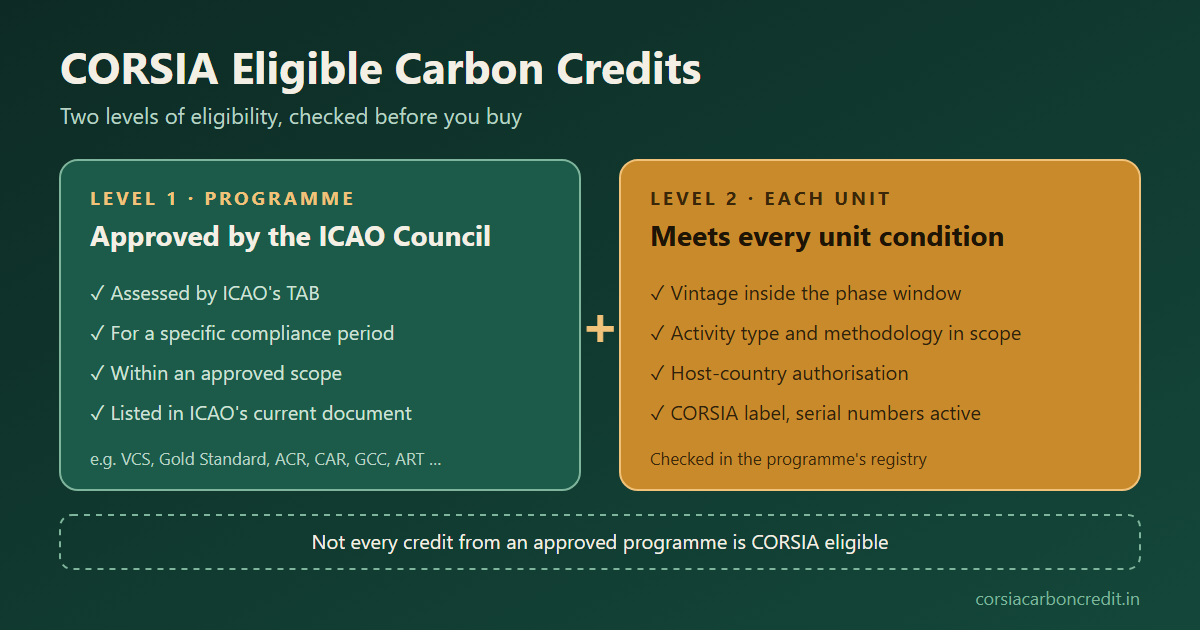
CORSIA eligible carbon credits are carbon credits that airlines can cancel to meet their offsetting requirements under ICAO's Carbon Offsetting and Reduction Scheme for International Aviation. A credit qualifies only if two things are true:
- its programme is approved by the ICAO Council for the relevant compliance period
- the individual unit meets every condition attached to that approval: scope, vintage, host-country authorisation and a CORSIA eligible label in the registry
Ordinary voluntary credits do not qualify automatically. For broader background, see our resources on CORSIA Carbon Credits.
This guide explains the requirements and the approved programmes, and gives a practical checklist for verifying eligibility before you buy. Time-sensitive information reflects official ICAO documents available in November 2026.
What Are CORSIA Eligible Carbon Credits?
CORSIA stands for the Carbon Offsetting and Reduction Scheme for International Aviation. The International Civil Aviation Organization (ICAO), the UN agency for civil aviation, set it up, and its detailed rules are in Annex 16, Volume IV to the Chicago Convention.
ICAO's official term for these credits is CORSIA Eligible Emissions Units (EEUs). Each unit generally represents one tonne of CO₂ reduced or removed by a project somewhere in the world. Aeroplane operators that have an offsetting requirement must acquire these units and cancel them, so that each tonne is counted only once.
Eligibility is different from ordinary certification:
- Certification under a programme such as Verra or Gold Standard shows a credit meets that programme's rules.
- CORSIA eligibility is an additional test set by ICAO. Many certified credits fail it, for example because of their vintage, project type or lack of host-country authorisation.
Why Are CORSIA Eligible Carbon Credits Important?
Aviation produces roughly 2–3% of global energy-related CO₂ emissions, according to the International Energy Agency, and most of its fuel is burned on international flights. CORSIA is ICAO's global market-based measure for those flights. It requires operators to compensate for emissions growth on covered routes above a baseline, which from 2024 is 85% of 2019 emissions.
CORSIA does not apply identically to every airline or flight:
- Monitoring, reporting and verification (MRV) apply to operators emitting more than 10,000 tonnes of CO₂ a year from international flights with aeroplanes above 5,700 kg.
- Offsetting applies only to flights between participating States (130 in 2026, with participation required for most large aviation States from 2027).
Where offsetting applies, eligible units are the main way to meet it, alongside any reductions from CORSIA eligible fuels. Integrity matters because each unit stands in for a tonne of real emissions. Transparent rules let States, auditors and the public trust the system. Airlines must check eligibility before buying, because an ineligible unit has no compliance value.
How Does ICAO Determine CORSIA Carbon Credit Eligibility?
The Technical Advisory Body (TAB)
ICAO's Technical Advisory Body assesses carbon-crediting programmes that apply to supply units to CORSIA. It uses ICAO's Emissions Unit Eligibility Criteria, which cover:
- programme design elements, such as governance, registries, validation and verification, and safeguards
- carbon offset credit integrity criteria, such as additionality, a credible baseline, permanence, leakage, counting units only once and doing no net harm
Council decisions
The TAB makes recommendations, and the ICAO Council decides. Decisions are published in the ICAO document CORSIA Eligible Emissions Units, which is updated after each Council decision. It sets out each programme's scope, meaning which activities, methodologies, dates and registries are included or excluded.
Programme level vs unit level
- Programme-level eligibility: the programme is approved to supply units for a specific compliance period, sometimes only conditionally.
- Unit-level eligibility: each individual unit must also meet the conditions of that approval.
Not every unit from an approved programme is eligible. Approvals are tied to compliance periods and change over time, so always use the latest edition of the ICAO document.
Key Eligibility Requirements for CORSIA Carbon Credits
1. Eligible carbon credit programme
The programme must be approved for the compliance period in which the airline will cancel the units. A programme approved for the pilot phase is not automatically approved for later periods.
2. Carbon credit vintage
Vintage is the year in which the emission reduction or removal took place.
- Pilot phase (2021–2023): units generally came from activities that started from 1 January 2016, with vintages from 2016 to 2020.
- First phase (2024–2026): units generally need a first crediting period starting on or after 1 January 2016, and vintages from 2021 to 2026.
3. Eligible project and unit type
The activity type and methodology must fall inside the programme's approved scope. The ICAO document lists exclusions for some programmes.
4. Additionality and environmental integrity
ICAO's criteria require units to be additional, based on credible baselines, permanent (with reversal safeguards), and adjusted for leakage.
5. Independent verification
Units must come from results that were monitored, reported and verified by accredited third parties under the programme's rules.
6. Host-country authorisation
For first-phase units, the country where the project is located must issue a Letter of Authorization for the units' use in international mitigation, including CORSIA.
7. Corresponding adjustments
The host country must also apply a corresponding adjustment under Article 6 of the Paris Agreement. This is an accounting step that removes the reduction from its own climate target, so the same tonne is not counted twice. Our explainer on corresponding adjustments covers this in plain terms.
8. Registry and traceability
Each unit must be held in the programme's designated registry with a unique serial number and a CORSIA eligible label. It must then be cancelled for CORSIA, with the operator and compliance period recorded. Some programmes require cancellation in a specific associated registry.
Requirements 6 and 7 are tied to the first phase. Always confirm the exact conditions for the period you are buying for.
Which Carbon Credit Programmes May Supply CORSIA Eligible Credits?
A carbon-crediting programme writes methodologies, accredits auditors, issues credits and runs or designates a registry. According to ICAO's CORSIA Eligible Emissions Units document (April 2026 edition), ten programmes were approved for the first phase (2024–2026), each with its own scope:
- Verra – Verified Carbon Standard (VCS). The largest voluntary programme, covering many project types. It issues Verified Carbon Units in the Verra Registry, where eligible units carry a CORSIA label.
- Gold Standard. It focuses on sustainable development benefits alongside climate impact, with credits recorded in its Impact Registry.
- American Carbon Registry (ACR). It issues Emission Reduction Tonnes and runs its own registry.
- Climate Action Reserve (CAR). It uses standardised protocols, mainly in North America, and issues Climate Reserve Tonnes.
- Global Carbon Council (GCC). A Qatar-based programme serving the Middle East, Asia and Africa.
- Architecture for REDD+ Transactions (ART). It credits jurisdictional forest programmes under its TREES standard.
- Isometric, Premium T-VER (Thailand), the Forest Carbon Partnership Facility (FCPF) and the BioCarbon Fund Initiative for Sustainable Forest Landscapes (ISFL).
The ICAO Council has also approved programmes for the 2027–2029 compliance period and conditionally approved the Paris Agreement Crediting Mechanism (PACM). These lists change after each Council decision.
Being listed does not mean all of a programme's credits qualify. Scope limits, vintage windows, authorisation and labelling still apply to each unit. Our guide to CORSIA eligible emissions units explains ICAO's criteria in more depth.
Difference Between CORSIA Eligible Carbon Credits and Regular Voluntary Carbon Credits
CORSIA eligible carbon credits vs regular voluntary carbon credits
| Comparison factor | CORSIA eligible carbon credits | Regular voluntary carbon credits |
|---|---|---|
| Eligibility | Must meet CORSIA requirements for the compliance period | Set by the programme and the buyer |
| Programme | Approved by the ICAO Council on TAB advice | Any voluntary programme |
| Vintage | Fixed windows for each phase | Set by the programme and buyer preference |
| Unit restrictions | Scope, authorisation and CORSIA label | Usually none beyond the programme's rules |
| Host-country authorisation | Required for first-phase units | Usually not required |
| Corresponding adjustment | Required for first-phase units | Usually not applied |
| Intended use | CORSIA compliance | Voluntary climate claims and other permitted uses |
| Verification | Programme verification plus State review of the cancellation report | Programme verification |
The categories are not interchangeable. A voluntary credit can support a company's own climate claim, but it cannot be used for CORSIA unless it meets every ICAO condition.
How Can Airlines Verify CORSIA Eligible Carbon Credits?
- Identify your requirements: the compliance period and the expected offsetting quantity.
- Open the latest ICAO CORSIA Eligible Emissions Units document.
- Confirm the programme is approved for that compliance period.
- Check the unit type and methodology against the approved scope.
- Verify the vintage and project start date.
- Review host-country authorisation, such as the Letter of Authorization.
- Check corresponding-adjustment conditions where required.
- Look up the serial numbers in the registry and confirm the CORSIA label.
- Confirm ownership and transfer history where shown.
- Check that the units are still active, not already retired or cancelled.
- Keep all evidence of purchase, transfer and cancellation.
Check both levels. A programme check alone misses unit-level problems, and a unit check alone is meaningless if the programme is not approved for your period.
Illustrative example (hypothetical)
This example is hypothetical. It does not describe a real airline, supplier, programme approval or serial number.
- The airline identifies its requirement for the first-phase compliance period.
- The supplier shares unit details: project, programme, methodology, vintage and serial numbers.
- The buyer checks programme eligibility in ICAO's current document.
- Vintage and unit conditions are verified. The vintage falls inside 2021–2026, the methodology is in scope, and a Letter of Authorization exists.
- Registry records are reviewed. The units are active and carry the CORSIA label.
- Purchase and transfer are arranged through the registry.
- The units are cancelled for CORSIA with the operator and compliance period recorded.
- Documentation is kept for the airline's Emissions Unit Cancellation Report to its State.
How Do Airlines Purchase and Use CORSIA Eligible Carbon Credits?
The usual sequence is:
- estimate the offsetting requirement from verified emissions on covered routes
- identify potentially eligible units and choose a supplier
- check ICAO eligibility and review unit documents
- negotiate terms, including price, delivery and replacement if units prove ineligible
- transfer the units through the relevant registry
- cancel the units for CORSIA
- keep records and report the cancellation to the State
These terms are different:
- Issuance creates a unit.
- Purchase is the contract.
- Transfer moves the unit between accounts.
- Cancellation permanently removes it for CORSIA.
- Retirement is the general term for permanent removal, usually for a voluntary claim.
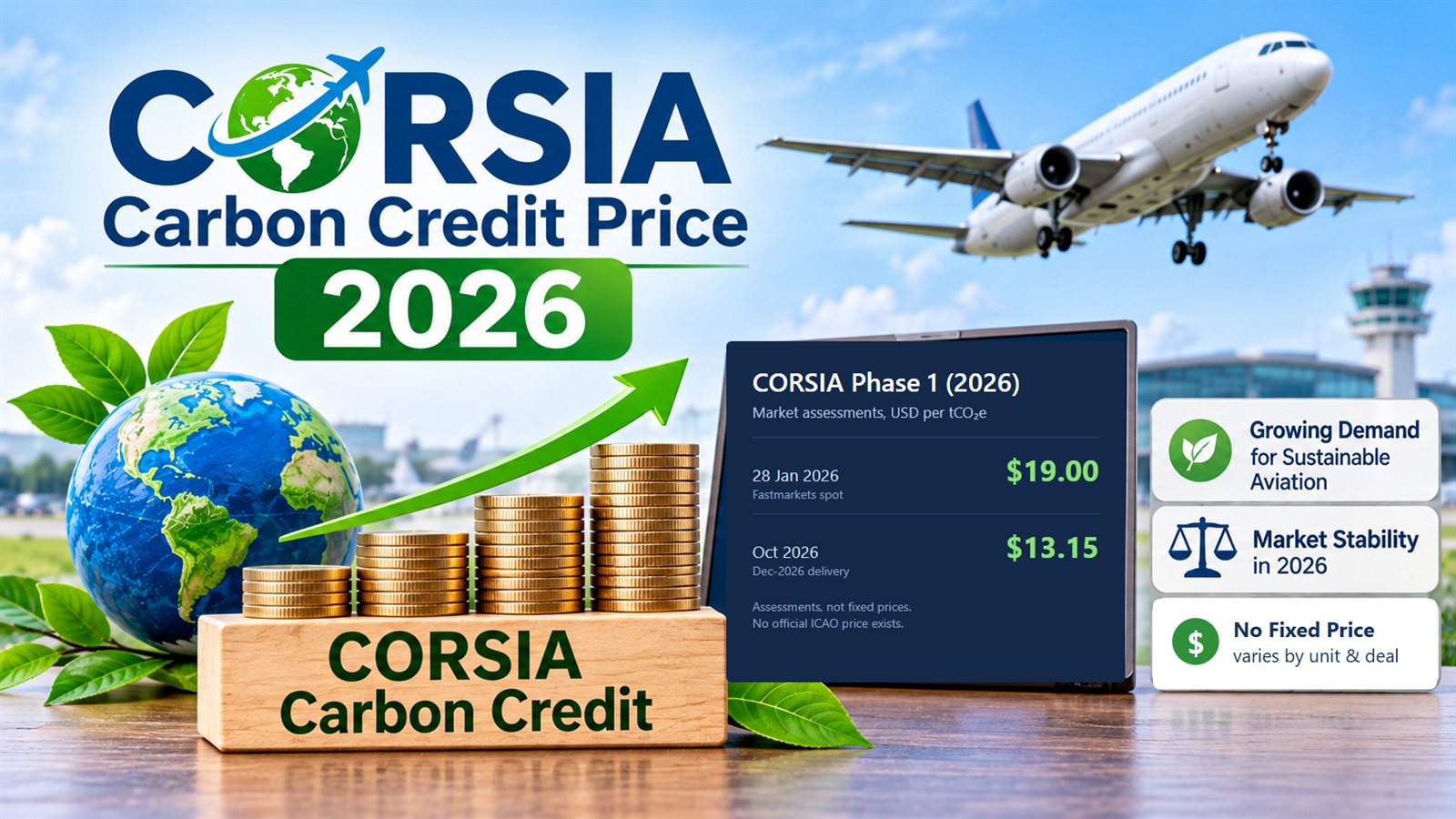
Buying units does not complete compliance. Only correct cancellation and reporting do. Our article on the CORSIA carbon market explains how units reach airlines. Our guide to the CORSIA carbon credit price in 2026 covers what eligible units have recently cost.
Common Mistakes to Avoid When Buying CORSIA Eligible Credits
- Assuming any voluntary credit qualifies. Check every unit against ICAO's document.
- Confusing programme and unit eligibility. An approved programme can still issue ineligible units.
- Ignoring vintage. Credits from before 2021 do not count for the first phase.
- Relying only on the supplier's word. Verify in the registry yourself.
- Overlooking authorisation. A missing Letter of Authorization makes a first-phase unit ineligible.
- Forgetting corresponding adjustments. These are what prevent double counting.
- Skipping registry checks. Confirm serial numbers, the CORSIA label and that the units are active.
- Confusing purchase with cancellation. Units must be cancelled for CORSIA.
- Using an outdated ICAO list. Approvals change after each Council decision.
- Ignoring the compliance period. Eligibility for one period does not carry over to the next.
Careful research, written confirmation of each unit's details and a complete evidence file prevent most of these problems.
Future of CORSIA Eligible Carbon Credits
Several confirmed and developing trends will shape eligible credits:
- Changing requirements as the second phase begins on 1 January 2027, with its own approved programmes and conditions
- Higher integrity expectations from ICAO, buyers and ratings agencies
- More transparent registries, with clearer labels and links between them
- More host-country authorisations, as countries build Article 6 systems
- Article 6 implementation, including the Paris Agreement Crediting Mechanism
- Airline demand, which already exceeds labelled first-phase supply
- Closer scrutiny at both programme and unit level
- More formal procurement and documentation practices
How quickly supply grows will depend on future ICAO decisions and host-country action, which cannot be predicted with certainty.
Frequently Asked Questions
What are CORSIA eligible carbon credits?
They are carbon credits, called CORSIA Eligible Emissions Units, that meet ICAO's requirements for a specific compliance period. Aeroplane operators cancel them to meet their CORSIA offsetting requirements.
Who determines whether carbon credits are eligible for CORSIA?
The ICAO Council decides, based on recommendations from its Technical Advisory Body, and publishes the results in the ICAO document CORSIA Eligible Emissions Units.
Which carbon credit programmes are eligible under CORSIA?
ICAO's April 2026 document lists ten programmes for the first phase (2024–2026): ACR, ART, ISFL, CAR, FCPF, GCC, Gold Standard, Isometric, Premium T-VER and Verra's VCS, each with its own scope. Other programmes are approved for 2027–2029. Always check the latest document.
Are all Verra and Gold Standard credits CORSIA eligible?
No. Only units within the approved scope, with eligible vintages, the required host-country authorisation and a CORSIA label in the registry qualify.
What are the vintage requirements for CORSIA eligible credits?
For the first phase, units generally need vintages from 2021 to 2026, from activities whose first crediting period started on or after 1 January 2016. Pilot-phase units generally had vintages from 2016 to 2020.
How can airlines verify CORSIA carbon credit eligibility?
Check the programme against ICAO's current document. Then check the specific units' methodology, vintage, authorisation and CORSIA label in the registry using their serial numbers.
What is the difference between CORSIA eligible credits and voluntary carbon credits?
CORSIA eligible credits meet ICAO's programme and unit conditions and can be used for compliance. Voluntary credits support voluntary claims and do not count for CORSIA unless they meet every ICAO condition.
How are CORSIA eligible emissions units used for airline compliance?
The airline acquires the units and cancels them in the registry for CORSIA, recording the operator and compliance period. It then reports the cancellation to its State in an Emissions Unit Cancellation Report.
Key Takeaways
CORSIA eligible carbon credits are what make international aviation's offsetting system work. Eligibility depends on:
- ICAO's decisions for each compliance period
- the programme's approval and its scope
- each unit's vintage and methodology
- host-country authorisation and corresponding adjustments where required
- traceable registry records with a CORSIA label
Verify every unit before you buy, and cancel it correctly for CORSIA afterwards.
To learn more about eligible units, pricing and airline compliance, explore the CORSIA resources at CORSIA Carbon Credit.