 DSTechnoverse company
The CORSIA carbon market is the market in which airlines obtain carbon credits that ICAO recognises as eligible, then cancel them to meet their offsetting requirements under the Carbon Offsetting and Reduction Scheme for International Aviation. It is not a single exchange. It is a network of carbon-crediting programmes, project developers, host governments, registries, brokers and aeroplane operators. Each unit must meet ICAO's eligibility rules before it can count.
This guide explains how the market works and who takes part. It covers why airline demand is running well ahead of eligible supply, what affects prices and what could shape the market's future. Time-sensitive figures reflect information available in November 2026.
What Is the CORSIA Carbon Market?
CORSIA stands for Carbon Offsetting and Reduction Scheme for International Aviation. It was adopted by the International Civil Aviation Organization (ICAO), the UN agency for civil aviation, and is ICAO's global market-based measure for international aviation. It is limited to one sector. It does not cover power plants, factories or domestic flights.
International aviation needed its own mechanism because its emissions cross borders and are hard to cut quickly. Sustainable aviation fuel (SAF) is still scarce, and aircraft fleets change slowly. CORSIA asks aeroplane operators to compensate for emissions growth on covered routes above a baseline, which from 2024 is 85% of 2019 emissions. They do this with emissions units that represent reductions or removals achieved elsewhere.
That requirement creates the CORSIA carbon market. Airlines need units, and projects around the world can supply them, provided the units are CORSIA eligible emissions units (EEUs). Eligibility is what separates this compliance market from the much broader voluntary carbon market. In the voluntary market, companies buy credits for their own climate claims under rules they largely choose themselves.
Not every airline or flight is affected in the same way. Monitoring, reporting and verification apply to operators emitting more than 10,000 tonnes of CO₂ a year from international flights with aeroplanes above 5,700 kg. Offsetting applies only to flights between participating States. Our guide to the CORSIA Carbon Offsetting and Reduction Scheme explains these rules in more detail.
How Does the CORSIA Carbon Market Work?
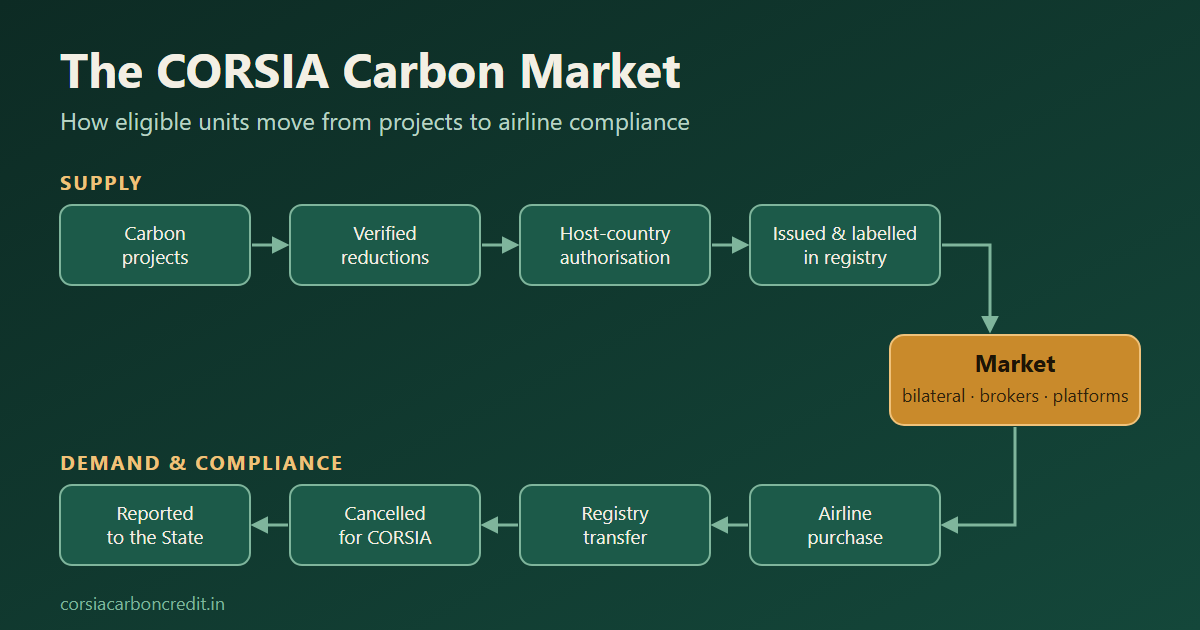
The market runs through eight connected steps:
- Monitoring and reporting. Aeroplane operators monitor fuel use, calculate CO₂ and submit verified emissions reports to their State every year.
- Offsetting requirements. At the end of each compliance period, the State calculates each operator's requirement for routes between participating States.
- Generating reductions or removals. Project developers run activities such as forest protection, clean cooking, renewable energy or carbon removal under an approved programme's methodology.
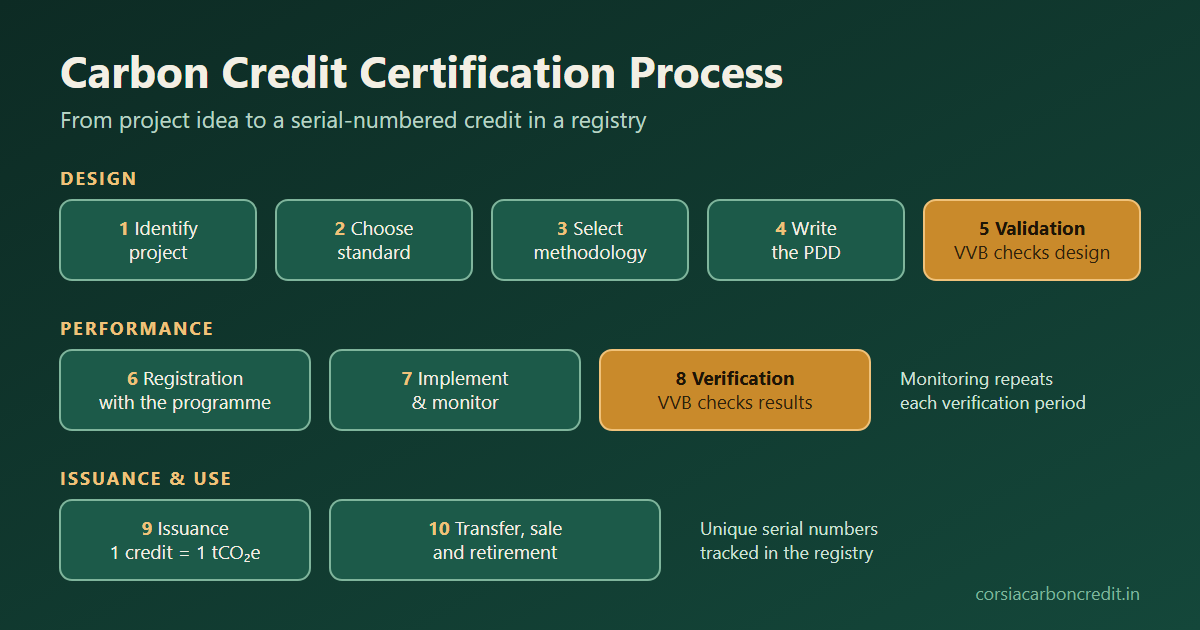
- Issuance. After independent verification, the programme issues units into its registry, each with a unique serial number.
- Supply to the market. Units that meet ICAO's conditions and are labelled CORSIA eligible become available to buyers.
- Acquisition. Airlines buy units directly from developers, through brokers or on trading platforms.
- Cancellation. The airline, or the seller on its behalf, cancels the units in the registry, recording CORSIA as the purpose.
- Reporting. The airline submits an Emissions Unit Cancellation Report to its State, which reviews it and reports to ICAO.
In short:
Carbon Projects → Emissions Reductions → Credit Issuance → Carbon Market → Airline Purchase → Unit Cancellation → Compliance Reporting
These steps are separate:
- Purchase is a commercial contract.
- Registry transfer moves units into the buyer's account. The units can still be used afterwards.
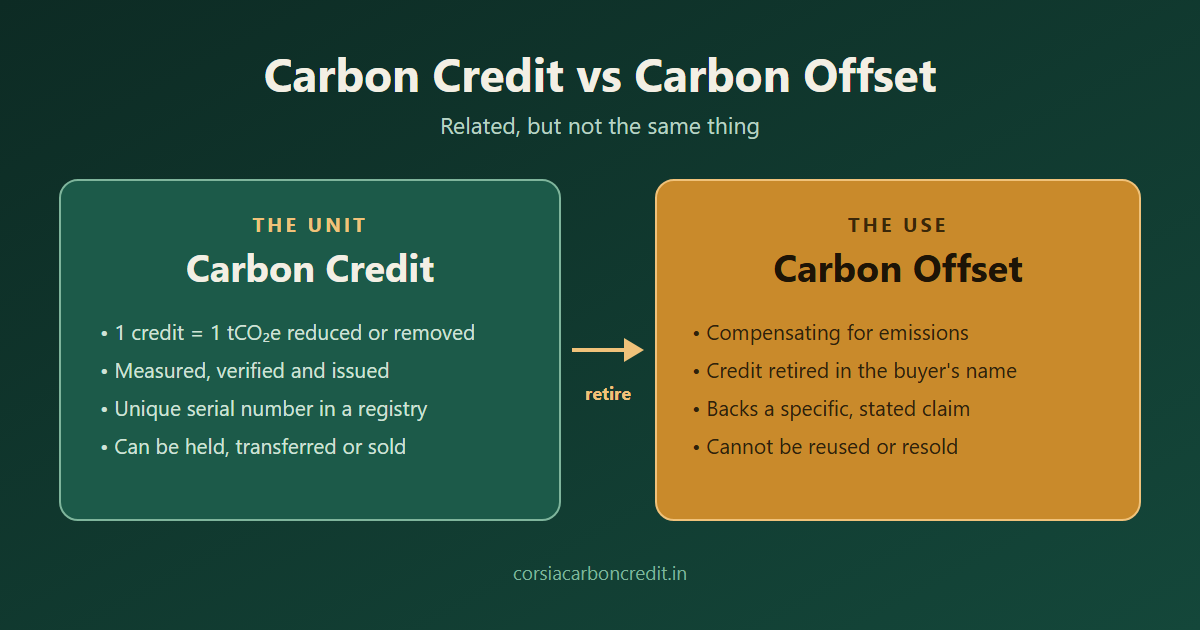
- Cancellation permanently removes units for a stated purpose, here CORSIA compliance.
- Retirement is the general market term for permanent removal. Under CORSIA, what counts is a cancellation recorded for CORSIA.
Buying a credit does not make an airline compliant. Compliance is shown only when eligible units are cancelled and reported correctly.
Structure and Key Participants in the CORSIA Carbon Market
1. ICAO
ICAO develops the CORSIA framework and its Standards. The ICAO Council decides which programmes can supply eligible units for each compliance period. It bases those decisions on recommendations from the Technical Advisory Body (TAB), which assesses programmes against ICAO's Emissions Unit Eligibility Criteria. ICAO does not issue, buy or sell credits.
2. Airlines and aeroplane operators
Operators monitor and report emissions, receive their offsetting requirement from their State, and then acquire and cancel eligible units. They are the market's main buyers.
3. Project developers
Developers design and run reduction or removal activities, apply programme methodologies, and arrange validation and verification. They also often help obtain host-country authorisation.
4. Carbon-crediting programmes
Programmes such as Verra's VCS, Gold Standard, ACR, ART and the Global Carbon Council set crediting rules and methodologies. They oversee validation, verification and issuance, and they run registries. ICAO's April 2026 list showed ten programmes approved for the first phase (2024–2026), each with its own conditions. Our article on CORSIA eligible emissions units lists them and explains what they mean.
5. Governments and host countries
For first-phase units, the country where the project is located must issue a Letter of Authorization for the units' international use. It must also apply a corresponding adjustment under Article 6 of the Paris Agreement, removing the reduction from its own climate accounts so it is not counted twice. Airlines' own States oversee compliance and review cancellation reports. Our explainer on corresponding adjustments explains this accounting step.
6. Registries and intermediaries
Registries record issuance, transfer and cancellation, and they apply the CORSIA eligible label. Brokers, trading platforms and marketplaces bring buyers and sellers together and help manage documentation.
No participant can declare a credit CORSIA eligible on its own. Eligibility comes from ICAO's decisions, the programme's approved scope and the unit-level conditions.
CORSIA Carbon Credit Supply and Demand
The supply side
Eligible supply depends on several conditions being met together:
- Approved programmes, each limited to specific activity types and compliance periods
- Unit-level rules, such as first crediting periods starting on or after 1 January 2016 and first-phase vintages of 2021–2026
- Host-country authorisation and corresponding adjustments, which require government processes that many countries are still setting up
- Registry labelling, because a unit is not eligible until it is tagged CORSIA eligible
- Lead times, because developing a project, verifying it and issuing credits can take years
The demand side
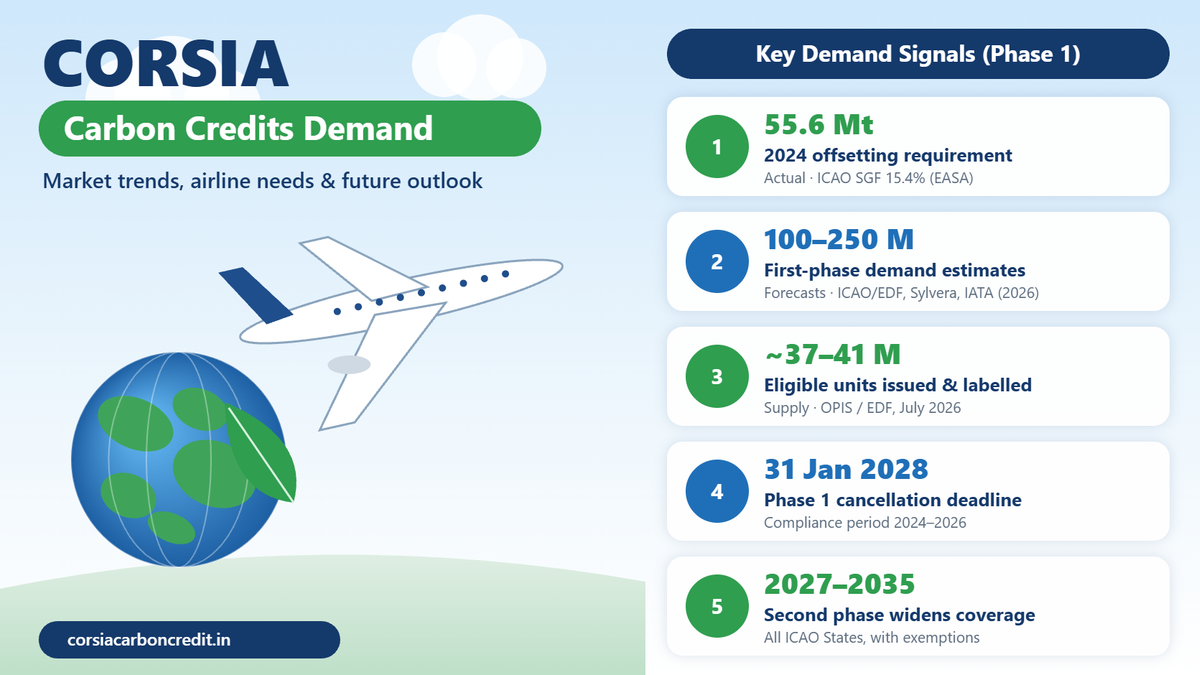
Demand comes from airline offsetting requirements. These depend on emissions growth on covered routes, the number of participating States (130 in 2026) and the three-year compliance periods. According to industry reporting, airlines must cancel units for the first phase by 31 January 2028. From 2027, the second phase makes participation required for most large aviation States, which should widen coverage.
The gap
The published estimates show a large mismatch:
- In September 2025, IATA estimated that airlines would need between 146 million and 236 million eligible units for the first phase.
- ICAO's August–September 2026 CORSIA newsletter reported about 44 million units labelled CORSIA eligible for that phase.
Estimates differ by source and change frequently, but they all point the same way: demand is well ahead of authorised, labelled supply.
Illustrative example (hypothetical figures)
Imagine a small market where airlines must cancel 100 units by a deadline, but only 30 eligible units exist. Airlines compete for those 30, so sellers can ask more. At the same time, project owners have a strong reason to obtain authorisations and labels for the units they hold. If 50 more units are then approved, the pressure eases. If approvals are slow, the shortage continues until the deadline. These numbers are for illustration only, not market statistics.
CORSIA Carbon Credit Prices and Market Dynamics
There is no single CORSIA carbon market price. Each transaction depends on the specific units involved:
- Supply and demand. Scarce eligible supply against fixed deadlines adds price pressure.
- Eligibility. Units that are fully authorised and labelled usually trade above units that are uncertain or not eligible.
- Vintage and methodology. These determine whether a unit qualifies and how buyers judge it.
- Authorisation status. Units without a Letter of Authorization carry eligibility risk for first-phase use.
- Integrity and quality. Buyers and ratings agencies look at additionality, permanence and co-benefits.
- Liquidity. Thin trading makes prices harder to discover.
- Procurement timing. Buying forward, buying on the spot market and buying close to a deadline carry different risks.
Readers should also distinguish indicative prices (published assessments), offers (asking prices) and completed transactions (agreed deals). These can differ substantially. This article does not quote prices, because they change quickly and depend on the specific units. Our guide to how carbon credit prices are quoted explains how to read a price.
| Market Factor | Potential Influence on Price |
|---|---|
| Limited eligible supply | May increase price pressure |
| Higher airline demand | May increase competition for units |
| Credit vintage | Can affect eligibility and value |
| Programme and methodology | Can affect buyer acceptance |
| Authorisation status | Can influence market availability |
| Market liquidity | Can affect transaction pricing |
CORSIA Carbon Market vs Voluntary Carbon Market
| Factor | CORSIA carbon market | Voluntary carbon market |
|---|---|---|
| Purpose | Meeting airline offsetting requirements | Corporate and personal climate claims |
| Main buyers | Aeroplane operators with CORSIA obligations | Companies, organisations and individuals |
| Regulatory framework | ICAO Standards, implemented by States | Programme rules and voluntary guidance |
| Credit eligibility | Only ICAO-approved programmes and units | Set by the buyer and the standard |
| Programme requirements | Must pass TAB assessment and Council approval | Programme's own governance |
| Compliance use | Counts towards CORSIA obligations | No regulatory compliance value |
| Cancellation | Must be cancelled for CORSIA and reported to the State | Retired for a voluntary claim |
| Pricing and procurement | Shaped by deadlines and constrained eligible supply | Wide range across project types and quality levels |
Many voluntary credits come from the same programmes as CORSIA units, but not every voluntary credit is eligible for CORSIA. Eligibility depends on ICAO's programme conditions and on each unit's own characteristics.
Market Opportunities and Challenges in the CORSIA Carbon Market
Potential opportunities
- Project development. Demand for eligible reduction and removal projects supports new development.
- Wider supply as more programmes and host countries complete approvals and authorisations.
- Better registry infrastructure, including clearer labelling and links between registries.
- Host-country participation. Clear authorisation processes let host countries attract investment.
- Aviation engagement, as airlines build longer-term procurement plans.
- Transparency, through public registry data and ICAO disclosures.
- Service providers, such as auditors, registries, advisers and marketplaces, can support the process.
Major challenges
- Limited eligible supply compared with first-phase demand
- Strict programme and unit-level conditions that rule out many existing credits
- Double-counting risk, which is why authorisations and corresponding adjustments matter
- Authorisation complexity, because many host countries are still building their Article 6 systems
- Price uncertainty for airlines' budgets and for developers' investment decisions
- Uneven quality across project types and methodologies
- Documentation requirements at every stage, from issuance to the cancellation report
Future Outlook of the CORSIA Carbon Market
Several confirmed developments will shape the market:
- Second phase from 1 January 2027. Participation becomes required for most large aviation States.
- Changing eligibility. The ICAO Council continues to approve programmes for the 2027–2029 period. It has conditionally approved the Paris Agreement Crediting Mechanism (PACM).
- ICAO's commitment. The 42nd ICAO Assembly in 2025 reaffirmed CORSIA as the only global market-based measure for international aviation.
- Article 6. Host-country authorisations and corresponding adjustments now link CORSIA supply to Paris Agreement accounting.
Other questions remain open: how quickly authorised supply grows, how airline demand develops as traffic grows, how registry tracking improves, and how buyers weigh removals against reductions. None of these can be predicted with confidence.
Offsetting and SAF play different roles. CORSIA eligible fuels, which include SAF, reduce an airline's offsetting requirement by lowering its life cycle emissions. Eligible emissions units cover the remaining requirement through reductions made elsewhere. One does not replace the other. Our article on the CORSIA methodology for actual life cycle emissions values explains how SAF claims are calculated.
Taken together, the outlook is a market that is becoming larger and more regulated. Its growth depends less on demand, which is already clear, and more on how quickly high-integrity, authorised units reach the registries.
Frequently Asked Questions
What is the CORSIA carbon market?
It is the market in which airlines acquire ICAO-eligible carbon credits and cancel them to meet their CORSIA offsetting requirements for international flights between participating States.
How does carbon trading work under CORSIA?
Projects generate verified reductions, and programmes issue units in their registries. Eligible units are then sold through bilateral deals, brokers or platforms. Airlines cancel them for CORSIA and report the cancellation to their State.
Who buys carbon credits in the CORSIA market?
Mainly aeroplane operators with CORSIA offsetting requirements. Traders and intermediaries also buy units to resell them to airlines.
What types of carbon credits are eligible for CORSIA?
Only units from ICAO-approved programmes count. They must also fall within the approved scope and vintage window, carry any required host-country authorisation and be labelled CORSIA eligible in the registry.
What factors influence CORSIA carbon credit prices?
The balance of eligible supply and demand, authorisation status, vintage, methodology, quality, market liquidity and the timing of purchases relative to cancellation deadlines.
What is the difference between the CORSIA market and the voluntary carbon market?
The CORSIA market serves regulated airline obligations under ICAO rules. The voluntary market serves voluntary climate claims. Only units that meet ICAO's conditions count for CORSIA.
What is the future outlook for the CORSIA carbon market?
Demand is set to grow with the second phase from 2027. The main uncertainty is how quickly authorised, eligible supply increases through new programme approvals and host-country authorisations.
Key Takeaways
The CORSIA carbon market turns international aviation's offsetting requirements into demand for high-integrity emissions reductions and removals around the world. It works only when each link holds:
- ICAO eligibility decisions
- Approved programmes and correctly authorised units
- Accurate registry records with unique serial numbers
- Transparent trading
- Correct cancellation and reporting to the State
With demand now well above labelled supply, reliable information on eligibility, availability and documentation is as important as price.
For more guides on eligible units, registries, pricing and airline compliance, explore the CORSIA resources at CORSIA Carbon Credit.
Sources
- ICAO – CORSIA Eligible Emissions Units document (April 2026)
- ICAO – CORSIA Newsletter, August–September 2026
- ICAO – CORSIA Newsletter, January 2026 (participating States)
- ICAO – Expansion of approved emissions unit programmes
- IATA – Industry urges governments to expedite release of CORSIA eligible emissions units (September 2025)
- IATA – ICAO 42nd Assembly: key environment-related outcomes
- UNFCCC – Article 6 of the Paris Agreement