 DSTechnoverse company
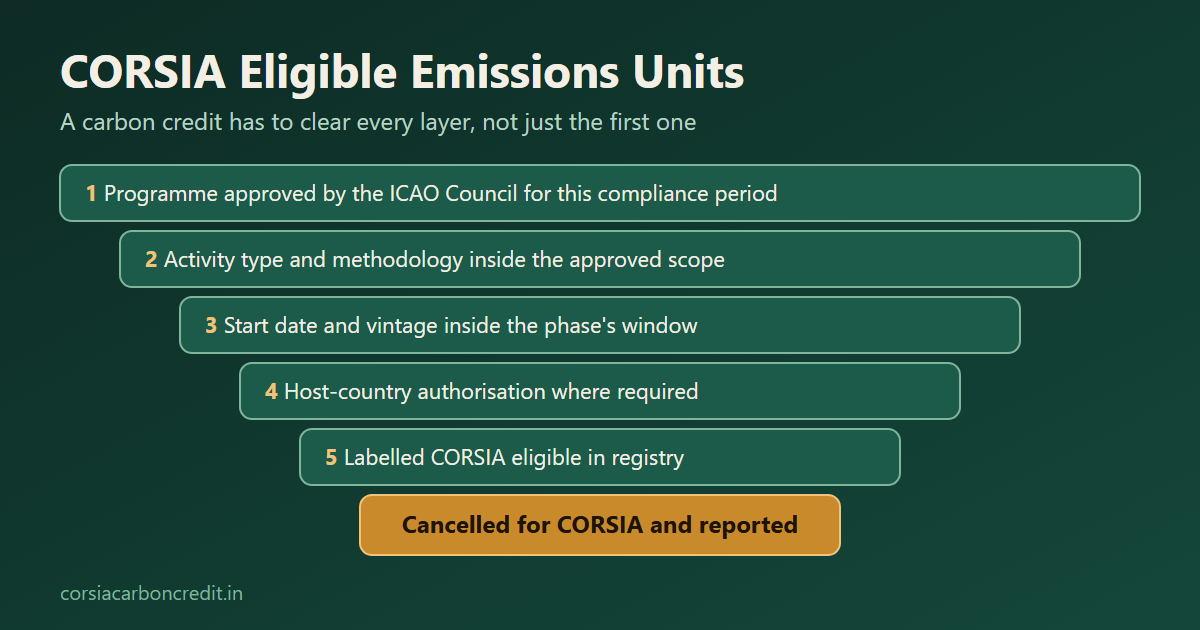
CORSIA Eligible Emissions Units are carbon credits that aeroplane operators can cancel to meet their offsetting requirements under the Carbon Offsetting and Reduction Scheme for International Aviation (CORSIA). Only units that meet all of ICAO's conditions count. The unit must come from a carbon-crediting programme the ICAO Council has approved for the relevant compliance period, and it must fall within that programme's approved scope. It must also meet the date and authorisation rules and be labelled as CORSIA eligible in the programme's registry.
Most carbon credits on the market do not meet all of these conditions. This guide explains how ICAO decides eligibility and which criteria matter. It also covers how airlines use eligible units and how to check a credit before buying it.
What Are CORSIA Eligible Emissions Units?
An emissions unit, usually called a carbon credit, represents one tonne of CO₂ equivalent that has been reduced, avoided or removed from the atmosphere by a specific activity. Examples include a wind farm, a forest protection project or a landfill gas system. A crediting programme issues the unit after the result has been measured and verified.
Under CORSIA, airlines must compensate for the growth in CO₂ from international flights between participating States. They do this by acquiring eligible units and cancelling them, so that each unit is used only once. The number needed depends on the airline's verified emissions and ICAO's growth factors. Our guide to the CORSIA Carbon Offsetting and Reduction Scheme explains how that requirement is set.
The difference from an ordinary carbon credit is who sets the rules. For a voluntary credit, the standard and the buyer decide what is acceptable. For a CORSIA eligible emissions unit, ICAO's rules decide, and the airline's State checks that they were followed.
How Does ICAO Determine CORSIA Emissions Unit Eligibility?
Eligibility is decided in two layers: the programme and the unit.
The Technical Advisory Body (TAB)
ICAO's Technical Advisory Body (TAB) is a panel of experts set up by the ICAO Council in 2019. It assesses carbon-crediting programmes that apply to supply units to CORSIA, using ICAO's CORSIA Emissions Unit Eligibility Criteria (EUC). The TAB then recommends which programmes, and which parts of them, should be eligible. The ICAO Council makes the final decision and publishes it in the ICAO document CORSIA Eligible Emissions Units.
Programme-level eligibility
Approval covers a programme for specific compliance periods: the pilot phase (2021–2023), the first phase (2024–2026) or the second phase (2027–2035, assessed period by period). A programme approved for one period is not automatically approved for the next. ICAO also grants some approvals conditionally, meaning the programme becomes eligible only after it meets set requirements.
Unit-level eligibility
Within an approved programme, the ICAO document sets out exactly which units qualify. Conditions can cover:
- Activity types or methodologies that are included or excluded
- Project start dates and vintage, meaning the years in which reductions took place
- Host-country authorisation and avoidance of double claiming
- Registry labelling: only units held in the listed registry and tagged as CORSIA eligible count
Programme approval does not make every credit from that programme eligible. A unit from a well-known, approved standard can still fail on any of these conditions.
Key Requirements for CORSIA Eligible Emissions Units
The EUC have two parts.
Carbon offset credit integrity criteria
ICAO's integrity criteria require that units:
- Are additional, meaning the reductions would not have happened without the carbon credit incentive
- Are based on a realistic and credible baseline
- Are quantified, monitored, reported and verified, including independent validation and verification by accredited third parties
- Have a clear and transparent chain of custody
- Represent permanent reductions, with measures to address the risk of reversal, such as fire destroying a forest project
- Assess and mitigate leakage, meaning emissions that simply move elsewhere
- Are counted only once towards a mitigation obligation
- Do no net harm to people or the environment
Programme design elements
Programmes must also have sound institutions behind the credits:
- Clear methodologies and a transparent process for developing them
- Issuance, retirement and cancellation procedures
- Registries with unique serial numbers
- Validation and verification rules
- Good governance
- Public participation and transparency
- Environmental and social safeguards
- Sustainable development criteria
- Rules to prevent double issuance, double use and double claiming
Phase-specific restrictions
ICAO has tightened the rules over time.
- Pilot phase: units generally came from activities starting from 1 January 2016, with vintages 2016–2020.
- First phase: units must generally come from activities whose first crediting period started on or after 1 January 2016, with vintages from 2021 to 2026. They also need a host-country Letter of Authorization and a corresponding adjustment, an accounting entry that stops the host country also counting the same reduction towards its own climate target. Our explainer on corresponding adjustments covers this in plain terms.
Exact conditions differ by programme, so the ICAO document is always the final reference.
CORSIA Eligible Carbon Credit Programmes and Standards
A carbon-crediting programme (also called a standard) writes the rules for projects. It approves methodologies, sets monitoring and verification requirements, accredits auditors, and runs a registry where each credit gets a unique serial number. ICAO does not issue, sell or hold credits, and it does not run a central exchange. Units are issued and cancelled in the programmes' own registries.
According to ICAO's CORSIA Eligible Emissions Units document (April 2026 edition), ten programmes were approved to supply units for the first phase (2024–2026):
- American Carbon Registry (ACR)
- Architecture for REDD+ Transactions (ART)
- BioCarbon Fund Initiative for Sustainable Forest Landscapes (ISFL)
- Climate Action Reserve (CAR)
- Forest Carbon Partnership Facility (FCPF)
- Global Carbon Council (GCC)
- Gold Standard
- Isometric
- Premium T-VER (Thailand)
- Verra's Verified Carbon Standard (VCS)
Each approval comes with its own scope and conditions. Some programmes' units must be cancelled in a specific associated registry to remain eligible.
ICAO has also approved programmes for the 2027–2029 compliance period and continues to assess more applicants. The Council has conditionally approved the Paris Agreement Crediting Mechanism (PACM). ICAO reported in its August–September 2026 newsletter that about 44 million units were labelled CORSIA eligible for the first phase.
Lists change after every Council decision. A programme's reputation or popularity in the voluntary market does not make it CORSIA eligible. Always check the latest ICAO document for the compliance period you are buying for.
General Carbon Credit vs CORSIA Eligible Emissions Unit
| Factor | General carbon credit | CORSIA eligible emissions unit |
|---|---|---|
| Intended use | Voluntary climate claims by companies or individuals | Meeting an airline's CORSIA offsetting requirement |
| Eligibility requirements | Set by the issuing standard and the buyer | Set by ICAO's EUC and Council decisions |
| Programme assessment | No ICAO assessment needed | Programme approved by the ICAO Council on TAB advice |
| Unit-level restrictions | Usually only buyer preferences | Scope, start date, vintage, authorisation and labelling |
| Compliance applicability | Not valid for CORSIA unless every condition is met | Valid only for the compliance period it is eligible for |
| Verification process | Programme verification of the project | Programme verification, plus State review of the airline's cancellation report |
How Are Eligible Emissions Units Used for CORSIA Compliance?
Airlines meet their offsetting obligations through these steps:
- Determine the requirement. The State calculates the airline's offsetting requirement for the compliance period from its verified emissions on covered routes, after any reductions from CORSIA eligible fuels.
- Identify eligible units. Match potential units against the ICAO document for that period.
- Check restrictions. Confirm the programme, unit type, methodology, vintage, authorisation status and label.
- Acquire the units through a bilateral contract, broker or marketplace.
- Transfer them into the airline's own registry account, or arrange cancellation on its behalf. Transferring a unit changes who holds it, but it can still be used afterwards.
- Cancel the units for CORSIA. Cancellation permanently removes them from circulation for that purpose. In everyday language this is often called retirement. Under CORSIA, the registry entry must state that the units were cancelled for CORSIA, and for which airline and compliance period.
- Report. The airline submits an Emissions Unit Cancellation Report to its State with the serial numbers. The State reviews it and reports to ICAO.
Buying a carbon credit does not by itself make an airline compliant. Compliance is shown only when eligible units are cancelled correctly and reported to the State. Our CORSIA explainer for airlines shows how these steps fit into the wider compliance cycle.
How to Verify Whether a Carbon Credit Is CORSIA Eligible
Use this checklist before you buy:
- Check the latest ICAO list. Confirm the programme is approved for the specific compliance period, and note any conditions.
- Confirm the programme and activity type. Make sure the project type and methodology fall inside the approved scope.
- Verify the vintage and start date. Both must fall inside the window for that phase.
- Review the methodology conditions for any exclusions that apply to it.
- Check the registry record. Look up the unique serial numbers and confirm that the units exist, have not been cancelled and carry the CORSIA eligible label.
- Confirm authorisation. For first-phase units, check that a Letter of Authorization exists and that the corresponding adjustment conditions apply.
- Keep evidence. Store issuance, transfer and cancellation records, which you will need for your report to the State.
Eligibility is always tied to a compliance period. A unit that qualified for the pilot phase is not automatically valid for the first phase. Our buyer's checklist for CORSIA-eligible units goes through each step in more detail.
Frequently Asked Questions
What are CORSIA eligible emissions units?
They are carbon credits that meet ICAO's eligibility rules for a specific CORSIA compliance period. Aeroplane operators cancel them to meet their offsetting requirements.
Who determines which emissions units are eligible under CORSIA?
The ICAO Council decides, based on recommendations from its Technical Advisory Body (TAB), which assesses programmes against the CORSIA Emissions Unit Eligibility Criteria.
Are all carbon credits eligible for CORSIA compliance?
No. Only units from ICAO-approved programmes count. They must also fall within the approved scope and date window, meet any authorisation requirements and be labelled CORSIA eligible in the registry.
What is the difference between an eligible programme and an eligible emissions unit?
An eligible programme is approved to supply units. An eligible unit is an individual credit from that programme that also meets every unit-level condition for the relevant compliance period.
How can airlines verify whether a carbon credit is CORSIA eligible?
Check the credit against the latest ICAO CORSIA Eligible Emissions Units document. Then confirm its activity type, vintage, authorisation and CORSIA label in the programme's registry using its serial numbers.
Why are vintage and registry tracking important for CORSIA emissions units?
Vintage decides which compliance period a unit can be used for. Registry tracking with unique serial numbers proves the unit is genuine, eligible and cancelled only once.
Key Takeaways
CORSIA Eligible Emissions Units are what allow international aviation's offsetting system to work. They let airlines compensate for emissions growth with credits that meet a common, ICAO-defined integrity bar.
Eligibility is narrow and changes over time. The programme must be approved for the right compliance period, and each unit must meet its scope, vintage, authorisation and labelling conditions. Before acquiring or using credits, check the current ICAO document, the programme's conditions and the registry records for every serial number.
To learn more about eligible units, registries and airline compliance, explore the CORSIA resources at CORSIA Carbon Credit.
Sources
- ICAO – CORSIA Eligible Emissions Units document (April 2026)
- ICAO – CORSIA Eligible Emissions Units overview
- ICAO – Understanding CORSIA Eligible Emissions Units (TAB webinar, February 2026)
- ICAO – TAB recommendations, September 2026
- ICAO – Expansion of approved emissions unit programmes
- ICAO – CORSIA Newsletter, August–September 2026
- World Bank – ISFL and FCPF approval for CORSIA first phase
- IATA – CORSIA fact sheet