 DSTechnoverse company
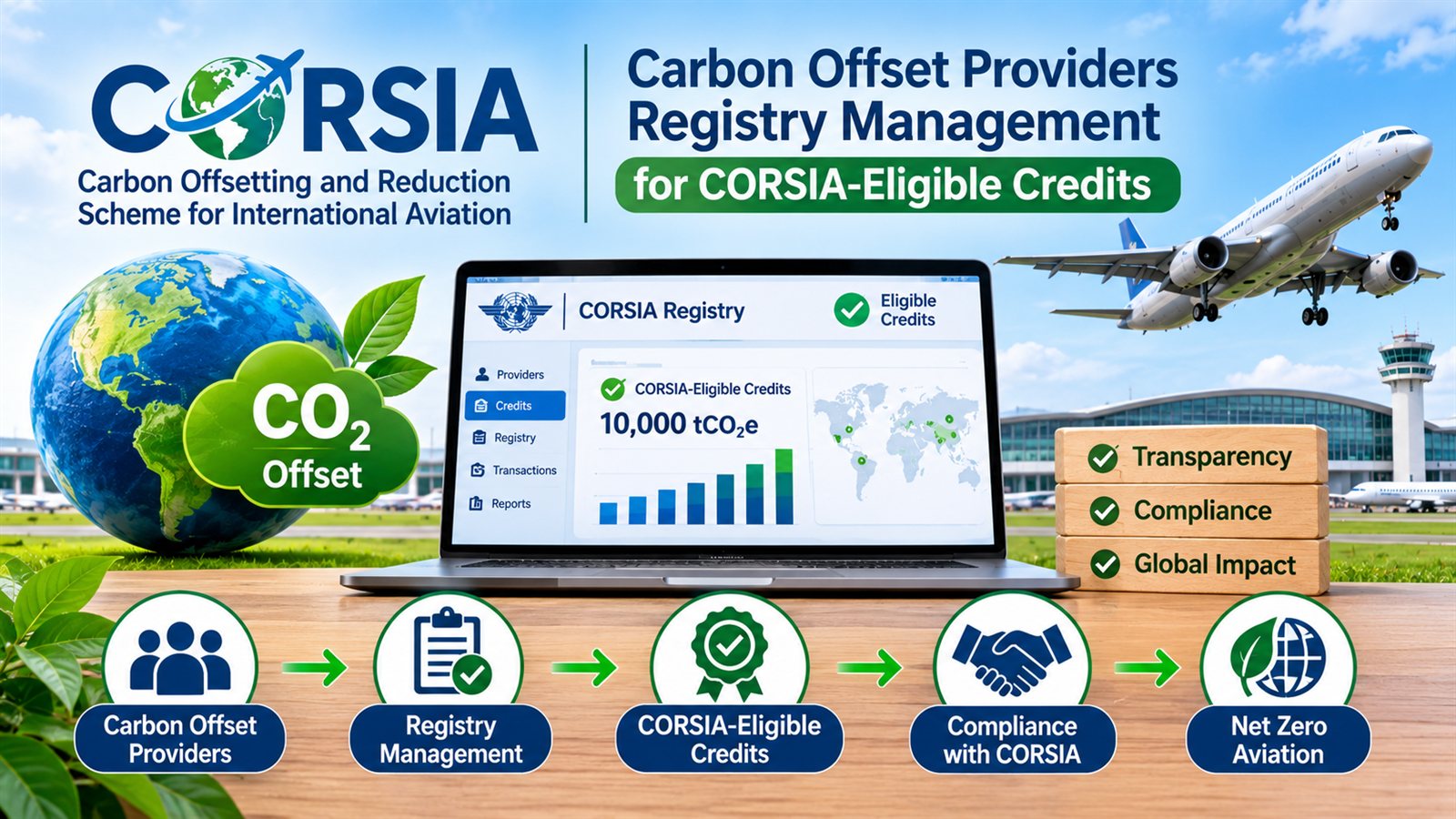
Carbon offset providers, registry management and CORSIA eligible credits are three linked parts of how airlines meet their offsetting obligations under CORSIA:
- Carbon offset providers help buyers find, check and acquire credits.
- Registries record each credit's serial number, owner and status, from issuance to cancellation.
- CORSIA eligible credits are the units that meet ICAO's rules for a compliance period.
A provider can source units, but only ICAO's rules and the unit's own registry record show whether it counts for CORSIA. For broader background, see our guides on CORSIA Carbon Credits.
This guide explains who does what, how a unit moves through a registry, how to verify eligibility and how to choose a provider carefully.
CORSIA does not affect every airline or flight in the same way. Monitoring, reporting and verification of emissions apply to operators emitting more than 10,000 tonnes of CO₂ a year from international flights with aeroplanes above 5,700 kg. The offsetting obligation, and therefore the need to buy and cancel eligible units, applies only to flights between participating States.
What Are Carbon Offset Providers and How Do They Work?
A carbon offset provider is an organisation that helps buyers obtain carbon credits. Business models vary widely. A provider may:
- source credits from project developers or other holders
- explain programmes, methodologies and quality differences
- coordinate transactions, including contracts, payment and delivery
- prepare documentation, such as registry extracts and retirement or cancellation evidence
- help with registry steps, such as arranging transfers or cancellations on a buyer's behalf, where the registry's rules allow
Providers are often confused with other market participants, but each has a different job:
- Project developer: runs the project that reduces or removes emissions.
- Carbon-crediting programme: sets rules and methodologies and oversees verification and issuance. Examples include Verra and Gold Standard.
- Registry operator: runs the database where units are issued, held, transferred and cancelled.
- Broker: matches buyers and sellers, usually without taking ownership of the credits.
- Offset provider: a broad term for firms that supply credits and related services. Some act as brokers, some buy and resell credits, and some also develop projects.
Most providers do not issue credits or operate registries. Only programmes issue credits, and only registries record them.
What Is Carbon Credit Registry Management?
A carbon credit registry is the official electronic record of carbon credits under a programme. Registry management means operating and using that record correctly. The registry:
- records issuance, creating units after verified results are approved
- assigns unique serial numbers that identify the project, vintage and batch of each unit
- holds accounts for developers, traders and buyers
- records transfers between accounts when units change hands
- tracks status, such as active, transferred, retired or cancelled, and any special labels
- records retirement or cancellation, including the beneficiary and purpose
- prevents double issuance and double use, because each serial number can be retired or cancelled only once
- provides transparency, with public project documents and issuance and retirement records that anyone can audit
In short, the registry follows a credit through its whole life, from issuance to final cancellation. Our guide to carbon registries and serial numbers shows how to read these records.
How Does Registry Management Work for CORSIA Eligible Credits?
1. Project and programme registration
The project registers under an ICAO-approved programme and follows a methodology inside that programme's approved CORSIA scope.
2. Verification of reductions or removals
An accredited verifier checks the project's monitoring results against programme requirements.
3. Issuance
The programme issues units into its registry. Eligible units must also be labelled CORSIA eligible. For first-phase (2024–2026) units, the label generally depends on host-country authorisation and corresponding-adjustment arrangements being in place.
4. Unit identification and tracking
Each unit's record shows its serial number, project, methodology, vintage, label and current holder. These details are what eligibility checks rely on.
5. Acquisition and transfer
A buyer acquires units through a contract. The units then transfer to the buyer's registry account, or to an account that will cancel them on the buyer's behalf. A transfer changes the holder. The unit can still be used afterwards.
6. Cancellation for CORSIA
The units are cancelled in the programme's registry, recording CORSIA as the purpose and identifying the aeroplane operator and compliance period. Cancellation is permanent. Some programmes require cancellation in a specific associated registry, so check ICAO's document for each programme.
7. Documentation and reporting
The airline submits an Emissions Unit Cancellation Report to its State, listing the serial numbers. The State reviews it, and the report is verified where the rules require. States then report to ICAO, which keeps the CORSIA Central Registry of information submitted by States. That is a reporting database, not a registry where units are held or traded.
These terms are different:
- Issuance creates the unit.
- Sale is a contract between buyer and seller.
- Transfer moves the unit between accounts.
- Cancellation permanently removes it for a stated compliance purpose, such as CORSIA.
- Retirement is the general term for permanent removal, usually for a voluntary claim.
Role of Carbon Offset Providers in CORSIA Eligible Credit Procurement
For airlines and other buyers, a provider may help to:
- identify potentially eligible units that match the compliance period
- check programme eligibility against ICAO's current document
- review vintage against the phase's date window
- check unit-level conditions, such as scope exclusions, authorisation and labelling
- pull registry information for the specific serial numbers offered
- coordinate procurement and negotiate terms
- support documentation, including contracts and delivery records
- coordinate transfers through the relevant registry
- support cancellation, with evidence the airline can include in its report
- explain compliance requirements in plain terms
A provider's claim does not establish ICAO eligibility. Eligibility depends on ICAO's rules for the relevant compliance period and on the unit's own registry record. The airline remains responsible for its own compliance.
How to Verify Whether a Carbon Credit Is CORSIA Eligible
Use this checklist before you buy:
- Check the latest ICAO CORSIA Eligible Emissions Units document.
- Confirm the programme is approved for the compliance period you are buying for.
- Review the unit type and methodology against the programme's approved scope.
- Check the vintage and project start date against that period's window.
- Confirm host-country authorisation, meaning a Letter of Authorization, where required.
- Check corresponding-adjustment arrangements where they are required.
- Look up the serial numbers in the registry and confirm the CORSIA eligible label.
- Check ownership and transfer history where the registry shows it.
- Confirm the units are still active, not already retired or cancelled.
- Keep evidence, such as registry extracts, contracts and cancellation confirmations.
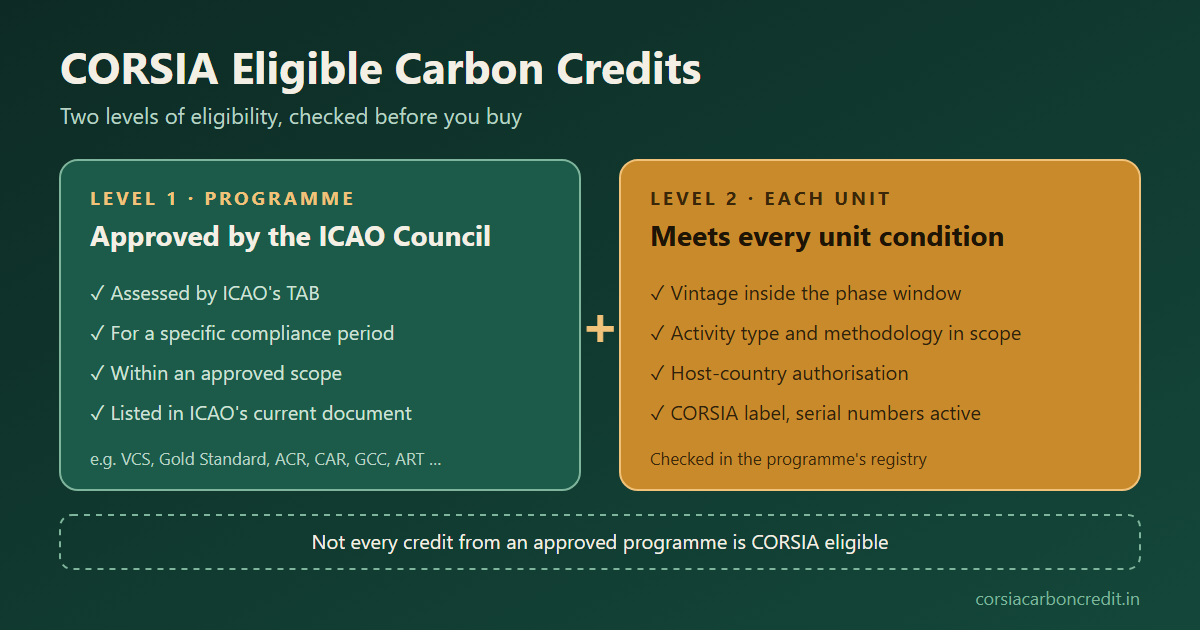
Programme eligibility is not the same as unit eligibility. A programme can be approved while many of its units still fail on vintage, scope, authorisation or labelling. Our guide to CORSIA eligible emissions units explains these conditions in detail.
Important Carbon Registry Systems and Carbon Credit Programmes
A programme writes the rules. A registry records the units. Many programmes run their own registry, sometimes through a technology provider.
- Verra Registry (Verified Carbon Standard). Verra's VCS is the largest voluntary programme. Its registry lists projects, documents and the issuance and retirement of Verified Carbon Units, including labels.
- Gold Standard Impact Registry. It records Gold Standard projects, issuances and retirements, along with information on sustainable development impacts.
- ACR Registry (American Carbon Registry). It tracks ACR's Emission Reduction Tonnes, with public project and credit reports.
- Climate Action Reserve registry. It tracks Climate Reserve Tonnes from projects under the Reserve's standardised protocols.
- Other systems, such as the ART registry for jurisdictional REDD+ credits and the Global Carbon Council registry. Article 6 registries are also emerging under the Paris Agreement.
Each registry shows different levels of detail, such as project documents, issuance batches, holders and retirement beneficiaries. Rules and fees change, so check each programme's current terms. Appearing on this list does not make a programme CORSIA eligible. Approval is granted by ICAO for each compliance period, with specific conditions.
Carbon offset provider vs carbon credit programme vs carbon registry
| Category | Main role | Key responsibility |
|---|---|---|
| Carbon offset provider | Supports buyers and sellers | Sourcing, procurement and transaction coordination, depending on services |
| Carbon credit programme | Sets crediting rules | Methodologies, project requirements, validation, verification and issuance oversight |
| Carbon registry | Records carbon credit units | Issuance records, serial numbers, transfers and cancellation status |
These are different functions, even when one organisation performs more than one of them.
How to Choose a Reliable Carbon Offset Provider for CORSIA Credits
Assess any provider against these points:
- Source transparency: it names the project, developer and programme.
- Programme and methodology details: it states them clearly, including versions.
- Evidence of current CORSIA eligibility: it refers to the ICAO document for the right compliance period.
- Unit-level documentation: it supplies serial numbers, vintage and the CORSIA label.
- Registry access: you can see the units in the registry before paying.
- Clear pricing and terms: it states what is included, when payment is due and when delivery happens.
- Vintage information: it is accurate and matches the registry.
- Authorisation documents: it provides Letters of Authorization where required.
- Transfer and cancellation procedures: it explains who cancels the units, in which account and for which compliance period.
- Experience: it has a track record in carbon market transactions.
- Clear contracts: they cover delivery failure, replacement and any change in eligibility.
Warning signs
- Unsupported eligibility claims, such as "CORSIA approved" with no ICAO reference or registry label
- Unclear credit origins, with no project name, programme or serial numbers
- Incomplete documentation, such as missing Letters of Authorization or registry extracts
- Refusal to show units in the registry before payment
- Promises of guaranteed compliance without unit-level evidence
Use the verification checklist above as a due diligence template.
Common Registry Management Risks and Challenges
- Incorrect eligibility claims. Units are described as CORSIA eligible without the label or a matching ICAO approval.
- Incomplete documentation. Registry extracts or authorisation documents are missing.
- Double counting. The same reduction is claimed by the host country and by a buyer without a corresponding adjustment.
- Unclear ownership. The seller cannot show the units in an account it controls.
- Wrong vintage. The vintage in the contract does not match the registry record.
- Unverified sources. Units are traced to projects with weak or missing verification.
- Account or transaction errors. Units are sent to the wrong account, or cancelled for the wrong purpose or period.
- Authorisation problems. A Letter of Authorization is delayed, withdrawn or conditional.
- Confusing cancellation with retirement. A voluntary retirement may not satisfy CORSIA's cancellation requirements.
- Rule changes. Eligibility conditions change between compliance periods.
To reduce these risks:
- verify serial numbers yourself
- insist on seeing units in the registry before payment
- use contracts with replacement clauses
- confirm the cancellation purpose and compliance period in writing
- keep a complete evidence file
Our article on CORSIA carbon credit costs explains how these checks and transaction costs fit into an airline's overall compliance budget.
Illustrative Example: An Airline Buys Eligible Units Through a Provider
This example is hypothetical. It does not describe a real airline, provider, transaction or price.
- The airline determines its requirement. Its State confirms the offsetting requirement for the compliance period.
- The provider identifies potentially eligible units. It proposes first-phase units from an approved programme.
- The buyer checks ICAO eligibility. The airline's team compares the programme and scope against ICAO's current document.
- Unit details are reviewed. Serial numbers, vintage, Letter of Authorization and CORSIA label are checked in the registry.
- The purchase is arranged. A contract sets out price, delivery and replacement terms.
- Units are transferred through the relevant registry to the account that will cancel them.
- Units are cancelled for CORSIA with the correct operator and compliance period recorded.
- Documentation is kept. The cancellation evidence goes into the airline's Emissions Unit Cancellation Report.
Future of Carbon Offset Providers and Registry Management Under CORSIA
Several trends are shaping this area:
- Eligible units are becoming more important as the second phase begins in 2027.
- Buyers expect clearer tracking, with better labelling and links between registries.
- Registry infrastructure is becoming more digital, with better search tools and data exports.
- Traceability is improving from issuance to cancellation.
- Documentation standards are rising, with clearer data on authorisation and vintage.
- Credit integrity faces more scrutiny from buyers, ratings agencies and regulators.
- Article 6 is linking registries to national accounting, as host-country authorisations and corresponding adjustments spread.
- ICAO eligibility decisions continue to change for each compliance period.
- Procurement processes are becoming more structured and documented.
The details will depend on future ICAO decisions and how markets develop, and they cannot be predicted precisely. Our article on the CORSIA carbon market covers the wider supply and demand picture.
Frequently Asked Questions
What are carbon offset providers?
They are organisations that help buyers source, check and acquire carbon credits, and coordinate the related transactions and documentation. Their services vary, and most do not issue credits or run registries.
What is carbon credit registry management?
It means operating and using the official record of carbon credits: issuance, serial numbers, account holdings, transfers, labels and final retirement or cancellation.
How are CORSIA-eligible credits tracked?
Each unit has a serial number in its programme's registry, along with its vintage, project and CORSIA eligible label. When used, it is cancelled for CORSIA with the operator and compliance period recorded.
Can any carbon offset provider supply CORSIA-eligible credits?
A provider can only supply units that already meet ICAO's conditions. Eligibility depends on the programme, scope, vintage, authorisation and label, not on the provider.
How can buyers verify CORSIA eligibility?
Check the latest ICAO document, then confirm the programme, methodology, vintage, authorisation and CORSIA label for the specific serial numbers in the registry. Also confirm the units are still active.
What is the role of a registry in carbon credit transactions?
The registry is the official record. It issues units with serial numbers, records which account holds them, moves them between accounts when they are sold, and marks them as retired or cancelled when they are used.
What is the difference between carbon credit cancellation and retirement?
Both permanently remove a unit so it cannot be used again. Retirement is the general term, usually for a voluntary claim. Cancellation for CORSIA records CORSIA as the purpose, along with the aeroplane operator and compliance period.
Why is registry transparency important for CORSIA compliance?
Transparent registry records let airlines, States and auditors confirm that reported units are genuine, eligible and cancelled only once, for the correct operator and compliance period.
Key Takeaways
Carbon offset providers, registry management and CORSIA eligible credits work together, but they are not the same thing. Providers help with sourcing and transactions. Programmes set the rules. Registries record each unit from issuance to cancellation.
Good practice depends on:
- reliable sourcing
- current ICAO eligibility checks
- unit-level documentation
- transparent registry records
- secure transfers
- correct cancellation for CORSIA
- complete compliance records
Effective registry management and careful due diligence let buyers manage eligible emissions units transparently and with confidence.
To learn more about eligible units and airline compliance, explore the CORSIA resources at CORSIA Carbon Credit.