 DSTechnoverse company
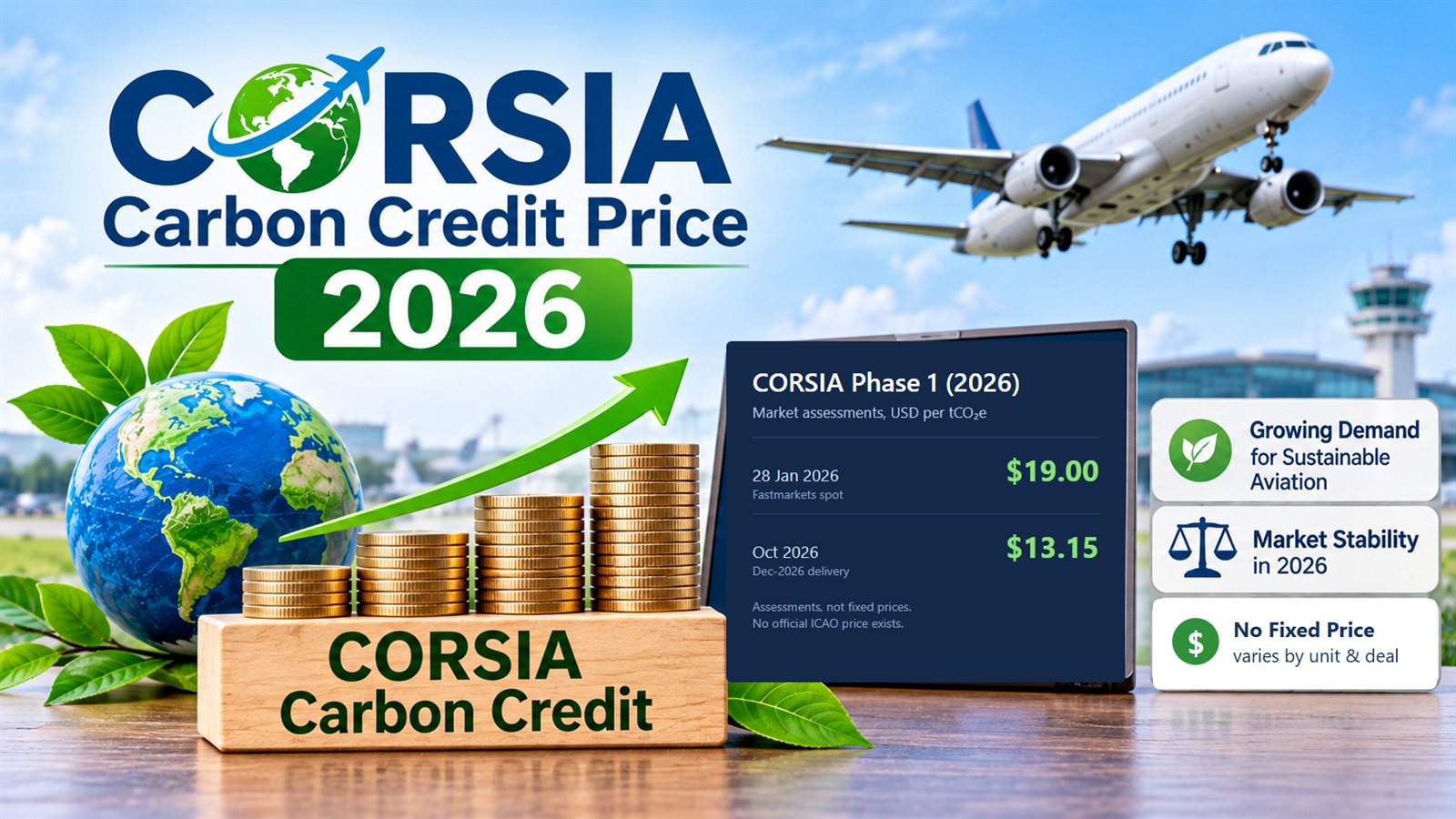
What is the CORSIA carbon credit price in 2026? There is no fixed or official price. CORSIA-eligible emissions units are bought and sold privately, and prices vary by unit and deal. Published market assessments for first-phase (2024–2026) units fell during 2026:
- USD 19.00 per tonne of CO₂e on 28 January 2026 (Fastmarkets spot assessment)
- USD 13.15 per tCO₂e for December 2026 delivery, cited in mid-October 2026
These are reference points, not prices you can buy at. For more on eligible units, see our CORSIA Carbon Credits resources.
This guide explains what these figures mean, why prices differ, how they compare with voluntary credits, and how airlines can estimate and compare costs. All figures reflect information available in November 2026.
What Is the CORSIA Carbon Credit Price in 2026?
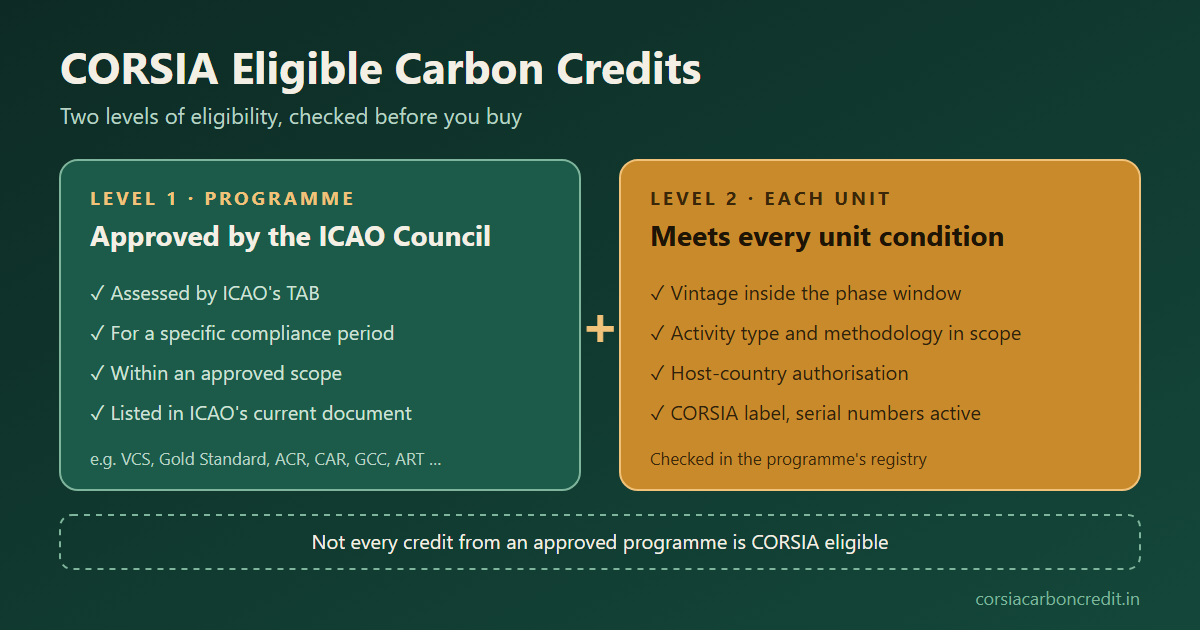
The CORSIA carbon credit price is what a buyer pays for one CORSIA eligible emissions unit. That is a carbon credit from an ICAO-approved programme that meets every unit-level condition for the relevant compliance period. One unit generally represents one tonne of CO₂e.
ICAO does not set this price. Prices depend on programme, project type, vintage, authorisation status, delivery date and contract terms. That is why no single price applies to every eligible unit.
Published 2026 price observations
| Date | Product | Price (USD per tCO₂e) | Type of figure | Source |
|---|---|---|---|---|
| 28 Jan 2026 | First-phase (CP1) spot | 19.00 | Price assessment | Fastmarkets, 4 Feb 2026 |
| Late Jan 2026 | CP1 December 2026 futures (ICE) | 14.50–16.00 | Exchange trades | Reported by Fastmarkets, 4 Feb 2026 |
| 30 Jan 2026 | CP1 spot on Climate Impact X | 17.05 bid / 18.50 offer | Bid and offer (not trades) | Fastmarkets, 9 Feb 2026 |
| Mid-Oct 2026 | CP1 December 2026 delivery | 13.15 | Price assessment (assessor not named) | green.earth, 16 Oct 2026 |
All of these are for first-phase units. Prices for second-phase units, other delivery dates or individual projects can differ. Check current data before budgeting.
Spot, forward and futures prices
CORSIA prices are quoted in several ways, and they are not directly comparable:
- Spot price: for units delivered now, typically within days of the trade.
- Forward price: agreed today for units delivered later, such as units not yet issued or labelled. It reflects both the expected value of the units and the risk that they are never delivered.
- Futures price: a standardised exchange contract for delivery on a set date, such as December 2026. Futures make it easier to see where the market expects prices to settle.
- Bid and offer: what buyers are willing to pay and what sellers are asking. The gap between them, the spread, shows how liquid the market is.
A spot assessment and a December futures price on the same day can differ. Always compare figures of the same type.
What moved prices in 2026
The fall from about USD 19 to about USD 13 during 2026 shows how sensitive this market is to supply news. Each batch of newly authorised and labelled units from a programme adds supply, and reports in early 2026 linked lower prices to Verra-tagged units entering the market. On the other side, demand is driven by the first-phase cancellation deadline and by airlines building positions ahead of the second phase. Both sides depend on decisions outside the market's control, such as host-country authorisations and ICAO approvals. That is why prices can move quickly.
Is There a Fixed Price for CORSIA-Eligible Carbon Credits?
No. ICAO's role is regulatory:
- ICAO sets the CORSIA rules and how offsetting requirements are calculated.
- The ICAO Council, advised by the Technical Advisory Body (TAB), approves which programmes and units are eligible for each compliance period.
- Programmes such as Verra or Gold Standard issue units into their registries and label eligible ones.
- Buyers and sellers agree prices directly, through brokers or on trading platforms.
ICAO does not run an exchange. A provider's quote is a commercial offer, not an official ICAO price. Before comparing prices, confirm that each unit really is eligible and of acceptable quality. A cheap unit that turns out to be ineligible is worthless for compliance.
Key Factors Affecting CORSIA Carbon Credit Prices in 2026
1. Carbon credit quality and integrity
Buyers look at additionality, permanence where relevant, robust quantification and independent verification. Stronger integrity can support a higher price and reduce reputational risk.
2. CORSIA programme eligibility
Only units from programmes approved for the relevant compliance period count. The more limited the eligible pool, the more buyers compete for it.
3. Carbon credit vintage
First-phase units generally need vintages from 2021 to 2026, from activities that started on or after 1 January 2016. Older vintages do not qualify, however cheap they are.
4. Supply and demand
Demand estimates far exceed labelled supply. In September 2025, IATA estimated that airlines would need between 146 million and 236 million eligible units for the first phase. ICAO's August–September 2026 newsletter reported about 44 million labelled units. New labelled supply entering the market during 2026 coincided with lower prices.
5. Project type and methodology
Removals, cookstoves, forestry and renewable energy have different costs, risks and buyer appeal, so their prices differ.
6. Host-country authorisation and corresponding adjustments
First-phase units need a Letter of Authorization from the host country and a corresponding adjustment. Units with completed paperwork are lower-risk for buyers, and delays in authorisation limit supply.
7. Market conditions and transaction costs
Liquidity, delivery dates, payment terms, brokerage, registry fees and due diligence costs all affect what a buyer actually pays.
CORSIA Carbon Credit Price vs Regular Voluntary Carbon Credit Price
CORSIA-eligible credits vs regular voluntary carbon credits
| Comparison factor | CORSIA-eligible units | Regular voluntary carbon credits |
|---|---|---|
| Eligibility | Must meet CORSIA requirements for the compliance period | Set by the programme and the buyer |
| Programme requirements | Programme approved by the ICAO Council | Depends on the chosen programme |
| Unit restrictions | Scope, vintage, authorisation and CORSIA label | Usually buyer preferences only |
| Vintage conditions | Fixed windows for each phase | Flexible |
| Documentation | Registry label, Letter of Authorization, cancellation evidence | Retirement record |
| Use | CORSIA compliance | Voluntary climate claims and other permitted uses |
| Buyer demand | Airlines with compliance deadlines | Companies with voluntary goals |
| Due diligence | ICAO eligibility plus quality checks | Quality checks set by the buyer |
| Pricing | Driven by eligible supply, compliance demand and deal terms | Driven by project type, quality and market conditions |
Ordinary voluntary credits are not automatically CORSIA eligible. CORSIA units are not always more expensive than every voluntary credit. Some high-quality removal credits sell for much more. Compare like with like. Our guide to CORSIA eligible emissions units explains the eligibility conditions in detail.
How Much Does CORSIA Compliance Cost an Airline in 2026?
The total cost of compliance is not the same as the price of one credit. It can include:
- the eligible units required, where offsetting applies
- the unit purchase price
- brokerage or procurement fees
- registry and transaction charges
- monitoring, reporting and verification (MRV)
- administration and documentation
- internal compliance management
CORSIA does not apply to every airline and flight in the same way:
- MRV applies to operators emitting more than 10,000 tonnes of CO₂ a year from international flights with aeroplanes above 5,700 kg.
- Offsetting applies only to flights between participating States.
An airline may therefore have MRV costs but little or no offsetting cost. Our guide to the carbon credit costs of CORSIA ICAO breaks these costs down in more detail.
How to Estimate CORSIA Carbon Credit Procurement Costs
The basic formula is:
Estimated credit procurement cost = Number of eligible units required × Price per unit
Add brokerage, registry, transaction and administrative costs to get the full procurement budget.
Illustrative example (hypothetical)
USD 15 is an illustrative assumption. It is not an actual or official 2026 CORSIA price.
An airline hypothetically needs 10,000 eligible units and assumes USD 15 per unit:
10,000 × USD 15 = USD 150,000
This is not a real airline's cost or an ICAO calculation. The actual figure depends on the final verified offsetting requirement, the prices actually paid and the additional costs listed above.
How Can Airlines Compare CORSIA Carbon Credit Prices?
- Confirm the compliance requirements that apply to your operation.
- Identify the quantity and type of eligible units needed.
- Check the current ICAO eligibility document.
- Confirm programme-level eligibility for the compliance period.
- Verify unit-level conditions, such as scope exclusions.
- Review vintage and methodology.
- Check registry records, serial numbers and the CORSIA label.
- Confirm host-country authorisation where required.
- Compare quotes on the same basis: same compliance period, currency, delivery date and fee treatment.
- Check all extra fees and transaction conditions.
- Confirm transfer and cancellation procedures.
- Keep all purchase and compliance documents.
Do not choose units on price alone. An ineligible or poorly documented unit can cost more in the end.
Common pricing mistakes
- Comparing a voluntary price with a CORSIA price. Ordinary voluntary credits with the same project type can trade far below eligible units because they cannot be used for compliance.
- Ignoring delivery risk. A low forward price for units not yet labelled may hide the risk that authorisation never arrives.
- Using an old figure. CORSIA prices moved by about a third during 2026, so a quote from months ago can be badly out of date.
- Leaving out fees. Brokerage, registry and due diligence costs change the real price per tonne.
- Treating an assessment as a quote. An assessment is an estimate of the market, not an offer anyone will sell at. Our article on carbon offset providers and registry management explains how to check providers and registry records before buying.
Where Can Buyers Find Reliable CORSIA Carbon Credit Price Information?
Useful sources include:
- price assessments from reporting agencies such as Fastmarkets, OPIS and S&P Global Platts
- exchange data, such as ICE's CORSIA futures contracts and Climate Impact X's spot contracts
- programme documents and registry data to confirm the specific units being priced
- verified supplier quotes for actual, identified units
- market research and industry publications
- aviation industry sources, such as IATA, for demand context
ICAO's CORSIA Eligible Emissions Units document is an eligibility list, not a price list. When comparing figures, match the date, unit category, currency and type of figure, whether assessment, offer, bid or trade. Our guide on how carbon credit prices are quoted explains these terms.
CORSIA Carbon Credit Market Outlook for 2026
The factors to watch for the rest of 2026 and beyond:
- Eligibility changes, as the second phase starts on 1 January 2027 with its own approved programmes
- Eligible supply, as more units are labelled and host countries issue authorisations
- Airline buying ahead of the first-phase cancellation deadline
- Credit integrity, including how buyers rate different project types
- ICAO updates to the approved programme list
- Host-country authorisations and progress on Article 6
- Market transparency, including more assessments and exchange contracts
- Registry infrastructure and labelling
- Buyer preferences, such as interest in removals or particular regions
Analysis, not a forecast: the 2026 assessments above fell as more labelled supply reached the market, even though estimated demand remained far higher than supply. Prices could move in either direction depending on new approvals, authorisations and buying ahead of deadlines. This article does not predict future prices.
Frequently Asked Questions
What is the CORSIA carbon credit price in 2026?
There is no fixed price. Published assessments for first-phase units ranged from USD 19.00 per tCO₂e (28 January 2026, Fastmarkets) to USD 13.15 per tCO₂e (December 2026 delivery, cited in October 2026).
Does ICAO set the price of CORSIA carbon credits?
No. ICAO decides which units are eligible. Buyers and sellers set prices in the market.
Are all CORSIA-eligible units the same price?
No. Prices vary with programme, project type, vintage, authorisation status, delivery date and contract terms.
Are CORSIA credits more expensive than voluntary carbon credits?
Not always. CORSIA units often carry a premium over ordinary avoidance credits, but some voluntary credits, such as high-quality removals, can cost more.
How do airlines calculate CORSIA carbon credit costs?
Multiply the number of eligible units required by the price per unit. Then add brokerage, registry, MRV and administrative costs.
Where can I find current CORSIA carbon credit prices?
From price reporting agencies, exchanges offering CORSIA contracts, and verified supplier quotes for identified units. Always note the date and type of each figure.
Key Takeaways
The CORSIA carbon credit price in 2026 is not one number. Published assessments for first-phase units fell from about USD 19 in January to about USD 13 by October. What any buyer pays depends on:
- eligibility and integrity
- vintage
- supply and demand
- host-country authorisation
- transaction terms
The price of a credit is also only part of an airline's total compliance cost. Compare prices using current, dated sources on a like-for-like basis, and check eligibility before price.
To learn more about eligible units and airline compliance, explore the CORSIA resources at CORSIA Carbon Credit.
Sources
- Fastmarkets – CORSIA spot prices continue to slide, all eyes still on supply (4 February 2026)
- Fastmarkets – CORSIA prices extend losses as Verra-tagged supply enters market (9 February 2026)
- green.earth – CORSIA activity builds across prices, airlines and supply (16 October 2026)
- ICE – CORSIA Eligible Emissions Units (2024–2026) Futures
- ICAO – CORSIA Eligible Emissions Units
- ICAO – CORSIA Newsletter, August–September 2026
- IATA – Industry urges governments to expedite release of CORSIA eligible emissions units (September 2025)