 DSTechnoverse company
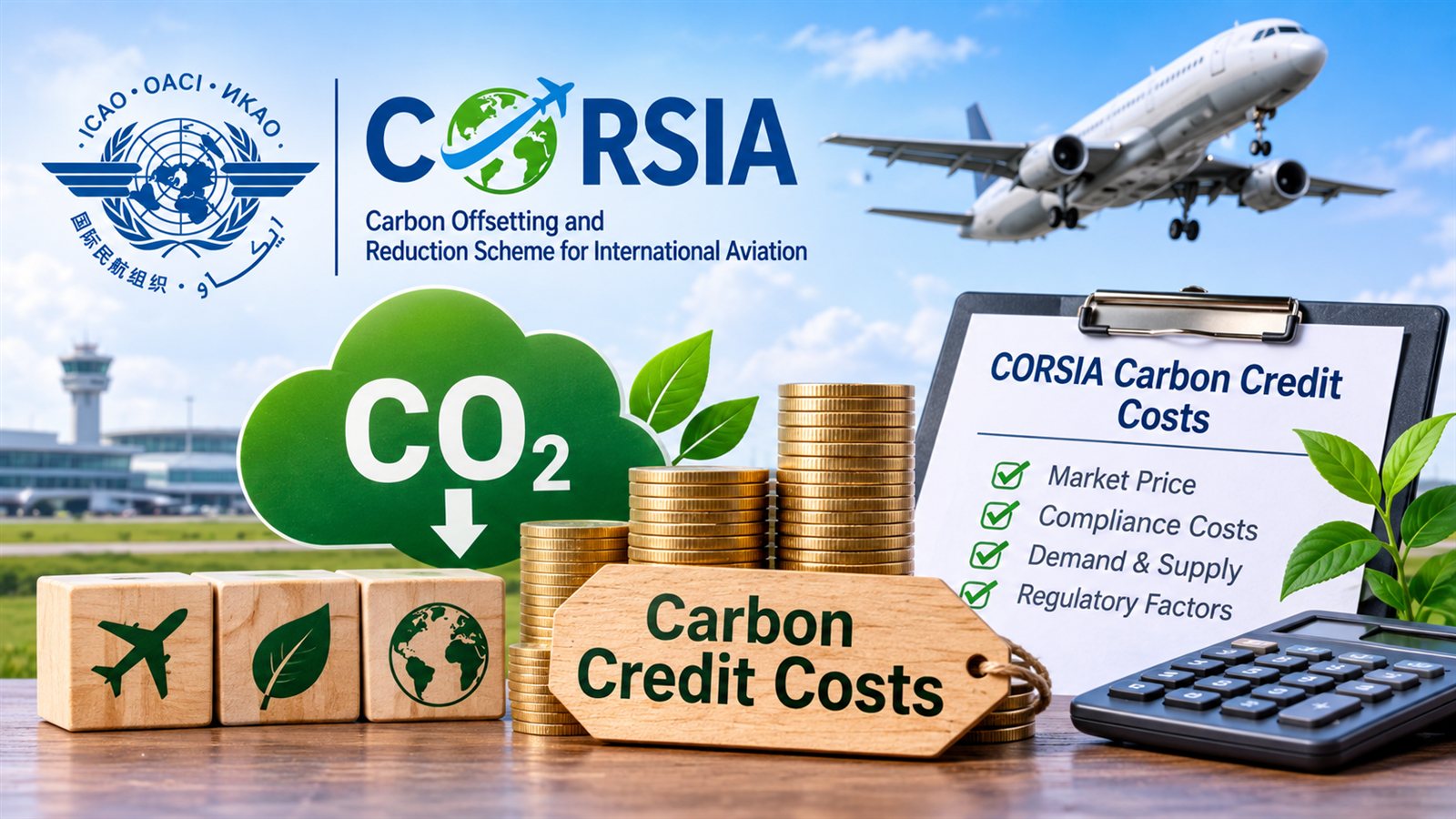
The carbon credit costs of CORSIA ICAO are what an airline pays to buy and cancel CORSIA eligible emissions units to meet its offsetting requirement. They also include the wider expenses of complying with the scheme. ICAO does not set a fixed price. Each unit's price is agreed in the market and depends on supply, demand, vintage, eligibility and timing. An airline's total cost is the number of units it must cancel multiplied by the price it pays, plus monitoring, verification and administration costs. For background on the units themselves, see our guides on CORSIA Carbon Credits.
This guide separates three ideas that are often confused: the price of one unit, the total cost of buying units, and the wider cost of compliance. It covers what drives each, how to estimate them and what may affect them in future. Time-sensitive figures reflect information available in November 2026.
What Are Carbon Credit Costs Under ICAO CORSIA?
CORSIA, the Carbon Offsetting and Reduction Scheme for International Aviation, is ICAO's global market-based measure for international aviation. Under it, aeroplane operators compensate for growth in CO₂ emissions on routes between participating States. Growth is measured against a baseline, which from 2024 is 85% of 2019 emissions.
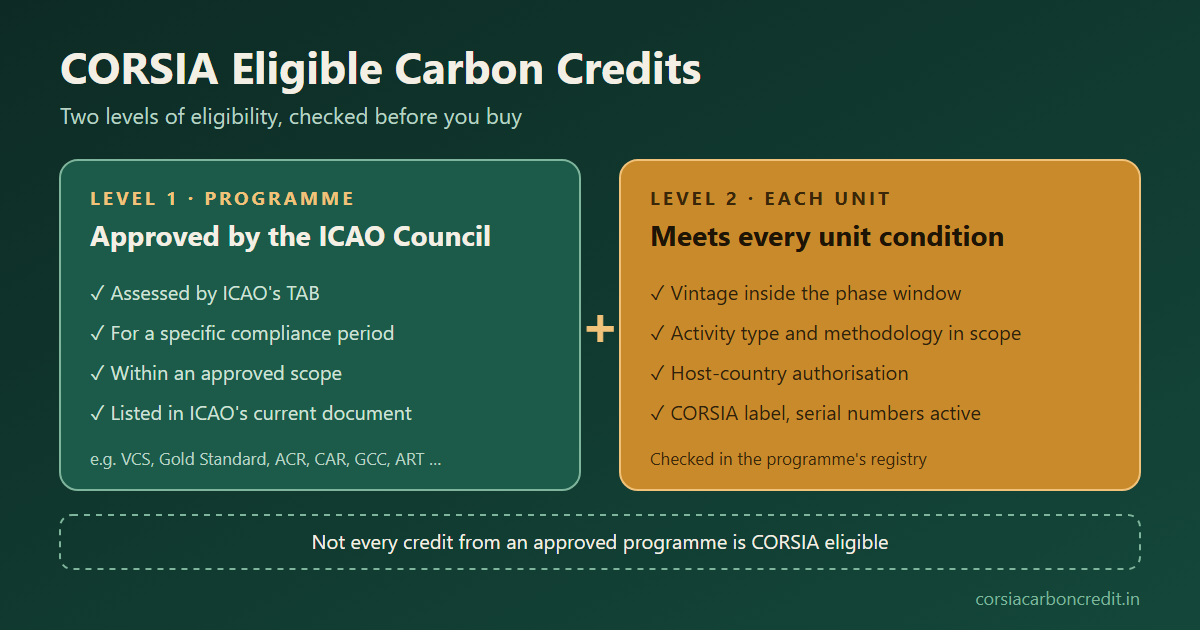
Airlines meet that requirement with CORSIA Eligible Emissions Units (EEUs). These are carbon credits from ICAO-approved programmes that also meet unit-level conditions. Each unit generally represents one tonne of CO₂ reduced or removed elsewhere. The airline buys the units, then cancels them in a registry and reports the cancellation to its State.
There are therefore three different cost ideas:
- Unit price: what one eligible unit costs in a particular deal.
- Procurement cost: the number of units needed multiplied by the prices paid.
- Total compliance cost: procurement plus monitoring, verification, registry and internal costs.
CORSIA does not set one retail price that applies to every eligible unit.
Does ICAO Set a Fixed Price for CORSIA Carbon Credits?
No. ICAO's role is regulatory, not commercial:
- ICAO sets the framework, its Standards and the rules for calculating offsetting requirements.
- The ICAO Council, advised by the Technical Advisory Body (TAB), decides which programmes and units are eligible for each compliance period.
- Carbon-crediting programmes issue units into their registries, where units are labelled CORSIA eligible and later cancelled.
- Buyers and sellers, including airlines, project developers, traders and brokers, agree prices bilaterally, through intermediaries or on trading platforms.
ICAO does not run a central exchange and does not publish a market price. Official ICAO documents tell you which units count and how much an airline must offset. Commercial sources, such as price reporting agencies and brokers, tell you what units are trading for. The two types of information should not be mixed up.
Prices differ because eligible units are not identical. They differ in programme, project type, vintage, authorisation status, delivery date and contract terms.
How Much Do CORSIA Carbon Credits Cost?
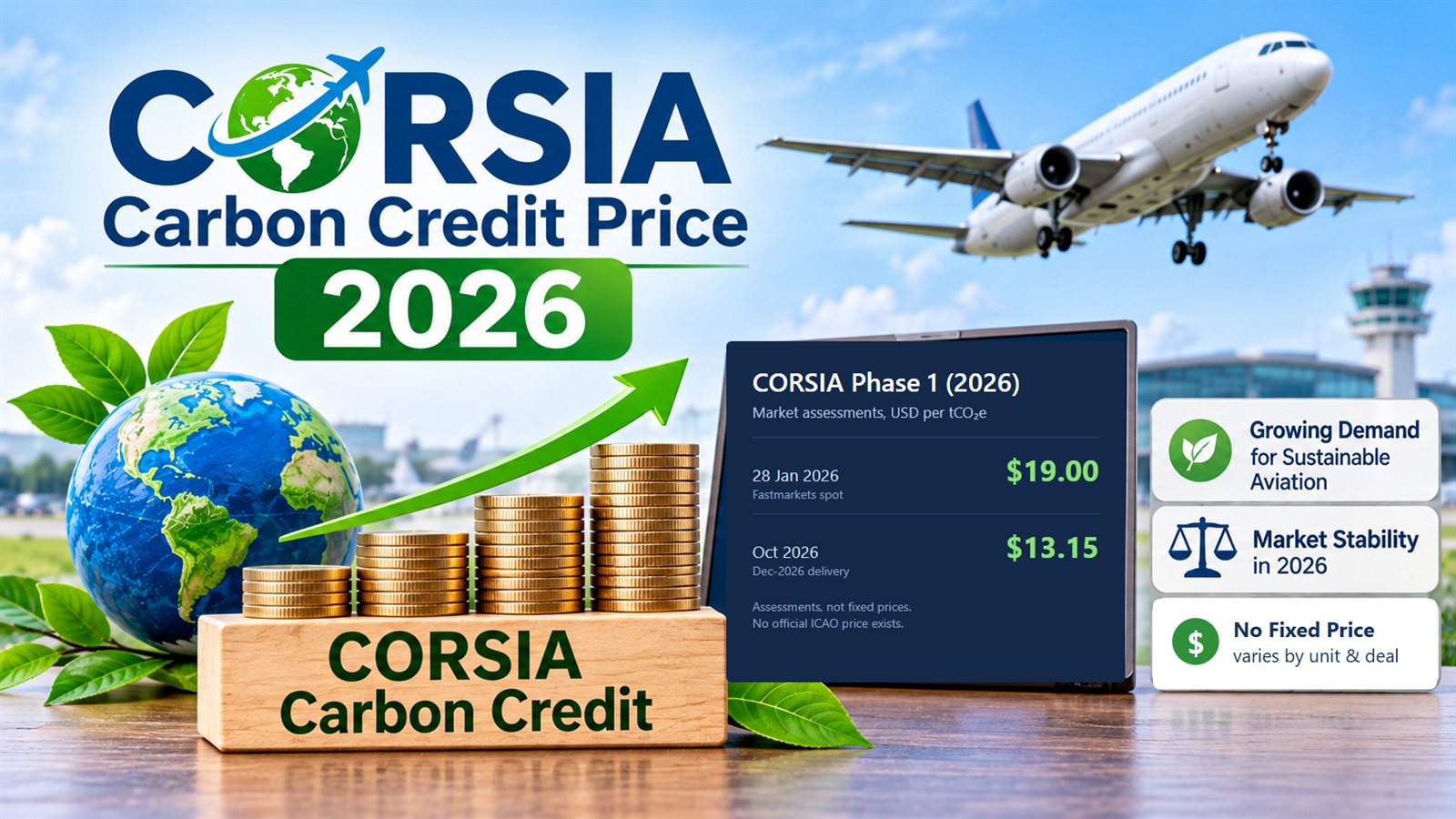
There is no single answer, but published market assessments give a guide. A market report published on 16 October 2026 cited an assessment of USD 13.15 per tonne of CO₂e for first-phase (2024–2026) eligible units for December 2026 delivery (green.earth).
Treat this as a reference point, not a price you can buy at:
- It is an assessment. A price reporting agency estimated it from market activity. It is not a seller's quote or a confirmed trade.
- The unit is one tCO₂e, priced in US dollars.
- It applies to a specific product, here first-phase units for a set delivery date. Prices for other vintages, programmes or the second phase can differ.
- It changes. Assessments move with market conditions, so check the latest data before budgeting.
When comparing prices, ask:
- Is the figure an indicative assessment, an offer (asking price) or a completed transaction?
- Is the unit already eligible and labelled, or still awaiting authorisation?
- What are the vintage, the programme and the delivery date?
- What volume and payment terms apply?
Our guide on how carbon credit prices are quoted explains how to read a quoted price.
How Are CORSIA Carbon Credit Compliance Costs Calculated?
At its simplest:
Estimated carbon credit procurement cost = Number of eligible emissions units required × Price per eligible emissions unit
Each part of this takes work:
- Determine the offsetting requirement. The airline's State calculates it from verified emissions on covered routes, using ICAO's growth factors for the compliance period. It then deducts any emissions reductions claimed from CORSIA eligible fuels.
- Convert it into units. One unit generally covers one tonne of CO₂.
- Select eligible units that meet the ICAO conditions for that compliance period.
- Check market prices for those specific units.
- Estimate the purchase budget, allowing for price movement before you buy.
- Add transaction and administrative costs, such as brokerage, registry fees and internal staff time.
Illustrative example (hypothetical)
This is an illustration only. It is not an ICAO price, a market quotation or a forecast.
An airline expects to cancel 10,000 eligible units and assumes a purchase price of USD 8 per unit:
10,000 × USD 8 = USD 80,000 estimated credit acquisition cost.
The real cost could differ. The final offsetting requirement may change after verification, the units bought must actually be eligible, real transaction prices will vary, and other compliance expenses come on top. Buying units also does not complete compliance. The units must be cancelled for CORSIA and reported to the State.
Carbon credit price vs total CORSIA compliance cost
| Factor | Carbon credit price | Total compliance cost |
|---|---|---|
| Meaning | Cost of one eligible emissions unit | Full cost of meeting CORSIA requirements |
| Main components | Unit price and transaction terms | Unit purchases plus MRV, verification, registry and administration |
| Influencing factors | Supply, demand, vintage, eligibility, timing | Offsetting requirement, unit price, verification scope, internal resources |
| Calculation basis | Price per eligible unit | All costs for the compliance period |
Mixing up the two leads to bad budgets. A low unit price does not mean low compliance costs if the requirement is large or administration is complex.
Factors That Affect CORSIA Carbon Credit Prices
1. Supply of eligible emissions units
Only units that pass every ICAO condition count, so eligible supply is much smaller than the wider carbon market. ICAO's August–September 2026 newsletter reported about 44 million units labelled CORSIA eligible for the first phase.
2. Airline demand
Demand comes from offsetting requirements. In September 2025, IATA estimated that airlines would need between 146 million and 236 million eligible units for the first phase.
3. Credit quality and environmental integrity
Buyers look at additionality, permanence and the risk of reputational problems. Higher-integrity units can carry a premium.
4. Credit vintage
First-phase units generally need vintages from 2021 to 2026, from activities that started on or after 1 January 2016. Older credits do not qualify, which limits supply.
5. Programme and methodology eligibility
Only approved programmes, within their approved scope, can supply eligible units. Our guide to CORSIA eligible emissions units explains these conditions.
6. Host-country authorisation and corresponding adjustments
First-phase units need a Letter of Authorization from the host country and a corresponding adjustment. Slow government processes hold back supply and affect prices.
7. Market liquidity and procurement timing
Thin trading makes prices harder to discover. Buying close to a cancellation deadline can mean competing with other airlines for the same scarce units.
| Factor | Possible impact on cost |
|---|---|
| Limited eligible supply | Upward price pressure |
| Higher airline demand | More competition for units |
| Higher integrity or quality | Possible price premium |
| Vintage restrictions | Fewer usable units |
| Programme and methodology limits | Narrower choice of units |
| Authorisation status | Authorised units may cost more than unauthorised ones |
| Liquidity and timing | Wider spreads and deadline risk |
Other Costs Associated with CORSIA Compliance
Buying units is not the only expense. Airlines also pay for:
- Emissions monitoring: fuel measurement systems and procedures.
- Data collection and management: flight-by-flight records and IT systems.
- Emissions reporting: preparing the annual report for the State.
- Third-party verification: an accredited verification body checks the emissions report and, where required, the cancellation report.
- Cancellation reporting: documenting serial numbers and cancellations.
- Procurement and transaction costs: broker fees, legal review and due diligence.
- Registry fees: account and transaction charges, where applicable.
- Internal management: staff time, training and governance.
Verification costs depend on the operator, the scope of the work and the service agreement. ICAO does not publish a single verification price list. These administrative costs are separate from the purchase price of the units.
How Can Sustainable Aviation Fuel Affect CORSIA Compliance Costs?
Sustainable aviation fuel (SAF) is jet fuel made from sources such as waste oils, residues or synthetic processes. It can have much lower life cycle emissions than fossil jet fuel.
Under CORSIA, a fuel counts only if it is a CORSIA eligible fuel. That means it must:
- meet ICAO's sustainability criteria, including at least 10% lower life cycle emissions than the fossil baseline
- be certified by an ICAO-approved Sustainability Certification Scheme
- have a life cycle emissions value taken either from an ICAO default value or from an actual value calculated with ICAO's methodology
Verified reductions from eligible fuels are deducted from an operator's offsetting requirement, which reduces the number of units it must buy. Our article on the CORSIA methodology for actual life cycle emissions values explains how those values are calculated.
SAF and emissions units are different routes. SAF lowers emissions in aviation itself. Emissions units compensate with reductions made elsewhere. SAF is not automatically cheaper or more expensive per tonne avoided, and not every SAF qualifies under CORSIA.
CORSIA Carbon Credit Costs: Pilot Phase, First Phase and Second Phase
| Implementation phase | Years | Participation |
|---|---|---|
| Pilot phase | 2021–2023 | Voluntary for States |
| First phase | 2024–2026 | Voluntary for States (130 States in 2026) |
| Second phase | 2027–2035 | Required for most States, with exemptions |
These phases are not the same as compliance periods. Offsetting is settled in three-year compliance periods (2021–2023, 2024–2026, 2027–2029 and so on), and units are cancelled at the end of each.
Costs vary between operators because:
- Route coverage. Only flights between two participating States carry offsetting obligations. Monitoring and reporting still apply to other international flights.
- Baseline. From 2024 the baseline is 85% of 2019 CO₂ emissions, so offsetting covers growth above that level.
- Growth factors. Under the current rules, the requirement is based on the sector's overall growth factor applied to each operator's covered emissions. An operator-specific element is phased in for later periods.
- Operator profile. Fleet, routes, fuel efficiency and growth all differ.
Cost estimates should therefore use the rules for the relevant compliance period, not a generic figure.
For historical context, ICAO's environmental committee (CAEP) estimated in 2016 that CORSIA costs might equal roughly 0.2–0.6% of international aviation revenues in 2025, rising to 0.5–1.4% in 2035. That was a modelling estimate made before COVID-19 and the baseline changes. It is not a current price or cost.
How Can Airlines Manage and Estimate CORSIA Carbon Credit Costs?
Practical steps include:
- Forecast offsetting requirements from traffic plans and verified emissions.
- Monitor emissions throughout the year, not only at reporting time.
- Track eligible supply and check the latest ICAO eligibility document.
- Compare unit options: programme, project type, vintage and authorisation status.
- Check vintage and programme conditions before signing any contract.
- Plan budgets with a range of price scenarios rather than a single figure.
- Consider SAF claims where eligible fuel is available and economical.
- Keep records of verification, purchases, registry transfers and cancellations.
- Avoid last-minute buying close to cancellation deadlines.
No supplier can guarantee compliance on its own. Compliance depends on the units being eligible, correctly cancelled and reported. Our articles on the carbon credit certification process and the CORSIA carbon market cover how credits are created and how eligible units reach airlines.
Future Outlook of CORSIA Carbon Credit Prices and Compliance Costs
Future costs will depend on factors that cannot be predicted with certainty:
- Traffic growth in international aviation, which drives emissions above the baseline
- Changes in requirements, especially when the second phase begins in 2027
- Supply of eligible units, including new programme approvals and labelled issuances
- ICAO eligibility decisions for each compliance period
- Host-country authorisations and progress on Article 6 of the Paris Agreement
- Market transparency and liquidity, including the development of futures and assessments
- SAF adoption, which reduces offsetting requirements where it is used
- Airline procurement strategies, such as buying forward versus buying close to the deadline
Today, demand clearly exceeds labelled supply, so prices could rise. However, new approvals and authorisations could ease the pressure. This article does not forecast prices.
Frequently Asked Questions
How much do CORSIA carbon credits cost?
There is no fixed price. Prices vary by unit and deal. As one reference point, a market report dated 16 October 2026 cited an assessment of USD 13.15 per tCO₂e for first-phase units for December 2026 delivery. Always check current data.
Does ICAO set the price of CORSIA carbon credits?
No. ICAO decides which units are eligible and how offsetting requirements are calculated. Prices are agreed between buyers and sellers in the market.
How are CORSIA carbon credit costs calculated?
Multiply the number of eligible units required by the price paid per unit. Then add monitoring, verification, transaction and administrative costs to get the total compliance cost.
What factors affect CORSIA eligible emissions unit prices?
Eligible supply, airline demand, quality, vintage, programme eligibility, host-country authorisation, market liquidity and the timing of purchases.
Do airlines have to pay additional costs for CORSIA compliance?
Yes. Airlines also bear the costs of monitoring, data management, reporting, third-party verification, registry and transaction fees, and internal administration.
Can Sustainable Aviation Fuel reduce CORSIA carbon offsetting costs?
Certified CORSIA eligible fuels can reduce the offsetting requirement and therefore the number of units needed. SAF has its own costs, and not every SAF qualifies.
Will CORSIA carbon credit prices increase in the future?
Nobody can say for certain. Demand currently exceeds labelled supply, but new programme approvals, host-country authorisations and market developments could change prices in either direction.
Key Takeaways
The carbon credit costs of CORSIA ICAO depend on several factors:
- the price of the eligible units bought
- the size of each airline's offsetting requirement
- the balance of eligible supply and demand
- eligibility and vintage conditions
- administrative and verification expenses
- any reductions claimed from CORSIA eligible fuels
There is no universal CORSIA carbon credit price. Airlines should estimate costs from the ICAO rules for their compliance period and from current, clearly dated market information.
To learn more about eligible units, pricing and airline compliance, explore the CORSIA resources at CORSIA Carbon Credit.
Sources
- green.earth – CORSIA activity builds across prices, airlines and supply (16 October 2026)
- ICAO – CORSIA Newsletter, August–September 2026
- ICAO – CORSIA Eligible Emissions Units
- ICAO – CORSIA FAQs
- IATA – Industry urges governments to expedite release of CORSIA eligible emissions units (September 2025)
- ICE – CORSIA Eligible Emissions Units (2024–2026) Futures
- UNFCCC – Article 6 of the Paris Agreement