 DSTechnoverse company
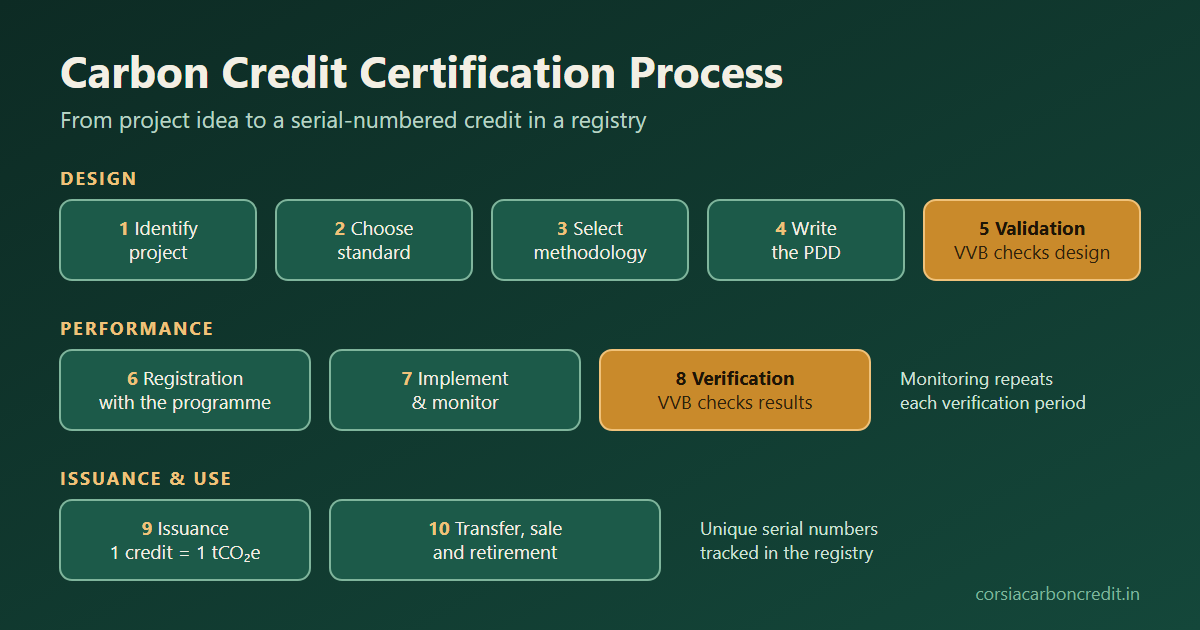
The carbon credit certification process is the series of checks a greenhouse gas reduction or removal project must pass before a carbon-crediting programme issues credits for it. The developer chooses a standard and an approved methodology and writes a Project Design Document. An independent auditor validates the design, and the programme registers the project. The project is then monitored, and an independent auditor verifies the results. Only then does the programme issue credits into its registry, generally one credit for each tonne of CO₂ equivalent (tCO₂e).
This guide walks through each step, the documents involved, what affects time and cost, and whether certified credits can be used for CORSIA.
What Is Carbon Credit Certification?
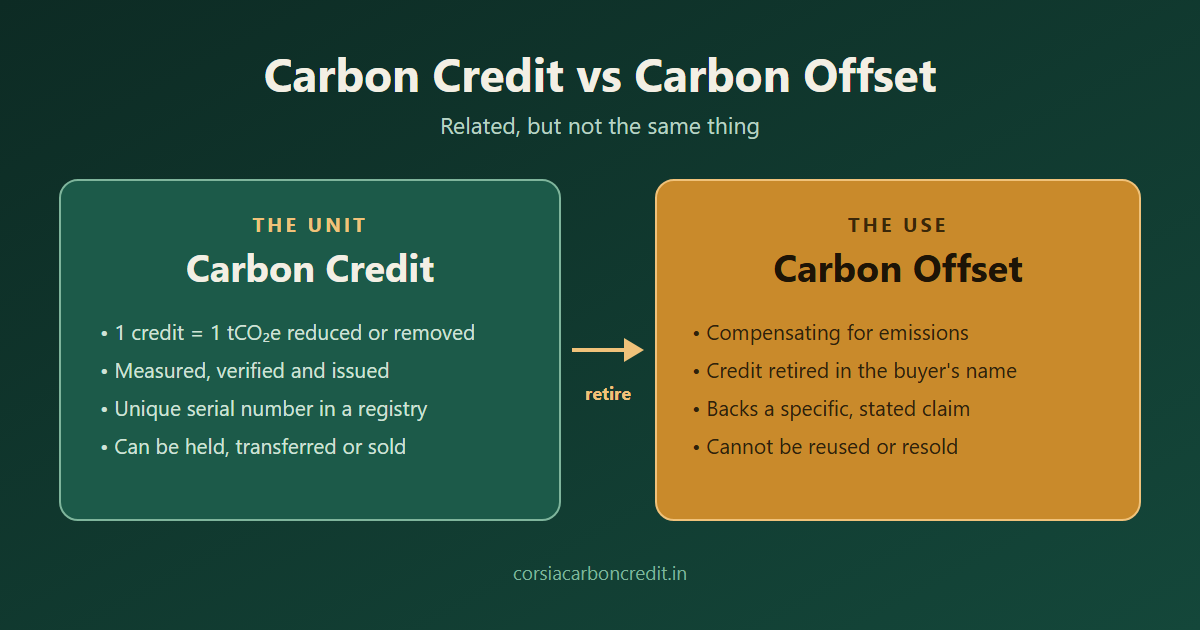
A carbon credit is a tradable unit representing a measured reduction or removal of greenhouse gases, generally equal to one metric tonne of CO₂e under the issuing programme's rules. CO₂e is a common unit that converts gases such as methane and nitrous oxide into their CO₂ equivalent.
Carbon credit certification means checking a project against the rules of a specific carbon-crediting programme, also called a standard. It is not a government licence or a general environmental label. It is an assessment, carried out by accredited third parties and the programme itself, of whether the project's design and results meet that programme's requirements.
Certification matters because nobody can see a tonne of avoided emissions. Buyers need confidence that:
- the reductions are real and would not have happened anyway (additionality)
- they are measured against a credible baseline, meaning what would have happened without the project
- emissions shifted elsewhere (leakage) are accounted for
- stored carbon stays stored (permanence), with safeguards if it is released
- each tonne is credited and used only once
An unverified "carbon credit" is just a claim. A certified credit has passed independent validation and verification and has been issued with a unique serial number in a public registry. That is what makes it traceable and tradable.
Which Carbon Credit Standards and Certification Programmes Are Used?
Each programme sets its own rules: which methodologies are allowed, how auditors are accredited, how projects are registered and how credits are issued. The main programmes include:
- Verra – Verified Carbon Standard (VCS). The largest voluntary programme by volume, covering forestry, energy, waste, agriculture and more. Verra maintains a methodology library, accepts validation and verification only from approved validation and verification bodies (VVBs), and issues Verified Carbon Units (VCUs) in the Verra Registry.
- Gold Standard. Set up by environmental NGOs, it requires projects to show contributions to the UN Sustainable Development Goals and to consult stakeholders closely. Its own terms for the two audit stages are "design certification" and "performance certification". Credits are issued in the Gold Standard Impact Registry.
- American Carbon Registry (ACR). One of the oldest programmes. It approves its own methodologies, uses accredited third-party verifiers, and issues Emission Reduction Tonnes (ERTs) in the ACR Registry.
- Climate Action Reserve (CAR). Focused mainly on North America. It uses standardised protocols rather than project-by-project methodologies and issues Climate Reserve Tonnes (CRTs) after verification by accredited bodies.
- Global Carbon Council (GCC). A Qatar-based programme serving the Middle East, Asia and Africa. It uses accredited verifiers and issues Approved Carbon Credits (ACCs) in the GCC Registry.
Procedures, fees and terms differ between programmes, so the steps below describe the common pattern, not one universal process. Our comparison of carbon standards explains how these programmes differ in practice. Being well known does not make a programme or its credits CORSIA eligible. That is decided separately by ICAO, as explained later in this guide.
Step-by-Step Carbon Credit Certification Process
Step 1: Identify a carbon reduction or removal project
The developer identifies an activity that reduces emissions or removes CO₂, such as:
- renewable energy
- landfill or biogas methane capture
- reforestation or forest protection
- improved cookstoves
- waste management
- industrial energy efficiency
- engineered carbon removal such as biochar
Not every project qualifies. It must be additional, measurable, and covered by an applicable methodology. A wind farm in a market where wind is already the cheapest option, for example, may fail the additionality test.
Step 2: Select the appropriate carbon credit standard
The choice depends on:
- project type and location
- whether the standard has a suitable methodology
- buyer preferences and intended use, including compliance schemes such as CORSIA
- fees and procedures
- the standard's eligibility rules, such as start-date limits
Step 3: Select an approved methodology
A methodology (or protocol) is the rulebook for calculating credits. It defines:
- Project boundary: which sites, gases and emission sources are included.
- Baseline scenario: what would happen without the project.
- Additionality test: how to show the project needs carbon finance, for example through investment analysis, barrier analysis or common-practice checks.
- Emission sources: project emissions that must be subtracted.
- Monitoring parameters: what must be measured, how and how often.
- Leakage: how to account for emissions displaced elsewhere.
- Quantification: the equations that turn data into tonnes of CO₂e.
Step 4: Prepare the Project Design Document (PDD)
The PDD (some programmes call it a project description) is the project's master document. It covers:
- the project description, technology and timeline
- location, maps and project boundary
- the baseline scenario
- the methodology and version applied
- the additionality demonstration
- estimated reductions or removals over the crediting period
- the monitoring plan
- environmental and social impacts, safeguards and stakeholder consultation
Step 5: Project validation
An accredited, independent VVB reviews the PDD. It:
- checks documents against programme and methodology requirements
- assesses the baseline and additionality arguments
- reviews the monitoring plan
- usually visits the site
- raises findings that the developer must resolve
Validation assesses the proposed design. It does not confirm any credits achieved. It ends with a validation report and opinion. Some programmes, including the Climate Action Reserve under many protocols, handle eligibility checks differently, for example alongside the first verification.
Step 6: Project registration
The developer submits the PDD, validation report and supporting documents to the programme. The programme:
- reviews completeness and compliance
- issues clarification requests where needed
- decides whether to register the project
Registered projects are usually listed publicly in the programme's registry. Registration does not guarantee that credits will be issued. Credits depend on verified performance.
Step 7: Project implementation and monitoring
The project operates, and the developer follows the monitoring plan. This means:
- collecting meter readings, activity records and survey data
- calibrating equipment
- applying measurement procedures
- keeping evidence such as invoices, logbooks and satellite imagery
At the end of each monitoring period, the developer prepares a monitoring report that calculates the reductions or removals achieved.
Step 8: Independent verification
A VVB, often a different one from the validator depending on programme rules, verifies the monitoring report. It:
- reviews evidence and checks the data
- recalculates emission reductions
- inspects the site where required
- issues findings that must be corrected
The result is a verification report confirming the quantity of reductions or removals for that period.
Validation checks the plan before it happens. Verification checks the results after they happen.
Step 9: Carbon credit issuance
The developer submits the verification report and an issuance request. The programme reviews it. If approved, it creates credits in the developer's registry account, each with a unique serial number showing the project, vintage and batch. Programmes may set aside a share of credits in a buffer pool to cover reversal risk, especially for forestry projects.
Step 10: Transfer, sale and retirement
Issued credits can then be:
- Transferred between registry accounts, which records a change of holder
- Sold, which is a commercial transaction usually completed by a transfer
- Retired or cancelled, which permanently removes the credit so it cannot be used again, with the beneficiary and purpose recorded
Registry tracking prevents the same credit from being used twice. Our guide to carbon registries and serial numbers shows how to check a credit yourself.
Carbon Credit Validation vs Verification vs Certification
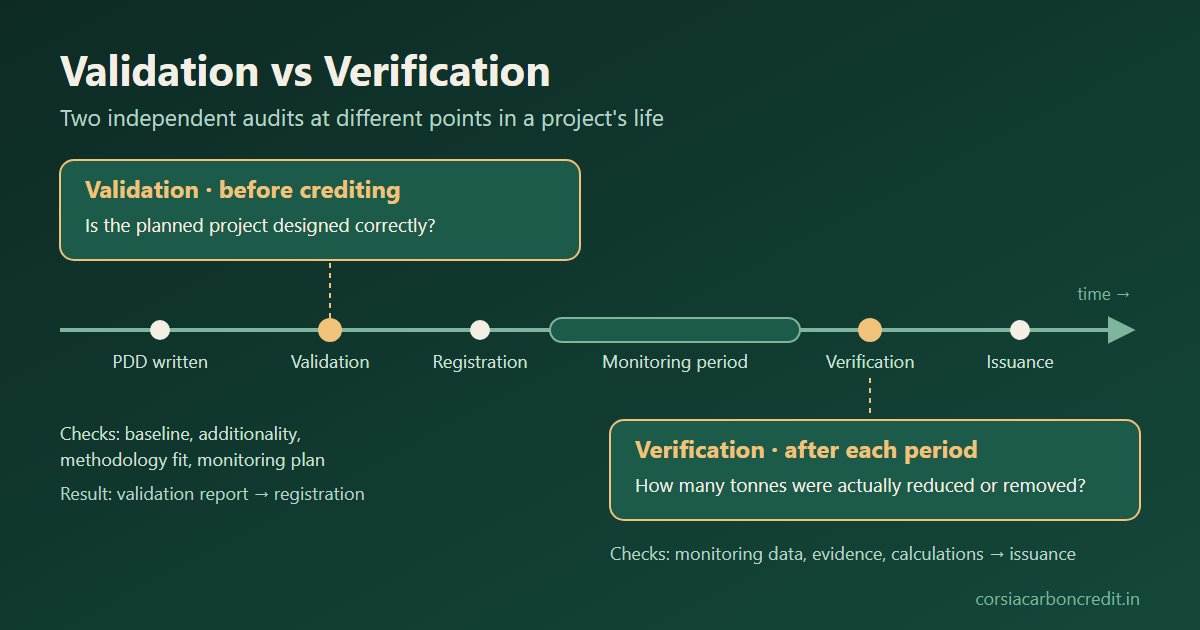
| Process | Meaning | Main purpose |
|---|---|---|
| Validation | Assessment of the proposed project design | Checks whether the project meets design requirements before crediting |
| Verification | Assessment of monitored project results | Confirms the reductions or removals actually achieved in a period |
| Certification / programme approval | Formal decision by the programme | Registers the project or approves issuance under the programme's rules |
Terms and decision-making procedures vary between programmes. Gold Standard's "design certification" and "performance certification", for example, broadly correspond to validation and verification.
Documents and Requirements Needed for Carbon Credit Certification
Typical requirements include:
- Project Design Document (PDD)
- Location and boundary data, such as maps or GPS polygons
- Baseline assessment
- Methodology and the tools it relies on
- Additionality analysis
- Monitoring plan
- GHG calculation records, usually spreadsheets
- Implementation evidence, such as commissioning certificates and purchase records
- Monitoring reports
- Validation and verification reports
- Legal permissions and proof of ownership of the emission reductions
- Environmental and social impact information and stakeholder consultation records
Exact requirements depend on the programme, methodology, project type and country. Our page on project documents buyers receive explains which of these documents buyers later rely on.
How Long Does Carbon Credit Certification Take and What Does It Cost?
There is no standard timeline or price. Both depend on:
- project size and complexity, since a single solar plant is simpler than a large forest programme
- methodology availability, because needing a new methodology adds significant time
- documentation and data quality, since gaps lead to more audit findings and delays
- validation and verification scope, including whether site visits are needed
- programme fees for registration, issuance and registry accounts
- VVB fees, which auditors quote for each project
- monitoring and reporting costs over the project's life
Timelines and costs can differ widely between projects and programmes. Check current fee schedules on each programme's website and ask VVBs for quotes.
Can Certified Carbon Credits Be Used for CORSIA Compliance?
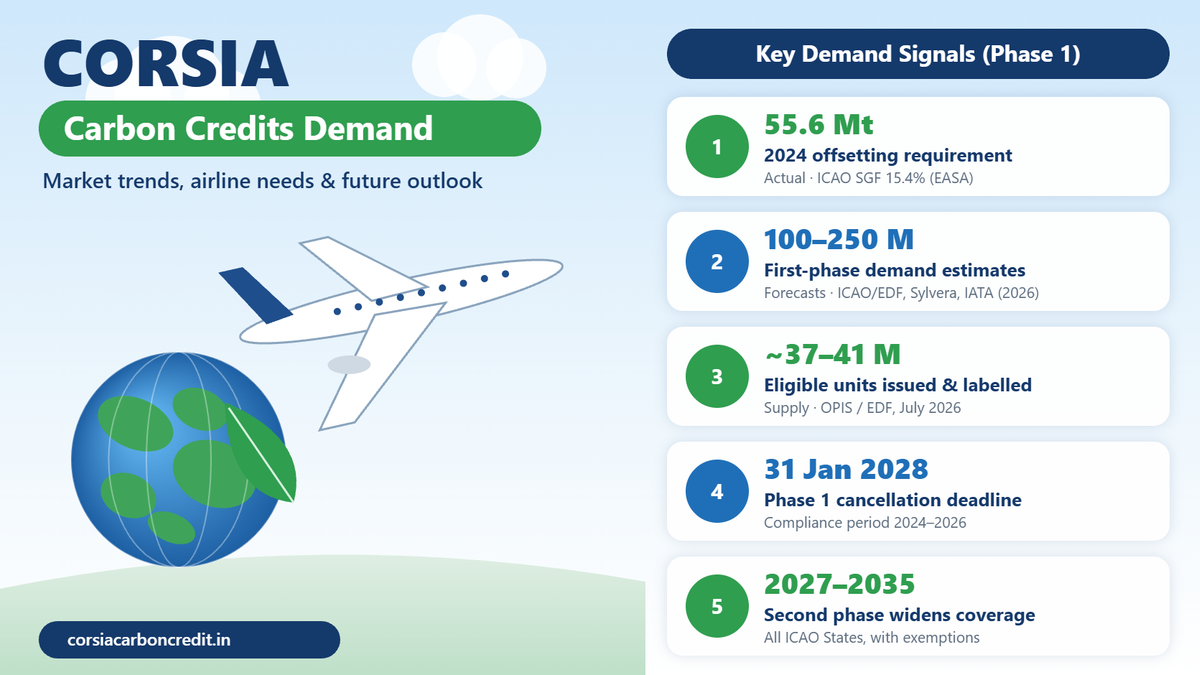
CORSIA is ICAO's carbon offsetting scheme for international aviation. Airlines meet their offsetting requirements by cancelling CORSIA eligible emissions units.
ICAO's Technical Advisory Body (TAB) assesses carbon-crediting programmes, and the ICAO Council approves them for specific compliance periods. Within an approved programme, individual units must also meet ICAO's conditions:
- the approved activity scope and methodologies
- start date and vintage windows; for example, first-phase (2024–2026) units generally need a first crediting period starting on or after 1 January 2016 and vintages from 2021 to 2026
- for first-phase units, a host-country Letter of Authorization and a corresponding adjustment to prevent double counting
- a CORSIA eligible label in the registry
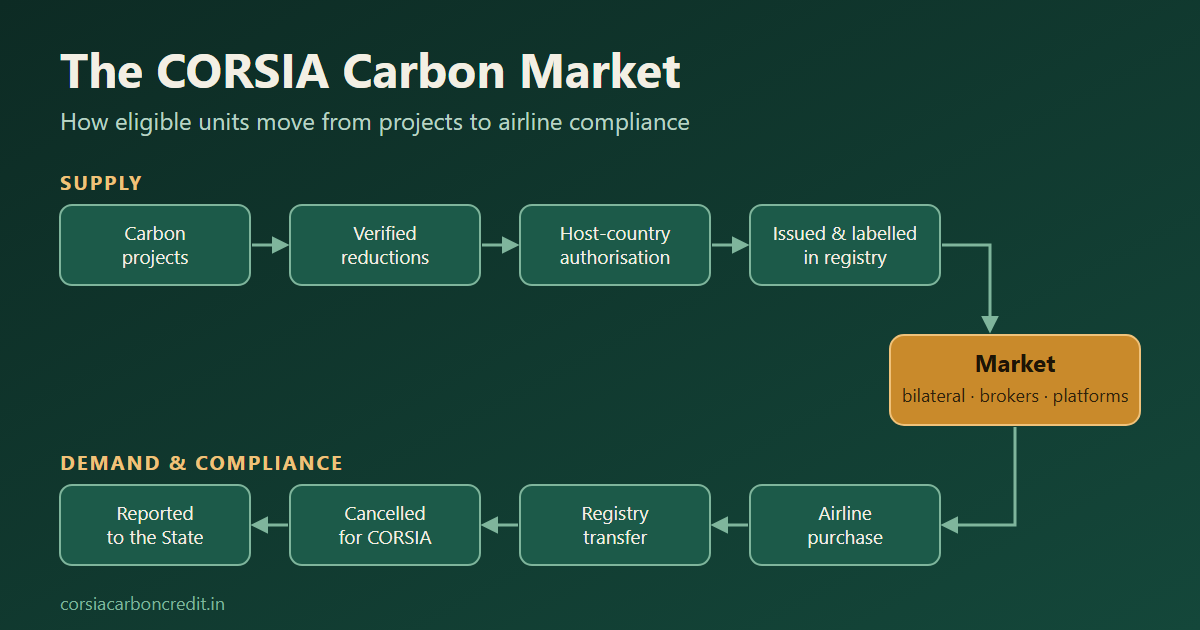
A carbon credit certified under a recognised voluntary programme is not automatically eligible for CORSIA. Always check the latest ICAO document and the specific unit's conditions. Our guide to CORSIA eligible emissions units explains these rules. Our article on the CORSIA carbon market explains how eligible units reach airlines.
Hypothetical Example: A Solar Project's Certification Journey
This example is hypothetical and does not describe a real project, outcome or quantity.
- Project planning: a developer plans a solar plant supplying a regional grid and checks whether carbon finance is needed for it to go ahead.
- Methodology selection: it chooses a programme with an applicable grid-connected renewable energy methodology.
- PDD preparation: it documents the plant, the grid emission baseline, the additionality case and the monitoring plan based on electricity meters.
- Validation: a VVB reviews the PDD, visits the site and raises findings that the developer resolves.
- Registration: the programme reviews the file and registers the project.
- Monitoring: after a year of operation, the developer compiles metered output and calculates reductions.
- Verification: a VVB checks the meter data and calculations.
- Credit issuance: the programme approves issuance.
- Registry recording: credits appear in the developer's account with serial numbers.
Whether such a project would actually qualify, and how many credits it would receive, depends on the real data and the programme's rules.
Frequently Asked Questions
What is the carbon credit certification process?
It is the sequence of steps a project follows to earn credits: choose a standard and methodology, prepare a PDD, pass validation, register, monitor results, pass verification, and receive issued credits in a registry.
How do I get a carbon project certified?
Choose a suitable programme and approved methodology, prepare the PDD, hire an accredited VVB for validation, apply for registration, then monitor the project and have each monitoring period verified before requesting issuance.
What is the difference between carbon credit validation and verification?
Validation checks the proposed project design before crediting. Verification checks the reductions or removals actually achieved during a monitoring period.
Which standards are used for carbon credit certification?
Widely used programmes include Verra's VCS, Gold Standard, the American Carbon Registry, the Climate Action Reserve and the Global Carbon Council. Each has its own methodologies, procedures and registry.
How long does carbon credit certification take?
It varies widely with project type, complexity, methodology, data quality and programme review times. There is no fixed timeline.
How much does carbon credit certification cost?
Costs include VVB audit fees, programme registration and issuance fees, registry fees and monitoring expenses. They vary by project and programme, so check current fee schedules and auditor quotes.
Are all certified carbon credits eligible for CORSIA?
No. Only units from ICAO-approved programmes that meet the scope, vintage, authorisation and labelling conditions for the relevant compliance period are eligible.
Key Takeaways
The carbon credit certification process turns a climate project into traceable, tradable credits. It runs from project identification, standard and methodology selection, the PDD, validation and registration through monitoring, verification and issuance.
Each step depends on a few essentials:
- the right programme and an approved methodology
- reliable monitoring data
- independent validation and verification
- transparent registry records
- full compliance with the programme's requirements
For compliance uses such as CORSIA, a further layer of ICAO eligibility rules applies on top.
To learn more about carbon credits, registries and CORSIA requirements, explore the resources at CORSIA Carbon Credit.