 DSTechnoverse company
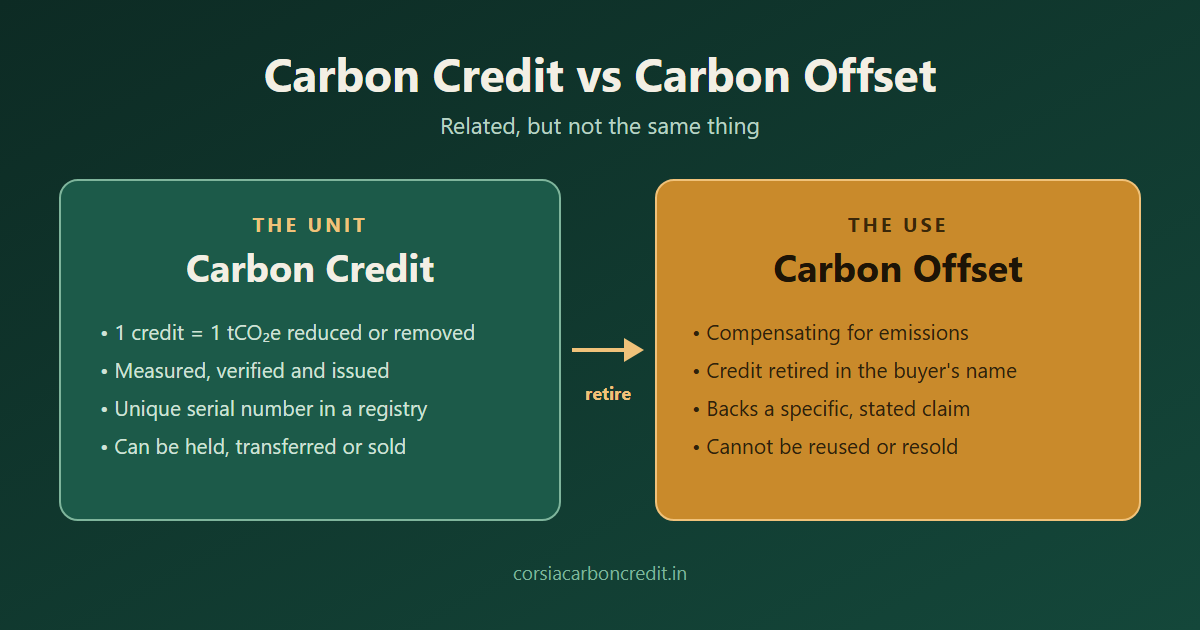
What is the difference between carbon credit and carbon offset? A carbon credit is a measured, verified and tradable unit, generally representing one tonne of CO₂ equivalent (tCO₂e) reduced or removed by a project. A carbon offset is the act of using such credits to compensate for emissions released somewhere else. In short, the credit is the unit, and offsetting is the use. A credit becomes an offset only when it is retired against a stated emissions claim.
People often use the two terms interchangeably, but the difference matters for buyers, sustainability reporting and compliance schemes such as CORSIA. This guide explains both terms, shows how they connect and sets out the rules that make an offsetting claim credible.
What Is a Carbon Credit?
A carbon credit is a certificate issued by a carbon-crediting programme. It confirms that a specific project reduced or removed a quantity of greenhouse gases, generally one metric tonne of CO₂e per credit. CO₂e converts gases such as methane and nitrous oxide into the amount of CO₂ with the same warming effect.
Credits come from activities such as:
- Renewable energy: solar or wind power replacing fossil-fuel electricity
- Methane capture: collecting gas from landfills or farm waste instead of releasing it
- Forestry: planting trees or protecting forests that would otherwise be cut down
- Carbon removal: technologies such as biochar or direct air capture that take CO₂ out of the air
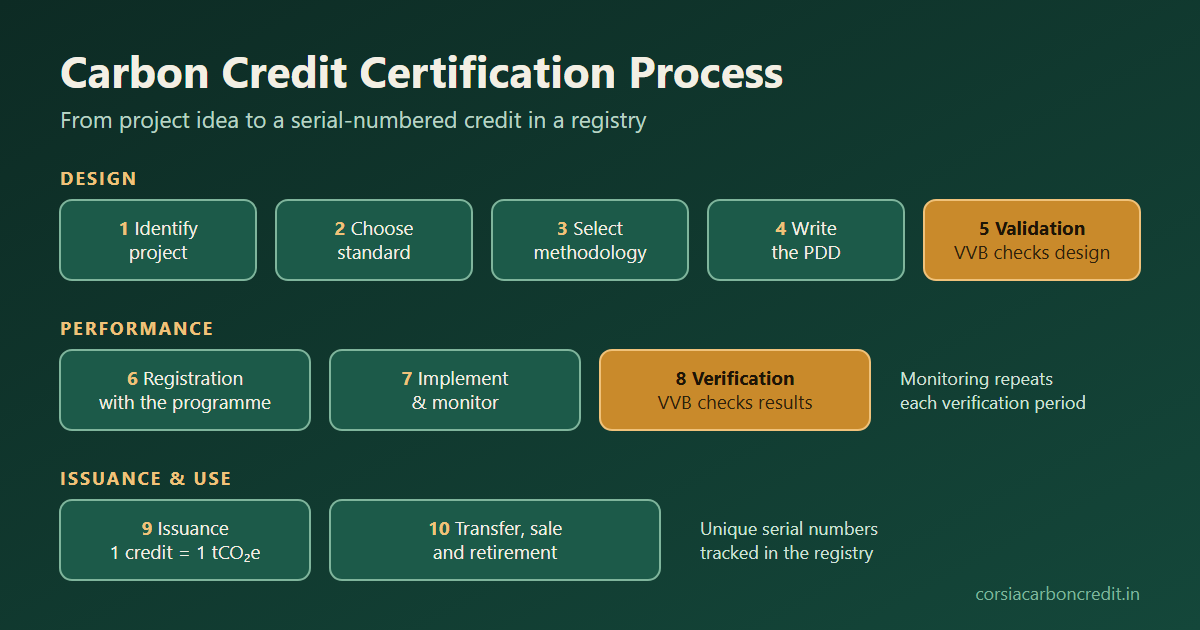
A credit is not created simply because a project exists. Under a programme such as Verra, Gold Standard, the American Carbon Registry or the Climate Action Reserve, the project must follow these steps:
- Apply an approved methodology, the rulebook for calculating reductions.
- Establish a baseline, meaning what would have happened without the project.
- Show additionality, meaning the reductions would not have happened anyway.
- Monitor its results and have them verified by an accredited independent auditor.
- Receive credits from the programme, which issues them into a public registry with unique serial numbers.
Exact rules differ by programme and methodology. Our guide to the carbon credit certification process walks through each step.
Once issued, credits can be held, transferred between registry accounts or sold. Buyers acquire them directly from developers, through brokers or through marketplaces.
Not every credit is a removal. Many represent avoided or reduced emissions, such as methane that was never released. Others represent removals, such as carbon taken up by new forests. That difference matters for some climate claims.
What Is a Carbon Offset?
Carbon offsetting means compensating for greenhouse gas emissions you produce by supporting an equivalent reduction or removal elsewhere. In practice, an organisation offsets by acquiring carbon credits and retiring them against a defined portion of its emissions.
Organisations offset for several reasons:
- to deal with residual emissions they cannot yet cut, such as from flights or industrial heat
- to support voluntary climate targets
- to meet a legal obligation in some compliance schemes
The link between the emitter and the project is purely an accounting one. A company in Delhi that retires credits from a landfill gas project in Brazil does not change its own emissions. It pays for a reduction elsewhere and claims it as compensation.
Offsetting does not physically take the company's own emissions out of the atmosphere unless the underlying project is a removal project. Even then, the CO₂ removed is not the same molecules the company emitted.
That is why credit quality, independent verification and proper retirement matter. It is also why offsetting is different from reducing emissions directly:
- Reduction lowers your own footprint, for example by improving energy efficiency or switching to renewable power.
- Offsetting compensates for the emissions that remain.
Most credible climate strategies reduce first and offset only what is left.
What Is the Difference Between Carbon Credit and Carbon Offset?
The simplest way to separate them:
- A carbon credit is a thing: a quantified, issued unit with a serial number.
- A carbon offset is an outcome or claim: using that unit to compensate for emissions.
Carbon markets create, verify and trade credits. Offsetting is one of the main ways credits are used. Credits can also be bought and held, traded, or used for compliance in regulated systems.
| Comparison factor | Carbon credit | Carbon offset |
|---|---|---|
| Meaning | A quantified unit representing an emission reduction or removal | An action or claim to compensate for emissions |
| Main purpose | Represents a tradable environmental unit | Compensates for emissions |
| Measurement | Generally 1 credit = 1 tCO₂e | Based on the emissions being compensated |
| Market role | Can be issued, held and traded | Describes how credits are used |
| Verification | Governed by the issuing programme's rules | Depends on the credits used and how the claim is made |
| Retirement | May be transferred or retired | Credits used to offset must be retired or cancelled |
| Example | One issued credit from a wind farm | Retiring that credit to offset one tonne of a company's emissions |
Context and the market framework matter. In everyday speech, "buying offsets" usually means buying credits that will be retired. Some organisations use "offset" for the credit itself. Under regulated schemes, precise terms apply: CORSIA, for example, speaks of emissions units that are cancelled. When terms are used loosely, ask one question: has a specific credit been retired, and for whose claim?
How Do Carbon Credits and Carbon Offsets Work Together?
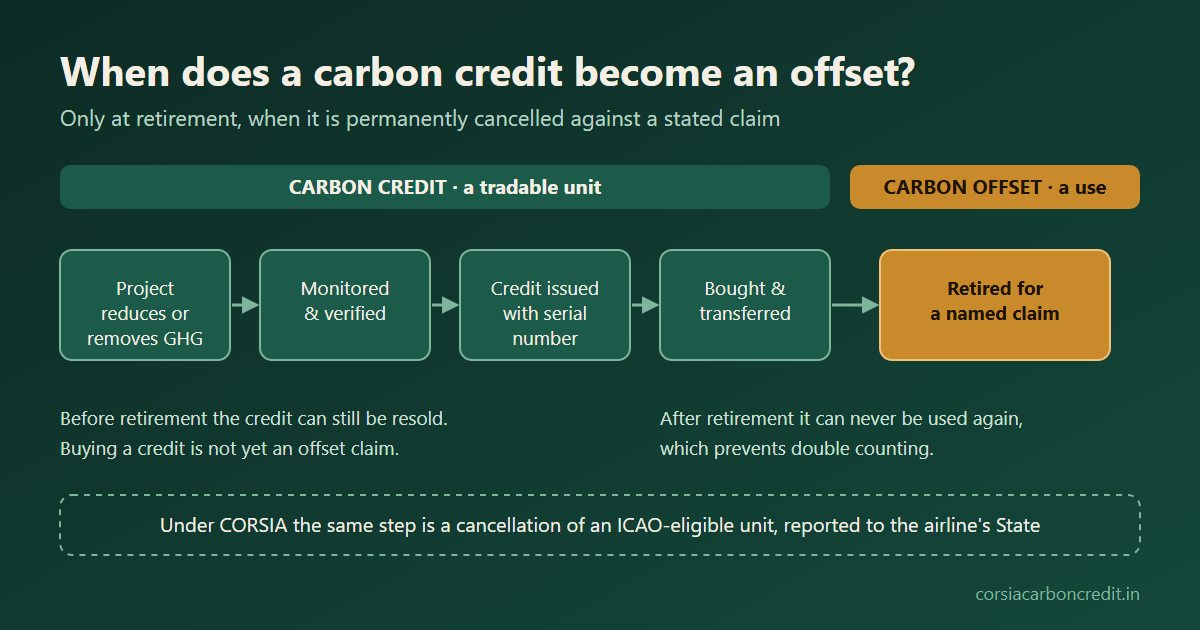
The two concepts meet at retirement. The full sequence is:
- A project carries out an emission reduction or removal activity.
- It follows an applicable methodology.
- Results are monitored and quantified.
- Independent validation and verification take place where the programme requires them.
- The programme issues credits into a registry.
- A buyer acquires the credits.
- The buyer retires or cancels them for a stated offsetting purpose.
- The buyer reports the claim transparently, naming the credits retired.
Until step 7, the credit is still a tradable asset and could be sold on. After step 7, it becomes the basis for an offset claim and can never be used again.
Example 1: How a carbon credit is created (hypothetical)
This example is hypothetical and does not describe a real project.
A municipal landfill installs a system to capture methane and burn it in an engine to generate electricity. The developer registers the project under a programme with an applicable landfill gas methodology. It measures captured gas with calibrated meters over a monitoring period and has the results verified by an accredited auditor. The programme then issues credits equal to the verified reduction, each with a serial number in the registry. At this point the project has carbon credits. Nothing has been offset yet.
Example 2: How a business offsets (hypothetical)
All figures are illustrative.
A consulting firm measures its annual footprint at 500 tCO₂e. It cuts 100 tonnes by switching to renewable electricity, then decides to compensate for 200 tonnes of business travel emissions. It buys 200 verified credits and retires them in the registry with the firm named as beneficiary. Its public report says it offset 200 tCO₂e of business travel and lists the serial numbers. The remaining 200 tonnes are not offset, and the report says so.
Types of Carbon Credit and Carbon Offset Projects
1. Renewable energy projects
Solar, wind and other renewable power that displaces fossil generation. Additionality is harder to show where renewables are already the cheapest option, so many programmes have narrowed eligibility for these projects.
2. Forestry and nature-based projects
Afforestation, reforestation, forest conservation (often called REDD+) and improved forest management. These projects face permanence risk from fire or logging, so programmes use buffer pools to cover possible reversals.
3. Methane reduction projects
Landfill gas capture, agricultural methane management and wastewater treatment improvements. Methane is a powerful greenhouse gas, so these projects can deliver large reductions.
4. Energy efficiency projects
Industrial efficiency, efficient equipment and qualifying clean cooking projects that replace inefficient stoves.
5. Carbon removal projects
Direct air capture, biochar and other carbon dioxide removal methods that store carbon for long periods.
A project category does not guarantee eligibility or quality. Every project must follow its programme's methodology and rules, and integrity varies within each category.
Voluntary vs Compliance Carbon Credits and Offsets
| Factor | Voluntary carbon market | Compliance carbon market |
|---|---|---|
| Why credits are used | Corporate climate goals and claims | Legal or regulatory obligations |
| Who sets the rules | Programmes, buyers and voluntary guidance | Governments or international bodies |
| Eligible credits | Chosen by the buyer, within programme rules | Only units that meet the scheme's criteria |
| Quality requirements | Vary; buyers set their own thresholds | Fixed by the scheme |
| Retirement and reporting | Retired for a voluntary claim, reported by the company | Cancelled for the scheme and reported to the regulator |
| Example | A company offsetting business travel | An airline cancelling units under CORSIA |
Rules differ widely across schemes and countries, so always check which framework applies to your claim.
How Are Carbon Credits Verified, Certified and Retired?
Credible credits rest on several layers of integrity:
- Standards and programmes set the rules and accredit auditors.
- Methodologies define the baseline, additionality tests, leakage and calculations.
- MRV (monitoring, reporting and verification) turns project data into audited results.
- Independent validation checks the design, and verification checks the results.
- Registry issuance gives each credit a unique serial number.
- Transfer records changes of ownership between registry accounts.
- Retirement or cancellation permanently removes the credit for a stated purpose and beneficiary.
Retirement is what prevents double counting, where two parties claim the same tonne. Buying a credit is not the same as retiring it. If credits sit unretired in an account, no offset has happened, and they could still be sold. Credible offset claims should cite retirement records or certificates. Our guide to claims after retiring credits explains how to word those claims.
Common Mistakes When Using Carbon Credits to Offset
Confusing the two terms leads to some predictable errors:
- Claiming an offset before retirement. Credits held in an account, or still on a supplier's books, do not support a claim. Retire first, then claim.
- Offsetting instead of reducing. Buying credits while doing nothing about avoidable emissions weakens a climate claim and may attract greenwashing criticism.
- Treating all credits as equal. A credit from a well-designed methane project and one from a project with a weak baseline are both "one tonne" on paper, but they do not carry the same integrity.
- Calling reductions removals. Most credits represent avoided emissions. A claim that you have "removed" carbon needs removal credits.
- Vague claims. Statements such as "carbon neutral" without the scope, the tonnes covered and the retired serial numbers are hard to check and increasingly challenged by regulators.
- Assuming any credit meets a compliance rule. Voluntary credits do not automatically count for regulated schemes, including CORSIA.
Our guide to retirement certificates shows what proof of retirement should contain.
Carbon Credits and Carbon Offsets Under CORSIA
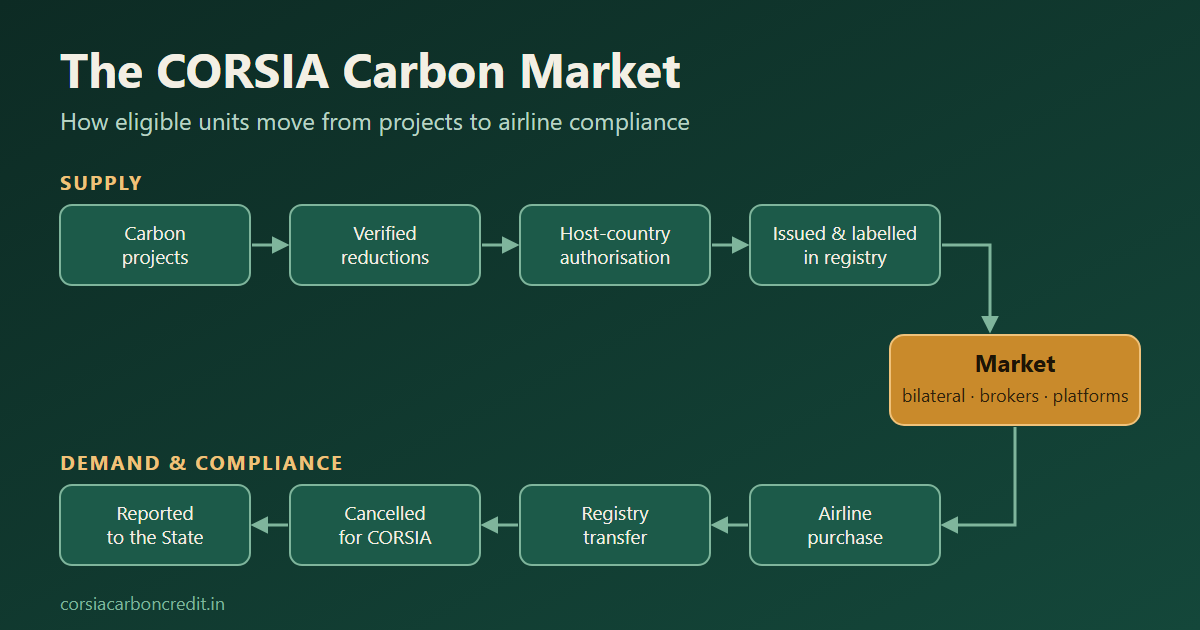
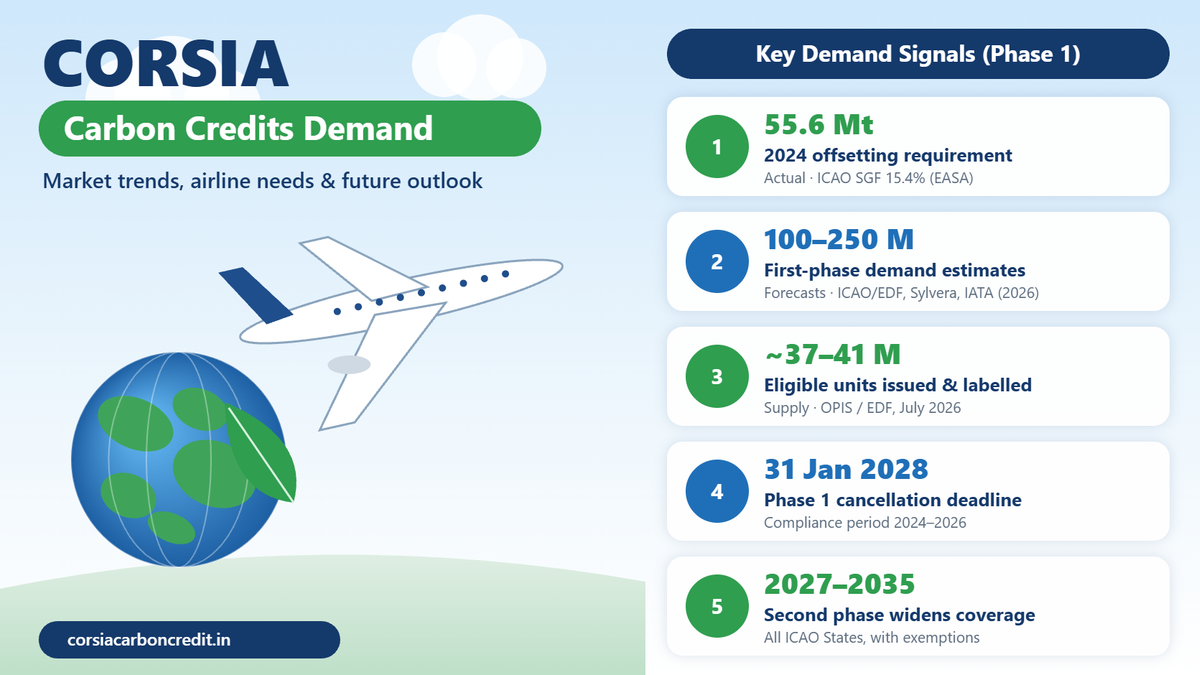
CORSIA, the Carbon Offsetting and Reduction Scheme for International Aviation, is ICAO's global market-based measure for international flights. Aeroplane operators must compensate for emissions growth on routes between participating States. Their offsetting requirement is met by cancelling CORSIA eligible emissions units.
Here the general rule applies with extra conditions:
- Programme level: the ICAO Council, advised by its Technical Advisory Body, approves which programmes can supply units for each compliance period.
- Unit level: each unit must fall within the approved scope and meet date and vintage windows. For the 2024–2026 first phase, that generally means activities starting on or after 1 January 2016 and vintages from 2021 to 2026. First-phase units also need host-country authorisation and corresponding adjustments, and must be labelled CORSIA eligible in the registry.
- Cancellation: the operator cancels the units for CORSIA and reports them to its State.
Not every carbon credit or voluntary offset is eligible for CORSIA. Eligibility must be checked against ICAO's current requirements for the relevant compliance period. Our guide to CORSIA eligible emissions units explains these rules. Our article on the CORSIA carbon market covers how airlines obtain eligible units.
Frequently Asked Questions
What is the difference between carbon credit and carbon offset?
A carbon credit is a verified, tradable unit, generally equal to one tonne of CO₂e reduced or removed. A carbon offset is the use of retired credits to compensate for emissions.
Are carbon credits and carbon offsets the same thing?
Not exactly. They are closely linked and often used interchangeably, but the credit is the unit and offsetting is the claim or action. A credit only supports an offset claim once it has been retired.
How does a carbon credit become a carbon offset?
When its holder retires or cancels it in the registry for a stated purpose and beneficiary. It can then never be sold or used again.
Does one carbon credit equal one tonne of CO₂?
Generally, one credit represents one metric tonne of CO₂ equivalent (tCO₂e), which can include other greenhouse gases converted to CO₂ terms, under the issuing programme's rules.
How do businesses use carbon credits to offset emissions?
They measure their emissions, reduce what they can, buy verified credits for a defined portion of what remains, retire them in their own name and report the claim with the serial numbers.
What is the difference between carbon reduction and carbon offsetting?
Reduction lowers an organisation's own emissions, for example through efficiency or clean energy. Offsetting compensates for remaining emissions by retiring credits from reductions or removals made elsewhere.
Are all carbon offsets eligible under CORSIA?
No. Only units from ICAO-approved programmes that meet the scope, vintage, authorisation and labelling conditions for the relevant compliance period can be used for CORSIA.
Key Takeaways
So, what is the difference between carbon credit and carbon offset? A carbon credit is a quantified, verified unit representing an emission reduction or removal. Carbon offsetting is using eligible credits, retired in your name, to compensate for emissions.
The two are connected, but a credit supports an offset claim only after retirement. A credible claim depends on:
- high-integrity projects
- reliable measurement and independent verification
- transparent registries
- proper retirement
- accurate wording of the claim
- the rules of the market you operate in, which are stricter still for compliance schemes such as CORSIA
To learn more about carbon credits and CORSIA requirements, explore the resources at CORSIA Carbon Credit.