 DSTechnoverse company
How do you calculate carbon credits from solar? Multiply the solar electricity delivered (in MWh) by the applicable grid emission factor (in tCO₂e/MWh). That gives the emissions avoided by displacing grid power. Then subtract any project emissions and methodology deductions. If the project is eligible, registered and independently verified, the programme may issue roughly one credit per tonne of CO₂e. For how credits are used in aviation, see our CORSIA Carbon Credits resources.
This guide walks through the calculation step by step, gives India's official grid emission factors, shows worked examples for 1,000 MWh and a 1 MW plant, and explains why many solar projects no longer qualify for credits.
What Are Carbon Credits from Solar Energy?
A solar plant generates electricity without burning fossil fuels during operation. When its power feeds into the grid, it displaces electricity that coal, gas or other plants would otherwise have generated. The emissions avoided can potentially qualify as carbon credits under an applicable programme and methodology.
Installing solar panels does not automatically generate tradable carbon credits. The project must:
- use an approved methodology
- meet the programme's eligibility and additionality rules
- be registered, monitored and independently verified
- have its credits issued by the programme's registry
How Do Solar Projects Generate Carbon Credits?
- The solar project generates electricity.
- That electricity displaces power from the baseline source, usually the existing grid mix.
- Avoided emissions are estimated using the methodology.
- Project emissions and other deductions are taken into account.
- Results are monitored and independently verified.
- Credits may be issued if all programme requirements are met.
How Do You Calculate Carbon Credits from Solar Power?
The simplified calculation is:
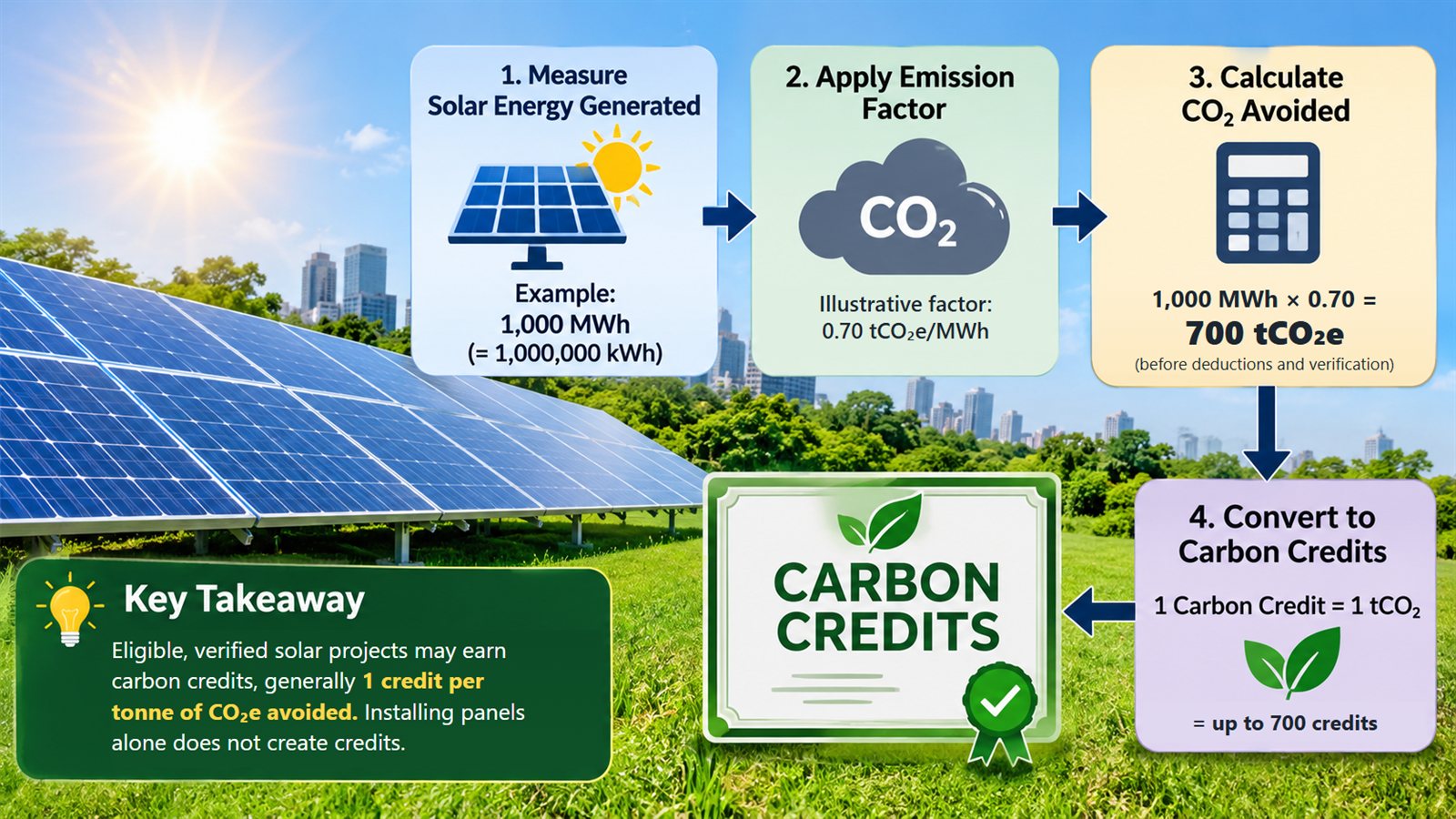
Avoided emissions (tCO₂e) = Solar electricity generated (MWh) × Applicable grid emission factor (tCO₂e/MWh)
- Solar electricity generated: the net electricity delivered to the grid, measured in kWh or MWh. 1 MWh = 1,000 kWh.
- Grid emission factor: the tonnes of CO₂ emitted per MWh of electricity in the relevant grid, for the relevant period.
- Project emissions and deductions: methodology-specific items, such as fossil fuel used on site or backup generators.
- Leakage, uncertainty and adjustments: usually small for solar, but required where the methodology says so.
This is a simplified illustration, not an approved methodology. The exact rules depend on the methodology, project location, grid boundary and monitoring requirements. Our general guide on how to calculate carbon credits explains the wider formula with leakage and deductions.
Step-by-Step Solar Carbon Credit Calculation
1. Measure Solar Electricity Generation
Generation is measured using:
- calibrated energy meters at the grid connection point, the main source for crediting
- inverter monitoring systems, useful for cross-checking
- project records, such as utility invoices and grid operator statements
Methodologies normally count net electricity exported to the grid, after the plant's own consumption.
2. Identify the Baseline Electricity Source
The baseline is the electricity source the solar plant replaces. For a grid-connected plant, that is usually the regional or national grid. For a captive or off-grid system, it might be a diesel generator the solar plant replaces.
3. Determine the Applicable Grid Emission Factor
A grid emission factor represents the CO₂ emitted per MWh of electricity generated in a grid. Methodologies based on the UNFCCC Clean Development Mechanism (CDM) use a combined margin, which blends:
- the operating margin (OM): emissions from existing fossil-fuel plants that the project displaces
- the build margin (BM): emissions from recently built plants that new capacity would otherwise have added
India's official factors come from the Central Electricity Authority's CO₂ Baseline Database for the Indian Power Sector. Version 22.0 (August 2026), covering FY 2025-26, reports:
- weighted average: 0.675 tCO₂/MWh
- simple operating margin: 0.963 tCO₂/MWh
- build margin: 0.446 tCO₂/MWh
- combined margin (50:50): 0.705 tCO₂/MWh
The CEA notes that, under the CDM grid emission factor tool, solar and wind projects may weight the operating margin and build margin at 75% and 25%. Applying that weighting to the FY 2025-26 values gives about 0.834 tCO₂/MWh (our calculation: 0.75 × 0.963 + 0.25 × 0.446). Which value applies depends on the methodology and the project's monitoring choices.
Always use the correct country, grid region, reporting period and methodology-approved factor. CEA updates the database each year, and the factors have been falling as more renewable energy joins the grid.
4. Calculate Avoided Emissions
Multiply the net electricity generated by the applicable factor. For example, 500 MWh × 0.70 tCO₂e/MWh = 350 tCO₂e (illustrative).
5. Account for Project Emissions and Deductions
Subtract:
- project emissions, such as diesel backup generation or fossil fuel used on site
- leakage, if the methodology requires it, for example where old equipment is moved elsewhere
- uncertainty deductions, if monitoring data is incomplete
- other adjustments required by the methodology
6. Convert Verified Emission Reductions into Carbon Credits
One carbon credit generally represents one metric tonne of CO₂e, under the programme's rules. Calculated reductions are not automatically issued credits. They first need independent verification and approval by the programme.
Solar Carbon Credit Calculation Example
All figures are illustrative. The 0.70 factor is not an official current Indian grid emission factor, and the result is not a guaranteed issuance.
- Annual solar electricity generation: 1,000 MWh
- Illustrative grid emission factor: 0.70 tCO₂e/MWh
1,000 MWh × 0.70 tCO₂e/MWh = 700 tCO₂e
The 700 tCO₂e is an estimate of baseline emissions avoided. The final eligible quantity may be lower after:
- project emissions, such as 5 tCO₂e from a diesel backup generator
- any methodology-specific deductions
- corrections found during verification
With 5 tCO₂e of project emissions, the illustrative result would be 695 tCO₂e, potentially up to 695 credits if verified and issued.
How Many Carbon Credits Can a 1 MW Solar Plant Generate?
Capacity alone is not enough to calculate credits. A plant's megawatt rating shows its maximum output, not how much electricity it actually generates. The number of credits depends on:
- annual electricity generation
- solar irradiation and location
- capacity factor, the actual output compared with the theoretical maximum
- plant performance and downtime
- the grid emission factor
- the project baseline
- the applicable methodology and eligibility conditions
Illustrative 1 MW calculation (hypothetical assumptions):
- Maximum possible output: 1 MW × 8,760 hours = 8,760 MWh a year
- Assumed capacity factor: 19%
- Estimated generation: 8,760 × 0.19 = 1,664 MWh a year
- With an illustrative factor of 0.70: 1,664 × 0.70 = about 1,165 tCO₂e a year
- With the 0.834 factor derived from CEA's FY 2025-26 data: 1,664 × 0.834 = about 1,388 tCO₂e a year
The two results differ by more than 200 tonnes just because of the emission factor. There is no universal number of carbon credits per MW of solar.
Factors That Affect Solar Carbon Credit Calculations
- Plant location: sunlight and the grid it connects to.
- Annual electricity generation: the volume that drives the result.
- Grid emission factor: varies by country, grid and year.
- Commissioning date: sets which vintages and rules apply.
- Baseline methodology: which grid factor and margin weighting is used.
- Additionality: whether the plant needed carbon finance.
- Ownership and electricity attributes: if the same MWh is sold as a Renewable Energy Certificate or claimed by an electricity buyer, also selling carbon credits for it could be double counting.
- Monitoring and verification: meter accuracy and data completeness.
- Programme rules: many programmes now restrict solar credits, as explained below.
Why many solar projects no longer qualify
Solar power is now often cheaper than fossil power, so regulators and standards question whether carbon credits are needed to make it happen:
- Verra limited grid-connected renewable projects to least developed countries from 2019. Its new methodology VMR0017, active since 23 April 2026, adds a list of eligible non-LDC countries for technologies including solar PV, subject to strict additionality tests. It applies in full to registration requests from 1 January 2027.
- Gold Standard restricts grid-connected renewable projects mainly to least developed countries, small island developing states and landlocked developing countries, with a narrow exception for low- and lower-middle-income countries where the technology's share of grid capacity is below 5%.
- The Integrity Council for the Voluntary Carbon Market (ICVCM) decided in August 2024 that existing renewable energy methodologies, including CDM ACM0002, did not qualify for its Core Carbon Principles label. It later approved Verra's revised VMR0017 in April 2026, with extra conditions.
In India, the Carbon Credit Trading Scheme offset mechanism includes a methodology for grid-connected electricity generation from renewable sources (BEE methodology BM EN01.001, published March 2025, adapted from ACM0002). It issues Carbon Credit Certificates, which are domestic instruments, separate from international voluntary credits.
Can Residential and Rooftop Solar Projects Generate Carbon Credits?
Possibly, but rarely on their own.
- System size: a 5 kW home system might generate about 7 MWh a year, which is only a few tonnes of CO₂e. That is far too small to cover certification costs alone.
- Aggregation: developers can bundle many rooftop systems into a Programme of Activities (PoA) or grouped project, sharing the costs.
- Documentation: each installation needs records of location, capacity and commissioning date.
- Metering: reliable generation data is needed for every system or sample.
- Ownership and carbon rights: contracts must state who owns the reductions, the homeowner, the installer or the developer.
- Monitoring and verification costs: these can exceed the value of the credits for small portfolios.
Not every rooftop installation is eligible, or economically viable, for carbon credit generation.
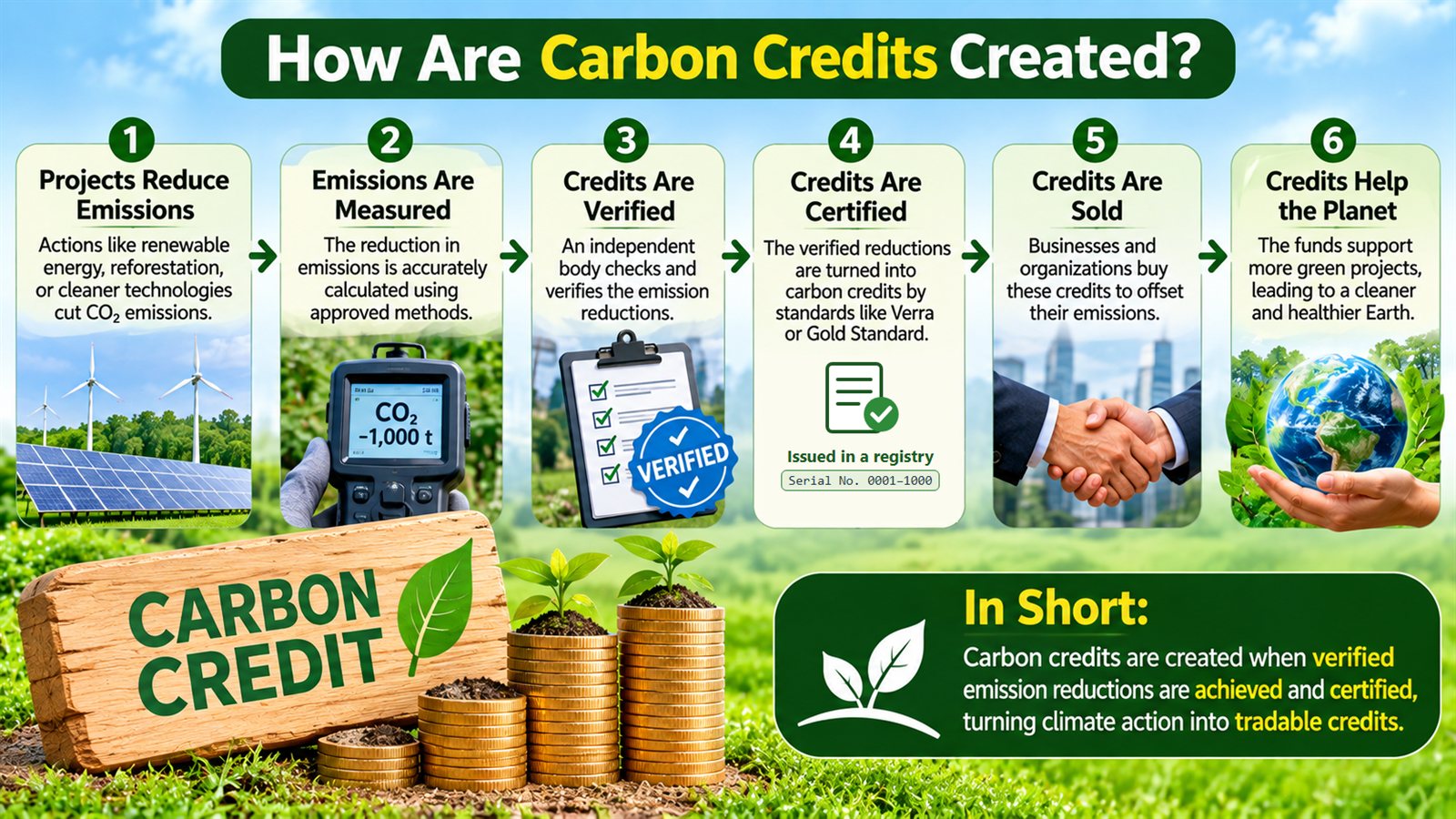
What Are the Requirements for Registering a Solar Carbon Credit Project?
- Select an eligible programme, checking its rules for solar in your country.
- Choose an approved methodology, such as VMR0017 under Verra, or CDM small-scale methodologies where still accepted.
- Prepare a Project Design Document.
- Establish the baseline and demonstrate additionality.
- Demonstrate ownership and rights to the emission reductions and electricity attributes.
- Complete validation by an accredited validation and verification body (VVB).
- Register the project with the programme.
- Monitor electricity generation according to the monitoring plan.
- Obtain independent verification.
- Receive formal credit issuance in the programme's registry.
Our guide to how carbon credits are created explains each of these stages in more detail.
How Are Solar Carbon Credits Verified and Issued?
- Project developers run the plant, collect meter data and prepare monitoring reports.
- VVBs check the data, meters, emission factors and calculations.
- Carbon credit programmes review the verification and approve issuance.
- Registries issue the credits, with unique serial numbers, and track transfers and retirements.
Four stages are often confused:
- Estimated reductions: forecasts in the design document.
- Monitored reductions: calculated from actual meter data.
- Independently verified reductions: confirmed by a VVB.
- Formally issued credits: created in the registry and available to sell.
Can Solar Carbon Credits Be Sold in the Carbon Market?
Yes, once issued. Sales usually go through:
- direct buyers, such as companies with climate targets
- voluntary carbon markets and marketplaces
- project developers and intermediaries, such as brokers and traders
The credits are transferred or retired through the registry. Transaction costs and any revenue-sharing arrangements reduce what the project receives. Our guide to the carbon credit marketplace explains how these platforms work.
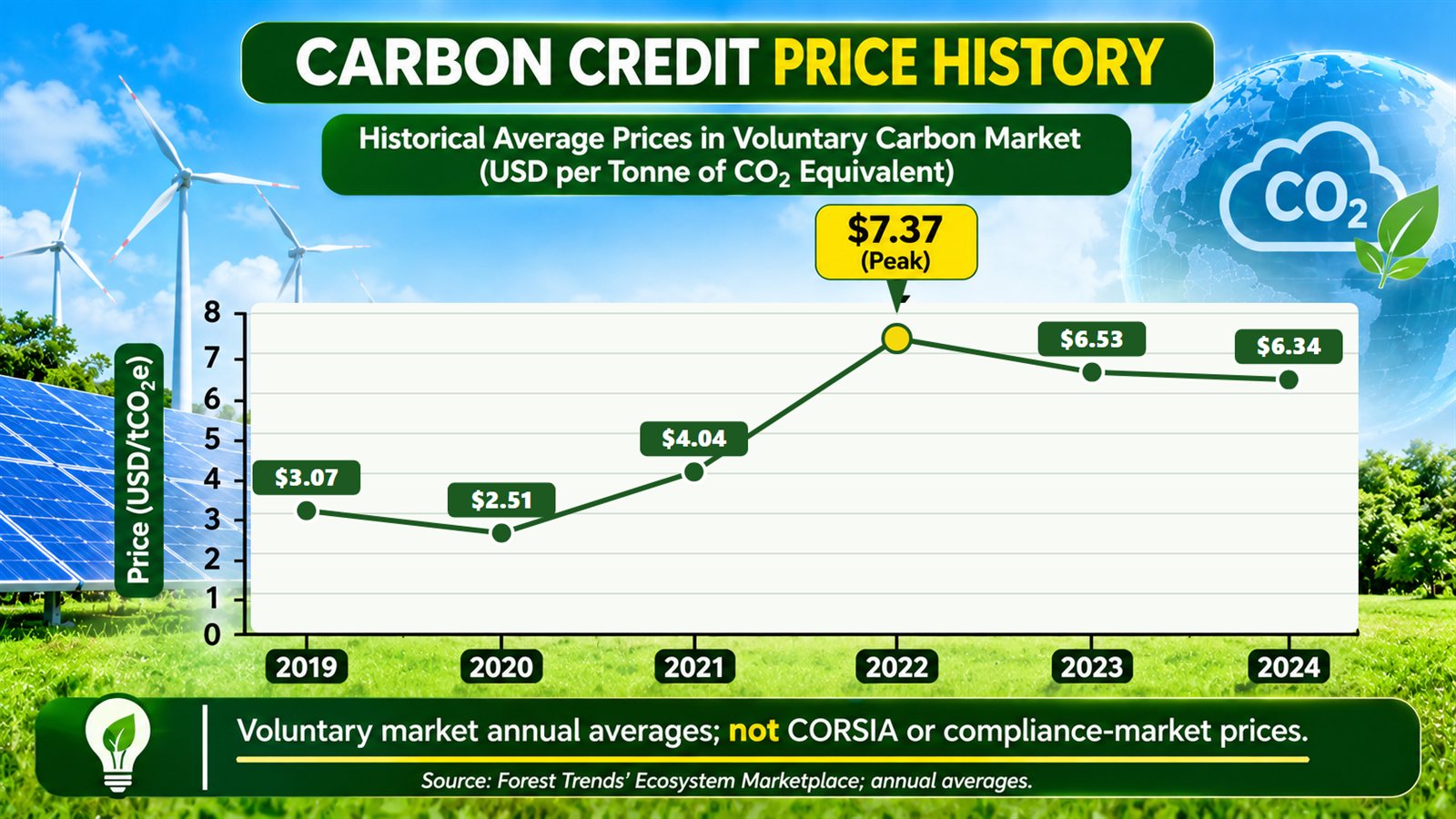
Solar credit prices are not fixed. Renewable energy credits have generally been among the lowest-priced voluntary credits, averaging about USD 2.67 per tCO₂e in 2024 (Ecosystem Marketplace). Newer, more clearly additional projects may achieve more.
Are Solar Carbon Credits Eligible Under CORSIA?
CORSIA, the Carbon Offsetting and Reduction Scheme for International Aviation, is ICAO's global market-based measure for international aviation. Airlines with offsetting requirements must cancel CORSIA eligible emissions units.
- ICAO decides which programmes are eligible for each compliance period, and under which conditions.
- An ordinary solar carbon credit is not automatically a CORSIA eligible unit.
- The credit must come from an eligible programme and methodology, have an eligible vintage, and meet unit-level requirements. For the first phase (2024–2026), these include host-country authorisation with a corresponding adjustment.
In India, the government's list of activities for international transfers under Article 6.2 of the Paris Agreement covers renewable energy with storage (the stored component only) and solar thermal power, not ordinary standalone solar PV. Not every solar project credit qualifies under CORSIA. Our guide to CORSIA eligible carbon credits explains the checks.
Common Mistakes in Solar Carbon Credit Calculations
- Using the wrong grid emission factor, such as the weighted average instead of the methodology's combined margin
- Confusing kWh with MWh, which makes results 1,000 times too large or too small
- Ignoring project emissions, such as diesel backup
- Assuming installed capacity equals electricity generation
- Using outdated emission factors, since CEA values change every year
- Ignoring additionality requirements and programme restrictions on solar
- Treating estimated reductions as issued credits
- Assuming every solar installation qualifies
Frequently Asked Questions
How many carbon credits does 1 MW of solar generate?
There is no fixed number. As an illustration, a 1 MW plant at a 19% capacity factor generates about 1,664 MWh a year, which at 0.70 tCO₂e/MWh is about 1,165 tCO₂e before deductions. Actual credits depend on eligibility and verification.
How do you calculate carbon credits from solar electricity?
Multiply net solar electricity delivered (MWh) by the applicable grid emission factor (tCO₂e/MWh), then subtract project emissions and methodology deductions. Verified tonnes can then be issued as credits.
What is the grid emission factor in solar carbon credit calculations?
It is the CO₂ emitted per MWh of grid electricity that solar displaces. In India, CEA's Version 22.0 database gives a FY 2025-26 combined margin of 0.705 tCO₂/MWh (50:50 weighting) and a weighted average of 0.675.
Can rooftop solar generate carbon credits?
Sometimes, but usually only when many systems are bundled into a programme of activities by a developer. Single systems are too small to cover certification costs, and eligibility rules apply.
How much money can a solar carbon credit generate?
Prices are not fixed. Renewable energy credits averaged about USD 2.67 per tonne in 2024 (Ecosystem Marketplace), among the lowest in the voluntary market. Costs and fees reduce net income.
Do solar projects automatically qualify for carbon credits?
No. They must meet a programme's eligibility and additionality rules, which now restrict many grid-connected solar projects, and be registered, monitored and verified.
Are solar energy carbon credits eligible under CORSIA?
Not automatically. They must come from an ICAO-approved programme and meet unit-level conditions such as vintage and host-country authorisation. India's Article 6.2 list does not include standalone solar PV.
Conclusion
So, how do you calculate carbon credits from solar? Multiply the eligible solar electricity generated by the applicable baseline grid emission factor, then apply methodology-specific adjustments such as project emissions.
But calculation is only the start. Formal carbon credit issuance requires project eligibility, monitoring, independent verification and registry approval, and programme rules for solar have become much stricter.
To learn more about carbon credits, CORSIA and carbon markets, explore the resources at CORSIA Carbon Credit.
Sources
- Central Electricity Authority – CO₂ Baseline Database for the Indian Power Sector, User Guide Version 22.0 (August 2026)
- UNFCCC CDM – Tool to calculate the emission factor for an electricity system
- Verra – VMR0017 Grid-connected electricity generation from renewable sources (ACM0002 revision) v1.0
- Gold Standard – Renewable Energy Activity Requirements
- ICVCM – Carbon credits from current renewable energy methodologies will not receive CCP label (August 2024)
- Bureau of Energy Efficiency – Approved Methodologies under the Offset Mechanism
- PIB – MoEFCC list of activities for international carbon trading under Article 6.2
- ICAO – CORSIA Eligible Emissions Units
- Ecosystem Marketplace – State of the Voluntary Carbon Market reports