 DSTechnoverse company
How do you calculate carbon credits? You estimate what emissions would have been without a project (the baseline). Then you subtract what the project actually emits, plus any leakage and other deductions the methodology requires, and express the result in tonnes of CO₂ equivalent (tCO₂e). After independent verification, the programme can issue credits, generally one credit per tonne of CO₂e reduced or removed. For how credits are used in aviation, see our CORSIA Carbon Credits resources.
Careful calculation matters because each credit is a promise that a real tonne of emissions was avoided or removed. Overestimates mean buyers pay for reductions that never happened. This guide focuses on the formula and worked calculations. For a broader explanation of monitoring and measurement, see our companion guide on how carbon credits are measured.
Introduction to Carbon Credit Calculation
A carbon credit is a certificate issued by a carbon-crediting programme. It represents a quantified, verified reduction or removal of greenhouse gases.
- One credit generally equals one metric tonne of CO₂e, subject to the issuing programme's rules and verification.
- Reduction credits come from preventing emissions, such as replacing coal power with wind or capturing landfill methane.
- Removal credits come from taking CO₂ out of the air and storing it, such as growing forests, biochar or direct air capture.
Projects show their climate impact by comparing what happened with what would have happened without them. That comparison is only credible if the data, assumptions and equations are transparent and independently checked. Accurate calculation is what makes carbon markets trustworthy.
What Is Carbon Credit Calculation?
Carbon credit calculation is the process of quantifying, in tCO₂e, the greenhouse gas reductions or removals a project achieves over a monitoring period.
It has two possible outcomes:
- Emission reductions: the project prevents emissions that would otherwise occur, such as methane escaping from a landfill.
- Removals: the project takes CO₂ out of the atmosphere and stores it, such as carbon absorbed by new trees.
Project developers first estimate these benefits when designing a project, then measure them during operation. Both steps must follow an approved methodology: a rulebook from the crediting programme that sets the equations, default values, monitoring requirements and deductions for that project type. Using an approved methodology makes results consistent and auditable.
Basic Carbon Credit Calculation Formula
The general conceptual formula is:
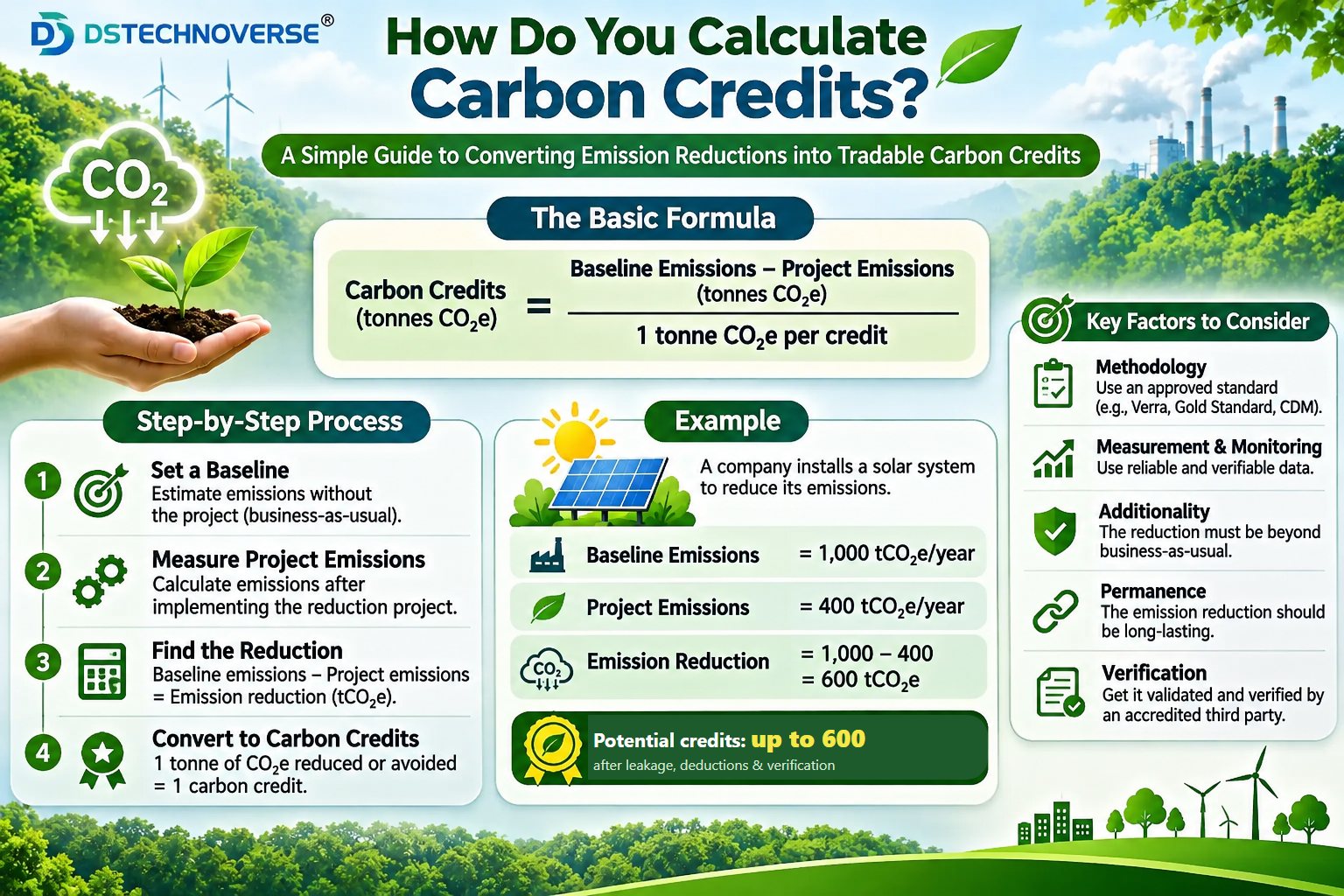
Net emission reductions = Baseline emissions − Project emissions − Leakage − Applicable deductions
- Baseline emissions: emissions expected without the project, under a business-as-usual scenario.
- Project emissions: emissions the project itself causes after it is implemented, such as fuel or electricity used to run equipment.
- Leakage: additional emissions outside the project's boundary that happen because of the project.
- Applicable deductions: methodology-specific adjustments, such as uncertainty discounts, buffer pool contributions or other required deductions.
For removal projects, the logic is similar: net removals are the project's carbon stock gains, minus baseline removals, project emissions, leakage and deductions.
This is a simplified educational formula, not a universal standard-specific one. Actual equations differ by project type, carbon standard and methodology. Verified net reductions or removals may lead to credit issuance, but only after all programme requirements are met.
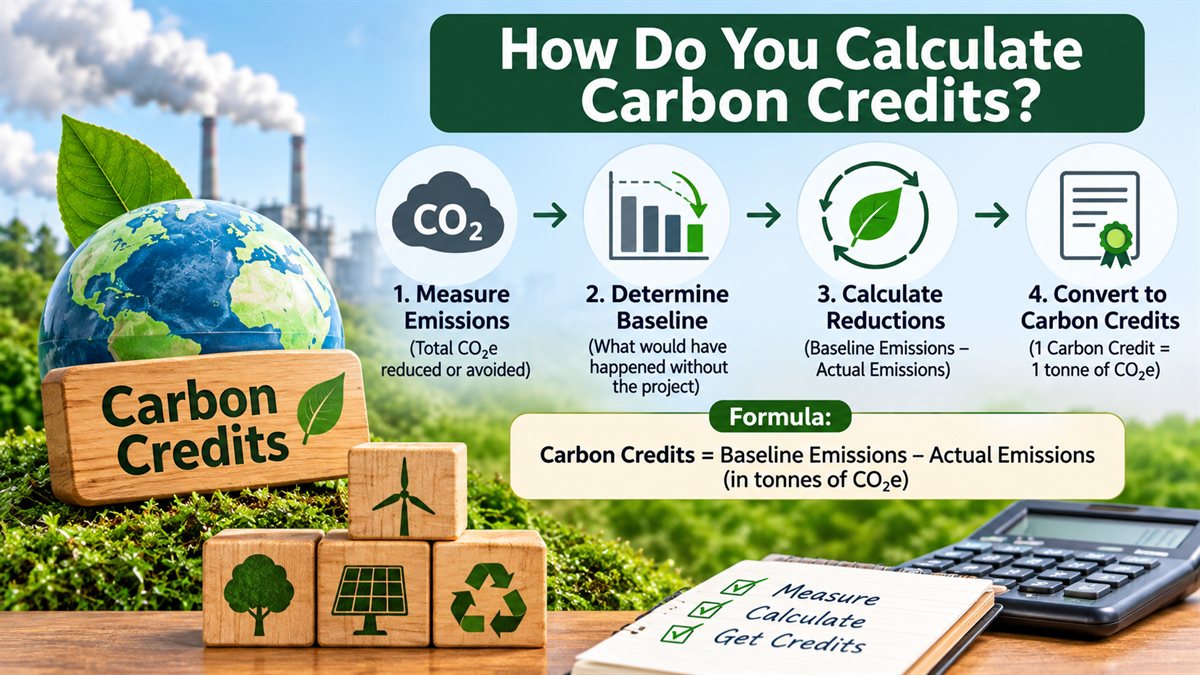
The infographic shows the core idea, baseline minus actual emissions. Real calculations also subtract leakage and methodology-specific deductions, as the steps below explain.
Step-by-Step Process for Calculating Carbon Credits
Step 1: Establish the Project Baseline
The baseline is the business-as-usual scenario: the emissions that would most likely have occurred without the project.
- It is set using the methodology's rules, historical data and project-specific conditions, such as the local electricity grid mix or past fuel use.
- Methodologies usually require conservative assumptions, so that reductions are not overstated.
- The baseline has the biggest influence on the final result. An inflated baseline creates credits for reductions that never happened.
Step 2: Measure Project Emissions
Once the project runs, the developer measures the emissions it causes. Typical sources include:
- fuel consumption, such as diesel for generators or vehicles
- electricity usage, such as power for pumps, compressors or fans
- industrial processes, such as gases released during production
- transportation, such as trucks moving biomass or waste
- other relevant sources inside the project boundary, such as fertiliser use
These are recorded using meters, invoices, logs and sampling, following the methodology's monitoring plan.
Step 3: Calculate Greenhouse Gas Emissions in CO₂e
Projects can involve several gases:
- carbon dioxide (CO₂), from burning fuel
- methane (CH₄), from landfills, wastewater, livestock and rice paddies
- nitrous oxide (N₂O), from fertilisers and some industrial processes
- other gases, such as hydrofluorocarbons (HFCs), in specific industrial projects
Each gas is converted into a common unit using its Global Warming Potential (GWP), its warming effect relative to CO₂ over a set period, usually 100 years:
CO₂e = Quantity of greenhouse gas × Applicable global warming potential
The applicable GWP values and the IPCC assessment report they come from must follow the relevant methodology and reporting rules.
Step 4: Account for Leakage
Leakage happens when a project shifts emissions outside its boundary instead of eliminating them. Examples:
- Forestry: protecting a forest may push logging or farming to a nearby area.
- Agriculture: taking land out of crop production may cause land to be cleared elsewhere.
- Renewable energy: leakage is usually small, but can arise if old equipment is moved and reused elsewhere.
Methodologies set out how to estimate leakage, often using default factors or monitoring of nearby areas. Estimated leakage is deducted where required.
Step 5: Apply Methodology-Specific Adjustments
Methodologies may also require:
- uncertainty deductions, which reduce results when data is imprecise
- conservative baseline assumptions, which choose the lower plausible estimate
- reversal risk assessments, for projects where stored carbon could be released
- buffer pool contributions, where a share of credits is set aside to cover future reversals, mainly in forestry and soil projects
- other programme-specific adjustments, such as caps or discount factors
Not every project uses the same deductions. A wind farm has no reversal risk, so it does not need a buffer. A forest can burn, so it usually does.
Step 6: Validate and Verify the Calculation
- Validation: an accredited validation and verification body (VVB) checks the project design and baseline before crediting.
- Monitoring, Reporting and Verification (MRV): the developer monitors data and reports results for each period.
- Supporting documentation: a Project Design Document and monitoring reports set out the boundary, methodology, data and calculations.
- Independent verification: a VVB checks the data and calculations, often with a site visit, and raises findings that must be fixed.
Our guide to the carbon credit certification process explains each stage.
Step 7: Carbon Credit Issuance
After the programme approves the verification, it can issue credits into its registry.
- Each credit receives a unique serial number, showing the project, vintage and other details.
- The registry tracks each credit until it is retired, so it cannot be sold or claimed twice.
Calculated, verified and issued are different stages. Only issued credits exist as tradable units.
Practical Examples of Carbon Credit Calculation
All figures in these examples are hypothetical and are not official programme values, emission factors or project results.
Example 1: Renewable Energy Project
A hypothetical solar project replaces grid electricity from fossil fuel plants.
- Baseline emissions: 10,000 tCO₂e
- Project emissions: 3,000 tCO₂e
- Leakage and other applicable deductions: 500 tCO₂e
Calculation:
- Baseline − project emissions: 10,000 − 3,000 = 7,000 tCO₂e
- Minus leakage and deductions: 7,000 − 500 = 6,500 tCO₂e
The 6,500 tCO₂e is an illustrative net reduction, before any further methodology adjustments or verification. It does not automatically mean 6,500 credits will be issued.
Example 2: Methane Capture Project
A hypothetical landfill project captures and burns methane that would otherwise escape. Burning (destroying) methane turns it into CO₂, which has a much lower warming effect.
- Baseline methane emissions: 1,000 tonnes of CH₄ a year would escape without the project.
- Methane captured and destroyed: 900 tonnes of CH₄.
- Residual methane emissions: 100 tonnes of CH₄ still escape.
- Hypothetical GWP: 28, the IPCC AR5 100-year value. The methodology decides which value applies.
- Project emissions: 300 tCO₂e, from electricity for pumps and the flare.
- Leakage: 0 tCO₂e in this example.
- Uncertainty deduction: 5%, a hypothetical figure.
Calculation:
- Baseline: 1,000 × 28 = 28,000 tCO₂e
- Residual methane: 100 × 28 = 2,800 tCO₂e
- Reduction from destroyed methane: 28,000 − 2,800 = 25,200 tCO₂e
- Minus project emissions: 25,200 − 300 = 24,900 tCO₂e
- Minus leakage: 24,900 − 0 = 24,900 tCO₂e
- Minus 5% uncertainty: 24,900 − 1,245 = 23,655 tCO₂e
Methane projects often generate large results because methane has a high GWP. That is also why accurate gas flow and methane concentration monitoring is so important.
Example 3: Reforestation Project
A hypothetical reforestation project plants native trees on degraded land. Developers estimate removals by measuring tree growth in sample plots and converting biomass into carbon using approved equations. They then convert carbon to CO₂ by multiplying by 44/12, the ratio of the molecular weight of CO₂ to that of carbon.
For one monitoring period:
- Gross carbon stock increase: 5,000 tCO₂e, from above-ground and below-ground biomass and, where the methodology allows, soil carbon.
- Baseline removals: 500 tCO₂e, the growth that existing vegetation in the project boundary would have achieved anyway.
- Project emissions: 100 tCO₂e, from site preparation and vehicle fuel.
- Leakage: 200 tCO₂e, because grazing displaced from the land moves elsewhere.
- Buffer contribution: 15% of net removals, a hypothetical figure set by a non-permanence risk assessment.
Calculation:
- Gross removals minus baseline: 5,000 − 500 = 4,500 tCO₂e
- Minus project emissions: 4,500 − 100 = 4,400 tCO₂e
- Minus leakage: 4,400 − 200 = 4,200 tCO₂e of net removals
- Buffer contribution: 15% × 4,200 = 630 tCO₂e held in the buffer pool
- Remaining for the project: 4,200 − 630 = 3,570 tCO₂e
The difference between the gross 5,000 tCO₂e and the 3,570 tCO₂e that may reach the developer shows why gross removals should never be reported as credits. The buffer exists because of permanence and reversal risks: fire, pests or illegal logging could release the stored carbon later.
How Are Carbon Credits Calculated for Different Project Types?
Each project type measures different things, which is why project-specific methodologies are necessary:
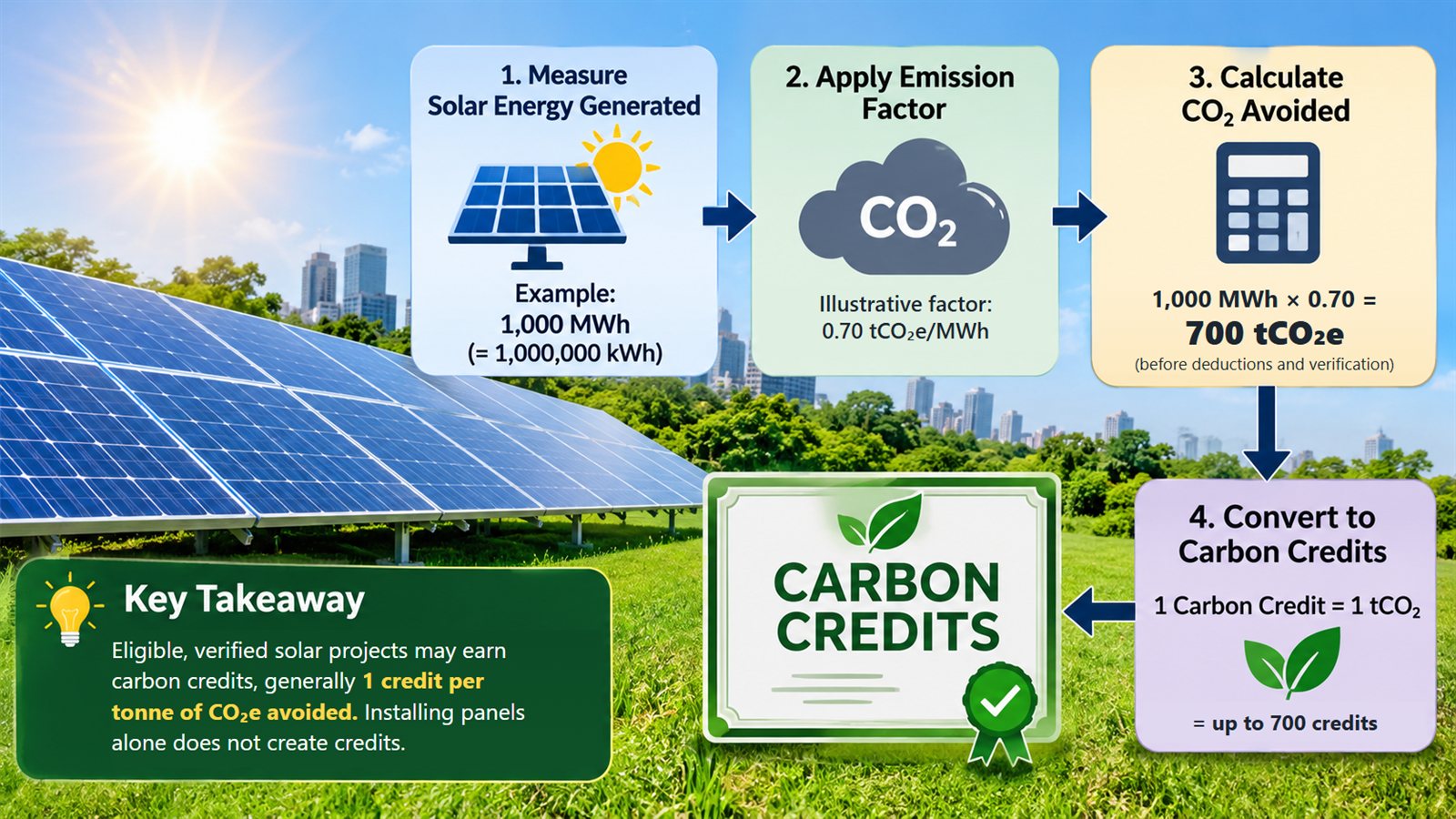
- Solar and wind energy: electricity delivered to the grid (MWh) multiplied by the grid emission factor (tCO₂/MWh) of the power it displaces.
- Hydropower: also electricity delivered × grid emission factor. Methodologies may also require accounting for methane from reservoirs, depending on reservoir size and power density.
- Forestry and reforestation: changes in carbon stocks measured from sample plots and remote sensing, with buffer contributions for reversal risk.
- Methane capture: gas flow and methane concentration, converted using methane's GWP and adjusted for destruction efficiency.
- Improved cookstoves: fuel saved per household multiplied by an emission factor, adjusted for how often the stoves are actually used and how much of the wood is non-renewable.
- Waste management: avoided methane from composting or diverting waste from landfill, based on waste quantities and composition.
- Energy efficiency: energy use before and after the improvement multiplied by fuel or grid emission factors.
- Agricultural soil carbon: changes in soil organic carbon from sampling and models, with buffers for reversal risk.
- Direct carbon removal: metered tonnes of CO₂ captured and stored, minus the energy and process emissions used to capture it.
A simple illustration: a hypothetical wind farm delivering 20,000 MWh with an assumed grid emission factor of 0.7 tCO₂/MWh would displace 20,000 × 0.7 = 14,000 tCO₂e of baseline emissions, before project emissions and deductions.
How Is Carbon Dioxide Equivalent (CO₂e) Used in Carbon Credit Calculations?
CO₂ equivalent (CO₂e) expresses all greenhouse gases in one unit: the amount of CO₂ that would cause the same warming.
- Different gases trap different amounts of heat, so they cannot simply be added together by weight.
- GWP converts each gas into CO₂e.
- Tonnes of CO₂ count only carbon dioxide. Tonnes of CO₂e include all gases, weighted by GWP.
- A common unit lets a methane project, a forestry project and a wind farm be compared and traded in the same market.
GWP values come from IPCC assessment reports:
- The Fifth Assessment Report (AR5) gives 100-year GWPs of 28 for methane and 265 for nitrous oxide.
- The Sixth Assessment Report (AR6) gives about 27 for non-fossil methane, about 30 for fossil methane and 273 for nitrous oxide.
Illustrative example (hypothetical quantity): a project avoids 100 tonnes of methane and 10 tonnes of nitrous oxide.
- Using AR5 values: (100 × 28) + (10 × 265) = 2,800 + 2,650 = 5,450 tCO₂e
- Using AR6 values of 27 and 273: (100 × 27) + (10 × 273) = 2,700 + 2,730 = 5,430 tCO₂e
The 20-tonne difference comes only from the GWP edition. Official calculations must use the values the applicable methodology specifies.
What Factors Affect the Number of Carbon Credits a Project Generates?
- Project baseline. A higher, more realistic baseline means larger reductions, but it must be justified.
- Actual emissions reductions. How well the project performs in practice.
- Project size and duration. Larger projects and longer crediting periods generate more credits overall.
- Greenhouse gas type. Methane and N₂O projects have high GWPs, so they generate more tCO₂e per tonne of gas.
- Measurement accuracy. Imprecise data leads to larger uncertainty deductions.
- Additionality. If the project would have happened anyway, it should earn no credits.
- Leakage. Shifted emissions are deducted.
- Permanence. Reversal risk triggers buffer contributions.
- Monitoring and verification. Gaps in monitoring reduce the credits that can be claimed, and auditors may correct figures.
- Approved methodology. Each one has its own equations and default values.
- Applicable deductions and uncertainty. Programme-specific discounts reduce the final number.
Two similar projects can generate different quantities of credits. For example, two solar farms of the same size may face different grid emission factors, use different methodologies, or have different data quality.
What Is the Difference Between Calculated, Verified and Issued Carbon Credits?
- Calculated emission reductions: the developer's estimates, made at the design stage or in a monitoring report. They are not yet checked.
- Verified emission reductions: reductions an accredited VVB has independently checked against the applicable methodology. Verification can reduce the figure.
- Issued carbon credits: units formally issued by the crediting programme and recorded in its registry with unique serial numbers.
After issuance, credits can go through further stages:
- Transfer: the credit moves from one registry account to another, for example when it is sold.
- Retirement: the holder permanently uses the credit to claim its emission reduction, and it can never be used again.
- Cancellation: the credit is permanently removed from circulation, for example to meet a compliance obligation such as CORSIA or to correct an error. Programmes use the terms "retirement" and "cancellation" in slightly different ways.
Which Standards and Methodologies Are Used to Calculate Carbon Credits?
Major carbon-crediting programmes include:
- Verra's Verified Carbon Standard (VCS), the largest programme by credits issued
- Gold Standard, which also requires sustainable development benefits
- American Carbon Registry (ACR)
- Climate Action Reserve (CAR), with protocols mainly for North America and Mexico
- Global Carbon Council (GCC), a programme based in the Middle East and North Africa region
Each programme publishes approved methodologies or protocols for specific project types. Developers choose the methodology that matches their activity, location and data, and the programme's rules decide how monitoring and verification must work. Calculation rules vary between standards and project types, so the same activity can produce different results under different methodologies.
Being issued under one of these programmes does not make a credit suitable for every use. Some methodologies or vintages are excluded from compliance schemes such as CORSIA, and buyers may apply their own quality criteria. For more, see our guide to carbon credit standards.
How Are Carbon Credits Calculated Under CORSIA?
CORSIA, the Carbon Offsetting and Reduction Scheme for International Aviation, is ICAO's global market-based measure to address CO₂ from international aviation. It involves two separate calculations:
- The airline's offsetting requirement. The airline monitors fuel use on international flights and converts it to CO₂ using ICAO's fuel conversion factors, for example 3.16 tonnes of CO₂ per tonne of Jet-A or Jet-A1. Its State then applies ICAO's growth factors to emissions on routes between participating States. That determines how many units the airline must cancel.
- Project emission reductions. These are calculated by carbon projects as described in this guide.
Projects calculate reductions; airlines calculate obligations. To meet an obligation, an airline cancels CORSIA eligible emissions units.
- Programme eligibility: the unit must come from a programme the ICAO Council has approved for the relevant compliance period.
- Unit eligibility: the unit must also meet conditions on vintage, scope, host-country authorisation and labelling.
These must be checked separately. A credit calculated and issued under a voluntary standard is not automatically eligible for CORSIA compliance. Other compliance systems set their own tests too. Our guide to Singapore's carbon credit eligibility criteria shows how one national carbon tax system does it.
Common Mistakes in Carbon Credit Calculations
- Using an inaccurate baseline that assumes more emissions than would really occur
- Overestimating emission reductions, for example by assuming full usage of cookstoves or equipment
- Ignoring leakage from displaced activity
- Using incorrect GWP values, or mixing values from different IPCC reports
- Failing to account for project emissions, such as fuel and electricity used by the project
- Ignoring uncertainty and methodology-specific deductions
- Confusing gross reductions with net reductions
- Treating estimated reductions as issued carbon credits
- Ignoring independent verification
Each mistake can lead to over-crediting: credits that do not represent a real tonne. That damages the environmental integrity of the credits and the trust of buyers in the wider market.
Why Accurate Carbon Credit Calculation Matters
- Environmental integrity: each credit must represent a real tonne reduced or removed.
- Transparency: published methodologies and monitoring reports let anyone check the numbers.
- Buyer confidence: buyers need to know what they are paying for.
- Prevention of greenwashing: overstated credits let companies claim climate action that did not happen.
- Reliable emissions accounting: companies and countries rely on credits in their climate reporting.
- Compliance with standards: accurate calculations are needed to pass verification and issuance.
- Market credibility: international carbon markets depend on trust that a tonne is a tonne.
Future of Carbon Credit Measurement and Calculation
Already in use:
- Satellite monitoring and remote sensing are widely used to track forest cover and deforestation.
- Electronic meters and data loggers record energy output and gas flows continuously.
- Public registries publish project documents, issuances and retirements.
Emerging and developing:
- Digital MRV systems, which collect and transmit monitoring data automatically, are being tested by crediting programmes to make verification faster and more consistent.
- Artificial intelligence is being explored to estimate biomass, detect changes in land use and flag unusual data.
- Improved methodologies are being revised to use more conservative and dynamic baselines.
Expected developments:
- Greater transparency and links between registries.
- Further international rules under Article 6 of the Paris Agreement, which affect how credits are authorised and counted between countries.
Frequently Asked Questions
How do you calculate carbon credits?
Estimate baseline emissions, subtract project emissions, leakage and other required deductions, and express the result in tonnes of CO₂e. After independent verification, the programme may issue one credit per verified tonne.
What is the formula for calculating carbon credits?
A simplified formula is: net emission reductions = baseline emissions − project emissions − leakage − applicable deductions. Each approved methodology has its own detailed equations.
How many tonnes of CO₂e does one carbon credit represent?
Generally one metric tonne of CO₂ equivalent (tCO₂e) reduced or removed, subject to the issuing programme's rules and verification.
How are carbon emissions converted into CO₂e?
Multiply the quantity of each gas by its global warming potential. For example, 1 tonne of methane at a GWP of 28 equals 28 tCO₂e. Use the GWP values your methodology specifies.
What factors affect the number of carbon credits generated by a project?
The baseline, actual performance, project size and duration, gas type, measurement accuracy, additionality, leakage, permanence, monitoring, the methodology and any required deductions.
Who verifies carbon credit calculations?
Accredited independent validation and verification bodies check the calculations against the methodology. The crediting programme then reviews the verification before issuing credits.
Are carbon credits calculated differently under CORSIA?
Project reductions are calculated under the crediting programme's methodology. CORSIA separately calculates airlines' offsetting requirements, and only units from ICAO-approved programmes that meet unit-level conditions can be used.
Conclusion
So, how do you calculate carbon credits? Start with a realistic baseline, subtract the project's own emissions, leakage and methodology-specific deductions, and express the result in tCO₂e using the specified GWP values.
Accurate results need transparent data, an approved methodology, careful monitoring and independent verification. Even then, only units formally issued by a recognised crediting programme are carbon credits. Small errors in baselines, GWP values or data can greatly overstate results.
To learn more about CORSIA, carbon credits and international carbon market developments, explore the resources at CORSIA Carbon Credit.
Sources
- IPCC – Fifth Assessment Report, Working Group I (GWP values)
- IPCC – Sixth Assessment Report, Working Group I
- UNFCCC – Article 6 of the Paris Agreement
- GHG Protocol
- Verra – Verified Carbon Standard
- Gold Standard
- American Carbon Registry
- Climate Action Reserve
- Global Carbon Council
- ICAO – CORSIA Eligible Emissions Units
- World Bank – State and Trends of Carbon Pricing