 DSTechnoverse company
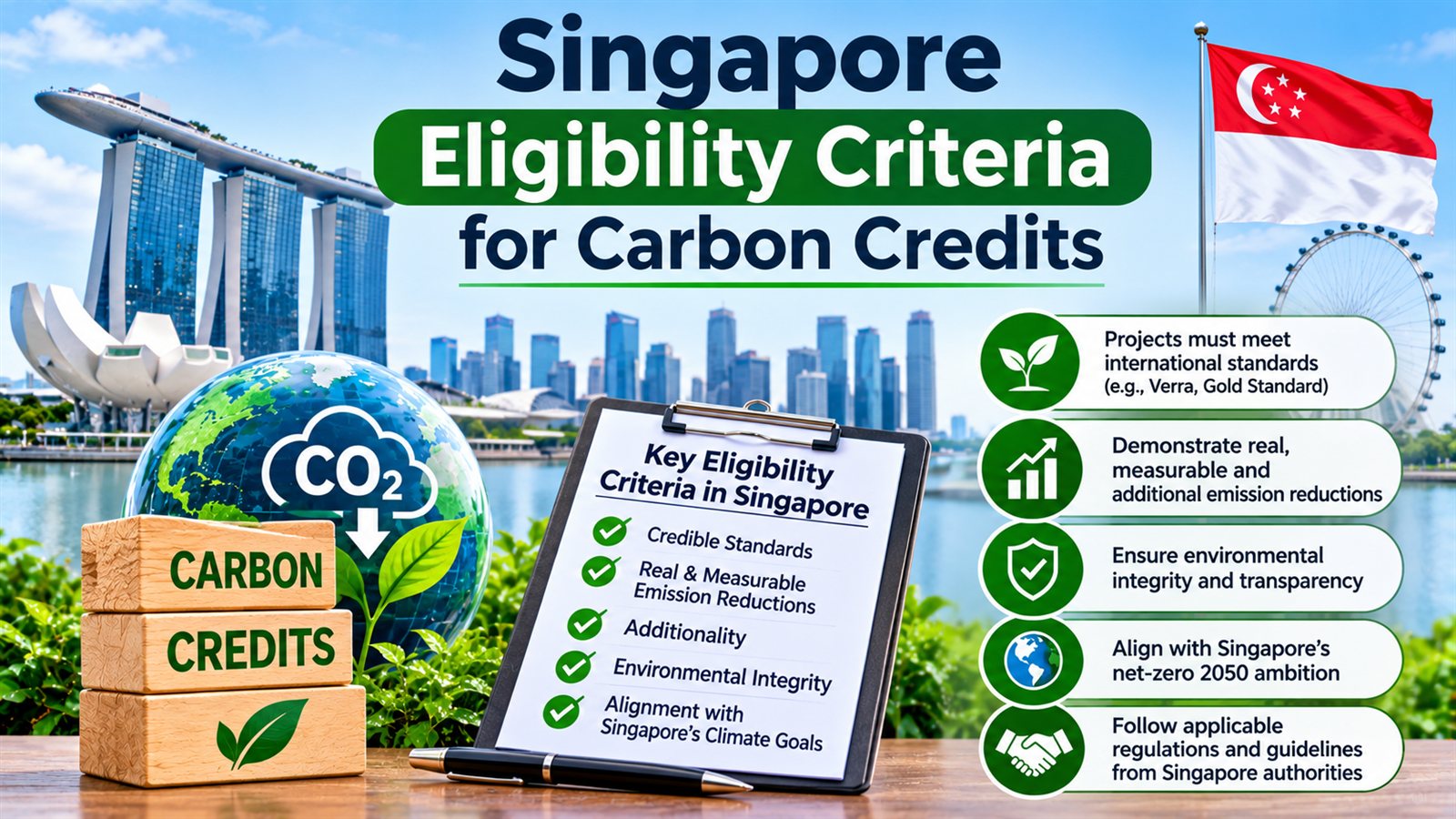
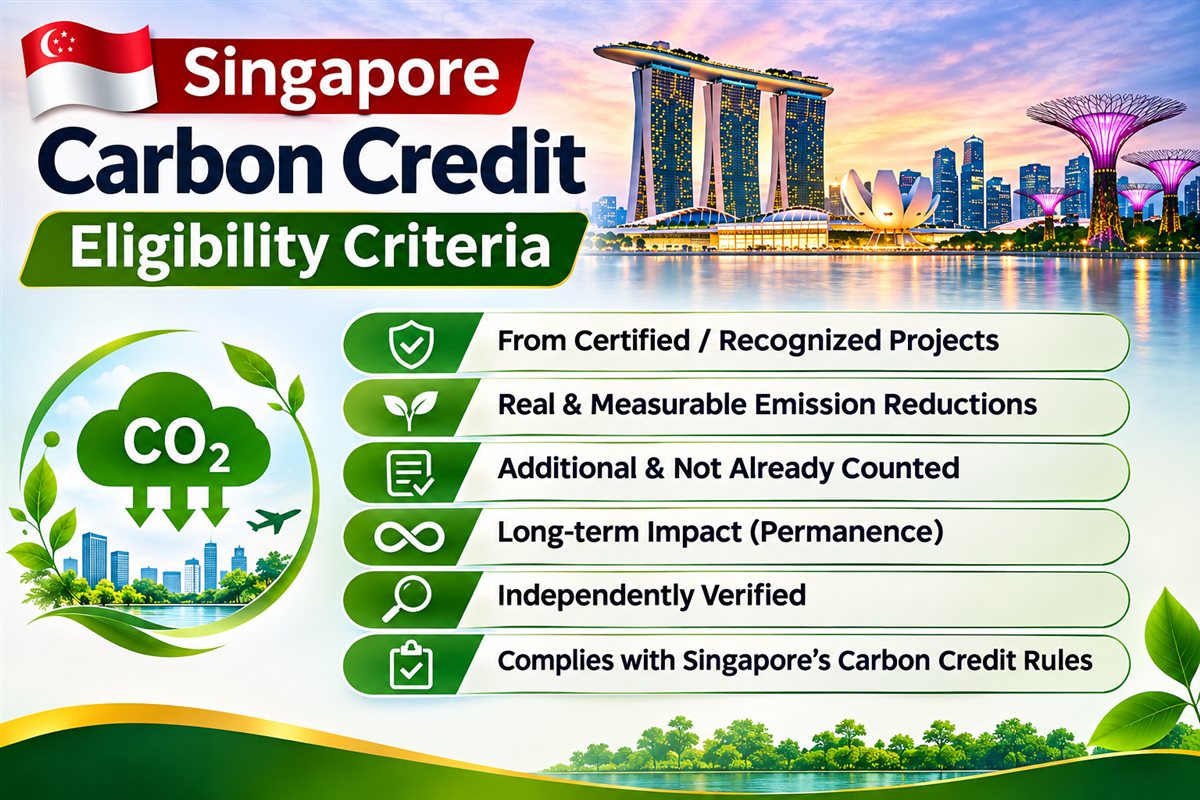
Singapore's carbon credit eligibility criteria decide which international carbon credits carbon tax-liable companies can use to offset up to 5% of their taxable emissions. Under Singapore's International Carbon Credit (ICC) Framework, a credit must meet all seven eligibility principles:
- not double-counted
- additional
- real
- quantified and verified
- permanent
- no net harm
- no leakage
Its reductions must also have occurred between 1 January 2021 and 31 December 2030, and the host country must have authorised it for a corresponding adjustment. In practice, eligible credits come from countries that have signed an Implementation Agreement with Singapore, and from programmes and methodologies on the relevant Eligibility List. For international aviation's separate scheme, see our CORSIA Carbon Credits resources.
This guide explains how the framework works, what each principle means, how Singapore assesses projects, how to check a credit, and how Singapore's rules differ from CORSIA. It is based on official Singapore government sources, last checked on 20 November 2026. It is general information, not legal advice. This website is not affiliated with or endorsed by the Government of Singapore or ICAO.
Introduction to Singapore's Carbon Credit Eligibility Framework
Singapore taxes greenhouse gas emissions from large facilities. According to the National Environment Agency (NEA), the carbon tax applies to facilities with annual direct emissions of at least 25,000 tCO₂e. Rates are:
- S$5 per tonne for 2019–2023
- S$25 for 2024 and 2025
- S$45 for 2026 and 2027
- a target of S$50–80 by 2030
Singapore also wants to support climate finance in other countries and build a high-integrity international carbon market. The ICC Framework connects these goals. Taxable companies can use a limited share of carefully screened international credits instead of paying tax on those tonnes. Every credit must deliver real, additional reductions and must not be double-counted against another country's climate target.
That is why Singapore sets strict eligibility criteria. A credit that is cheap but weak, or that is also counted by the host country, would undermine both the tax and Singapore's climate commitments.
What Is Singapore's International Carbon Credit (ICC) Framework?
An International Carbon Credit (ICC) is a carbon credit generated outside Singapore that meets Singapore's eligibility requirements. The main features of the framework are:
- Legal basis: it operates under Singapore's Carbon Pricing Act, as amended to allow carbon credits to be used against the carbon tax.
- Administration: NEA administers the carbon tax and the use of ICCs. The Ministry of Sustainability and the Environment (MSE) sets policy.
- Use: from 1 January 2024, carbon tax-liable facilities can surrender eligible ICCs to offset up to 5% of their taxable emissions each year.
- Article 6 link: eligible ICCs must be authorised by the host country for a corresponding adjustment under Article 6 of the Paris Agreement.
The 5% limit is not a general permission to use any credit. It is a cap on how much of a taxable facility's emissions can be covered. Only eligible ICCs count towards it, and companies outside the carbon tax have no offset quota at all.
A one-year rollover in 2026
On 11 May 2026, MSE announced that companies could roll over unused ICC offset quota from emissions year 2025 to emissions year 2026. It described this as a one-year transitional measure, citing "the lack of eligible ICCs available today". The rolled-over amount is adjusted by a credit conversion factor of 25/45, reflecting the tax rate rising from S$25 to S$45. Quota carried from 2024 into 2025 expired and could not be carried further.
Singapore's Seven Core Carbon Credit Eligibility Principles
MSE published the eligibility criteria in October 2023. Eligible ICCs must fulfil all seven principles. Failing any one of them is enough to make a credit ineligible.
1. Not double-counted
The reduction must not be counted more than once in breach of the Paris Agreement. If a host country sells a tonne to a Singapore company, it must apply a corresponding adjustment, adding that tonne back to its own emissions accounts. Otherwise both countries would claim the same reduction.
Example: a solar project in a partner country sells credits to a Singapore refinery. The host country authorises the transfer and adjusts its accounts, so only Singapore counts the tonnes.
2. Additionality
The reduction must go beyond what host-country laws already require, and beyond what would happen in a conservative business-as-usual scenario.
Example: if a country already requires landfills to capture methane, a landfill doing so is not additional.
3. Real emissions reductions or removals
Reductions must be quantified against a realistic, defensible and conservative business-as-usual baseline, so the claimed benefit is genuine rather than an artefact of an inflated starting point.
Example: a forest project cannot assume deforestation far higher than historical trends support.
4. Quantified and independently verified
Reductions must be calculated conservatively and transparently, and measured and verified by an accredited, independent third party before the ICC is issued. This depends on clear methodologies, monitoring data and audit reports.
Example: a cookstove project needs field surveys of stove use, not just sales figures, before it can be verified.
5. Permanence
Reductions must not be reversible. Where reversal is possible, as in forestry or soil carbon, there must be measures to monitor, mitigate and compensate for any material reversal.
Example: a reforestation project holds back credits in a buffer to cover losses from fire.
6. No net harm
Projects must not violate host-country laws, regulations or international obligations, and should not cause unacceptable harm to communities or the environment.
Example: a project that ignored land rights or environmental permits would fail this principle.
7. No leakage
The project must not cause a material increase in emissions elsewhere. If it might, there must be measures to monitor, mitigate and compensate for that increase.
Example: protecting one forest must not simply push logging into a neighbouring area without accounting for it.
The 2021–2030 window
In addition, the emissions reductions or removals must have occurred between 1 January 2021 and 31 December 2030. Credits from older vintages do not qualify, however strong they are.
Why Does Singapore Follow These Seven Eligibility Principles?
The principles exist so that every tonne used against Singapore's carbon tax represents a genuine, lasting climate benefit. Together they:
- protect environmental integrity, because an offset only works if the reduction it stands for is real, additional and permanent
- keep the carbon market credible, giving the tax and the offset system public trust
- prevent greenwashing, so companies cannot lower their tax bill with weak or recycled credits
- give buyers confidence, through clear tests they can check before paying
- create transparency and accountability, through independent verification, registries and authorisation records
- align with international cooperation, because the principles mirror Article 6 rules, which helps partner countries trust the transfers
Without these safeguards, the 5% offset allowance could reduce Singapore's tax revenue without any matching climate benefit.
Which Carbon Credits Are Eligible in Singapore?
Eligibility works at several levels at once:
- Host country: the project must be in a country with which Singapore has an applicable Implementation Agreement.
- Programme and methodology: the crediting programme and methodology must appear on that country's Eligibility List.
- Authorisation: the host country must authorise the credits for use and apply a corresponding adjustment.
- Vintage: the reductions must fall within 2021–2030.
- Principles: the credits must meet all seven principles.
NEA has signed memoranda of understanding with five carbon-crediting programmes:
- Gold Standard
- Verra's Verified Carbon Standard
- the Global Carbon Council
- the American Carbon Registry
- Architecture for REDD+ Transactions (ART)
Eligibility lists are specific to each host-country agreement, because Singapore and each partner agree which methodologies apply. The lists are reviewed and updated regularly.
For example, Ghana's list (updated 29 July 2026) accepts:
- Gold Standard for the Global Goals methodologies published before 31 March 2023, excluding the land use, forestry and agriculture category
- Verra VCS methodologies published before 31 March 2023, excluding most land-use methodologies, with VCS projects also required to show co-benefits
Methodologies can be refused if they are suspended, under review or not the latest version.
A credit issued under one of these programmes is not automatically eligible. If the project is in a country without an Implementation Agreement, uses a methodology not on that country's list, lacks authorisation, or falls outside the 2021–2030 window, it does not qualify. Our guide to carbon credits standards explains how these programmes work.
Host-Country Authorisation and Corresponding Adjustments
Host-country authorisation is the step that makes an international credit usable in Singapore. Without it, a credit cannot meet the "not double-counted" principle, however strong the project is.
Article 6.2 of the Paris Agreement allows countries to cooperate by transferring Internationally Transferred Mitigation Outcomes (ITMOs), which are emission reductions moved from one country's climate accounts to another's.
Four ideas make this work:
- Host-country authorisation: the selling country formally approves the reductions for international transfer.
- Corresponding adjustment: the host country adds the transferred tonnes back to its emissions accounts, so it does not count them towards its own target.
- Implementation Agreements: Singapore signs these legally binding bilateral agreements with each partner country. They set out how projects are approved, which methodologies apply and how transfers are authorised.
- ICCs and ITMOs: an ICC under Singapore's framework is in effect an ITMO that meets Singapore's eligibility requirements.
This differs from much of the voluntary carbon market, where many credits are sold without host-country authorisation or adjustment.
Singapore's Article 6 cooperation also requires two contributions:
- a 5% share of proceeds for the host country's adaptation actions or the Adaptation Fund
- the cancellation of 2% of authorised credits at issuance, to deliver an overall mitigation in global emissions
Programme registration or credit issuance alone does not make a credit eligible. A credit can be properly issued by Verra or Gold Standard and still fail Singapore's rules if the host country has not authorised it for corresponding adjustment under an Implementation Agreement.
Singapore's Eligible Host Countries and Implementation Agreements
As of 20 November 2026, Singapore's Article 6 cooperation page lists 14 countries with which Singapore has signed or substantively concluded Implementation Agreements:
- Bhutan
- Chile
- Ghana
- Kenya
- Lao PDR
- Mongolia
- Papua New Guinea
- Paraguay
- Peru
- the Philippines
- Rwanda
- Thailand
- Vietnam
- Zambia
The Kenya and Zambia agreements were announced on 16 and 18 November 2026. Earlier government pages, written in mid-2026, still refer to 11 agreements. Country-specific Eligibility Lists had been published for Ghana, Bhutan, Peru, Rwanda, Thailand and Mongolia. Our guide to the Singapore carbon credit eligibility list covers each country's status in detail.
The process has several stages, and they should not be confused:
- Memorandum of understanding (MOU): a non-binding intention to work towards an agreement. Singapore has MOUs with several further countries.
- Signed Implementation Agreement: the legally binding framework.
- Operational arrangements: for example, calls for project applications, which MSE reported had been launched in Bhutan, Ghana, Peru, Rwanda and Thailand between late 2025 and early 2026.
- Authorised projects: approved by both governments.
- Issued, available credits: the only units that can actually be surrendered.
A signed agreement does not mean credits are already available. MSE's May 2026 rollover was introduced precisely because few eligible ICCs existed yet, and Ghana's project register showed no registered projects as of August 2026. Eligibility requirements and approved methodologies differ by host country. Check the official Singapore Carbon Markets Cooperation website for each country's current list and project register.
How Does Singapore Assess Carbon Credit Project Eligibility?
Project eligibility is assessed separately from programme recognition. A recognised programme is only one of ten checks:
- Project location and host country
- An applicable Singapore–host-country Implementation Agreement
- An eligible crediting programme on that country's list
- An accepted methodology, in its latest version and within any cut-off date
- Project design and baseline assessment that is realistic and conservative
- Additionality evidence beyond legal requirements and business as usual
- Monitoring and verification documentation from an accredited independent verifier
- Host-country authorisation under the agreement
- Corresponding adjustment arrangements
- Registry issuance and traceability of the resulting credits
A project can pass the first four checks and still fail on authorisation, additionality or verification.
How Can Businesses Check Whether a Carbon Credit Is Eligible in Singapore?
- Identify the host country where the project is located.
- Check for a signed Implementation Agreement with Singapore, not just an MOU.
- Read that country's Eligibility List on the official Singapore carbon markets website.
- Confirm that the programme and methodology are on the list.
- Check the project's authorisation status under the agreement.
- Verify the crediting period and vintage fall within 2021–2030.
- Confirm the host country's authorisation for corresponding adjustment.
- Review validation, verification, issuance and registry records, including serial numbers.
- Confirm that the credits meet every ICC requirement before buying or surrendering them, using NEA's current guidance.
Always check the individual project and credits, not just the standard's name, and do not rely only on supplier claims or marketing descriptions. Our guide to the carbon credit certification process explains the validation and verification records to look for.
Singapore Carbon Credit Eligibility vs CORSIA Eligibility
Singapore's framework and CORSIA are both high-integrity systems, but they are separate.
- Purpose: Singapore's ICCs offset part of a domestic carbon tax. CORSIA units meet international aviation offsetting obligations.
- Authority: Singapore's MSE and NEA set ICC rules. ICAO's Council, advised by its Technical Advisory Body, decides CORSIA eligibility.
- Eligibility route: Singapore works through bilateral Implementation Agreements and country-specific eligibility lists. CORSIA approves programmes for each compliance period, with unit-level scope and vintage conditions.
- Vintage: Singapore requires reductions in 2021–2030. CORSIA's first phase generally requires vintages from 2021 to 2026 and project start dates from 2016.
- Host-country requirements: both require host-country authorisation and corresponding adjustments for the relevant units.
- Intended use: the two schemes serve different compliance obligations.
An ICC eligible in Singapore is not automatically CORSIA eligible, and a CORSIA-eligible unit is not automatically eligible in Singapore. Each must be checked against its own rules. Ordinary voluntary credits are eligible for neither by default. Our guide to CORSIA eligible carbon credits explains ICAO's rules.
Common Reasons Carbon Credits May Not Qualify in Singapore
- No host-country authorisation for corresponding adjustment
- No Implementation Agreement with the host country, or only an MOU
- A methodology missing from that country's Eligibility List
- Double-counting risk, for example because the host country still counts the tonnes
- Weak additionality evidence, including reductions already required by local law
- Poor monitoring or verification, or no accredited third-party audit before issuance
- Permanence or leakage concerns without adequate safeguards
- A vintage outside 2021–2030
- Non-compliance with project, registry or NEA surrender requirements
Developers can reduce these risks by choosing partner countries with agreements in force, using listed methodologies and applying through official calls. Buyers can reduce them by verifying each credit's authorisation, methodology, vintage and registry record before signing.
Benefits of Singapore's Carbon Credit Eligibility Framework
- Higher environmental integrity: only authorised, verified, additional credits qualify.
- Greater market confidence: clear, published criteria and country lists.
- More transparent transactions: project registers, authorisation records and registry tracking.
- Better project accountability: independent verification before issuance.
- International climate cooperation: bilateral agreements channel finance to partner countries, with a share of proceeds for adaptation.
- Support for credible projects: a clear route to market for high-quality developers.
Eligibility does not guarantee any particular credit price, commercial return or buyer demand.
What Does Singapore's Eligibility Framework Mean for Carbon Credit Buyers and Project Developers?
- Carbon tax-liable companies:
- plan purchases within the 5% limit
- factor in the 2026 rollover rules
- check eligibility before signing any contract
- International credit suppliers: eligibility depends on the host country's agreement with Singapore, not just the standard. Offering "Singapore-eligible" credits without authorisation is a red flag.
- Project developers:
- design projects in partner countries
- use methodologies on the eligibility list
- apply through official calls for projects
- plan for authorisation and corresponding adjustments from the start
- Intermediaries: due diligence on authorisation status, vintage and registry records is essential.
- Sustainability and climate finance professionals: the framework shows how Article 6 can link domestic carbon pricing with international climate finance.
In every case, check current eligibility before making commercial commitments, because lists and agreements change.
Future Outlook for Singapore's International Carbon Credit Market
Confirmed policy
- The carbon tax rises to S$45 for 2026–2027, with a stated aim of S$50–80 by 2030.
- Eligible ICCs can cover up to 5% of taxable emissions.
- Implementation Agreements had been signed or concluded with 14 countries by November 2026, with calls for projects launched in several of them.
- A one-year quota rollover from 2025 to 2026 was introduced because eligible ICCs were scarce.
Expectations and possibilities
- more Implementation Agreements, as MOU partners move towards binding agreements
- more eligible supply, as approved projects issue credits
- continued emphasis on environmental integrity and transparency, including NEA's national registry for tracking surrendered ICCs
- a balance of supply and demand that will depend on project approvals and issuance timelines
- opportunities for international developers in partner countries, alongside challenges around authorisation timelines and methodology approval
None of these future developments is guaranteed.
Frequently Asked Questions
What are Singapore's carbon credit eligibility criteria?
International credits must meet all seven principles: not double-counted, additional, real, quantified and verified, permanent, no net harm and no leakage. The reductions must have occurred between 2021 and 2030, and the host country must authorise them for corresponding adjustment.
What are the seven principles of Singapore's ICC Framework?
Not double-counted, additional, real, quantified and verified, permanent, no net harm, and no leakage. Eligible ICCs must fulfil all seven.
What is the 5% carbon credit offset limit in Singapore?
Since 1 January 2024, carbon tax-liable facilities can use eligible ICCs to offset up to 5% of their taxable emissions each year. It is a cap on use, not permission to use any credit, and a one-year rollover of unused 2025 quota into 2026 was allowed.
Why are corresponding adjustments required for Singapore carbon credits?
So the same reduction is not counted twice. The host country authorises the transfer and adds the tonnes back to its own accounts, so only Singapore counts them.
Are all Verra and Gold Standard credits eligible in Singapore?
No. NEA has MOUs with both programmes, but a credit also needs a host country with an Implementation Agreement, a methodology on that country's Eligibility List, host-country authorisation and a 2021–2030 vintage.
How can businesses verify whether a carbon credit meets Singapore's eligibility criteria?
Check the host country's Implementation Agreement and Eligibility List on carbonmarkets-cooperation.gov.sg. Then confirm the methodology, project authorisation, vintage, corresponding adjustment, verification reports and registry serial numbers.
What is the difference between Singapore and CORSIA carbon credit eligibility?
Singapore-eligible ICCs offset part of Singapore's carbon tax under bilateral agreements. CORSIA-eligible units meet airline obligations under ICAO's rules. Eligibility under one does not mean eligibility under the other.
Conclusion
Singapore's approach to international carbon credits is built on high integrity. Credits must meet all seven eligibility principles, fall within the 2021–2030 window, and come from a partner country with a signed Implementation Agreement. They must also use a methodology on that country's Eligibility List and carry host-country authorisation with a corresponding adjustment. Even then, they can cover only up to 5% of a facility's taxable emissions.
For buyers and developers, the lesson is to check the specific project and credits against current official lists, not just the name of a standard.
For more on CORSIA carbon credits and international carbon market developments, explore the resources at CORSIA Carbon Credit.
Sources
- MSE – Singapore sets out eligibility criteria for international carbon credits under the carbon tax regime (4 October 2023)
- MSE – Roll over of unutilised ICC offset quota for emissions year 2025 (11 May 2026)
- NEA – Carbon tax
- NCCS – International collaboration (last updated 30 July 2026)
- Singapore Carbon Markets Cooperation
- Singapore Carbon Markets Cooperation – Our Article 6 Cooperation (updated 20 November 2026)
- Singapore Carbon Markets Cooperation – Ghana Eligibility List (updated 29 July 2026)
- Singapore Statutes Online – Carbon Pricing Act
- UNFCCC – Article 6 of the Paris Agreement
- ICAO – CORSIA Eligible Emissions Units