 DSTechnoverse company
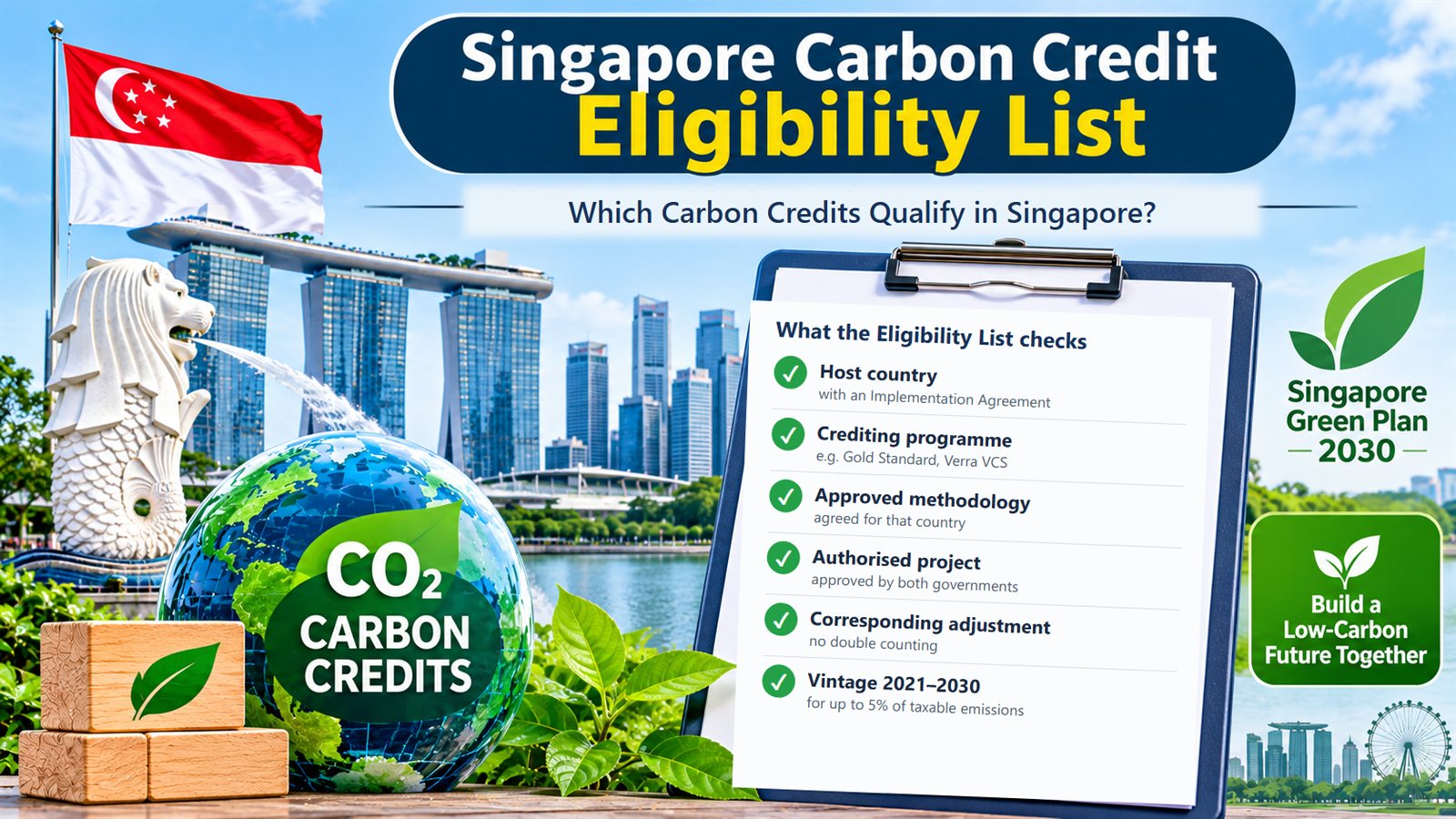
Singapore's carbon credit Eligibility List sets out which international carbon credits Singapore's carbon tax-liable companies can use to offset up to 5% of their taxable emissions. It is not one global list. It is agreed country by country with each host country that has signed an Implementation Agreement with Singapore. Each country's list names:
- the accepted carbon-crediting programmes
- the accepted methodologies
- any exclusions
On top of that, credits must:
- come from an authorised project
- carry a corresponding adjustment
- date from 2021–2030
- meet Singapore's seven eligibility principles
For aviation's separate scheme, see our CORSIA Carbon Credits resources.
This guide explains what the list contains, the current status of each country, and how to verify an individual credit. All time-sensitive information was checked on 20 November 2026 against Singapore's official Carbon Markets Cooperation website, NEA and MSE. It is general information, not legal advice. This website is not affiliated with or endorsed by the Government of Singapore or ICAO.
Introduction to Singapore's Carbon Credit Eligibility List
Singapore taxes greenhouse gas emissions from large facilities, at S$45 per tonne in 2026 and 2027 according to the National Environment Agency (NEA). From 1 January 2024, taxable facilities may surrender eligible International Carbon Credits (ICCs) to cover up to 5% of their taxable emissions.
The Eligibility List decides which credits count. It matters for three reasons:
- it protects environmental integrity, so only credible, authorised reductions reduce Singapore's tax base
- it avoids double counting with host countries' climate targets
- it gives buyers and developers a clear test before money changes hands
Buyers and suppliers should check eligibility before buying or selling. Credits outside the list cannot be surrendered to NEA, however good they look.
What Is Singapore's International Carbon Credit (ICC) Framework?
An ICC is an international carbon credit that meets Singapore's eligibility requirements. The framework has these main features:
- Legal basis: Singapore's Carbon Pricing Act, which allows eligible credits to be used against the carbon tax.
- Administration: NEA administers the carbon tax and the surrender of ICCs. The Ministry of Sustainability and the Environment (MSE) sets policy.
- Use: carbon tax-liable facilities can offset up to 5% of their taxable emissions each year with eligible ICCs.
- Rollover: in May 2026, MSE allowed a one-year rollover of unused 2025 quota into 2026, adjusted by a factor of 25/45, citing the lack of eligible ICCs available.
The framework is not a general approval system for voluntary carbon credits. It covers only credits that meet Singapore's specific bilateral and integrity requirements, and only for carbon tax-liable companies.
What Is Included in Singapore's Carbon Credit Eligibility List?
To judge whether a credit qualifies, check each of these components:
- Eligible host country: the project must be in a country with which Singapore has an Implementation Agreement.
- Bilateral Implementation Agreement: the legally binding framework for Article 6 cooperation with that country.
- Eligible crediting programmes: named on that country's list.
- Accepted methodologies: the specific methodologies, with cut-off dates and exclusions.
- Eligible project types: these follow from the accepted methodologies, and some categories are excluded.
- Project authorisation: the project must be approved under the agreement.
- Crediting period and vintage: reductions must have occurred between 1 January 2021 and 31 December 2030.
- Corresponding adjustment: the host country must authorise the credits and adjust its accounts.
- Registry and tracking: credits must be traceable and surrendered to NEA according to its guidance.
According to the official site, "the Eligibility List differs by host countries as it is bilaterally agreed upon between Singapore and the respective host country". It is reviewed and updated regularly. The overall Eligibility List page was last updated on 2 November 2026.
Singapore's Eligible Countries for International Carbon Credits
Implementation Agreements signed or concluded
As of 20 November 2026, Singapore's Article 6 cooperation page lists 14 countries with which Singapore has signed or substantively concluded Implementation Agreements:
- Bhutan
- Chile
- Ghana
- Kenya
- Lao PDR
- Mongolia
- Papua New Guinea
- Paraguay
- Peru
- the Philippines
- Rwanda
- Thailand
- Vietnam
- Zambia
The site's newsroom announced the Kenya agreement on 16 November 2026 and the Zambia agreement on 18 November 2026, at COP31.
The page marks Bhutan, Chile, Ghana, Lao PDR, Mongolia, Peru, Rwanda, Thailand, Vietnam and Zambia as having entered into force. Some other government pages, such as NEA's carbon tax page, still refer to 11 Implementation Agreements, because they were written earlier. Always use the latest official listing.
Country-specific Eligibility Lists published
The overall Eligibility List page links published lists for six countries:
- Ghana
- Bhutan
- Peru
- Rwanda
- Thailand
- Mongolia
Calls for projects
NEA reports that application calls for carbon credit projects were launched in Bhutan, Ghana, Peru, Rwanda and Thailand between late 2025 and early 2026. The official site states that the Singapore–Ghana Implementation Agreement, signed on 27 May 2024, "is open for project applications".
Authorised projects and issued credits
Supply is still at an early stage. Ghana's project register stated "There are no projects registered at the moment" (page updated 3 August 2026). NEA notes that projects "typically take up to four years to generate credits", so supply will take time to build up. We could not confirm from official pages that any ICCs had been issued and made available for surrender as of 20 November 2026.
Several distinctions matter here:
- MOUs are only intentions to negotiate. Singapore has MOUs with further countries, such as Bangladesh, announced on 14 November 2026.
- Signed agreements are not the same as agreements that have entered into force.
- A published country list does not mean projects are authorised.
- Authorised projects do not mean credits are issued and available.
Eligible Carbon Credit Programmes and Standards in Singapore
NEA has signed memoranda of understanding with five carbon-crediting programmes:
- Gold Standard
- Verra's Verified Carbon Standard (VCS)
- the Global Carbon Council (GCC)
- the American Carbon Registry (ACR)
- Architecture for REDD+ Transactions (ART)
Whether each programme is actually usable depends on each country's list.
Example: Ghana's Eligibility List (updated 29 July 2026)
- Gold Standard for the Global Goals: all active methodologies published before 31 March 2023, except those in the Land Use and Forestry & Agriculture category.
- Verra VCS: all active methodologies published before 31 March 2023, except most of those in Sectoral Scope 14 (agriculture, forestry and other land use), with specified exceptions. VCS projects must also demonstrate co-benefits through the CCB Standards, SD VISta or another VCS-recognised standard.
- Grounds for refusal: a methodology may be refused if it is not aligned with domestic law, is suspended or under formal review, or "is not the latest version".
The other programmes were not on Ghana's list as published.
What each programme does
- Verra VCS: the largest voluntary programme. It verifies projects through approved validation and verification bodies (VVBs) and issues Verified Carbon Units.
- Gold Standard: combines climate impact with sustainable development requirements, with design and performance certification.
- GCC: a Qatar-based programme with its own standards and approved verifiers.
- ACR: a US-rooted programme that approves its own methodologies and uses accredited verifiers.
- ART: credits jurisdictional forest programmes, run at national or subnational level, under its TREES standard.
Programme recognition does not make every credit eligible. Our guide to carbon credits standards explains these programmes in more depth.
Which Types of Carbon Credit Projects May Qualify?
The following are illustrative categories only, not a blanket approved list:
- renewable energy
- methane avoidance and capture, such as landfill gas
- forestry and reforestation, where the country's list allows it
- improved cookstoves
- waste management
- energy efficiency
- nature-based carbon removal
- other reduction or removal activities covered by accepted methodologies
Actual eligibility depends on the host country's list, the specific methodology and its date, project authorisation and the other conditions. Ghana's list, for example, excludes most land-use and forestry methodologies. A forestry project in Ghana would therefore usually not qualify, even under a recognised programme.
Singapore's Seven Core Eligibility Principles
According to MSE, every eligible ICC must meet all seven principles:
- Not double-counted. The reduction is not counted more than once in breach of the Paris Agreement. Example: without a corresponding adjustment, a host country and a Singapore buyer could both claim the same tonne.
- Additional. It goes beyond host-country legal requirements and a conservative business-as-usual scenario. Example: methane capture that local law already requires is not additional.
- Real. It is measured against a realistic, defensible and conservative baseline. Example: a forest project cannot assume unrealistically high deforestation.
- Quantified and verified. It is calculated conservatively and transparently, and verified by an accredited independent third party before issuance. Example: cookstove credits need verified usage data, not just sales figures.
- Permanent. It is not reversible, or there are measures to monitor, mitigate and compensate any material reversal. Example: forest projects hold buffer credits against fire.
- No net harm. It does not violate host-country laws, regulations or international obligations. Example: a project that ignores land rights fails this principle.
- No leakage. It causes no material increase in emissions elsewhere, or that increase is monitored and compensated. Example: protecting one forest must not simply move logging next door.
Our Singapore eligibility criteria guide explains each principle in more detail.
Role of Article 6 of the Paris Agreement
Article 6.2 of the Paris Agreement lets countries cooperate by transferring Internationally Transferred Mitigation Outcomes (ITMOs), which are emission reductions moved between countries' climate accounts. Several ideas make this work:
- Host-country authorisation: the host government formally approves the transfer.
- Corresponding adjustment: the host country adds the transferred tonnes back to its emissions accounts, so it does not count them towards its own target. This is what prevents double counting.
- Implementation Agreements: these set the process for approving projects, applying the Eligibility List and authorising transfers between Singapore and each partner.
- Contributions: Singapore's Article 6 page describes a 5% share of proceeds for adaptation, and the cancellation of 2% of authorised credits at issuance for an overall mitigation in global emissions.
ICCs are ITMOs that meet Singapore's specific requirements. Not every ITMO is an eligible ICC, and the terms are not interchangeable in every context.
How to Check the Latest Singapore Carbon Credit Eligibility List
- Visit carbonmarkets-cooperation.gov.sg.
- Open Environmental Integrity › Overall Eligibility List and note its "last updated" date.
- Check the list of host countries with published lists.
- Find the Implementation Agreement for the project's country under "Our Article 6 Cooperation", and check whether it has entered into force.
- Read the country-specific Eligibility List, including its programmes, methodology cut-off dates and exclusions.
- Confirm the programme and methodology your project uses, including its version.
- Check the project register for that country to see whether the project is registered and authorised.
- Check the vintage and monitoring period, which must fall within 2021–2030.
- Confirm corresponding adjustment through host-country authorisation.
- Review registry and issuance records for the credits' serial numbers. Then follow NEA's ICC guidance for surrender.
How to Verify Whether an Individual Carbon Credit Is Eligible
Never rely only on a programme name or project type. For each credit, check:
- project identity and location, and that the host country has an Implementation Agreement
- host-country authorisation under that agreement
- the methodology, which must be on the country's list in the right version and within the cut-off date
- the crediting programme, which must be on the country's list
- vintage and monitoring period, within 2021–2030
- verification documents from an accredited independent verifier
- serial numbers and registry records
- corresponding adjustment status
- transfer and retirement records, to confirm the credits have not been used elsewhere
Our guide to the carbon credit certification process explains how to read verification and registry documents.
Singapore Carbon Credit Eligibility List vs CORSIA Eligibility List
- Objective: Singapore's list governs offsets against a domestic carbon tax. CORSIA governs international aviation's offsetting obligations.
- Authority: MSE and NEA set Singapore's rules, agreed bilaterally with host countries. The ICAO Council, advised by its Technical Advisory Body, decides CORSIA eligibility.
- Structure: Singapore lists programmes and methodologies per host country. CORSIA approves programmes for each compliance period, with unit-level scope and vintage conditions.
- Vintage: Singapore requires reductions from 2021–2030. CORSIA's first phase generally requires vintages from 2021 to 2026.
- Shared requirement: both require host-country authorisation and corresponding adjustments for the relevant units.
A Singapore-eligible ICC is not automatically CORSIA eligible, and a CORSIA-eligible unit is not automatically eligible in Singapore. Ordinary voluntary credits qualify for neither by default. Our guide to CORSIA eligible carbon credits explains ICAO's rules.
Common Mistakes When Using Singapore's Carbon Credit Eligibility List
- Treating all voluntary credits as eligible: only listed, authorised credits count.
- Assuming a recognised standard guarantees eligibility: country lists exclude some methodologies and categories.
- Using outdated information: the number of agreements rose from 11 to 14 during 2026.
- Confusing an MOU or a signed agreement with one in force.
- Ignoring project authorisation: a methodology on the list is not enough on its own.
- Overlooking corresponding adjustments.
- Failing to check vintage: credits from before 2021 do not qualify.
- Confusing issued credits with credits available for surrender: supply is still building.
What the Eligibility List Means for Carbon Credit Buyers and Project Developers
- Carbon tax-liable businesses should plan within the 5% cap, consider the 2026 rollover rules, and contract only for credits that clearly meet the list.
- International suppliers need host-country authorisation and a listed methodology. Claims of "Singapore-eligible" credits without these are a red flag.
- Project developers should choose countries with agreements in force, use methodologies on that country's list and apply through official calls. They should also plan for long lead times.
- Intermediaries should verify each credit's authorisation, methodology, vintage and registry history.
- Sustainability consultants should advise clients to keep full documentation and check the latest lists before committing.
Commercial risks include authorisation delays, methodology changes and slow issuance. Contracts should address these.
Future Outlook for Singapore's Carbon Credit Eligibility List
Confirmed developments
- Implementation Agreements grew to 14 by November 2026, including Kenya and Zambia.
- Country lists have been published for six countries.
- Application calls are open in several partner countries.
- A one-year quota rollover has been applied.
Expectations, not confirmed
- more countries moving from MOUs to agreements
- more country-specific lists and methodologies
- first projects registered and credits issued in the coming years
- continued demand for high-integrity credits as the tax rises towards S$50–80 by 2030
- greater emphasis on transparent monitoring and registries
Conclusion
Singapore's carbon credit Eligibility List keeps its carbon tax offset system credible by accepting only authorised, high-integrity Article 6 credits. Eligibility must be checked at five levels:
- the country and its Implementation Agreement
- the programme
- the methodology on that country's list
- the project's authorisation
- the individual credit's vintage, corresponding adjustment and registry record
With 14 agreements but few credits yet registered, checking the latest official lists before any commitment is essential. For more on CORSIA carbon credits and international carbon market developments, explore the resources at CORSIA Carbon Credit.
Frequently Asked Questions
What is Singapore's carbon credit eligibility list?
It is the set of host-country-specific lists naming which carbon-crediting programmes and methodologies can produce International Carbon Credits for offsetting up to 5% of Singapore's taxable emissions.
Which countries are eligible to supply carbon credits to Singapore?
As of 20 November 2026, Singapore listed 14 countries with signed or concluded Implementation Agreements. Country-specific Eligibility Lists were published for Ghana, Bhutan, Peru, Rwanda, Thailand and Mongolia. Check the official site for current status.
Which carbon credit standards are accepted in Singapore?
NEA has MOUs with Gold Standard, Verra VCS, GCC, ACR and ART. Which ones are accepted for a particular project depends on that host country's Eligibility List. Ghana's list, for example, names Gold Standard and VCS methodologies.
How can I check whether a carbon credit is eligible in Singapore?
Check the host country's Implementation Agreement and Eligibility List on carbonmarkets-cooperation.gov.sg. Confirm the programme, methodology, project authorisation, 2021–2030 vintage, corresponding adjustment and registry records, then follow NEA's surrender guidance.
Are all Verra and Gold Standard carbon credits eligible in Singapore?
No. Only credits from countries with an Implementation Agreement, using methodologies on that country's list, with host-country authorisation and 2021–2030 vintages, are eligible.
What is the difference between Singapore ICC eligibility and CORSIA eligibility?
Singapore's list governs offsets against its domestic carbon tax through bilateral agreements. CORSIA governs airline obligations under ICAO's rules. Eligibility under one does not imply eligibility under the other.
Can Singapore companies use international carbon credits to offset their carbon tax?
Yes. Carbon tax-liable facilities can use eligible ICCs to offset up to 5% of their taxable emissions each year from 2024. A one-year rollover of unused 2025 quota into 2026 was allowed.
Sources
- Singapore Carbon Markets Cooperation – Overall Eligibility List (updated 2 November 2026)
- Singapore Carbon Markets Cooperation – Our Article 6 Cooperation (updated 20 November 2026)
- Singapore Carbon Markets Cooperation – Ghana Eligibility List (updated 29 July 2026)
- Singapore Carbon Markets Cooperation – Project register (updated 14 November 2026)
- MSE – Eligibility criteria for international carbon credits (4 October 2023)
- MSE – Roll over of unutilised ICC offset quota (11 May 2026)
- NEA – Carbon tax
- UNFCCC – Article 6 of the Paris Agreement
- ICAO – CORSIA Eligible Emissions Units