 DSTechnoverse company
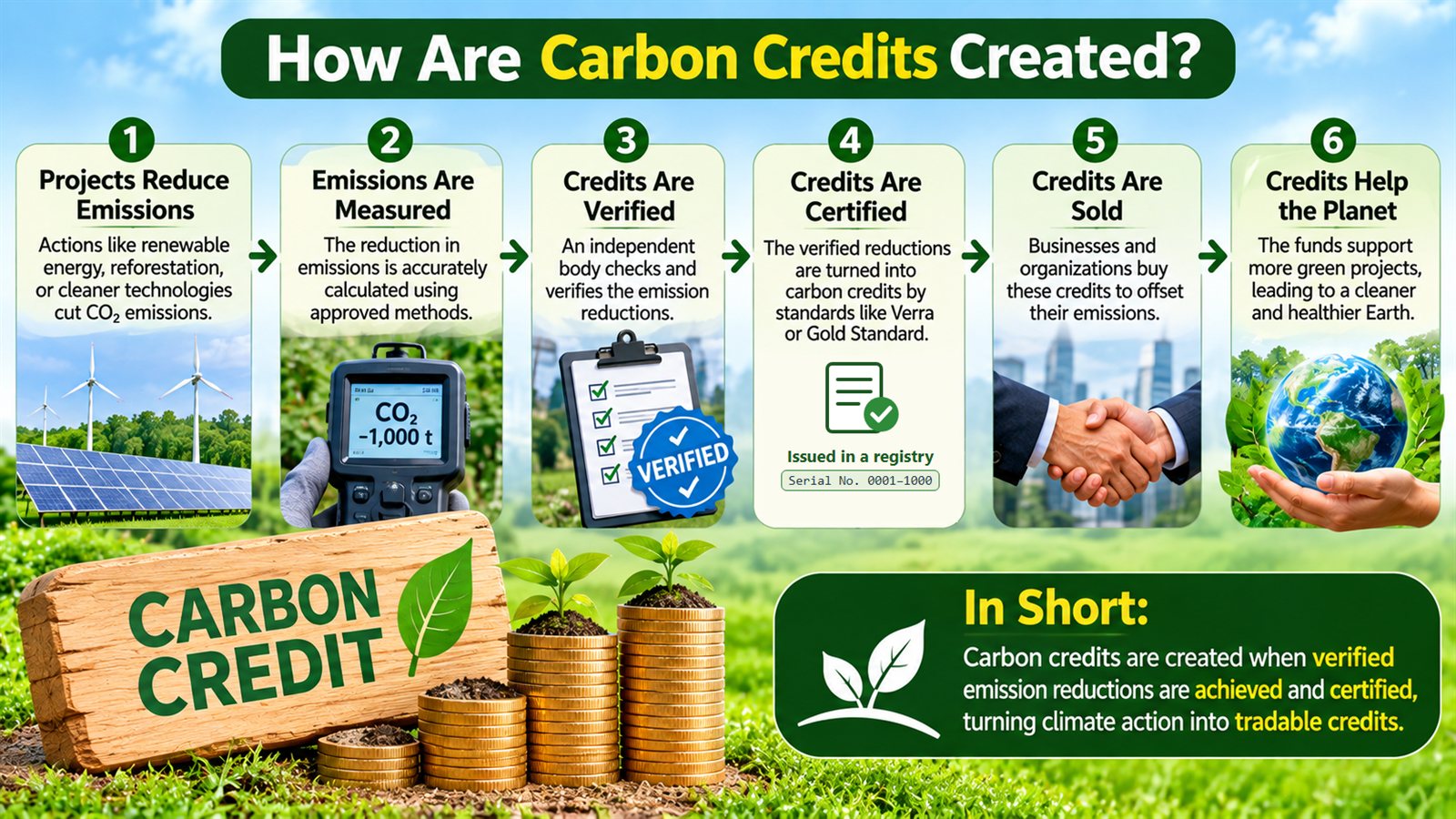
How are carbon credits created? A project that reduces or removes greenhouse gases follows an approved methodology to measure its results against a baseline. It is validated and registered with a carbon-crediting programme, monitors its performance, and has its results independently verified. The programme then issues credits into a registry, generally one credit for each verified tonne of CO₂ equivalent. For how credits are used in aviation, see our CORSIA Carbon Credits resources.
This guide walks through each stage, explains who is responsible for what, and shows how CORSIA-eligible units have extra requirements on top of the general process.
What Are Carbon Credits?
A carbon credit is a tradable certificate issued by a carbon-crediting programme. It represents one metric tonne of CO₂ equivalent (tCO₂e) reduced or removed, subject to the programme's rules.
- Reduction credits come from preventing emissions, such as capturing landfill methane.
- Removal credits come from taking CO₂ out of the air and storing it, such as growing forests or producing biochar.
Credits are used by companies for voluntary climate targets, by airlines under CORSIA, and in some regulated schemes. They channel finance to projects that would not otherwise happen. That only works if each credit represents a real, additional, measured tonne, which is why the creation process is so detailed.
How Are Carbon Credits Created?
In short, the carbon credit creation process has three phases:
- Design: choose an eligible project, standard and methodology; set the baseline; show additionality; document everything.
- Approval: an independent body validates the design, and the programme registers the project.
- Crediting: the project monitors results, an independent body verifies them, and the programme issues credits into a registry.
An environmentally beneficial activity does not automatically create carbon credits. Credits exist only once a programme formally issues them.
Step-by-Step Process of Creating Carbon Credits
1. Identify a Carbon Reduction or Removal Project
Activities that can potentially generate carbon credits include:
- renewable energy, such as solar, wind, hydro and biogas
- afforestation and reforestation
- methane capture from landfills, wastewater or livestock manure
- improved waste management, such as composting
- energy efficiency, such as efficient cookstoves or industrial upgrades
- agricultural and soil carbon practices
- biochar and other carbon removal technologies, such as direct air capture
The project needs a clear owner, a defined location, enough scale to cover certification costs, and a realistic chance of meeting a programme's rules.
2. Select an Appropriate Carbon Credit Standard and Methodology
A carbon-crediting programme, or standard, sets the overall rules and runs the registry. Examples include Verra's Verified Carbon Standard, Gold Standard, the American Carbon Registry and the Climate Action Reserve.
A methodology (called a protocol by some programmes) is the detailed rulebook for one project type. It sets:
- the project boundary, meaning which sites, sources and gases are counted
- how to determine the baseline scenario
- monitoring requirements, such as what to measure and how often
- the calculation procedures and default values
The developer chooses a methodology that matches the activity, location and available data.
3. Establish the Baseline Scenario
The baseline is what would most likely have happened without the project. For example, a new wind farm's baseline might be electricity from the existing grid mix. Baseline emissions are the starting point for calculating reductions, so an inflated baseline creates credits for tonnes that were never really avoided. Methodologies require conservative, evidence-based baselines.
4. Demonstrate Additionality
A project is additional if the reductions would not have happened without carbon credit revenue. Reductions that would have happened anyway, because the project was already profitable, common practice or legally required, may not qualify.
Methodologies use tests such as:
- regulatory surplus: the activity is not required by law
- investment analysis: the project is not viable without carbon revenue
- barrier analysis: obstacles that carbon finance helps overcome
- common practice analysis: the activity is not already widespread
5. Prepare Project Documentation
The developer prepares a Project Design Document (PDD) or project description, covering:
- the project activity, location and timeline
- ownership and carbon rights, the legal right to the emission reductions
- the methodology, baseline and additionality evidence
- the monitoring plan
- stakeholder considerations, such as local consultation, which some programmes, including Gold Standard, require
- environmental and social safeguards
- supporting evidence, such as permits, contracts and technical data
6. Project Validation and Registration
- Validation: an accredited validation and verification body (VVB) independently assesses whether the project design, baseline, additionality and monitoring plan meet the methodology and programme rules.
- Registration: the programme reviews the validated documents and formally accepts the project into its system.
Validation is an independent assessment; registration is the programme's decision. Some programmes allow validation and the first verification to happen together.
7. Monitor Emission Reductions or Carbon Removals
Once operating, the developer follows the monitoring plan:
- collecting operational data, such as electricity output, gas flow or fuel use
- measuring emissions and removals, through meters, sampling, surveys or remote sensing
- monitoring activities, such as whether stoves are used or trees survive
- keeping records for audit, such as calibration certificates and logs
At the end of each monitoring period, the results are written up in a monitoring report.
8. Independent Verification
A VVB reviews the monitoring report. It:
- checks the data against the methodology
- recalculates or tests the calculations
- reviews supporting evidence, often with a site visit
- raises findings that the developer must correct
The VVB then issues a verification report stating the quantity of reductions or removals it can confirm. This may be lower than the developer's estimate.
9. Carbon Credit Issuance
The programme reviews the verification report. When all requirements are met, including any fees and buffer contributions, it issues credits into the project's registry account. Each credit receives a unique serial number identifying the project and vintage, so it can be tracked and not counted twice.
10. Transfer, Sale and Retirement of Credits
- Issuance: credits are created in the project's account.
- Transfer: ownership moves to another registry account.
- Sale: the commercial deal between buyer and seller, which usually results in a transfer.
- Retirement or cancellation: the credit is permanently used to make a claim or meet an obligation, and can never be resold.
Credits are bought by companies, airlines, governments and intermediaries. Our guide on how to get paid for carbon credits explains the sales side.
How Are Carbon Credits Calculated?
The general concept is:
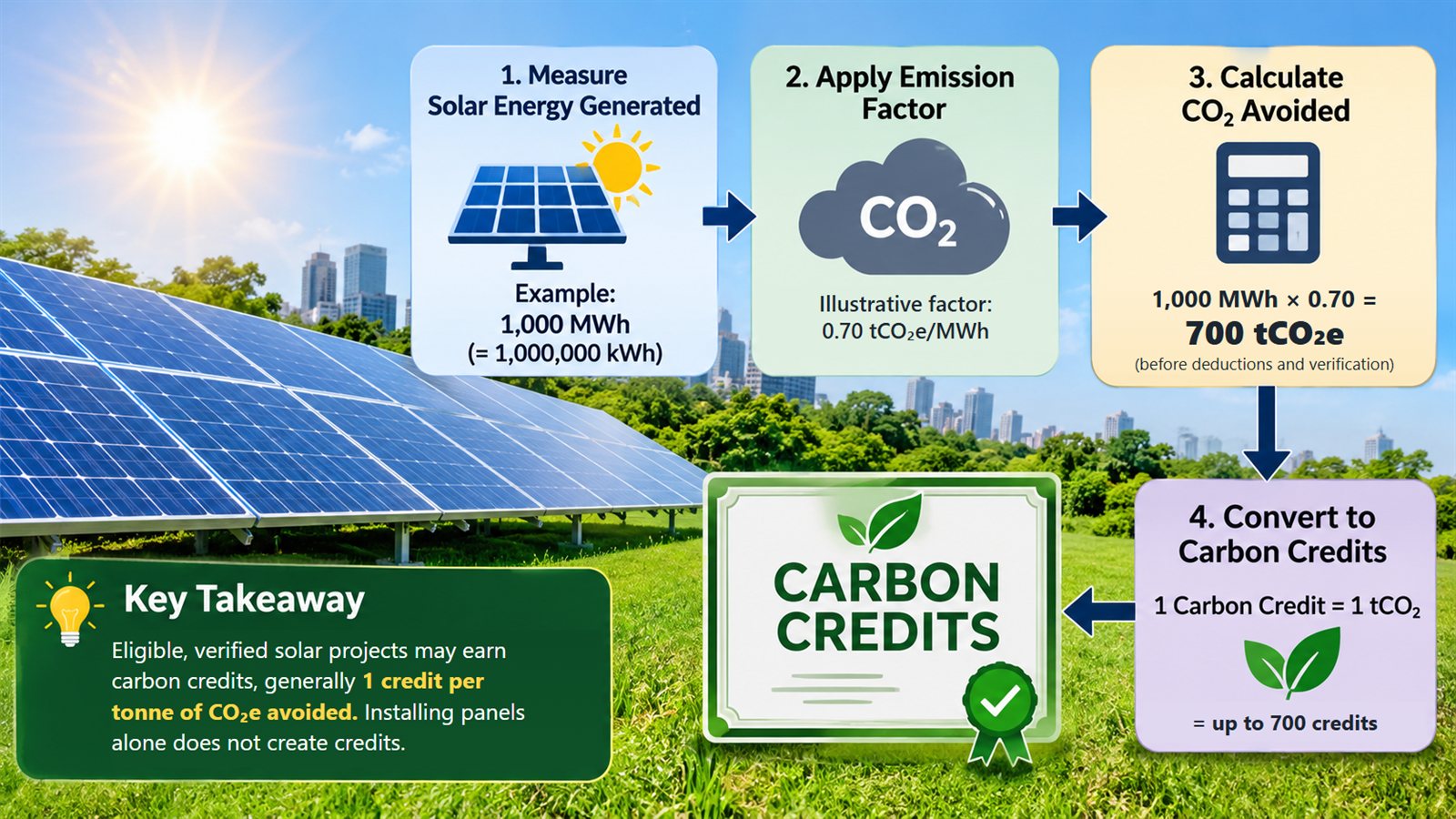
Net emission reductions = Baseline emissions − Project emissions − Leakage − Applicable deductions
- Baseline emissions: emissions in the without-project scenario.
- Project emissions: emissions the project itself causes, such as fuel for equipment.
- Leakage: emissions shifted outside the project boundary because of the project.
- Applicable deductions: uncertainty discounts, buffer contributions or other methodology-specific adjustments.
All gases are expressed in CO₂ equivalent (CO₂e), using global warming potential values to convert gases such as methane and nitrous oxide.
Illustrative example (hypothetical figures): a landfill gas project for one monitoring period has:
- baseline emissions: 5,000 tCO₂e
- project emissions: 800 tCO₂e
- leakage: 200 tCO₂e
- uncertainty deduction: 200 tCO₂e
5,000 − 800 − 200 − 200 = 3,800 tCO₂e of net reductions, which may lead to up to 3,800 credits after verification and issuance.
This simplified formula is not universal. The actual rules depend on the approved methodology. Our guide on how to calculate carbon credits gives more worked examples.
What Types of Projects Can Generate Carbon Credits?
- Renewable energy: displaces fossil electricity. Many programmes now restrict credits for grid-connected renewables in countries where they are already commercially viable.
- Forestry and reforestation: remove and store carbon, with buffers for fire or logging risk.
- Methane destruction and capture: prevents a powerful greenhouse gas from escaping.
- Waste management: avoids methane through composting, recycling or diversion from landfill.
- Energy efficiency: reduces fuel or electricity use, such as efficient cookstoves.
- Agriculture and soil carbon: changes in tillage, fertiliser use, rice cultivation or grazing.
- Carbon capture and removal technologies: biochar, direct air capture and bioenergy with carbon capture and storage.
Eligibility depends on the programme, methodology and applicable requirements, not just the project type.
Who Verifies and Issues Carbon Credits?
Each participant has a different role:
- Project developers design and run the project, collect data and prepare documents.
- Carbon credit standards and programmes set rules, approve methodologies, register projects and issue credits.
- Validation and verification bodies (VVBs) are accredited independent auditors that validate project designs and verify results. They do not issue credits.
- Carbon registries record each credit's issuance, transfers and retirement. They are usually run by or for the programme.
- Buyers and intermediaries purchase, trade and retire credits. They do not certify them.
Our guide to the carbon credit certification process explains validation, verification and issuance in more detail.
How Long Does It Take to Create Carbon Credits?
There is no fixed timeline. It depends on:
- project development, including feasibility, financing and construction
- documentation and validation, including VVB availability and findings to fix
- programme registration reviews, including any queues
- the length of the monitoring period, since credits can only be verified after results occur
- verification and the programme's issuance review
Nature-based projects often take longer, because trees and soils store carbon slowly. Some project types cannot be verified until several years after planting. Developers should plan for delays rather than rely on a fixed date.
Can Individuals, Farmers and Businesses Create Carbon Credits?
- Individuals cannot create credits from everyday actions, such as cycling or using less electricity.
- Farmers and landowners can take part in eligible projects, usually through an aggregator that combines many farms or plots into one project. This spreads the cost of validation, monitoring and verification.
- Companies can develop projects at their own sites, such as methane capture or efficiency upgrades, if the reductions go beyond legal requirements and are not double-claimed in their own emissions reporting.
- Project developers create and manage projects professionally, often with investors.
Participants need clear ownership rights, land documentation, ongoing monitoring and a written revenue-sharing arrangement. Eligibility and financial returns are not guaranteed.
How Are CORSIA Carbon Credits Created?
CORSIA, the Carbon Offsetting and Reduction Scheme for International Aviation, is ICAO's global market-based measure for international aviation. Airlines with offsetting requirements must cancel CORSIA eligible emissions units.
ICAO does not create credits itself. Instead:
- The ICAO Council decides which carbon-crediting programmes are eligible, based on recommendations from its Technical Advisory Body.
- Projects are still created under those programmes' methodologies, following the same general process as above.
- Units must also meet unit-level conditions for the relevant compliance period. For the first phase (2024–2026), that generally means activities that started on or after 1 January 2016 and vintages from 2021 to 2026. First-phase units also need host-country authorisation with a corresponding adjustment, and must be identified as CORSIA eligible in the programme's registry.
Ordinary voluntary carbon credits are not automatically eligible for CORSIA, even when they come from an approved programme. Our guide to CORSIA eligible carbon credits explains these checks.
Common Challenges in Carbon Credit Creation
- Demonstrating additionality: proving the project needs carbon finance.
- Establishing reliable baselines: avoiding inflated without-project scenarios.
- Measuring and monitoring emissions: keeping data complete and accurate over many years.
- Project financing: costs come years before any credit revenue.
- Verification costs: recurring audits can be expensive for small projects.
- Permanence and reversal risks: stored carbon can be lost through fire, pests or land-use change.
- Leakage and double counting: emissions shifted elsewhere, or the same tonne claimed twice.
- Regulatory and methodology changes: programmes revise methodologies, and countries change rules on authorisation and exports.
Frequently Asked Questions
How are carbon credits generated?
A project reduces or removes emissions under an approved methodology, is validated and registered, monitors its results and has them independently verified. The programme then issues credits into a registry.
How much CO₂ reduction is required to create one carbon credit?
Generally one metric tonne of CO₂ equivalent (tCO₂e), reduced or removed and verified under the programme's rules. Deductions such as buffer contributions may apply before issuance.
Can farmers generate carbon credits?
Yes, through eligible practices such as soil carbon, agroforestry or rice methane reduction, usually by joining an aggregated project. Eligibility and income are not guaranteed.
Who verifies carbon credits?
Accredited independent validation and verification bodies verify results against the methodology. The carbon-crediting programme then reviews the verification and issues the credits.
How long does it take to generate carbon credits?
There is no fixed timeline. It depends on project development, validation, registration, monitoring periods, verification and issuance reviews. Nature-based projects often take longer.
Can renewable energy projects generate carbon credits?
Yes, where an applicable methodology covers them and they pass additionality tests. Many programmes now restrict credits for grid-connected renewables in countries where they are already commercially viable.
Are all generated carbon credits eligible under CORSIA?
No. Only units from ICAO-approved programmes that meet the compliance period's conditions, including vintage and, for the first phase, host-country authorisation, are CORSIA eligible.
Conclusion
So, how are carbon credits created? Through a structured process: an eligible project uses an approved methodology, sets a conservative baseline, proves additionality, is validated and registered, monitors its results and has them independently verified. Only then does the programme issue credits into a registry, ready to be transferred, sold and retired.
Each step exists so that a credit represents a real tonne of CO₂e. CORSIA units must meet further eligibility conditions on top of this process.
Our guide to the current price of one carbon credit shows what credits sell for once they are created. To learn more about CORSIA carbon credits and carbon markets, explore the resources at CORSIA Carbon Credit.