 DSTechnoverse company
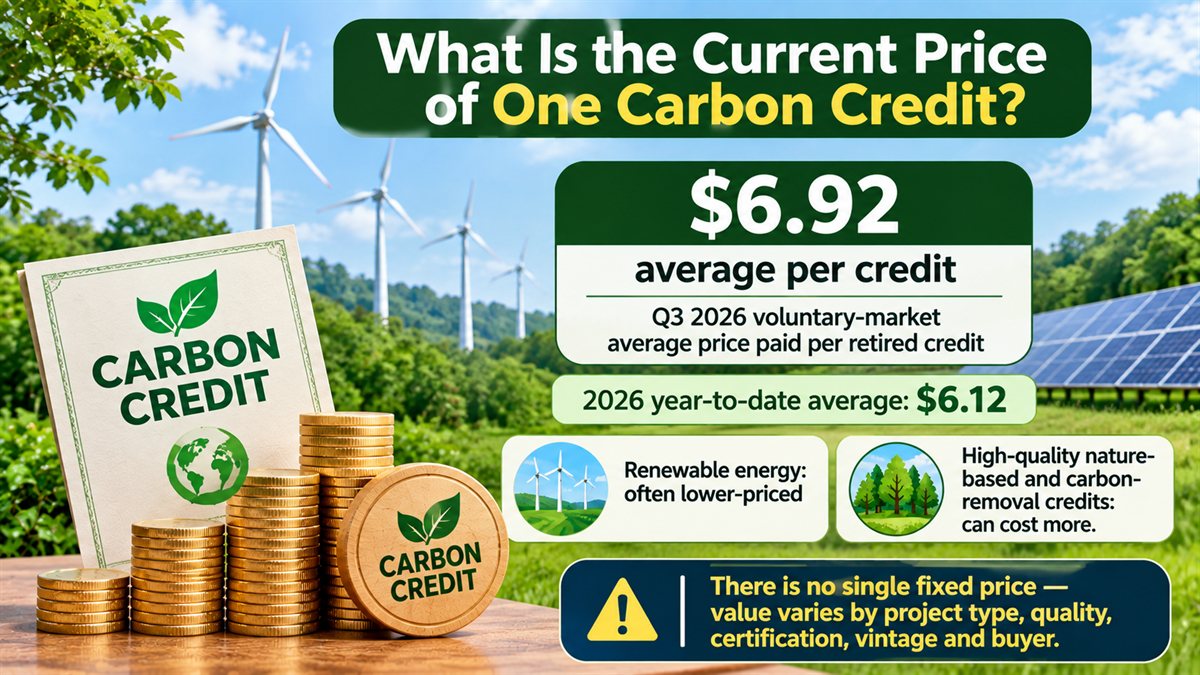
What is the current price of one carbon credit? There is no single market price. One carbon credit generally represents one tonne of CO₂ equivalent (tCO₂e), but in 2026 its price ranges widely:
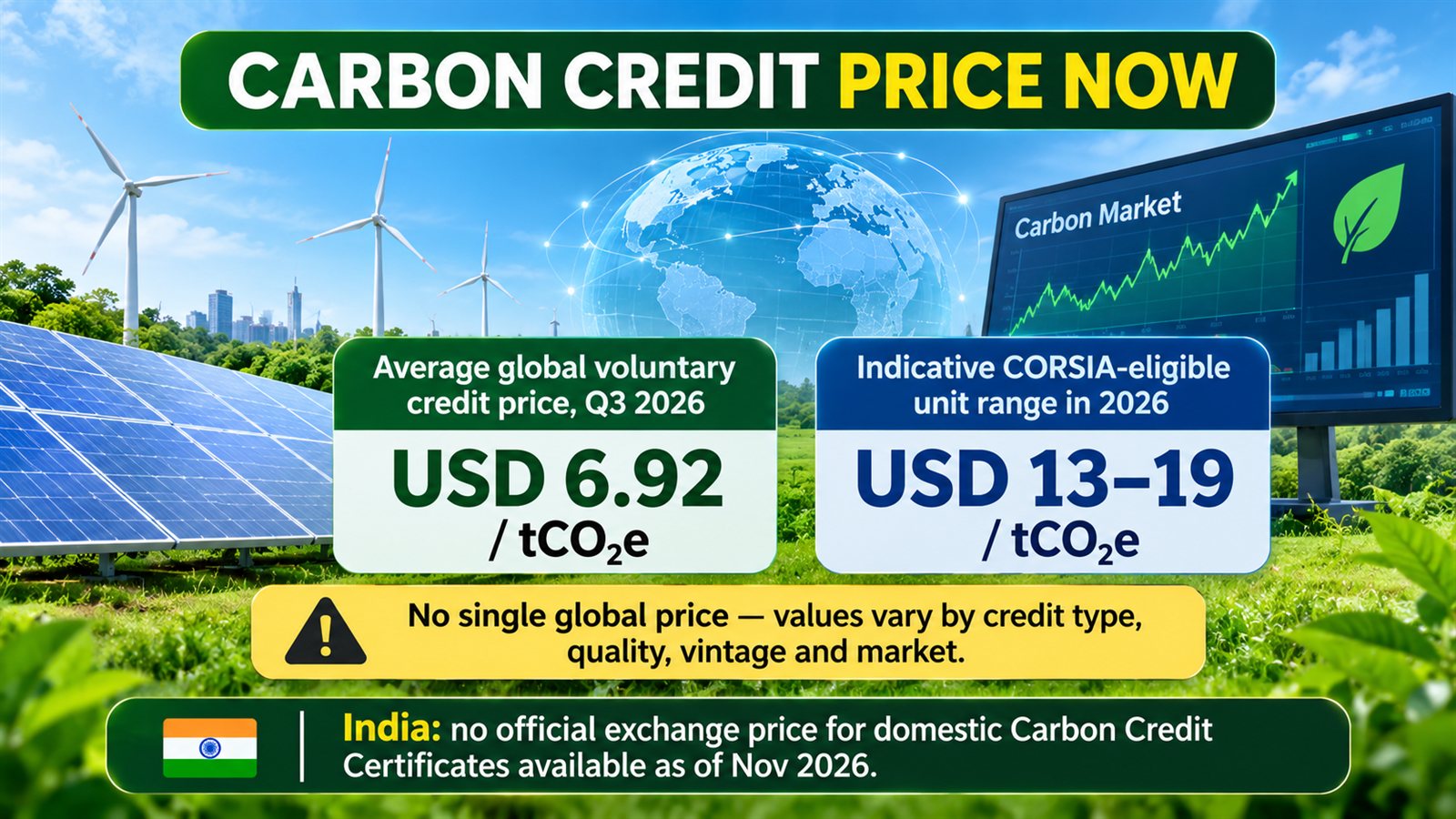
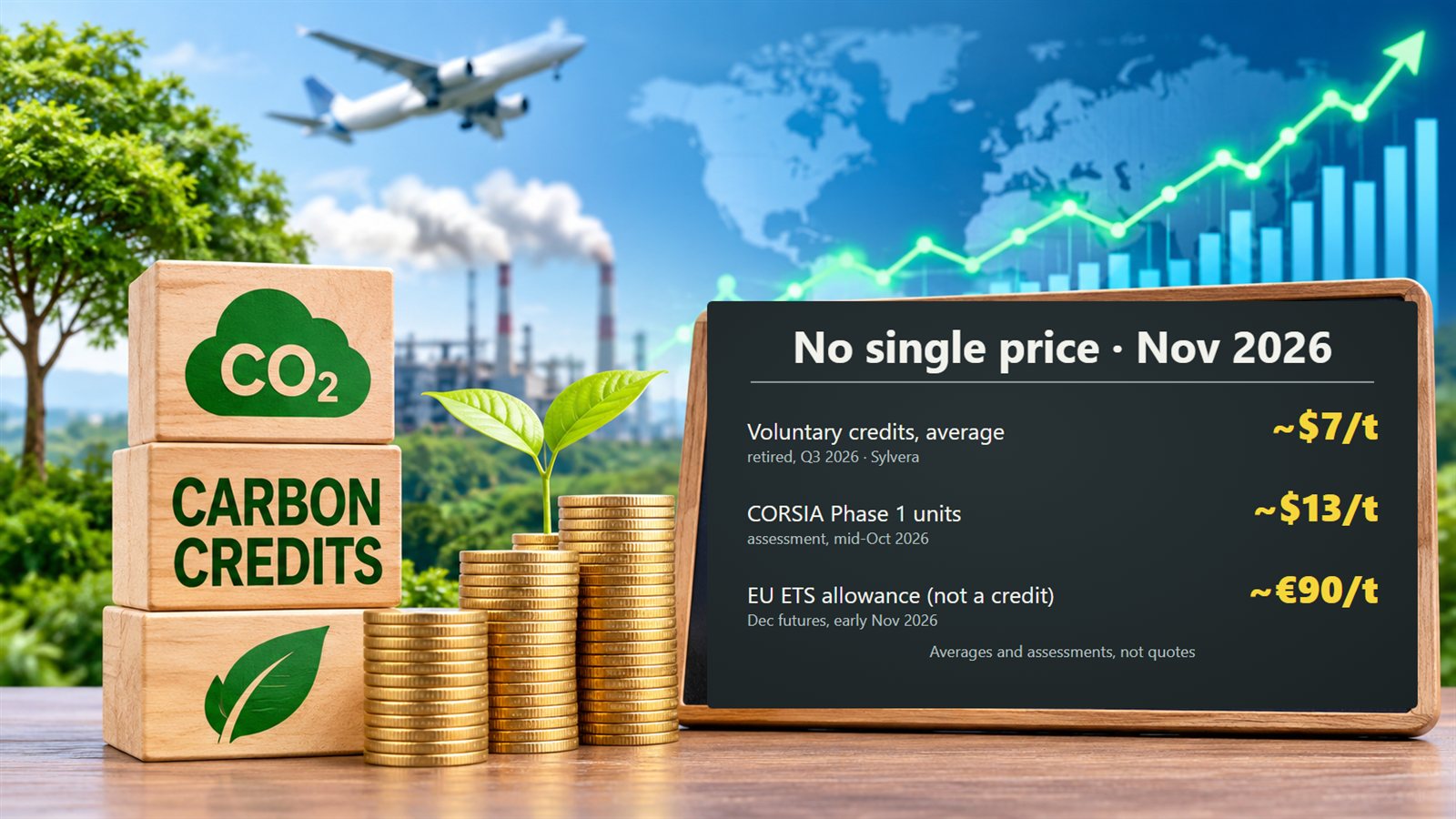
- about USD 7 for the average voluntary credit retired in Q3 2026 (Sylvera)
- about USD 13–19 for CORSIA-eligible units during 2026
- well over USD 100 for some durable carbon removals
The price depends on project type, quality, verification, vintage, registry, eligibility and demand. For aviation-specific guidance, see our CORSIA Carbon Credits resources.
This article is a dated price snapshot for November 2026 (last checked 21 November 2026), with the source and type of figure stated for every number. For the drivers of value in more depth, see our guide to the value of carbon credits.
What Is a Carbon Credit and How Is Its Value Determined?
A carbon credit is a certificate issued by a carbon-crediting programme. It confirms that a project reduced or removed one tonne of CO₂e, measured against a baseline and checked by an independent auditor. Credits come from activities such as wind farms, methane capture, forest protection, reforestation and biochar.
Credits have financial value because buyers want them:
- companies use them for climate goals
- airlines use them for CORSIA compliance
- some regulated schemes accept them
Two credits for the same tonne can have very different prices, because buyers judge:
- how confident they are that the tonne is real, additional and permanent
- what type of tonne it is, an avoided emission or a durable removal
- what they can use it for, a voluntary claim or compliance
- how scarce that kind of credit is
What Is the Current Price of One Carbon Credit in 2026?
There is no single global price. Different markets and project categories trade at different levels, and most voluntary deals are private. The best available guide is the average price paid for credits retired: about USD 6.92 per tonne in Q3 2026 and USD 6.12 for Q1–Q3 2026, according to Sylvera. Prices are quoted in US dollars per tCO₂e, except EU allowances, which are quoted in euros per tonne.
| Category | Price | Date or period | Type of figure | Source |
|---|---|---|---|---|
| Voluntary credits, all types | USD 6.92 per tCO₂e | Q3 2026 | Average of retired credits | Sylvera, via price tracker |
| Voluntary credits, all types | USD 6.12 per tCO₂e | Q1–Q3 2026 | Average of retired credits | Sylvera |
| Reforestation (ARR) | USD 12.80–23.47 per tCO₂e | Q3 2026 | Average by quality rating | Sylvera |
| Forest protection (REDD+) | USD 3.56–7.75 per tCO₂e | Q3 2026 | Average by quality rating | Sylvera |
| All removal credits | USD 19.50 per tCO₂e | 2024 | Average reported deals | Ecosystem Marketplace |
| CORSIA first-phase units | USD 19.00 per tCO₂e | 28 Jan 2026 | Spot price assessment | Fastmarkets |
| CORSIA first-phase units | USD 13.15 per tCO₂e | Mid-Oct 2026 | Assessment, Dec-2026 delivery | green.earth |
| EU ETS allowances | about €90 per tonne | 2–4 Nov 2026 | December futures, ICE | GMK Center |
Read these figures carefully:
- Averages summarise many past deals.
- Assessments are price reporting agencies' estimates.
- Bids and offers are what buyers and sellers are asking.
- Executed transactions are what was actually paid.
None of the figures above is a guaranteed price for buying or selling. Prices also change, so always check the latest data. Our carbon credit price chart shows how these figures compare over time.
Carbon Credit Prices by Project Type
1. Renewable energy credits
Solar, wind and hydropower credits are abundant and often from older projects. Many markets no longer need carbon finance to build renewables, which weakens additionality. Ecosystem Marketplace data put the average at about USD 2.67 per tCO₂e in 2024.
2. Forestry and REDD+ credits
Credits from forest conservation, avoided deforestation and improved forest management vary widely with baseline credibility and quality ratings. Sylvera's Q3 2026 data shows USD 3.56 per tCO₂e for lower-rated REDD+ credits and USD 7.75 for higher-rated ones. Improved forest management ranged from USD 12.79 to 21.07.
3. Afforestation and reforestation credits
Tree planting and forest restoration remove CO₂ over long periods, but need monitoring and protection against reversal. In Q3 2026 they averaged USD 12.80 (lower rated) to USD 23.47 (higher rated) per tCO₂e.
4. Energy efficiency credits
This category includes improved cookstoves, industrial efficiency and household energy programmes. Ecosystem Marketplace reported about USD 7.30 per tCO₂e for household devices, including cookstoves, in 2024. Measurement quality strongly affects their value.
5. Methane capture and waste management credits
Landfill methane capture, agricultural methane, composting and other waste management projects deliver large, measurable reductions. We found no single verified 2026 category average, and prices vary with additionality and local regulation. For example, capture may already be required by law in some places.
6. Agricultural and soil carbon credits
Soil carbon and other agricultural credits are a smaller, newer segment. Prices depend heavily on measurement methods and reversal risk, and we found no reliable public 2026 average.
7. Biochar credits
Biochar turns biomass into a stable form of carbon that can be stored in soil for long periods. Ecosystem Marketplace reported biochar at over USD 160 per tCO₂e in 2024, and all removal credits at about USD 19.50.
8. Direct air capture and other durable removals
Direct air capture (DAC) and bioenergy with carbon capture and storage (BECCS) are among the most expensive options, because they are costly to build and run. Public price data is limited, because many deals are private, multi-year forward purchases.
Durable removals command more because they store carbon for long periods, cost more to deliver and are in demand for net-zero claims.
Voluntary Carbon Credit Prices vs Compliance Carbon Prices
Voluntary carbon market (VCM)
- Companies buy project-based credits by choice, for their own climate commitments.
- Quality and project type vary widely, and so do prices.
- Most trades are private, so prices are tracked through averages and benchmarks.
Compliance carbon markets
- Laws require covered companies to hold permits or units.
- Emissions trading systems, such as the EU ETS, mainly trade allowances, which are government permits to emit under a cap. Some schemes accept limited offset units.
- Carbon taxes are fixed government rates and are not traded.
- Compliance credits are project-based credits that a regulated scheme accepts, often within limits, such as eligible international credits under Singapore's carbon tax or CORSIA units for airlines.
EU ETS allowances traded near €90 per tonne in early November 2026. That is far above voluntary credit prices, but allowances are a different instrument. Their price cannot be treated as a voluntary credit price, and voluntary credits cannot be surrendered in their place.
What Is the Price of CORSIA-Eligible Carbon Credits?
CORSIA, ICAO's Carbon Offsetting and Reduction Scheme for International Aviation, requires airlines with offsetting obligations on routes between participating States to cancel CORSIA Eligible Emissions Units (EEUs).
These units only qualify if they meet both levels of eligibility:
- Programme level: the programme must be approved by the ICAO Council for the relevant compliance period.
- Unit level: the unit must fall within the approved scope and the vintage window. For the first phase, that generally means activities starting on or after 1 January 2016 and vintages from 2021 to 2026. First-phase units also need host-country authorisation with a corresponding adjustment, and a CORSIA label in the registry.
Because eligible supply is limited, first-phase units were assessed above the average voluntary credit price during 2026, but there is no fixed premium and not every unit sells at the same price. IATA's October 2026 figures put first-phase demand at 200–250 million units, while authorised supply covered about 72 million units in August 2026. Yet assessments fell during 2026, from USD 19.00 in January to USD 13.15 by mid-October, as new labelled supply reached the market.
ICAO does not set a price, and ordinary voluntary credits do not automatically qualify. Our guide to the CORSIA carbon credit price in 2026 covers these prices in more detail.
What Is the Price of Carbon Credits in India?
India's Carbon Credit Trading Scheme (CCTS) creates the Indian Carbon Market:
- The Bureau of Energy Efficiency (BEE) administers it under the Ministry of Power.
- A compliance mechanism sets emission intensity targets for notified sectors.
- An offset mechanism covers voluntary projects.
- Both issue Carbon Credit Certificates (CCCs).
- The Central Electricity Regulatory Commission (CERC) notified regulations in February 2026 for trading CCCs on approved power exchanges.
- Grid Controller of India acts as the registry.
As of November 2026, no official exchange price for CCCs was available. Large-scale trading had not yet started, and a November 2026 report quoted BEE as saying trading would begin for most sectors by the end of 2027.
CCCs are domestic instruments. International voluntary credits from Indian projects, such as Verra or Gold Standard credits, are separate. Their prices should not be presented as the CCC price.
What Factors Affect the Price of a Carbon Credit?
- Project type and methodology: reduction or removal, and which rulebook it follows
- Additionality: whether the project needed carbon finance
- Permanence: how long carbon stays stored
- Independent verification: the quality of the audit
- Co-benefits: biodiversity, health and community income
- Vintage: the year of the reduction, with newer vintages often preferred
- Registry and programme: transparency and reputation
- Supply and demand: scarcity of a particular type
- Host-country authorisation: needed for some international uses
- CORSIA eligibility: can raise value where it applies, by giving access to airline buyers
- Location and delivery risk: especially for forward contracts
- Market reputation and buyer preferences: ratings, media scrutiny and corporate policies
The more of these a credit scores well on, the more buyers are usually willing to pay.
How Has the Value of Carbon Credits Changed Over Time?
On a comparable series of Ecosystem Marketplace annual averages for voluntary transactions:
| Year | Average (USD per tCO₂e) |
|---|---|
| 2019 | 3.07 |
| 2020 | 2.51 |
| 2021 | 4.04 |
| 2022 | 7.37 |
| 2023 | 6.53 |
| 2024 | 6.34 |
Source: Ecosystem Marketplace State of the Voluntary Carbon Market reports, as first reported. Later editions revise some years slightly.
The pattern reflects several shifts:
- a surge in corporate net-zero pledges in 2021–2022
- quality scrutiny that cooled demand in 2023–2024
- a growing price gap between older, low-rated credits and newer, high-rated ones
- rising interest in removals
- since 2024, CORSIA demand creating a separate market for eligible units
Compliance allowance prices and carbon taxes are not part of this series.
How Can Businesses Calculate the Value of Carbon Credits?
Estimated cost = Number of credits × Price per credit
Illustrative example (hypothetical)
USD 10 is an assumed quote, not a market price. A company wants 1,000 credits at USD 10 per tCO₂e:
1,000 × USD 10 = USD 10,000
The final cost may also include brokerage, transaction and registry fees, taxes and contractual terms such as delivery dates and replacement guarantees.
Do not choose on price alone. Compare:
- quality ratings and methodology
- verification reports
- vintage and registry records
- eligibility for your intended use
- retirement terms and documentation
Where Can Buyers Check Current Carbon Credit Prices?
- Ecosystem Marketplace: annual reports on voluntary market prices by category.
- Sylvera: price and rating data, including averages by quality.
- Patch and AlliedOffsets: market data and price indicators.
- Price reporting agencies and exchanges, such as Fastmarkets, OPIS, S&P Global Platts, ICE and Climate Impact X, for CORSIA and other benchmarks.
- World Bank Carbon Pricing Dashboard: covers carbon taxes and emissions trading systems, not a universal voluntary credit spot price.
- ICAO CORSIA documentation: for eligibility, not prices.
Each source tracks a different segment and type of figure. Always check the publication date and methodology before relying on a quoted price.
How Can Buyers Check the Actual Price of Carbon Credits?
A benchmark tells you the market level. A supplier quote tells you what you will actually pay. To compare quotes fairly, check:
- Registry information: the credits exist, are issued in the seller's account and have not been retired.
- Project documentation: the project design document, methodology and monitoring reports.
- Credit vintage: the year of the reduction, since older vintages are usually cheaper.
- Certification and verification: the programme and the latest verification report.
- Eligibility status: for example, a CORSIA label or host-country authorisation if you need it.
- Marketplaces and supplier quotations: compare several quotes for the same type, vintage and quality.
- Transaction terms and retirement requirements: delivery date, fees, payment terms, and whether the price includes retirement in your name.
A cheap quote for an old, low-rated credit is not comparable to a higher quote for a recent, rated or eligible one. Our guide on how much you can earn from carbon credits shows how these prices look from the seller's side.
Are Carbon Credit Prices Expected to Increase?
Evidence so far: the average voluntary price has been broadly flat, at about USD 6–7 from 2023 to 2026, while the gap between low-rated and high-rated credits has widened. CORSIA unit assessments fell during 2026 as new supply arrived.
Confirmed facts
- CORSIA's second phase starts in 2027.
- India's CERC trading regulations were notified in 2026.
- Article 6 mechanisms are being put into practice.
Possible influences, not forecasts
- demand for high-integrity credits, which may widen the price gap with low-rated ones
- growth in carbon removal technologies, which may lower removal costs over time
- Article 6, linking credits to national accounting
- CORSIA demand, with first-phase demand estimated well above authorised supply
- India's domestic market, once exchange trading begins
- supply constraints from project development and issuance timelines
- more transparency and standardisation in price reporting
This article does not predict future prices or recommend investments, and no price increase is guaranteed.
Frequently Asked Questions
How much does one carbon credit cost in 2026?
There is no single price. The average voluntary credit retired in Q3 2026 sold for about USD 6.92 per tonne (Sylvera). CORSIA-eligible units were assessed at USD 13.15 in mid-October 2026, and durable removals can cost over USD 100.
What is the average price of a carbon credit?
About USD 6.12 per tonne for Q1–Q3 2026 and USD 6.92 for Q3 2026, based on Sylvera's averages of credits retired. Ecosystem Marketplace reported USD 6.34 for 2024.
Why do carbon credit prices vary by project?
Projects differ in cost, additionality, permanence, co-benefits, vintage and demand. Durable removals cost more to produce and are valued more than abundant avoidance credits, such as renewable energy at about USD 2.67 in 2024.
Are CORSIA carbon credits more expensive?
They were assessed above the voluntary average in 2026, at USD 19.00 in January and USD 13.15 in mid-October, because eligible supply is limited. There is no fixed premium, and prices fell during the year.
What is the price of one carbon credit in India?
No official exchange price for India's Carbon Credit Certificates was available as of November 2026, because trading under the CCTS had not yet started. Voluntary credits from Indian projects sell at international market prices.
Where can businesses check carbon credit prices?
Use dated data from Ecosystem Marketplace, Sylvera, AlliedOffsets, price reporting agencies and exchanges, then compare supplier quotes against registry records. Note the date, unit and type of each figure.
Can carbon credit prices change over time?
Yes. They can rise or fall with demand, new supply, regulation, CORSIA developments and quality concerns. No one can predict prices with certainty.
Key Takeaways
So, what is the current price of one carbon credit? In November 2026:
- average voluntary credits are worth about USD 7 per tonne
- CORSIA-eligible units are worth about USD 13–19
- durable removals can exceed USD 100
- India's Carbon Credit Certificates have no official price yet
Prices differ because project type, quality, permanence, vintage, eligibility and demand all differ. Buyers should look beyond the price to credibility, eligibility, verification and market conditions.
The price of one carbon credit depends on its project category, quality, certification, market conditions and buyer requirements. For more on CORSIA carbon credits, eligibility requirements and carbon market developments, explore the resources at CORSIA Carbon Credit.
Sources
- Carbon credit price tracker – Sylvera and Ecosystem Marketplace data (reviewed 5 October 2026)
- Ecosystem Marketplace – State of the Voluntary Carbon Market reports
- Fastmarkets – CORSIA spot prices continue to slide (4 February 2026)
- green.earth – CORSIA activity builds across prices, airlines and supply (16 October 2026)
- GMK Center – European carbon prices exceeded €90/t in November (1 November 2026)
- IATA / EuropaWire – ICAO joins alliance to address CORSIA supply shortfall (13 October 2026)
- World Bank – Carbon Pricing Dashboard
- ICAO – CORSIA Eligible Emissions Units
- Bureau of Energy Efficiency – Indian Carbon Market