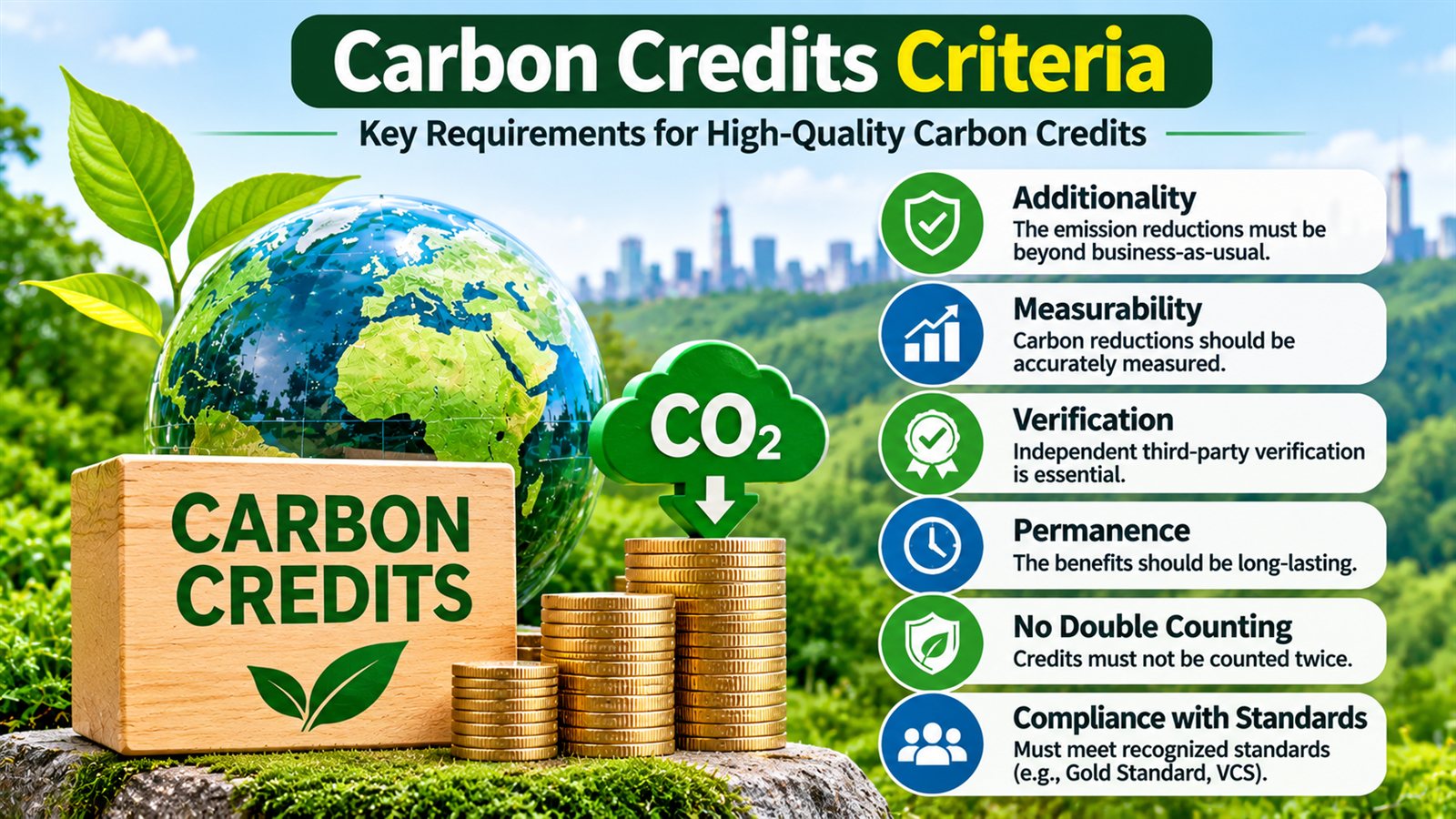
 DSTechnoverse company
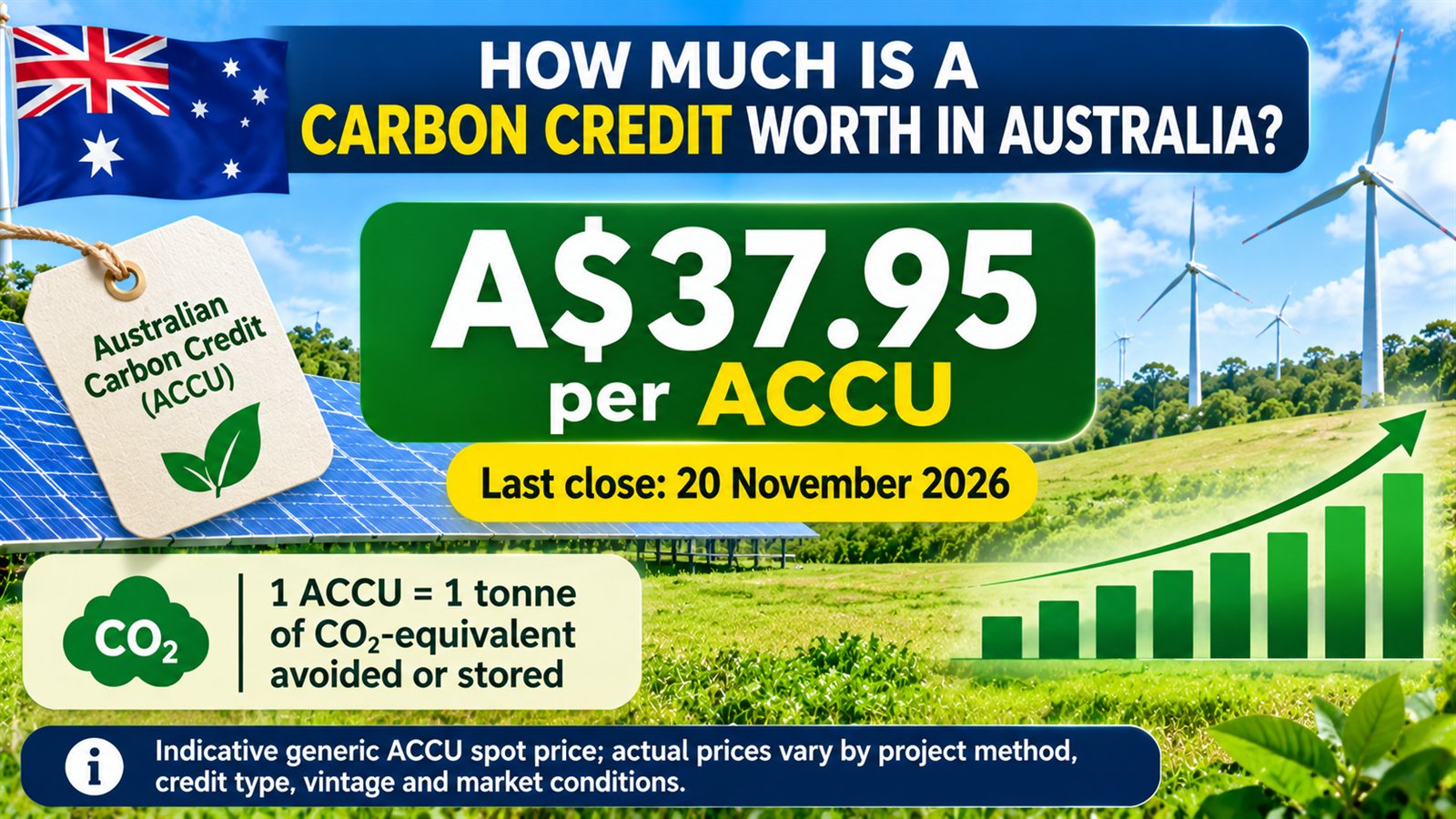
How much is a carbon credit worth in Australia? One generic Australian Carbon Credit Unit (ACCU) closed at A$37.95 on 20 November 2026, according to broker CORE Markets. That is a spot price for immediate delivery. One ACCU represents one tonne of CO₂ equivalent (tCO₂e), so a tonne of Australian carbon credit was worth roughly A$38. Prices vary by project type and contract, and change daily. For aviation-specific guidance, see our CORSIA Carbon Credits resources.
This article explains what that price means, how much 1 to 1,000 ACCUs are worth, what a seller actually receives, and what drives ACCU values.
Introduction – Understanding the Value of a Carbon Credit in Australia
A carbon credit represents one tonne of greenhouse gas emissions avoided or stored by an eligible project. In Australia, the main carbon credit is the ACCU, issued by the federal Clean Energy Regulator (CER). One ACCU generally represents 1 tCO₂-e, under the scheme's rules.
Carbon credits have monetary value because someone needs or wants them:
- Large industrial facilities covered by the Safeguard Mechanism use ACCUs to help meet declining emissions limits.
- The Australian Government has bought ACCUs through contracts.
- Companies buy them for voluntary climate commitments.
Prices matter to:
- businesses, because they set the cost of compliance and climate claims
- project developers, because they decide whether a project is financially viable
- landholders and investors, because they shape potential income
How Much Is One Carbon Credit Worth in Australia?
- Latest verifiable price: A$37.95 per ACCU
- Currency: Australian dollars (AUD)
- Unit: per ACCU, equal to 1 tCO₂-e
- Date: close of 20 November 2026
- Source: CORE Markets
- Type: generic ACCU spot price, not an auction result, forward price or average
That was 0.30% below the previous close of A$38.05 on 19 November. Tasman Environmental Markets reported on 10 November 2026 that ACCUs had traded within a tight A$0.50 range since October.
Quick examples at the 20 November 2026 close:
- 1 ACCU: about A$37.95
- 100 ACCUs: about A$3,795
- 500 ACCUs: about A$18,975
- 1,000 ACCUs: about A$37,950
These are illustrative gross values at one day's closing spot price, not quotes. Real deals depend on project type, quantity, timing and contract terms.
Three figures are often confused:
- Market price: what ACCUs recently traded at, such as A$37.95.
- Estimated value: what a seller might expect for a particular parcel, which can be higher or lower.
- Amount received: what the seller keeps after fees, costs and taxes.
What Is an Australian Carbon Credit Unit (ACCU)?
Definition
An ACCU is a financial product issued by the Clean Energy Regulator, representing one tonne of CO₂-e stored or avoided by a registered project. ACCUs are created under the Carbon Credits (Carbon Farming Initiative) Act 2011, through what is now called the ACCU Scheme.
How ACCUs are generated
- A project registers with the CER under an approved method, the rulebook for that project type.
- It must meet additionality requirements, including being new and not required by law.
- It carries out the activity and monitors results.
- It submits reports, with audits by registered auditors at set points.
- The CER issues ACCUs for the verified abatement.
The role of the Clean Energy Regulator
The CER registers projects, issues ACCUs, runs the Australian National Registry of Emissions Units (ANREU), administers the Safeguard Mechanism, and publishes the Quarterly Carbon Market Report.
How ACCUs are issued and traded
ACCUs are issued into the project owner's ANREU account. They are traded mainly over the counter through brokers, sold directly to buyers, or delivered to the government under contracts.
How businesses use or surrender ACCUs
- Safeguard facilities surrender ACCUs to offset emissions above their baselines.
- Companies can cancel ACCUs voluntarily to support claims, such as carbon neutral certification.
- Once surrendered or cancelled, ACCUs cannot be used again.
Factors That Determine the Value of Australian Carbon Credits
- Supply and demand: the CER expected 22 to 26 million ACCUs to be issued in 2026, against growing Safeguard demand.
- Government climate policies: declining Safeguard baselines create compliance demand.
- ACCU Scheme regulations: new or revised methods change supply.
- Project methodology: buyers may value some methods more than others.
- Project quality and integrity: concerns about a method can lower demand for its ACCUs.
- Corporate demand: voluntary buyers add to compliance demand.
- Market confidence: policy surprises can move prices sharply.
- Credit availability: issuance timing affects how many ACCUs are ready to sell.
- Regulatory changes: reviews, such as the Climate Change Authority's 2026 ACCU Scheme review, can shift expectations.
- Delivery and reversal risks: forward deals carry delivery risk, and vegetation projects carry reversal risk, for example from fire.
Different instruments have different values because they serve different purposes and buyers. An ACCU, a voluntary credit and a European allowance each have their own market.
Australian Carbon Credit Price History
All figures are generic ACCU spot prices in A$ per ACCU, nominal, from the Clean Energy Regulator unless stated.
- 2015–2020: the government bought ACCUs through Emissions Reduction Fund auctions. The first three averaged about A$11.83, and fixed delivery contracts averaged A$16.32 (March 2020) and A$15.53 (September 2020).
- January 2021: about A$16.50 (RepuTex).
- Start of 2022: about A$51, after a record year of corporate and investor demand.
- Late January 2022: all-time high of A$57.50, on low volumes and speculative trading.
- March 2022: the government announced that projects could exit fixed delivery contracts and sell on the open market. The price fell to A$30.50 by 31 March.
- 2022–2023: integrity concerns led to the Chubb Review. The government's response, in January 2023, found the scheme essentially sound. The reformed Safeguard Mechanism began on 1 July 2023. Prices were A$33.80 at the end of 2022 and A$33.75 at the end of 2023.
- 2024: prices reached A$42.50 on 19 November 2024 before ending the year at A$36.63.
- 2025: A$36.60 at year end.
- 2026: A$36.28 at the end of March, A$37.95 at the end of June, A$39.03 on 14 August, and A$37.95 at the 20 November close (CORE Markets).
Our carbon credit price Australia chart shows these points on a chart, with more detail on each period.
Are All Carbon Credits Worth the Same Amount in Australia?
No. Different instruments trade at different prices:
- ACCUs: government-issued Australian credits, usable for Safeguard compliance. About A$37.95 on 20 November 2026.
- Voluntary carbon credits: issued by independent programmes such as Verra and Gold Standard. The average credit retired worldwide in Q3 2026 sold for about US$6.92 (Sylvera).
- International carbon credits: project credits from other countries and programmes, priced in their own markets.
- CORSIA eligible emissions units: units approved for airlines' offsetting under ICAO rules. Assessed at about US$13.00 on 18 November 2026 (Fastmarkets).
- Compliance allowances: permits to emit under a cap, such as EU allowances at around €90 in mid-November 2026.
- Large-scale Generation Certificates (LGCs): Australian renewable electricity certificates, each representing one megawatt-hour, not a tonne of CO₂. They closed at A$7.25 on 20 November 2026 (CORE Markets). LGCs are not carbon credits.
These instruments are not interchangeable and should not be given the same price.
Within ACCUs, value can also vary with:
- project method, such as human-induced regeneration, savanna fire management or landfill gas
- vintage, the period when the abatement occurred
- eligibility for a buyer's purpose
- perceived quality and co-benefits
- buyer requirements
How Much Are 100, 500, and 1,000 Australian Carbon Credits Worth?
Total gross value = Number of carbon credits × Price per credit
Illustrative calculations at the generic ACCU spot close of A$37.95 on 20 November 2026 (CORE Markets). These are not quotes or actual transaction prices.
- 1 ACCU: 1 × A$37.95 = A$37.95
- 10 ACCUs: 10 × A$37.95 = A$379.50
- 100 ACCUs: 100 × A$37.95 = A$3,795
- 500 ACCUs: 500 × A$37.95 = A$18,975
- 1,000 ACCUs: 1,000 × A$37.95 = A$37,950
What a seller might actually receive (hypothetical)
All costs below are hypothetical assumptions, not actual fees.
A seller sells 1,000 ACCUs at A$37.95:
- Gross value: A$37,950
- Brokerage at an assumed 2%: A$759
- Other assumed costs, such as audit and reporting costs allocated to this sale: A$2,000
- Amount before tax: 37,950 − 759 − 2,000 = about A$35,191
The final amount also depends on:
- contract terms, such as a fixed price agreed earlier under a forward contract
- revenue sharing with landholders or partners
- taxes, where applicable, so independent tax advice is recommended
Where Can You Check the Current Carbon Credit Price in Australia?
- Clean Energy Regulator: Quarterly Carbon Market Reports and data workbooks, with spot prices, issuance and demand.
- Australian Government publications: the Department of Climate Change, Energy, the Environment and Water and the Climate Change Authority.
- ACCU market reports: from brokers such as CORE Markets and Jarden.
- Market analysts: such as RepuTex and Tasman Environmental Markets.
- Verified trading information: broker price pages show daily closes, though detailed history may need a subscription.
Official issuance information is not price information. The CER's registry shows how many ACCUs exist and who holds them, while brokers and reports show prices.
Our guide to the carbon credit price now gives dated international prices for comparison.
Can Individuals and Businesses Earn Money from Australian Carbon Credits?
Yes, through eligible projects:
- Project development: choose an activity covered by an approved ACCU Scheme method, such as regenerating native vegetation, savanna fire management or capturing landfill methane.
- Eligibility: the project must meet additionality requirements and have consent from people with relevant interests in the land.
- Project registration with the Clean Energy Regulator.
- Monitoring and reporting according to the method.
- Independent audit by a registered auditor at required points.
- ACCU issuance by the CER for the verified abatement.
- Selling to Safeguard facilities, the government, companies or through brokers.
Carbon storage projects must also meet permanence obligations, meaning the carbon must be maintained for 25 or 100 years.
Simply planting trees or doing something environmentally friendly does not automatically create saleable ACCUs. Projects must meet the scheme's eligibility and regulatory requirements. Income is not guaranteed. Our guides on how carbon credits are earned and how much you can earn from carbon credits explain the general process and costs.
Australian Carbon Credit Prices Compared with International Markets
| Instrument | Latest price | Date | Regulated by | Main buyers |
|---|---|---|---|---|
| ACCU (generic spot) | A$37.95 | 20 Nov 2026 | Clean Energy Regulator | Safeguard facilities, government, companies |
| Voluntary credits, average | US$6.92 | Q3 2026 | Independent programmes | Companies with voluntary targets |
| CORSIA Phase 1 units | US$13.00 | 18 Nov 2026 | ICAO eligibility rules, national registries | Airlines |
| EU ETS allowances | about €90 | mid-Nov 2026 | European Union | Covered European emitters |
Sources: CORE Markets, Sylvera, Fastmarkets, GMK Center.
Key differences:
- Regulation: ACCUs are government-issued and government-regulated. Voluntary credits depend on independent programmes.
- Eligibility: ACCUs can be used for Australian compliance. CORSIA units must meet ICAO's programme and unit rules. ACCUs are not automatically CORSIA eligible.
- Market structure: ACCUs trade over the counter in one country. EU allowances trade on exchanges.
- Pricing: different currencies, demand drivers and rules mean prices cannot be directly compared.
Our guide to CORSIA eligible carbon credits explains ICAO's requirements.
What Could Affect Australian Carbon Credit Values in the Future?
- Emissions reduction policies: Australia's targets of 43% below 2005 levels by 2030, a 2035 target of 62–70%, and net zero by 2050, as well as declining Safeguard baselines.
- Corporate climate commitments: voluntary demand depends on company targets and claims rules.
- Future ACCU supply: record issuance in 2026 could limit price rises.
- Demand from regulated entities: Safeguard facilities account for around 80% of ACCU demand, according to the Climate Change Authority.
- Project development: new methods could add supply.
- Market regulations: reviews and rule changes could raise or lower demand.
- International developments: global carbon market trends and Article 6 cooperation.
Prices could rise or fall. No price increase or investment return is guaranteed.
Frequently Asked Questions
How much is one carbon credit worth in Australia?
One generic ACCU closed at A$37.95 on 20 November 2026, according to CORE Markets. That is a spot price; actual deals vary by project type and contract.
What is the current ACCU price in Australia?
The latest verifiable generic ACCU spot close was A$37.95 on 20 November 2026 (CORE Markets), down 0.30% from A$38.05 the previous day.
How much is 1 tonne of carbon credit worth?
In Australia, one ACCU represents one tonne of CO₂-e, so a tonne was worth about A$37.95 at the 20 November 2026 close. International voluntary credits averaged about US$6.92 in Q3 2026.
Why do Australian carbon credit prices change?
Because of supply from new issuance, Safeguard compliance demand, policy announcements, method reviews, integrity concerns and market confidence.
Are ACCUs worth more than voluntary carbon credits?
At current prices, generic ACCUs trade well above the average international voluntary credit, because they are usable for Australian compliance. They are different instruments in different markets.
Who determines the value of Australian carbon credits?
The market does, through trades between buyers and sellers. The Clean Energy Regulator issues ACCUs and publishes data but does not set the spot price.
Can individuals sell carbon credits in Australia?
Yes, if they own ACCUs from a registered project or bought them in the market. Creating new ACCUs requires an eligible project registered with the Clean Energy Regulator.
How much are 1,000 ACCUs worth?
At the 20 November 2026 close of A$37.95, about A$37,950 before fees and taxes. The amount a seller receives depends on contract terms and costs.
Where can I check Australian carbon credit prices?
Check the Clean Energy Regulator's Quarterly Carbon Market Reports, broker price pages such as CORE Markets, and analyst commentary from firms such as RepuTex.
Can international buyers purchase Australian carbon credits?
They may be able to, through brokers and an account in Australia's national registry, subject to the Clean Energy Regulator's requirements. ACCUs are not automatically eligible for schemes such as CORSIA.
Conclusion
So, how much is a carbon credit worth in Australia? On 20 November 2026, one generic ACCU closed at A$37.95, so 1,000 ACCUs were worth about A$37,950 before costs. That price has been fairly stable in 2026, well below the A$57.50 record of January 2022.
The market price, a seller's estimated value and the amount actually received are different numbers. Fees, contract terms, project type and taxes all matter. ACCUs are also a distinct instrument, so their price should not be confused with voluntary credits, CORSIA units, EU allowances or LGCs.
To learn more about CORSIA carbon credits and international carbon markets, explore the resources at CORSIA Carbon Credit.
Sources
- CORE Markets – Market prices (ACCU and LGC closes, 20 November 2026)
- Clean Energy Regulator – Quarterly Carbon Market Report, June quarter 2026
- Clean Energy Regulator – Quarterly Carbon Market Report, March quarter 2026
- Clean Energy Regulator – Quarterly Carbon Market Report, December quarter 2025
- Clean Energy Regulator – Quarterly Carbon Market Report, March quarter 2022
- Tasman Environmental Markets – ACCU market rangebound (November 2026)
- Climate Change Authority – 2026 Review of the ACCU Scheme
- Office of Impact Analysis – Chubb Review of Australian Carbon Credit Units
- Sylvera – Carbon Market Data Snapshot Q3 2026
- Fastmarkets – CORSIA prices (November 2026)
- GMK Center – European carbon prices exceeded €90/t in November (2026)
- World Bank – Carbon Pricing Dashboard
- ICAO – CORSIA Eligible Emissions Units