 DSTechnoverse company
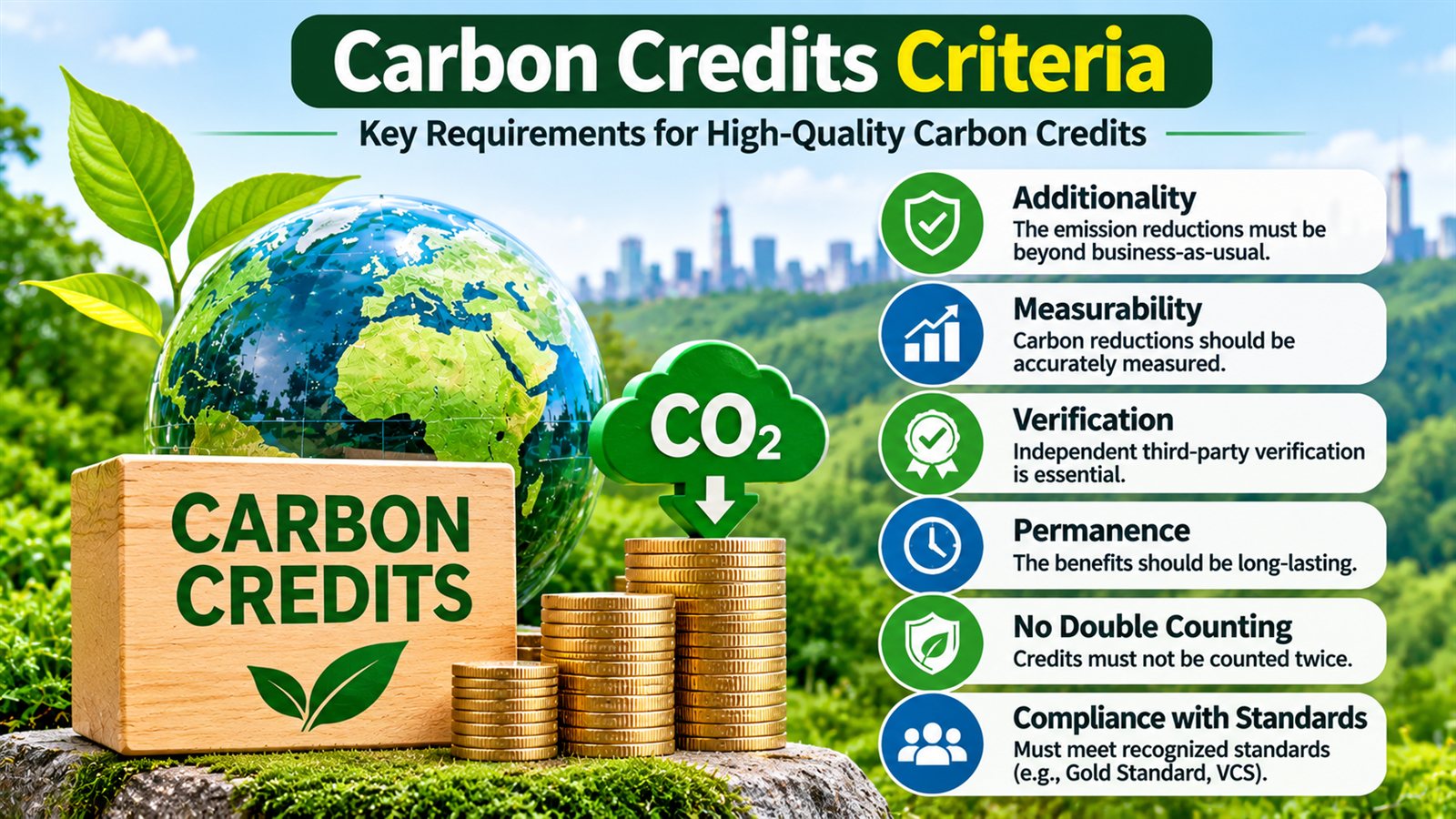
Carbon credits criteria are the tests a project must pass before its emission reductions or removals can be issued as credible carbon credits. A high-quality credit must be:
- additional, meaning it would not have happened without carbon finance
- based on a realistic baseline
- accurately measured and independently verified
- permanent, with reversal risks covered
- adjusted for leakage
- counted only once
- delivered with environmental and social safeguards
- tracked in a transparent registry
For how these criteria apply to aviation, see our CORSIA Carbon Credits resources.
These criteria exist because a credit is only a promise that a tonne of CO₂ equivalent was kept out of, or taken out of, the atmosphere. Project developers need to meet them, and buyers need to check them. This guide explains each criterion, how programmes apply them, and how they differ from the stricter eligibility rules for CORSIA.
What Are Carbon Credit Criteria?
Carbon credit criteria are the requirements that determine whether a project's claimed results are real and creditable. They are written into the rules of carbon-crediting programmes, such as Verra or Gold Standard, and into the methodologies those programmes approve for each project type.
Project eligibility is assessed in several stages:
- the developer documents the project against a methodology
- an independent auditor validates the design
- the programme registers the project
- an auditor verifies the monitored results
- the programme issues credits
One credit generally represents one metric tonne of CO₂e, under the programme's rules.
Programmes differ in their detailed requirements, the methodologies they accept and how strictly they apply each principle. The core quality principles, however, are broadly shared.
Why Are Carbon Credit Criteria Important?
Robust criteria:
- maintain trust in carbon markets
- ensure reductions are genuine, not just paperwork
- prevent over-crediting from inflated baselines
- reduce greenwashing, meaning misleading climate claims
- support transparency, through public documents and registries
- protect environmental integrity
- build buyer confidence and project accountability
- support credible climate action
Without them, credits could be issued for projects that would have happened anyway, for reductions that were never measured, or for the same tonne twice. Buyers relying on such credits would make false claims, and the climate would not benefit.
What Are the Key Criteria for Carbon Credits?
1. Additionality
Additionality means the reduction or removal would not have happened without the incentive of carbon credit revenue. Methodologies test it in several ways:
- Financial tests: is the project unviable without credit income?
- Regulatory tests: is the activity already required by law? If so, it is not additional.
- Barrier analysis: do technical, financial or institutional barriers block it without carbon finance?
- Common-practice tests: is the activity already widespread in the region?
Non-additional projects create credits without any real climate benefit, which undermines the market.
Hypothetical example: a factory installs efficient boilers that pay for themselves within a year through fuel savings. It would have done so anyway, so the project is probably not additional. A rural biogas programme that only becomes affordable with carbon revenue is more likely to be additional.
2. Baseline assessment
The baseline scenario describes what would most likely have happened without the project. Baseline emissions are the emissions in that scenario, estimated from historical data, reference scenarios and the methodology's rules. The project boundary defines which sites, gases and sources are included.
Realistic baselines matter because credits equal the difference between baseline and project emissions. An inflated baseline, such as assuming far more deforestation than would really occur, leads directly to over-crediting.
3. Measurability and quantification
Reductions and removals are measured through greenhouse gas accounting:
- Monitoring data, such as meter readings, fuel records and forest plots
- Emission factors that convert activity into emissions, such as tCO₂ per MWh
- CO₂e conversion, which turns methane and other gases into CO₂ terms using global warming potentials
- Methodology-based calculations with conservative deductions for measurement uncertainty
Educational example (hypothetical figures):
- baseline emissions: 8,000 tCO₂e
- project emissions: 2,000 tCO₂e
- leakage: 300 tCO₂e
8,000 − 2,000 − 300 = 5,700 tCO₂e of potential reductions, before verification and any further programme deductions.
4. Independent validation and verification
These are two distinct activities:
- Validation is the independent assessment of the project design, before crediting. It checks the baseline, additionality, methodology fit and monitoring plan.
- Verification is the independent assessment of actual results for each monitoring period. It checks the data, evidence and calculations, often with a site visit.
Both are carried out by accredited validation and verification bodies (VVBs). They review the project documentation, the monitoring reports and supporting evidence, and raise findings that must be corrected. Independent assessment matters because developers have a financial interest in claiming more credits. Terms and procedures differ by programme: Gold Standard, for example, uses "design certification" and "performance certification".
5. Permanence
Permanence means stored carbon stays out of the atmosphere for the long term. This matters most for removal and storage projects:
- Forestry and soil carbon face reversal risks from fire, deforestation, pests and land-use change.
- Programmes manage these risks by monitoring over time and holding back a share of credits in a buffer pool to replace any carbon that is lost.
- Avoidance projects, such as destroyed methane, do not have the same reversal risk once the emission has been prevented.
6. Leakage prevention
Leakage happens when a project's reductions cause emissions to rise somewhere else:
- protecting one forest may push logging into a neighbouring one
- a clean energy project may shift fossil fuel use to another market
Methodologies require projects to estimate and monitor leakage and to deduct it from creditable reductions. Without that adjustment, the net climate benefit is overstated.
7. Avoidance of double counting
Double counting means the same tonne is counted more than once. It takes three forms:
- Double issuance: two credits for one reduction, for example under two programmes.
- Double use: one credit used twice, for example sold again after retirement.
- Double claiming: two parties claim the same reduction, such as a buyer and the host country's climate target.
Safeguards include unique registry serial numbers, transparent registries and permanent retirement. For international transfers and some compliance uses, corresponding adjustments under Article 6 of the Paris Agreement are also required. The exact accounting and authorisation requirements depend on the credit's intended use and the applicable rules.
8. Monitoring and reporting
A monitoring plan sets out:
- the data to collect
- the equipment and methods to use
- how often to measure and report
- the monitoring boundary
Projects produce monitoring reports for each period and keep documentation for audit. Ongoing performance assessment shows whether the project is still delivering what it claims.
9. Environmental and social safeguards
Credible projects must do no harm. That includes:
- protecting biodiversity and ecosystems
- community participation and stakeholder consultation
- respecting land rights and gaining consent where required
- managing social impacts and environmental risks
- contributing to sustainable development where possible
- providing grievance and accountability mechanisms for affected people
A project that cuts emissions but displaces communities or damages ecosystems is not a high-quality project.
10. Registry transparency and traceability
A credible credit is traceable through its whole life:
- issuance records and a unique serial number
- ownership transfers between accounts
- retirement or cancellation, with the beneficiary and purpose recorded
- public registry information, so anyone can check the project and credit history
Our explainer on additionality, permanence and leakage covers three of these criteria in more depth.
What Are the Eligibility Criteria for Carbon Credit Projects?
Project eligibility depends on:
- project type and activity, which must be covered by the programme
- geographic and sectoral scope, since some methodologies apply only in certain regions or sectors
- the crediting programme, with its own rules and fees
- an approved methodology in its current version
- project start date and crediting period, within the programme's limits
- baseline requirements
- an additionality demonstration
- monitoring and verification arrangements
- environmental and social safeguards
- programme-specific documentation, such as a Project Design Document and evidence of ownership of the reductions
A project that reduces emissions does not automatically qualify. It must meet every requirement of the programme and methodology, and pass validation and verification.
How Do Carbon Credit Standards Evaluate These Criteria?
- Verra (Verified Carbon Standard): maintains a large methodology library. Projects are validated and verified by Verra-approved VVBs, and Verified Carbon Units are issued in the Verra Registry, with buffer pools for land-use projects.
- Gold Standard: adds mandatory sustainable development and stakeholder requirements to climate criteria, with design and performance certification by approved auditors.
- American Carbon Registry (ACR): approves its own methodologies through public consultation, uses accredited third-party verifiers, and issues Emission Reduction Tonnes.
- Climate Action Reserve (CAR): uses standardised protocols that set eligibility, additionality tests and quantification for each project type, verified by accredited bodies.
- Global Carbon Council (GCC): applies its own standards and accepted methodologies, with approved verifiers, and issues Approved Carbon Credits.
Their criteria are not identical. Methodology choices, additionality tests and safeguard requirements differ. Our guide to carbon credits standards compares these programmes in detail.
What Is the Difference Between Carbon Credit Quality Criteria and Certification Requirements?
| Carbon credit quality criteria | Certification and programme requirements |
|---|---|
| Additionality | Project registration |
| Accurate measurement | Approved methodologies |
| Permanence | Documentation such as the Project Design Document and monitoring reports |
| Leakage prevention | Validation |
| No double counting | Verification |
| Environmental integrity and safeguards | Registry issuance and tracking |
Quality criteria are the principles that make a credit trustworthy. Certification requirements are the procedures a programme uses to check and enforce those principles. A strong programme turns the principles into enforceable rules. Even so, the quality of individual projects can vary within one programme. Our guide to the carbon credit certification process explains the procedures.
What Are the CORSIA Eligibility Criteria for Carbon Credits?
CORSIA, ICAO's Carbon Offsetting and Reduction Scheme for International Aviation, applies its own eligibility layer on top of general quality.
- ICAO's Emissions Unit Eligibility Criteria cover programme design elements and credit integrity criteria. Units must be:
- additional
- based on a realistic baseline
- quantified, monitored, reported and verified
- permanent
- assessed and adjusted for leakage
- counted only once
- free of net harm
- backed by a clear chain of custody
- The Technical Advisory Body (TAB) assesses applicant programmes against these criteria.
- The ICAO Council approves programmes for specific compliance periods.
- Programme-level eligibility is not enough. Individual units must fall within the approved scope.
- Vintage: first-phase (2024–2026) units generally need activities starting on or after 1 January 2016 and vintages from 2021 to 2026.
- Host-country authorisation and corresponding adjustments are required for first-phase units.
- Registry and cancellation: units must carry a CORSIA label and be cancelled for CORSIA, recording the airline and compliance period.
A credit certified under a recognised voluntary standard is therefore not automatically CORSIA eligible. Always check ICAO's latest CORSIA Eligible Emissions Units document. Our guide to CORSIA eligible carbon credits explains these checks.
How Can Businesses Check Whether a Carbon Credit Meets Quality Criteria?
- Identify the crediting programme and its current rules.
- Check the approved methodology and its version.
- Review project documentation, including the design document and monitoring reports.
- Assess additionality: is the evidence convincing?
- Check the baseline calculations: are they realistic and conservative?
- Review validation and verification reports, including any findings.
- Assess permanence and leakage risks, and buffer arrangements.
- Check registry records and serial numbers.
- Confirm retirement or cancellation status, so the credits have not already been used.
- Verify CORSIA eligibility separately if the credits are for aviation compliance.
Due diligence protects buyers from paying for weak credits and making claims they cannot support.
Common Mistakes When Evaluating Carbon Credit Criteria
- Assuming all certified credits are equally good: quality varies by project and methodology.
- Ignoring additionality: this is the most common weakness in low-quality credits.
- Accepting unrealistic baselines: inflated baselines lead to over-crediting.
- Overlooking permanence risks: forest and soil carbon can be reversed.
- Ignoring leakage, which leads to an overstated net benefit.
- Confusing validation with verification: one checks the design, the other checks the results.
- Treating registry registration as proof of CORSIA eligibility: CORSIA has its own conditions.
- Assuming every credit from an eligible programme qualifies for CORSIA: unit-level rules still apply.
- Confusing issuance with retirement: an issued credit has not been used until it is retired.
To avoid these mistakes:
- read the project documents rather than relying on labels
- use independent ratings where available
- check registry records yourself
- confirm eligibility for your intended use in writing
Frequently Asked Questions About Carbon Credits Criteria
What are the main criteria for carbon credits?
Additionality, a realistic baseline, accurate measurement, independent validation and verification, permanence, leakage prevention, no double counting, robust monitoring, environmental and social safeguards, and registry traceability.
What makes a carbon credit high quality?
A high-quality credit represents a real, additional, conservatively measured and independently verified tonne of CO₂e. It is permanent, adjusted for leakage, counted only once and traceable in a transparent registry.
Why is additionality important in carbon credit projects?
If a project would have happened without carbon finance, its credits represent no extra climate benefit, and buyers' claims based on them are not real.
How are carbon credits verified?
An accredited independent verification body checks the project's monitoring data, evidence and calculations against the approved methodology, often with a site visit. The programme then reviews the verification before issuing credits.
What is the difference between carbon credit eligibility and certification?
Eligibility is whether a project or credit meets the required criteria for a programme or use. Certification is the process of registration, validation, verification and issuance that confirms those criteria are met.
Are all certified carbon credits eligible for CORSIA?
No. Only units from ICAO-approved programmes that meet the scope, vintage, host-country authorisation and labelling conditions for the relevant compliance period are eligible.
How can buyers check whether a carbon credit is reliable?
Review the programme, methodology, additionality evidence, baseline, verification reports, permanence and leakage arrangements, and registry records. Check eligibility separately for compliance uses such as CORSIA.
Key Takeaways
Carbon credits criteria ensure that emission reductions and removals are:
- measurable
- additional
- independently verified
- permanent
- adjusted for leakage
- counted only once
- delivered without social or environmental harm
Buyers and developers need to understand both these general quality principles and the specific requirements of their chosen programme. For aviation compliance, they also need ICAO's separate CORSIA eligibility conditions.
To learn more about CORSIA, carbon credits, certification and eligibility requirements, explore the resources at CORSIA Carbon Credit.