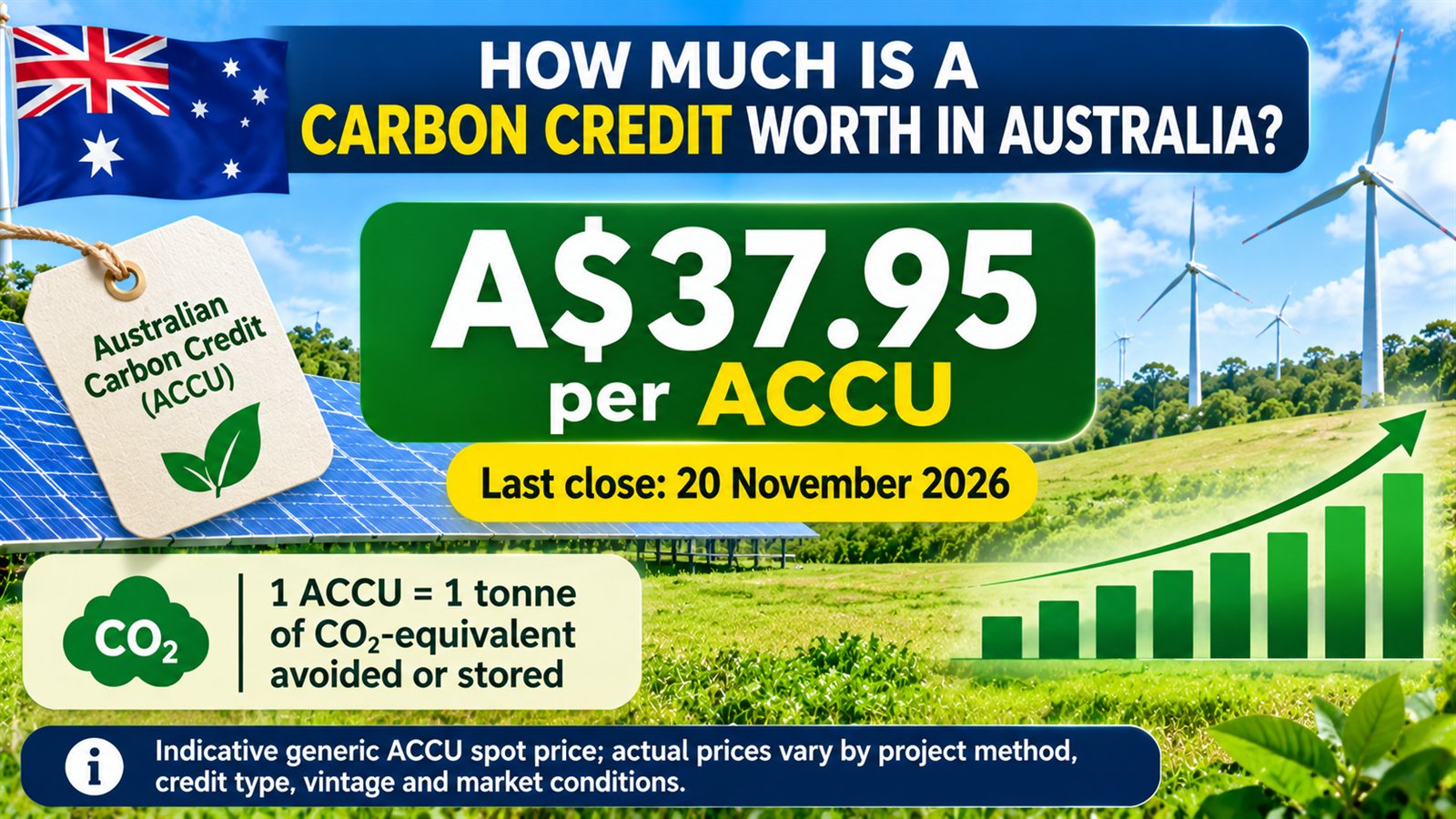
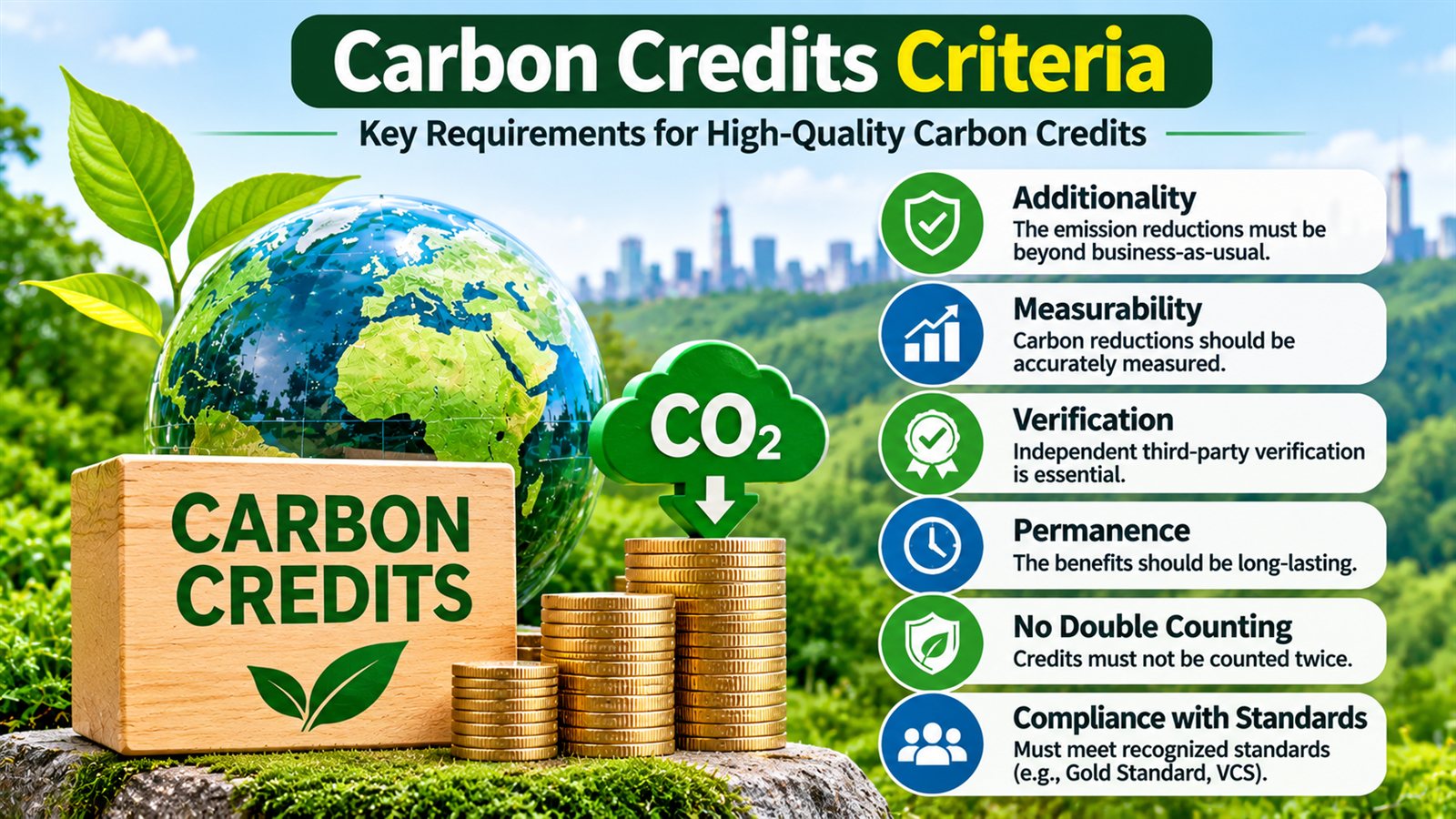
 DSTechnoverse company
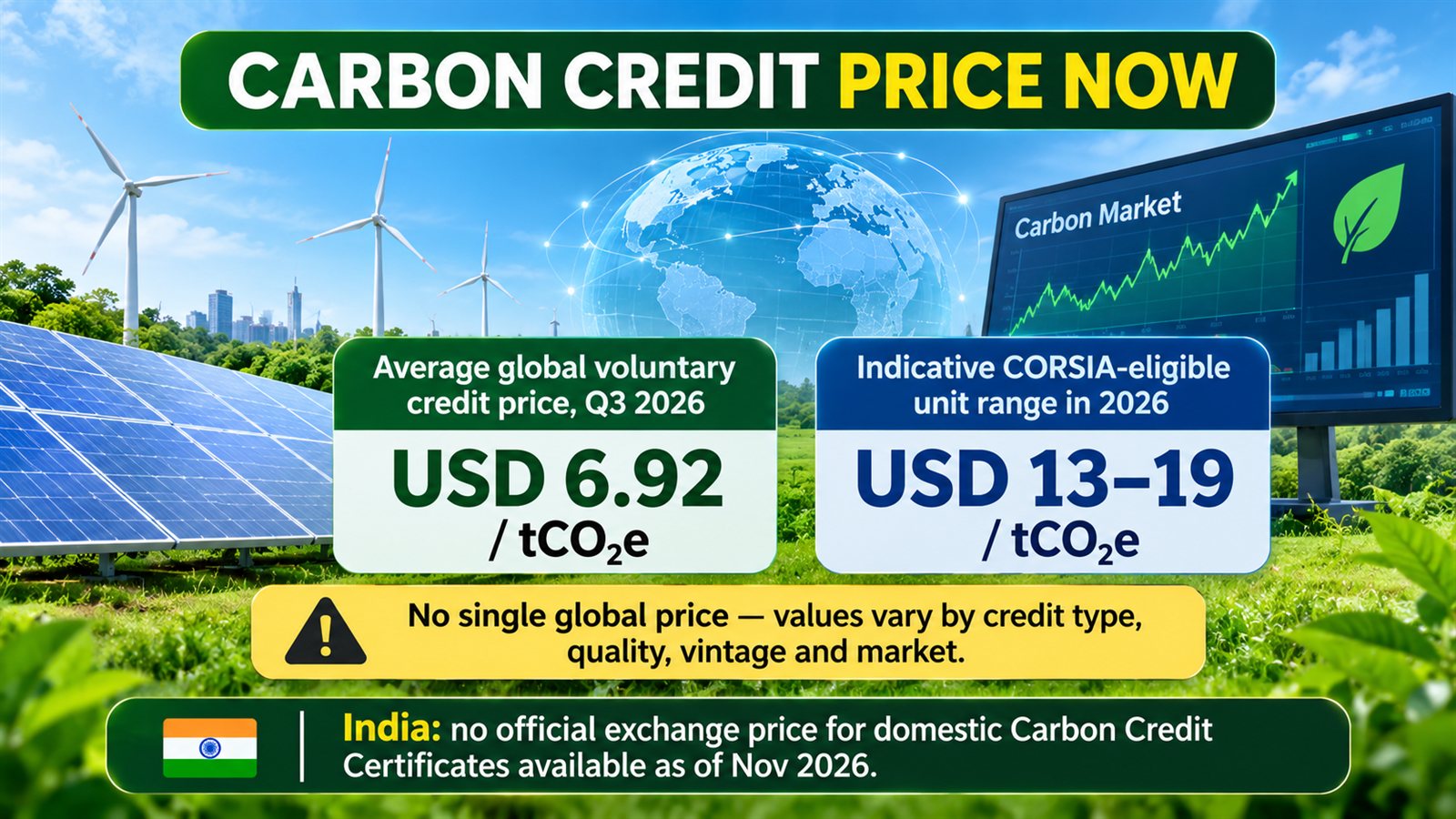
What is the carbon credit price now? There is no single price. As of 23 November 2026, the latest dated figures are:
- about USD 6.92 per tCO₂e for the average voluntary credit retired in Q3 2026 (Sylvera)
- about USD 13.00 per tCO₂e for CORSIA first-phase units in a spot assessment on 18 November 2026 (Fastmarkets)
- around €90 per tonne for EU emissions allowances in mid-November 2026, a separate compliance instrument
Prices vary by market, project type, quality and vintage, so always check the date and source of any quote. For aviation-specific guidance, see our CORSIA Carbon Credits resources.
Carbon credit pricing is the amount a buyer pays for one carbon credit, generally representing one metric tonne of CO₂ equivalent (tCO₂e) reduced or removed. Prices are not set by any authority. They emerge from deals between buyers and sellers and are tracked through averages, assessments and indices.
This article is a dated snapshot of the market now, with the source, date, unit and type of every figure. It also explains what moves prices and how to use them.
What Is the Current Carbon Credit Price in 2026?
Voluntary market: average prices
According to Sylvera's Q3 2026 Carbon Market Data Snapshot, which reports the average price paid per credit retired:
- Q3 2026: USD 6.92 per tCO₂e, up from USD 5.66 in Q3 2025
- 2026 year to date (Q1–Q3): USD 6.12 per tCO₂e, up from USD 5.40 a year earlier
- Retirements in Q3 2026: 30.6 million credits, down 9% year on year
Sylvera also reported that the price gap between higher- and lower-rated credits widened from USD 2.20 to USD 4.19 over the year. Buyers are paying more for quality.
Type of figure: average of credits retired, which reflects many different deals, not a live quote.
Avoidance and reduction credits
From the same Sylvera Q3 2026 data:
- Forest protection (REDD+): about USD 7.75 for higher-rated (BBB+) credits, up 58% from USD 4.90 a year earlier, and USD 3.56 for lower-rated (BB or below) credits
For renewable energy, the latest category average we found is USD 2.67 per tCO₂e for 2024 (Ecosystem Marketplace). That is historical, not a 2026 price.
Carbon removal credits
- Reforestation (ARR): about USD 12.80 to 23.47 per tCO₂e in Q3 2026, from lower- to higher-rated credits (Sylvera)
- All removal credits: about USD 19.50 on average in 2024 (Ecosystem Marketplace)
- Biochar: over USD 160 per tCO₂e in 2024 (Ecosystem Marketplace)
Current public prices for engineered removals, such as direct air capture, are not reliably available, because most deals are private forward purchases.
CORSIA eligible emissions units
- 18 November 2026: Fastmarkets assessed CORSIA Phase 1 spot units at USD 13.00 per tCO₂e, with bids at USD 12.50–12.95 and offers generally above USD 13.00.
- 7 October 2026: S&P Global Platts assessed Phase 1 units at USD 12.75.
- Mid-October 2026: green.earth reported an assessment of USD 13.15 for December 2026 delivery.
- 28 January 2026: Fastmarkets had assessed Phase 1 spot units at USD 19.00.
So CORSIA prices fell by about a third during 2026, as more labelled supply reached the market. S&P Global also launched separate Phase 2 price assessments on 2 November 2026.
Type of figure: price reporting agency assessments, not completed transactions.
India
As of November 2026, no official exchange price for India's Carbon Credit Certificates was available. Trading under the Carbon Credit Trading Scheme had not started at scale. A November 2026 report quoted the Bureau of Energy Efficiency as saying trading would begin for most sectors by the end of 2027.
Summary of dated price figures
| Market segment | Price | Date or period | Type of figure | Source |
|---|---|---|---|---|
| Voluntary credits, all types | USD 6.92/tCO₂e | Q3 2026 | Average of retired credits | Sylvera |
| Voluntary credits, all types | USD 6.12/tCO₂e | Q1–Q3 2026 | Average of retired credits | Sylvera |
| REDD+, higher-rated | USD 7.75/tCO₂e | Q3 2026 | Average by rating | Sylvera |
| Reforestation (ARR) | USD 12.80–23.47/tCO₂e | Q3 2026 | Average by rating | Sylvera |
| CORSIA Phase 1 units | USD 13.00/tCO₂e | 18 Nov 2026 | Spot assessment | Fastmarkets |
| EU ETS allowances | about €90/t | 12–13 Nov 2026 | Futures market price | GMK Center |
| India CCCs | No official price | Nov 2026 | — | BEE |
These figures should not be combined into one average. They measure different instruments in different ways.
Is There One Fixed Price for All Carbon Credits?
No. Every credit represents one tonne, but buyers value tonnes differently because of:
- different standards, such as Verra, Gold Standard or the American Carbon Registry
- different project categories, such as forestry, methane or renewables
- avoidance versus removal
- location and methodology
- vintage, the year the reduction happened
- environmental integrity and independent ratings
- permanence and reversal risks
- buyer requirements, such as CORSIA eligibility
- supply and demand for each type
- market liquidity, meaning how easily a credit can be bought or sold
Practical example (illustrative): Credit A is a 2016 renewable energy credit from a large wind farm in a country where wind power is already cheap. Credit B is a 2024 reforestation credit with a high rating and documented biodiversity benefits. Both represent one tonne, but Credit B might sell for several times Credit A's price, because buyers are more confident its tonne is additional and because removals are scarcer.
Carbon Credit Price by Market Type
Voluntary Carbon Market Price
In the voluntary carbon market, companies buy credits by choice, usually to meet net-zero or climate targets. They buy through brokers, marketplaces, exchanges or direct deals with developers.
- Quality strongly affects price, as the widening rating gap shows.
- Market assessments estimate where a credit type would trade. Transaction prices are what was actually paid.
- Prices vary widely because credits differ so much and most trades are private.
Our guide to the carbon credit marketplace explains how these trades work.
Compliance Carbon Market Price
Compliance markets are created by law. In an emissions trading system, a government sets a cap on emissions and issues allowances, permits to emit one tonne each. Covered companies must surrender enough allowances to cover their emissions, and can trade them.
- Supply is set by the cap, which falls over time.
- Demand depends on industrial output, energy prices and the weather.
- Regulatory changes can move prices sharply.
EU allowances traded around €90 per tonne in mid-November 2026. Allowances are not voluntary carbon credits. They are a different instrument, and their price should not be used to value voluntary credits. The World Bank's Carbon Pricing Dashboard tracks compliance prices and carbon taxes, not voluntary credit prices.
CORSIA Carbon Credit Price
CORSIA, the Carbon Offsetting and Reduction Scheme for International Aviation, is ICAO's global market-based measure for international aviation. Airlines with offsetting requirements must cancel CORSIA eligible emissions units, creating compliance demand.
Units must come from a programme approved by the ICAO Council and meet unit-level conditions. For the first phase (2024–2026), these include eligible vintages, host-country authorisation with a corresponding adjustment, and CORSIA labelling in the registry.
Because labelled supply is limited, CORSIA units have been assessed above the average voluntary price. Fastmarkets reported that more than 55 million tCO₂e had been tagged as Phase 1 eligible by November 2026. IATA estimated demand at 200–250 million units for the first phase.
There is no guaranteed universal CORSIA price, and ICAO does not set one. Our guide to the CORSIA carbon credit price in 2026 covers this market in more detail.
Carbon Credit Price in India
- Voluntary market: Indian projects sell credits internationally under programmes such as Verra and Gold Standard, at international voluntary prices.
- Carbon Credit Trading Scheme (CCTS): administered by the Bureau of Energy Efficiency under the Ministry of Power. It issues Carbon Credit Certificates (CCCs), through a compliance mechanism for obligated industries and an offset mechanism for voluntary projects.
- Trading: CCCs will trade on power exchanges under Central Electricity Regulatory Commission regulations notified in February 2026, with Grid Controller of India as the registry.
CCCs and voluntary credits are different instruments. No official CCC price was available as of November 2026, and voluntary credit prices should not be presented as CCC prices.
Carbon Credit Price by Project Type
Renewable Energy Carbon Credits
Solar, wind and hydro credits are abundant, and many come from older projects whose additionality is questioned. The latest category average we found is USD 2.67 per tCO₂e (2024, Ecosystem Marketplace). Many programmes now restrict new grid-connected renewable projects. Our guide on calculating carbon credits from solar explains these rules.
Forestry and REDD+ Carbon Credits
These protect existing forests from deforestation. Prices depend heavily on baseline credibility. In Q3 2026, Sylvera reported USD 3.56 (lower-rated) to USD 7.75 (higher-rated) per tCO₂e.
Afforestation and Reforestation Credits
These remove CO₂ by planting or restoring forests, with monitoring and buffers for reversal risk. In Q3 2026, they averaged USD 12.80 to 23.47 per tCO₂e, depending on rating (Sylvera).
Methane Capture Carbon Credits
Landfill, livestock and wastewater methane projects deliver large, measurable reductions. We found no reliable current public category average, because prices vary with methodology, location and local regulation.
Waste Management Carbon Credits
Landfill gas recovery, composting and organic waste treatment projects overlap with methane credits. No reliable current public average was available.
Agricultural and Soil Carbon Credits
Soil carbon is harder to measure and can be reversed if practices stop. This is a small, developing segment, and we found no reliable public 2026 average.
Biochar Carbon Credits
Biochar stores carbon in a stable form for long periods, with strict methodology and durability requirements. Ecosystem Marketplace reported over USD 160 per tCO₂e in 2024.
Direct Air Capture Carbon Credits
Direct air capture (DAC) offers high-durability geological storage but is expensive to build and run. Reliable public prices are not available, because most DAC credits are sold through private, multi-year forward contracts.
What Factors Determine the Price of One Carbon Credit?
- Project category: removals and newer technologies cost more than abundant avoidance credits.
- Project quality and integrity: high ratings attract more buyers.
- Additionality: buyers pay more when the project clearly needed carbon finance.
- Removal versus avoidance: removals are scarcer and preferred for net-zero claims.
- Certification programme: reputation and rules matter.
- Approved methodology: some methodologies, such as those with the ICVCM's Core Carbon Principles label, carry more buyer trust.
- Vintage: newer credits are usually preferred.
- Permanence and reversal risk: longer, safer storage commands more.
- Leakage: higher risk lowers confidence.
- Independent verification: quality audits support value.
- Co-benefits: biodiversity and community benefits can add value.
- Registry and transaction costs: these add to the final price.
- Supply and demand: scarcity of a credit type raises its price.
- Corporate climate commitments: these drive voluntary demand.
- Government policies: rules such as CORSIA and Article 6 create new demand.
- Buyer-specific requirements: eligibility needs narrow the pool of suitable credits.
The more of these a credit meets, the more buyers are usually willing to pay. But a higher price does not automatically mean a better credit.
How Is the Price of One Carbon Credit Calculated?
Total purchase cost = Number of carbon credits × Price per credit
All examples are hypothetical, not current quotes or guaranteed prices.
- Example 1: Small business purchase. 100 credits × USD 10 = USD 1,000
- Example 2: Medium-sized corporate purchase. 1,000 credits × USD 15 = USD 15,000
- Example 3: Large corporate purchase. 10,000 credits × USD 20 = USD 200,000
The final cost may also include:
- brokerage fees
- registry transfer and retirement charges
- marketplace fees
- due diligence costs, such as ratings or legal review
- contractual and administrative costs
Why Do Carbon Credit Prices Increase or Decrease?
- Demand changes: more corporate buying raises prices, while scaled-back pledges lower them.
- Supply of verified credits: CORSIA prices fell during 2026 as labelled supply grew.
- Availability of high-quality removals: limited supply supports removal prices.
- Corporate net-zero commitments: these set the long-term demand base.
- International aviation demand: CORSIA compliance deadlines create buying pressure.
- New regulations: Article 6 rules, national schemes and claim rules shape demand.
- Integrity initiatives: ICVCM labels and ratings increase demand for top-tier credits and reduce it for weaker ones.
- Methodology changes: stricter rules can cut supply or devalue older credits.
- Economic conditions: tighter budgets reduce discretionary buying.
- Buyer confidence: media scrutiny has repeatedly hit demand for some credit types.
The widening quality gap in 2026 shows several of these forces at once: demand moved towards higher-rated credits while lower-rated ones stayed cheap.
How Can Buyers Find the Current Carbon Credit Price?
- Carbon credit marketplaces: listed asking prices.
- Market data providers: for example, Sylvera, Ecosystem Marketplace and AlliedOffsets.
- Price reporting agencies: for example, Fastmarkets and S&P Global Platts, which publish assessments.
- Exchanges and indices: for example, ICE lists CORSIA eligible emissions unit futures.
- Broker quotations.
- Direct project developer quotations.
- Registry information: to confirm a credit exists and is unretired.
To compare fairly, use quotes for the same:
- project category
- vintage
- certification programme
- market segment
- transaction size
- delivery and retirement conditions
Registries record a credit's status and ownership, not its live market price.
How Can Sellers Get the Best Price for Carbon Credits?
- Choose an appropriate programme that your target buyers accept.
- Keep high-quality documentation, including design and monitoring reports.
- Demonstrate additionality clearly.
- Ensure reliable monitoring and verification.
- Understand buyer eligibility requirements, such as CORSIA labels or ratings.
- Compare several buyer quotations.
- Choose between spot and forward contracts, balancing price certainty and timing.
- Evaluate intermediary fees.
- Maintain transparent registry records.
Quality and certification can improve buyer interest, but they do not guarantee a premium price. Our guide on how much you can earn from carbon credits covers revenue and costs for sellers.
Are Carbon Credit Prices Expected to Rise in the Future?
Current data: voluntary averages rose year on year in Q3 2026, while CORSIA units fell from USD 19.00 to about USD 13.00 during 2026.
Historical trends: Ecosystem Marketplace's annual voluntary averages rose from about USD 2.51 (2020) to USD 7.37 (2022), then eased to about USD 6.34 (2024).
Forecasts: Sylvera has modelled CORSIA Phase 1 prices in a range of USD 15–53 per unit by January 2028. That is a single forecaster's scenario range, not a consensus.
Factors that could push prices up or down:
- growth or retreat in corporate climate commitments
- aviation demand as CORSIA deadlines approach, and Phase 2 from 2027
- demand for high-durability removals
- new supply of verified and authorised credits
- Article 6 and national policies
- better carbon accounting and verification
This article does not predict or guarantee future prices or returns.
Common Mistakes When Researching Carbon Credit Prices
- Assuming all credits cost the same
- Comparing voluntary credits with compliance allowances
- Using outdated quotes, such as a January CORSIA price in November
- Confusing asking prices with completed transactions
- Ignoring vintage
- Ignoring certification and methodology
- Assuming all CORSIA-related credits are interchangeable, since Phase 1 and Phase 2 units differ
- Treating a marketplace listing as a completed sale
- Ignoring transaction and registry fees
- Trusting unsupported price forecasts
Frequently Asked Questions About Carbon Credit Prices
What is the carbon credit price right now in 2026?
There is no single price. The average voluntary credit retired in Q3 2026 sold for about USD 6.92 per tCO₂e (Sylvera), and CORSIA Phase 1 units were assessed at USD 13.00 on 18 November 2026 (Fastmarkets).
How much does one carbon credit cost today?
From a few dollars for lower-rated avoidance credits to over USD 100 for durable removals. The figure depends on project type, quality, vintage and eligibility.
What is the average price of one carbon credit?
About USD 6.92 per tCO₂e in Q3 2026 and USD 6.12 for Q1–Q3 2026, based on Sylvera's averages of credits retired.
Why are some carbon credits more expensive than others?
Removals, higher ratings, newer vintages, strong additionality, permanence, co-benefits and compliance eligibility all increase what buyers will pay. Abundant, older or lower-rated credits sell for less.
What is the current price of CORSIA carbon credits?
Fastmarkets assessed CORSIA Phase 1 spot units at USD 13.00 per tCO₂e on 18 November 2026, down from USD 19.00 in January 2026. There is no official ICAO price.
What is the carbon credit price in India?
No official exchange price for India's Carbon Credit Certificates was available as of November 2026. Voluntary credits from Indian projects sell at international market prices.
Are carbon credit prices expected to increase?
They may rise or fall. Demand for quality credits and CORSIA compliance could support prices, while new supply could weigh on them. Forecasts vary widely and are not guarantees.
Where can I check live carbon credit prices?
Use price reporting agencies such as Fastmarkets and S&P Global Platts, data providers such as Sylvera, exchanges such as ICE, marketplaces and broker quotes. Always check the date and figure type.
What is the difference between voluntary and compliance carbon credit prices?
Voluntary credits are project-based and bought by choice. Compliance prices, such as EU allowances at around €90 in November 2026, are for government permits under a cap. They are different instruments.
Does one carbon credit always represent one tonne of CO₂?
Generally one metric tonne of CO₂ equivalent (tCO₂e), which can include other greenhouse gases converted into CO₂ terms, under the issuing programme's rules.
Conclusion
So, what is the carbon credit price now? In November 2026, the average voluntary credit costs about USD 7 per tonne, CORSIA Phase 1 units about USD 13, and durable removals far more. EU allowances near €90 belong to a different, compliance market, and India's CCCs have no official price yet.
Prices differ because credits differ in project type, quality, certification, vintage and eligibility. Voluntary, compliance and CORSIA markets each have their own demand and pricing. Buyers and sellers should rely on current, dated and reliable data, and compare like with like.
To learn more about CORSIA carbon credits and carbon markets, explore the resources at CORSIA Carbon Credit.
Sources
- Sylvera – Carbon Market Data Snapshot Q3 2026
- Fastmarkets – CORSIA prices tick higher on increased buyer inquiries (November 2026)
- Fastmarkets – CORSIA spot prices continue to slide (4 February 2026)
- green.earth – CORSIA activity builds across prices, airlines and supply (16 October 2026)
- ICE – CORSIA Eligible Emissions Units (2024–2026) Futures
- GMK Center – European carbon prices exceeded €90/t in November (2026)
- Ecosystem Marketplace – State of the Voluntary Carbon Market reports
- World Bank – Carbon Pricing Dashboard
- ICAO – CORSIA Eligible Emissions Units
- IATA / EuropaWire – ICAO joins alliance to address CORSIA supply shortfall (13 October 2026)
- Bureau of Energy Efficiency – Indian Carbon Market