 DSTechnoverse company
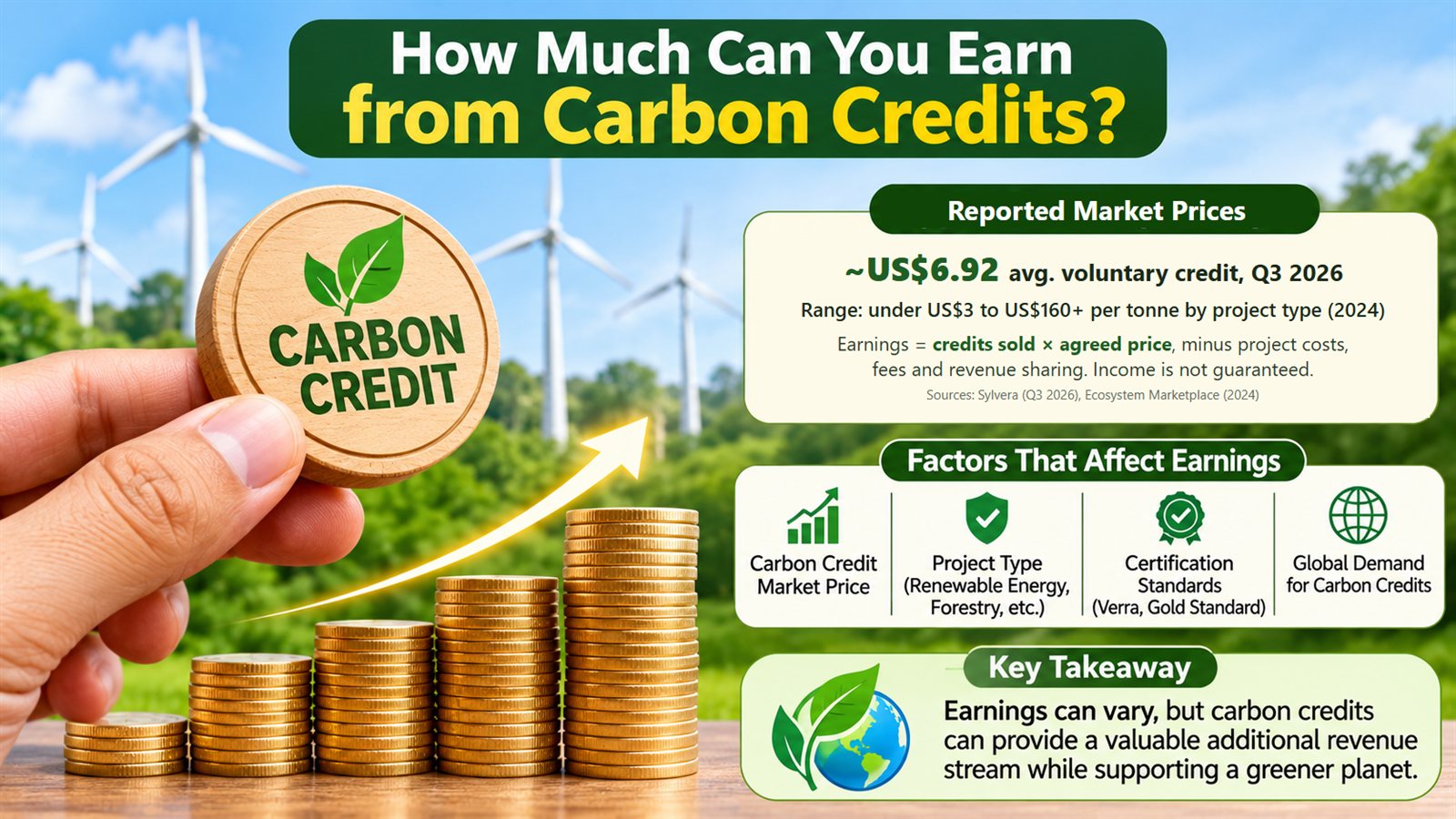
How much can you earn from carbon credits? There is no fixed amount. Earnings equal the number of credits you actually sell multiplied by the agreed price, minus project costs, fees and revenue sharing. Reported prices vary widely: the average voluntary credit retired in Q3 2026 sold for about USD 6.92 per tonne, while some removal credits sell for well over USD 100. For how credits work in aviation, see our CORSIA Carbon Credits resources.
This guide explains what credits are worth, how to estimate potential income and profit, and which costs and risks reduce what you keep. Every price below is dated and sourced, and every example is clearly hypothetical. Nothing here is a promise of income.
Introduction to Carbon Credit Earnings
A carbon credit is a tradable certificate representing one metric tonne of CO₂ equivalent (tCO₂e) reduced or removed, subject to the issuing programme's rules. Credits earn money because companies, airlines, governments and traders buy them to meet climate targets or compliance obligations.
Farmers, landowners, businesses and project developers can earn from credits. Their earnings differ because projects vary in size, type, quality, costs and buyer demand.
To earn anything, you need:
- an eligible project under an approved methodology
- successful monitoring and verification
- formal credit issuance in a registry
- a buyer or sales agreement
Planting trees or cutting emissions does not automatically generate payments. Only issued, sold credits produce revenue.
How Much Can You Earn from Carbon Credits?
Your earnings depend on how many credits are issued and sold, at what price, and at what cost.
- Project size sets the volume. A small farm may generate a few credits a year, while a large landfill gas project may generate tens of thousands.
- Project category sets the price range. Removals usually sell for more than avoided-emission credits.
- Credit quality affects value. Credits with strong additionality, permanence and ratings attract more buyers.
- Issued and sold credits matter, not estimates. Verification can reduce volumes, and some credits may not find a buyer.
- Costs come off the top. Gross revenue is not profit.
Two terms used throughout this guide:
- Gross revenue: total money received from selling credits.
- Net income (or profit): what remains after all project, transaction and revenue-sharing costs.
How Much Is One Carbon Credit Worth?
One credit generally represents one tonne of CO₂e. Its price is set by negotiation between buyers and sellers. No official price exists for voluntary credits. It varies by project category, quality, vintage, methodology and buyer demand.
Price data comes in different forms:
- asking prices, what sellers request
- indicative quotes from brokers
- market assessments by price reporting agencies
- completed transaction prices, what buyers actually paid
The figures below are reported averages, not offers.
Renewable Energy Carbon Credits
Solar, wind and hydropower credits are plentiful, and many come from older projects that would likely have been built anyway, which weakens additionality. Ecosystem Marketplace data put the average at about USD 2.67 per tCO₂e in 2024. Newer projects in places where renewables still need carbon finance may achieve more.
Forestry and Nature-Based Carbon Credits
Prices depend on the type of activity and its quality rating. In Q3 2026, according to Sylvera data:
- forest protection (REDD+) credits averaged about USD 3.56 to 7.75, from lower-rated to higher-rated credits
- reforestation (ARR) credits averaged about USD 12.80 to 23.47
- improved forest management credits averaged about USD 12.79 to 21.07
Restoration and removal credits generally attract more buyers than avoided-deforestation credits, whose baselines have faced criticism.
Methane Reduction Carbon Credits
Landfill gas capture, methane destruction and agricultural methane projects can generate large volumes, because methane has a high warming effect. Their prices vary widely by methodology, location and buyer, so we have not found one reliable current average to quote. Buyers look closely at monitoring of gas flow and destruction.
Improved Cookstove Carbon Credits
Cookstove credits fund cleaner stoves for households. Ecosystem Marketplace reported about USD 7.30 per tCO₂e for household devices, including cookstoves, in 2024. Their value depends heavily on usage data: studies have found some projects overestimated how often stoves were used, so buyers now favour projects with strong monitoring.
Carbon Removal Credits
Removal credits take CO₂ out of the air. Durable removals, such as biochar or direct air capture, store carbon for long periods, cost more to deliver and are sought for net-zero claims. Ecosystem Marketplace reported all removal credits at about USD 19.50 and biochar at over USD 160 per tCO₂e in 2024. Engineered removals are often sold through long-term offtakes rather than spot sales.
For a wider snapshot, see our guide to the current value of carbon credits.
How Much Can Farmers Earn from Carbon Credits?
Farmers usually earn through aggregated projects, in which a developer combines many farms into one project. Eligible practices may include:
- soil carbon improvement
- agroforestry
- reduced tillage
- cover cropping
- improved fertiliser management
- agricultural methane reduction, such as alternate wetting and drying in rice
Reductions or removals are measured using soil sampling, practice records, remote sensing and approved models. The aggregator manages verification and sales, then pays farmers under a revenue-sharing agreement.
Farm size, soil conditions, methodology, monitoring and verification all affect income.
Illustrative example (hypothetical figures):
- Farm size: 10 hectares
- Credits issued: 1 tCO₂e per hectare per year, so 10 credits
- Selling price: USD 15 per credit
- Gross revenue: 10 × 15 = USD 150 a year
- Farmer's share under the contract: 60%, so USD 90 a year, before tax
For a small farm, carbon income is usually modest. It works best as a supplement to better yields or lower input costs, not as a main income source. Income is not guaranteed, and payment can take years because credits require several monitoring periods.
How Much Can Landowners Earn from Carbon Credits?
Landowners may earn from forest conservation, reforestation and afforestation, improved forest management, land restoration or soil carbon projects. What they earn depends on:
- land ownership and clear carbon rights
- project eligibility under a methodology
- monitoring periods, often several years between verifications
- carbon storage potential of the land
- permanence and reversal risks, which lead to buffer contributions
- revenue-sharing agreements with the developer
Illustrative example (hypothetical figures):
- Reforestation area: 100 hectares
- Net credits after buffer: 8 tCO₂e per hectare per year, so 800 credits a year
- Selling price: USD 18 per credit
- Gross revenue: 800 × 18 = USD 14,400 a year
- Landowner's share: 50%, so USD 7,200 a year, before tax
Credits may only be issued every few years, and young trees remove little carbon in early years. Not every landowner or every piece of land qualifies.
How Much Can Businesses Earn from Carbon Credits?
Businesses may develop eligible projects in:
- renewable energy, where methodologies still allow it
- energy efficiency
- methane capture
- industrial emissions reduction
- waste management
- carbon removal
They earn by registering the project, getting it verified and selling issued credits.
Reductions a company uses for its own compliance or claims cannot automatically be sold to another buyer. Selling them while also counting them in its own emissions would be a double claim.
How to Calculate Potential Carbon Credit Earnings
Gross revenue = Number of carbon credits sold × Selling price per credit
Net profit = Gross revenue − Project development costs − Verification costs − Registry fees − Other applicable expenses
All figures below are hypothetical examples, not current offers or guaranteed returns.
Example 1: Small carbon credit project
- Credits sold: 500
- Selling price: USD 10 per credit
- Gross revenue: 500 × 10 = USD 5,000
- Total project and transaction expenses: USD 1,500
- Net income: 5,000 − 1,500 = USD 3,500
Example 2: Larger carbon credit project
- Credits sold: 10,000
- Selling price: USD 15 per credit
- Gross revenue: 10,000 × 15 = USD 150,000
- Total project and transaction expenses: USD 40,000
- Net income: 150,000 − 40,000 = USD 110,000
Actual earnings can be lower still because of:
- revenue-sharing agreements with landowners or communities
- taxes
- financing costs, such as interest on loans for upfront costs
- timing: costs come years before issuance, and payment depends on the contract
What Factors Determine Carbon Credit Earnings?
- Number of verified credits: sets the volume you can sell.
- Project category: removals generally earn more than avoidance.
- Credit quality: better-rated credits attract more buyers.
- Additionality: weak evidence reduces value or prevents issuance.
- Permanence: reversal risk means buffer deductions.
- Leakage: shifted emissions are deducted from credits.
- Monitoring and verification: gaps reduce issued volumes.
- Programme and methodology: some carry more buyer trust. Credits under methodologies approved by the Integrity Council for the Voluntary Carbon Market (ICVCM) can carry its Core Carbon Principles (CCP) label.
- Vintage: newer credits are usually preferred.
- Buyer demand and market supply: these move prices up or down.
- Development costs: these reduce profit.
- Broker and aggregator commissions: these reduce your share.
- Contract terms: fixed-price offtakes trade upside for certainty.
Two similar projects can earn different amounts. For example, two reforestation projects may differ in growth rates, ratings, buffer requirements, vintages and the contracts they signed.
How Do You Sell Carbon Credits and Receive Payment?
- Identify an eligible reduction or removal project.
- Select a crediting programme.
- Develop and register the project.
- Monitor reductions or removals.
- Obtain independent verification.
- Receive formally issued credits.
- Find buyers through direct agreements, brokers or marketplaces.
- Negotiate price and delivery conditions.
- Transfer or retire credits as the deal requires.
- Receive payment under the contract.
Sales take two main forms:
- Spot sales: existing issued credits are sold and delivered now, at current prices.
- Forward or offtake agreements: a buyer agrees to purchase future credits, often at a fixed price and sometimes with advance payment.
Our step-by-step guide on how to get paid for carbon credits covers this process, buyers and contracts in detail.
How Much Does It Cost to Generate Carbon Credits?
Costs that reduce earnings include:
- feasibility studies
- project design and documentation
- validation fees
- monitoring and data collection
- verification fees, repeated for each monitoring period
- registry fees for accounts, registration and issuance
- project management
- technology and equipment
- broker and marketplace commissions
- revenue-sharing payments
- legal and administrative expenses
Many of these costs are fixed regardless of project size. Validation and verification cost about the same for a small project as for a large one, which is why small projects often need aggregation to be viable. Our guide to the carbon credit certification process explains each stage that generates these costs.
How Much Can You Earn from Carbon Credits in India?
Indian projects already sell voluntary credits internationally, under programmes such as Verra and Gold Standard. Opportunities include:
- eligible agricultural projects, such as rice methane and soil carbon
- agroforestry and forestry
- renewable energy, though many programmes now restrict new grid-connected renewable credits in India
- methane reduction and waste management
- industrial emissions reduction
India is also building a domestic carbon market under the Carbon Credit Trading Scheme (CCTS):
- Compliance mechanism: obligated industries that beat their emissions-intensity targets earn Carbon Credit Certificates (CCCs).
- Offset mechanism: non-obligated entities can register eligible projects to earn CCCs.
CCCs and voluntary credits are different instruments. CCCs are domestic certificates, traded on Indian power exchanges under Central Electricity Regulatory Commission (CERC) oversight and held in the Grid-India registry. As of November 2026, no official CCC trading price had been published. A November 2026 report quoted the Bureau of Energy Efficiency as saying trading would begin for most sectors by the end of 2027. International voluntary prices should not be used to estimate CCC income.
Can You Earn More from CORSIA-Eligible Carbon Credits?
CORSIA, ICAO's Carbon Offsetting and Reduction Scheme for International Aviation, requires airlines to offset growth in international aviation emissions by cancelling CORSIA eligible emissions units.
For a unit to be eligible:
- it must come from a programme approved by the ICAO Council for the compliance period
- it must meet that period's unit conditions, including vintage, scope and, for the first phase, host-country authorisation with a corresponding adjustment
Programme and unit requirements must be checked separately. Eligibility gives access to airline buyers, whose demand is tied to compliance deadlines rather than voluntary pledges.
This does not mean every CORSIA-eligible credit sells for more. CORSIA first-phase units were assessed at about USD 13.15 in mid-October 2026 (green.earth), after falling earlier in the year. That figure is a market assessment for one product, not a guaranteed premium. Obtaining authorisation also adds time and requirements. Our guide to CORSIA eligible carbon credits explains the checks.
Common Mistakes That Reduce Carbon Credit Earnings
- Assuming all environmental activities generate credits
- Overestimating credit volumes before verification
- Ignoring project development costs
- Using an unsuitable methodology
- Choosing unreliable intermediaries
- Ignoring carbon ownership rights
- Failing to verify buyer credibility
- Accepting unclear revenue-sharing terms
- Assuming issued credits guarantee immediate payment
- Confusing voluntary and compliance prices. For example, EU ETS allowances, carbon taxes and India's CCCs are priced in different markets from voluntary credits. World Bank carbon pricing data mainly covers carbon taxes and emissions trading systems, not voluntary credit prices.
Is Earning Money from Carbon Credits Worth It?
It can be, but it depends on scale, costs and risk tolerance.
On the positive side:
- long-term revenue for projects with strong volumes and quality
- environmental and social benefits, such as restored land and cleaner air
On the other side:
- upfront investment in development and certification
- ongoing monitoring responsibilities over many years
- market price uncertainty
- recurring verification costs
- contractual and regulatory risks
Large projects, and small participants who join well-run aggregated projects, are more likely to see meaningful income. This is not investment advice. Get independent legal and financial advice before committing.
Future Outlook for Carbon Credit Earnings
Confirmed developments:
- Article 6 of the Paris Agreement now has operational rules, and countries are signing bilateral cooperation agreements.
- CORSIA's first phase (2024–2026) is creating compliance demand from airlines.
- ICVCM CCP labels are being applied to approved methodologies.
- India's CCTS has its legal framework, targets and trading regulations in place.
Expectations, not certainties:
- growing demand for high-integrity and removal credits
- more investment in nature-based projects with strong monitoring
- lower costs from digital MRV and satellite monitoring
- continued corporate climate commitments, though some companies have scaled back pledges
For developers, the opportunity lies in higher-quality credits. The challenge is meeting stricter integrity requirements at a viable cost.
Frequently Asked Questions
How much can you earn from carbon credits?
There is no fixed amount. Earnings equal credits sold × agreed price, minus costs and revenue sharing. The average voluntary credit retired in Q3 2026 sold for about USD 6.92 per tonne (Sylvera), but prices vary widely by project type.
How much is one carbon credit worth?
It depends on type and quality. In 2024, renewable energy credits averaged about USD 2.67 and biochar removals over USD 160 per tonne (Ecosystem Marketplace). Reforestation credits averaged about USD 12.80–23.47 in Q3 2026 (Sylvera).
How much can farmers earn from carbon credits?
Usually a modest amount, depending on farm size, practices, soil and the revenue share agreed with the aggregator. Small farms may earn only tens or hundreds of dollars a year, and income is not guaranteed.
Can individuals make money by selling carbon credits?
Not for everyday green actions. Landowners and farmers can earn by joining a registered project through a developer or aggregator, which handles certification and sales and shares the revenue.
How are carbon credit earnings calculated?
Gross revenue = credits sold × selling price. Net profit = gross revenue minus development, verification, registry and other costs, then any revenue sharing and taxes.
How much does it cost to generate carbon credits?
Costs include feasibility studies, design documents, validation, monitoring, verification, registry fees, commissions and legal work. Many are fixed, so small projects often need aggregation to be viable.
Do CORSIA-eligible carbon credits earn more money?
Not automatically. Eligibility gives access to airline buyers, and CORSIA first-phase units were assessed at about USD 13.15 in mid-October 2026. But prices change, and authorisation adds requirements.
Conclusion
So, how much can you earn from carbon credits? There is no fixed amount. Actual income depends on:
- the number of eligible credits generated
- the market selling price
- project quality
- verification and issuance
- project expenses
- buyer agreements
- revenue-sharing arrangements
Use dated price data, conservative volume estimates and full cost budgets to judge whether a project makes sense.
To learn more about CORSIA carbon credits and international carbon market developments, explore the resources at CORSIA Carbon Credit.
Sources
- Ecosystem Marketplace – State of the Voluntary Carbon Market reports
- Carbon credit price tracker – Sylvera and Ecosystem Marketplace data (reviewed 5 October 2026)
- green.earth – CORSIA activity builds across prices, airlines and supply (16 October 2026)
- ICVCM – Core Carbon Principles
- Verra
- Gold Standard
- ICAO – CORSIA Eligible Emissions Units
- UNFCCC – Article 6 of the Paris Agreement
- World Bank – State and Trends of Carbon Pricing
- Bureau of Energy Efficiency – Indian Carbon Market
- Ministry of Environment, Forest and Climate Change, India