 DSTechnoverse company
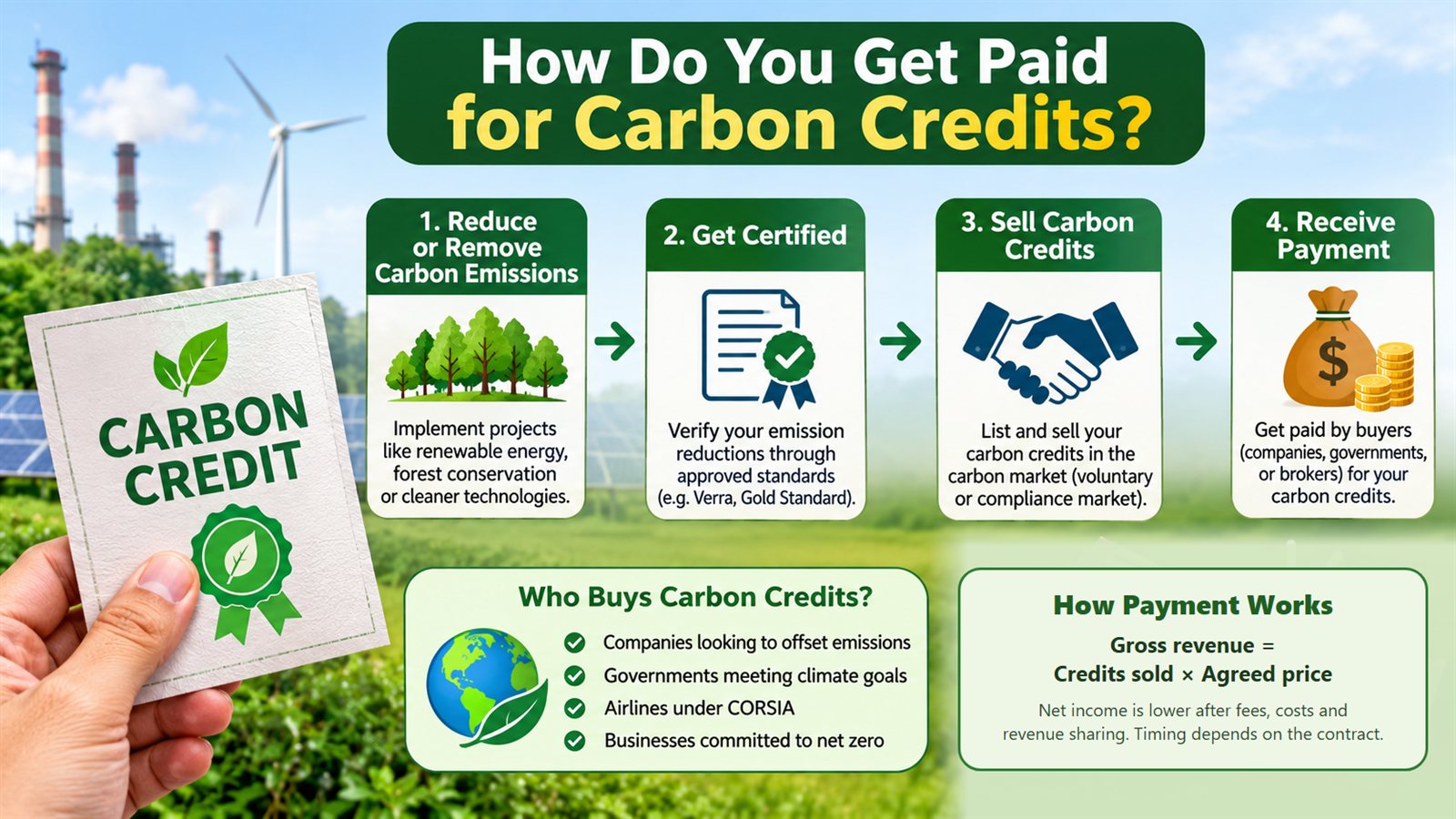
How do you get paid for carbon credits? You develop an eligible project that reduces or removes emissions, register it with a carbon-crediting programme, and have its results independently verified. The programme then issues credits into a registry. You sell those credits to a buyer, transfer them, and receive payment under the terms of your sales contract. For how credits are used in aviation, see our CORSIA Carbon Credits resources.
This guide explains the complete journey, from planning a project to receiving payment, for farmers, landowners, businesses and project developers. It uses dated, sourced price data and does not promise any particular income.
Introduction to Getting Paid for Carbon Credits
A carbon credit is a tradable certificate representing one metric tonne of CO₂ equivalent (tCO₂e) reduced or removed, subject to the issuing programme's rules.
Credits generate revenue because organisations buy them:
- companies to compensate for emissions they cannot yet cut, or to meet net-zero pledges
- airlines to meet obligations under CORSIA
- governments to help meet climate targets through international cooperation
- brokers and traders to resell to end buyers
Carbon markets connect project developers with these buyers through direct deals, brokers, marketplaces and exchanges.
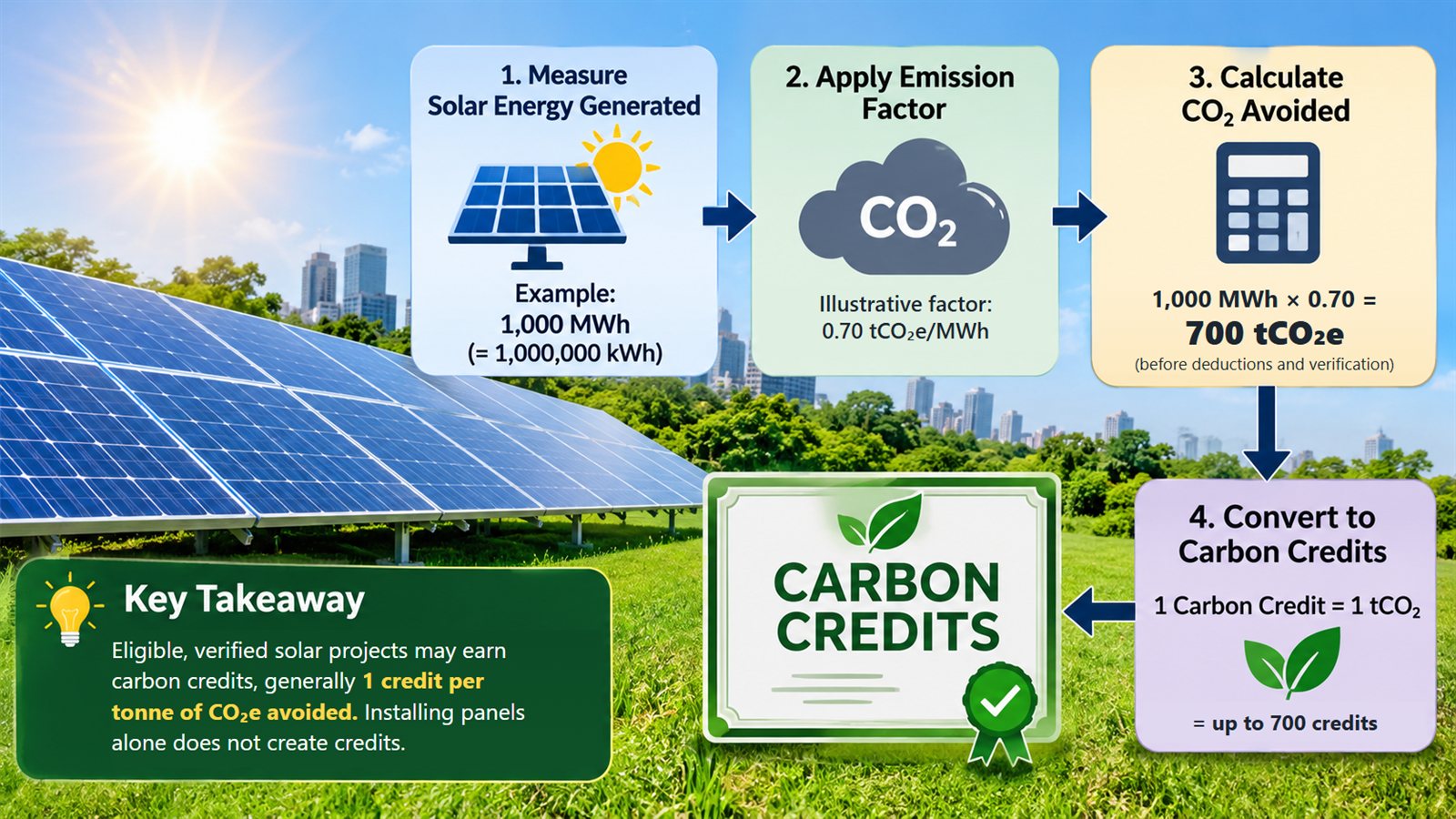
Carbon credits are not automatic payments for green activity. Planting trees or installing solar panels does not earn money by itself. Revenue only comes from credits that have been measured under an approved methodology, verified, issued and then sold.
What Does Getting Paid for Carbon Credits Mean?
Getting paid means selling issued carbon credits to a buyer for an agreed price. It involves four distinct stages:
- Estimated reductions: what the project expects to achieve
- Verified reductions: what an independent auditor confirms it achieved
- Issued credits: units the programme creates in its registry
- Sold credits: units transferred to a buyer who pays for them
Generating credits and earning revenue are different things. A project can be issued credits and still struggle to sell them if demand for that type is weak.
Who receives the money? That depends on:
- project ownership
- carbon rights, the legal right to the emission reductions, which may belong to the landowner, the project operator or, in some countries, the government
- contractual agreements between landowners, developers, aggregators and investors
- programme requirements, which require proof of rights before registration
Who Can Earn Money from Carbon Credits?
Farmers and Agricultural Landowners
Farmers may join eligible projects for soil carbon, agroforestry, improved fertiliser management or reduced methane from rice or livestock. Most join through an aggregator, because a single farm is usually too small to cover certification costs.
Forest Owners and Landowners
Owners of suitable land may take part in reforestation, afforestation, improved forest management or forest conservation projects. These need long-term commitments, often decades, because stored carbon must stay protected.
Businesses and Industrial Companies
Companies may develop projects that cut emissions beyond what is required by law, such as energy efficiency upgrades, methane capture or industrial process changes.
Renewable Energy Project Developers
Solar, wind and hydropower projects can earn credits only where an applicable methodology covers them and they pass additionality tests. Many programmes now restrict credits for grid-connected renewables in countries where these projects are already commercially viable without carbon finance.
Waste Management and Methane Capture Operators
Landfill gas capture, waste treatment and methane destruction projects can generate credits because methane has a strong warming effect.
Carbon Project Developers and Aggregators
Developers and aggregators design projects, combine many small activities into one project, manage certification and sell the credits. They then distribute revenue to participants under agreed contracts.
Eligibility always depends on the carbon standard, methodology, additionality, project circumstances and legal rights.
How Do You Get Paid for Carbon Credits? Step-by-Step Process
Step 1: Develop an Eligible Carbon Reduction or Removal Project
- Identify a suitable project activity.
- Define the project boundary: which sites, sources and gases are included.
- Check additionality: the project must go beyond business as usual and legal requirements.
- Confirm ownership and carbon rights.
- Choose a crediting programme, such as Verra, Gold Standard, the American Carbon Registry or the Climate Action Reserve, and a methodology that fits.
Step 2: Register the Carbon Credit Project
- Prepare a Project Design Document (PDD), where required, setting out the baseline, methodology and monitoring plan.
- Have the design validated by an accredited validation and verification body (VVB).
- Register the project with the programme and pay its fees.
Step 3: Monitor and Measure Emissions Reductions
- Compare actual emissions or removals with the baseline.
- Collect data using meters, sampling, records or remote sensing.
- Prepare monitoring reports and keep supporting evidence, such as invoices, logs and photos.
Our guide on how to calculate carbon credits shows the formulas behind this step.
Step 4: Get the Project Independently Verified
A VVB reviews the monitoring report, data and calculations, often with a site visit. It confirms the eligible reductions or removals, and may reduce the figure if evidence is weak.
Step 5: Receive Carbon Credit Issuance
After the programme approves the verification, it issues credits into the project owner's registry account. Each credit has a unique serial number, so its ownership and history can be traced. Only issued credits can be sold as carbon credits, not calculated or estimated reductions. Our guide to the carbon credit certification process covers Steps 2 to 5 in detail.
Step 6: Find Carbon Credit Buyers
- Direct corporate buyers: higher margins and long-term relationships, but they require time, contacts and due diligence support.
- Brokers: they reach many buyers quickly, but take a commission.
- Intermediaries and traders: they may buy credits outright, often at a discount, taking the resale risk.
- Exchanges and marketplaces: they offer visibility and price discovery, but listing does not guarantee a sale.
- Developers and aggregators: they handle sales for small participants and share revenue.
- Long-term offtake agreements: these give predictable revenue and sometimes upfront finance, but usually at a lower fixed price.
Step 7: Negotiate the Carbon Credit Sale
A sales agreement typically covers:
- quantity of credits and price per credit
- vintage, the year the reduction occurred
- project category and methodology
- quality evidence, such as verification reports and ratings
- delivery conditions and registry transfer requirements
- payment terms and each party's contractual responsibilities
There are two main types of deal:
- Spot transactions: existing issued credits are sold and delivered now.
- Forward or offtake agreements: the buyer commits to purchase future credits, often at a fixed price, sometimes with advance payment.
Step 8: Transfer or Retire Credits and Receive Payment
- Registry transfer: the seller moves credits to the buyer's registry account.
- Retirement or cancellation: sometimes the seller retires credits directly on the buyer's behalf, so they can never be resold.
- Delivery confirmation: the registry record confirms the transfer or retirement.
- Invoicing and payment: payment is usually by bank transfer against an invoice, in one sum or in milestones.
- Taxes and compliance: income tax, indirect taxes and foreign exchange rules may apply, depending on the country. Professional advice is recommended.
The payment sequence depends on the contract. Payment can come before delivery, after delivery, in stages, or under a forward agreement.
How Much Money Can You Get Paid for Carbon Credits?
There is no universal carbon credit price. Earnings depend on:
- project type: removals usually earn more than avoidance credits
- quality, additionality and permanence
- vintage and methodology: newer vintages and stronger methodologies are valued more
- buyer demand and supply
- verification, certification, registry and transaction costs, which reduce what the seller keeps
Here is dated market data. These are reported averages and assessments, not offers or guaranteed prices.
- Overall voluntary market: the average voluntary credit retired in Q3 2026 sold for about USD 6.92 per tonne, according to Sylvera data.
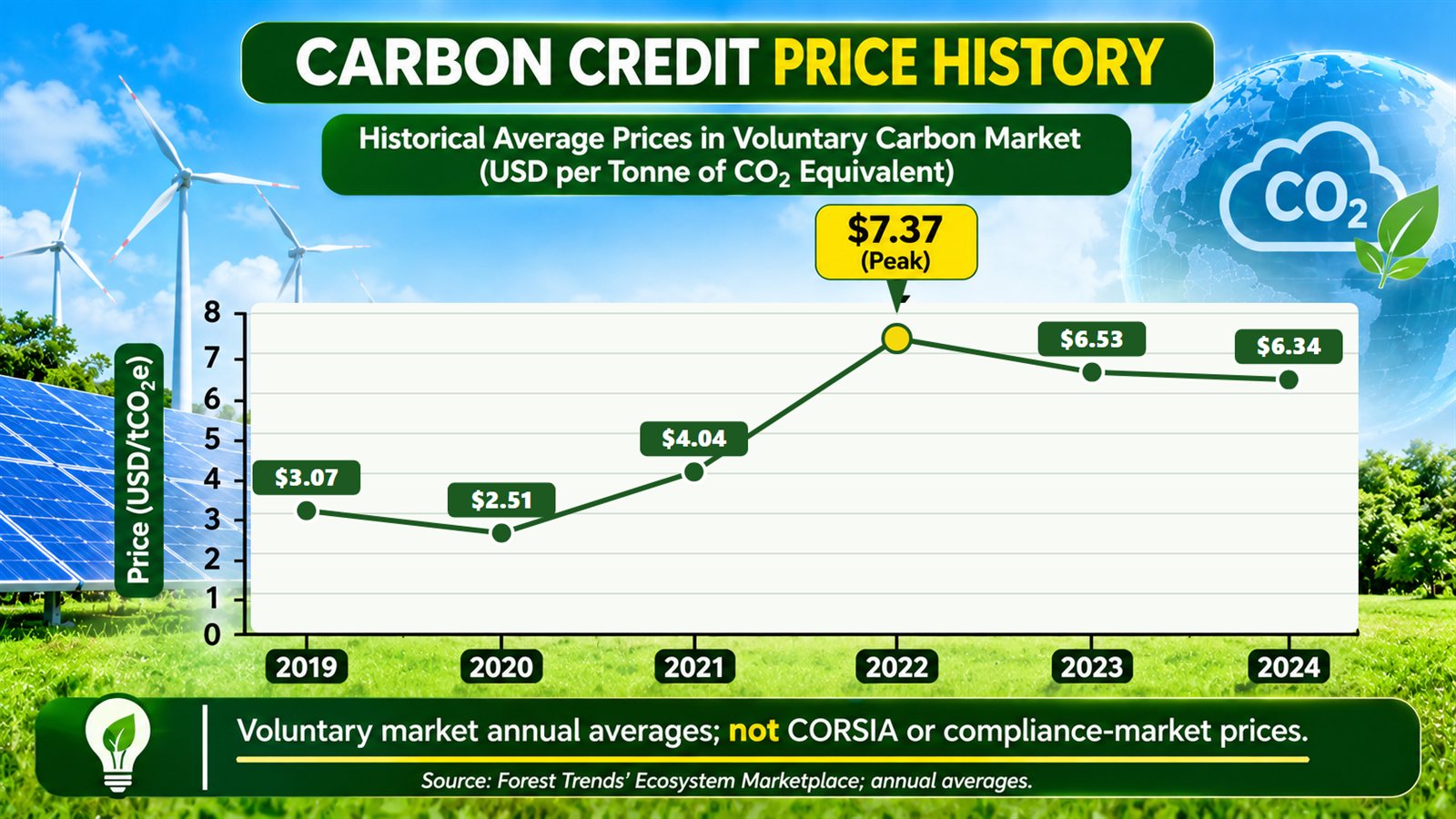
- Renewable energy credits: about USD 2.67 per tCO₂e on average in 2024 (Ecosystem Marketplace).
- Forestry and nature-based credits: in Q3 2026, forest protection (REDD+) credits averaged about USD 3.56–7.75, and reforestation credits about USD 12.80–23.47, depending on quality rating (Sylvera).
- Improved cookstove and household device credits: about USD 7.30 on average in 2024 (Ecosystem Marketplace).
- Carbon removal credits: about USD 19.50 on average for all removals in 2024, with biochar over USD 160 (Ecosystem Marketplace).
- CORSIA-eligible units: assessed at about USD 13.15 in mid-October 2026 (green.earth).
Methane reduction and industrial credits vary too widely by gas, methodology and buyer to give one reliable figure. Our guide to the current value of carbon credits covers prices in more detail.
What a project developer receives can be lower than these averages, because brokers, traders and fees sit between the project and the final buyer.
How Are Carbon Credit Payments Calculated?
The basic formula is:
Gross carbon credit revenue = Number of credits sold × Agreed price per credit
Example 1 (hypothetical figures):
- Issued carbon credits sold: 1,000
- Agreed price: USD 12 per credit
- Gross revenue: 1,000 × 12 = USD 12,000
Gross revenue is not what the project keeps. Possible deductions include:
- project development and consultancy costs
- validation and verification fees
- registry registration, issuance and account fees
- broker or marketplace commissions
- ongoing monitoring costs
- taxes and other contractual expenses
- revenue sharing with landowners, communities or investors
Example 2 (hypothetical figures, gross revenue versus net income):
A project sells 10,000 credits at USD 10 each:
- Gross revenue: 10,000 × 10 = USD 100,000
- Broker commission at 10%: USD 10,000
- Verification and monitoring costs: USD 15,000
- Registry and issuance fees: USD 5,000
- Net before revenue sharing: 100,000 − 10,000 − 15,000 − 5,000 = USD 70,000
- If 40% is shared with participating landowners under the contract, they receive USD 28,000 and the developer keeps USD 42,000, before tax.
The developer still has to recover the upfront costs of building the project from this amount. Real fees and shares vary widely by programme, project and contract.
How Do Farmers Get Paid for Carbon Credits?
Farmers usually earn through aggregated projects covering many farms. Eligible practices may include:
- soil carbon improvement
- agroforestry, planting trees on farmland
- reduced or no tillage
- cover cropping
- improved fertiliser management, which reduces nitrous oxide
- agricultural methane reduction, such as alternate wetting and drying in rice paddies
How it works:
- An aggregator registers one project covering many farms.
- Farmers provide farm-level data, such as practices, inputs, field boundaries and sometimes soil samples.
- The aggregator handles measurement, monitoring and verification.
- After credits are issued and sold, the aggregator distributes payments under a revenue-sharing agreement, often per hectare or per tonne.
Before joining, farmers should review:
- who owns the carbon rights
- land tenure, including whether a tenant or the owner signs
- how long the commitment lasts, and the penalties for leaving early
- monitoring obligations
- payment terms, timing and share percentages
Payments for soil and agricultural projects can take years to arrive, because credits need several monitoring periods and verification.
How Do Companies Sell Carbon Credits?
Companies can generate credits from:
- corporate emissions reduction projects
- renewable energy installations, where eligible
- energy efficiency improvements
- methane capture
- industrial process improvements
- carbon removal projects
The route is the same: register, verify, receive issuance, then sell. Buyers will carry out due diligence on the project documents, verification reports and registry records. The sale is completed through a sales agreement, with payment settlement on registry transfer or as agreed.
A company cannot sell credits for reductions it also counts towards its own reported emissions target without risking a double claim, so its claims need careful handling.
Where Can You Sell Carbon Credits?
- Direct corporate buyers, through tenders or bilateral negotiations
- Brokers, who match sellers with buyers for a commission
- Voluntary carbon marketplaces, online platforms where credits are listed
- Carbon exchanges, where standardised contracts or credits trade
- Project developers and aggregators, who buy or sell on behalf of participants
- Long-term purchase agreements, such as offtakes with large companies
Buyers judge credits by their quality, documentation, verification, registry records and environmental integrity. Many also use independent ratings.
No platform or broker can guarantee a buyer or a price. Always confirm a platform's current services, fees and track record before listing.
What Is the Difference Between Carbon Credit Sales and CORSIA Carbon Credit Sales?
- Voluntary carbon market: buyers purchase credits by choice, for their own climate targets or claims.
- Compliance carbon markets: buyers purchase units because a law or scheme requires it.
- CORSIA: ICAO's Carbon Offsetting and Reduction Scheme for International Aviation requires airlines to offset growth in international aviation emissions. They do this by cancelling CORSIA eligible emissions units.
To sell into CORSIA, a credit must meet two sets of requirements:
- Programme eligibility: the issuing programme must be approved by the ICAO Council for the relevant compliance period.
- Unit eligibility: the credit must meet that period's conditions, including vintage, scope, host-country authorisation with a corresponding adjustment, and labelling in the registry.
Airlines are the main buyers, and demand is driven by their compliance deadlines. Ordinary voluntary credits are not automatically CORSIA eligible, even from the same programme. Our guide to CORSIA eligible carbon credits explains these checks.
Risks and Challenges When Getting Paid for Carbon Credits
- Registration rejection for a weak design or an unsuitable methodology
- Insufficient additionality evidence
- Weak monitoring data, which leads to fewer verified credits
- Verification delays, which push back issuance and payment
- Price fluctuations between project start and sale
- Difficulty finding reliable buyers, especially for lower-demand credit types
- High broker commissions
- Contractual disputes over delivery or quality
- Unclear carbon ownership
- Revenue-sharing disagreements among participants
- Delivery and payment risk if a counterparty fails
How to reduce these risks:
- Get carbon rights and land tenure confirmed in writing.
- Use an established methodology and an experienced VVB.
- Keep complete, organised monitoring records.
- Use clear contracts with defined delivery, payment and dispute terms.
- Spread sales across buyers or use offtakes to manage price risk.
- Check counterparties before signing, and use escrow or staged payments where possible.
How to Avoid Carbon Credit Payment Scams
Warning signs include:
- promises of guaranteed income or fixed returns
- upfront fees without a clear service or written contract
- fake certification claims, such as credits that cannot be found on any registry
- unverified buyers with no traceable company identity
- unclear project ownership
- prices far above market data
- requests to transfer credits without proper documentation or contracts
Before any transaction:
- Check the project and credits on the official programme registry.
- Read the programme documentation for the project.
- Have legal agreements reviewed.
- Verify the buyer's identity and company records.
- Agree payment conditions before transferring any credits.
Future Opportunities in Carbon Credit Payments
Confirmed developments:
- Article 6 of the Paris Agreement now has operational rules for international transfers, and countries are signing bilateral agreements, such as Singapore's agreements with partner countries.
- CORSIA's first phase (2024–2026) has created compliance demand from airlines.
- Registries and programmes are adding more transparency, such as labels for authorised credits.
Market expectations, not certainties:
- Growing demand for high-integrity and removal credits
- More finance for nature-based projects with strong monitoring
- Lower costs from digital MRV and satellite monitoring, which could help smaller projects
- More opportunities for farmers through better aggregation models
Prices and demand can rise or fall, so plans should not depend on a single forecast.
Frequently Asked Questions
How do you get paid for carbon credits?
Develop an eligible project, register it, monitor results and have them independently verified. Once the programme issues credits, sell them to a buyer and receive payment, usually by bank transfer, under your sales contract.
How much money can you make selling carbon credits?
It varies widely. The average voluntary credit retired in Q3 2026 sold for about USD 6.92 per tonne (Sylvera), while removals often earn far more. Net income is lower after fees, commissions and revenue sharing.
Who buys carbon credits from farmers and businesses?
Companies with climate targets, airlines under CORSIA, governments through Article 6 cooperation, and brokers or traders who resell credits. Farmers usually sell through aggregators.
How can individuals sell carbon credits?
Individuals cannot sell credits for everyday green actions. Landowners and farmers can earn by joining a registered project, usually through an aggregator or developer, which handles certification and sales and shares revenue.
How long does it take to receive payment for carbon credits?
Often a year or more from project start to first issuance, and longer for nature-based projects. After issuance, payment timing depends on the contract: on delivery, in stages, or in advance under a forward deal.
How are carbon credit payments calculated?
Gross revenue = number of credits sold × agreed price per credit. Net income is what remains after verification, registry, broker and monitoring costs, taxes and any revenue sharing.
Can carbon credits be sold under CORSIA?
Yes, but only CORSIA eligible emissions units from ICAO-approved programmes that meet the compliance period's conditions, including vintage and host-country authorisation. Ordinary voluntary credits do not automatically qualify.
Conclusion
So, how do you get paid for carbon credits? You develop an eligible project, register it, measure the reductions or removals, get them independently verified, receive issued credits and sell them through a suitable channel under a clear contract.
Actual income depends on credit quality, project costs, buyer demand, contract terms and market conditions. No one can guarantee a price or a buyer. Careful planning, clear carbon rights and checking every counterparty matter as much as the project itself.
To learn more about CORSIA carbon credits and international carbon market developments, explore the resources at CORSIA Carbon Credit.
Sources
- Verra – Verified Carbon Standard and Registry
- Gold Standard
- American Carbon Registry
- Climate Action Reserve
- Ecosystem Marketplace – State of the Voluntary Carbon Market reports
- Carbon credit price tracker – Sylvera and Ecosystem Marketplace data (reviewed 5 October 2026)
- green.earth – CORSIA activity builds across prices, airlines and supply (16 October 2026)
- ICAO – CORSIA Eligible Emissions Units
- UNFCCC – Article 6 of the Paris Agreement
- World Bank – State and Trends of Carbon Pricing