 DSTechnoverse company
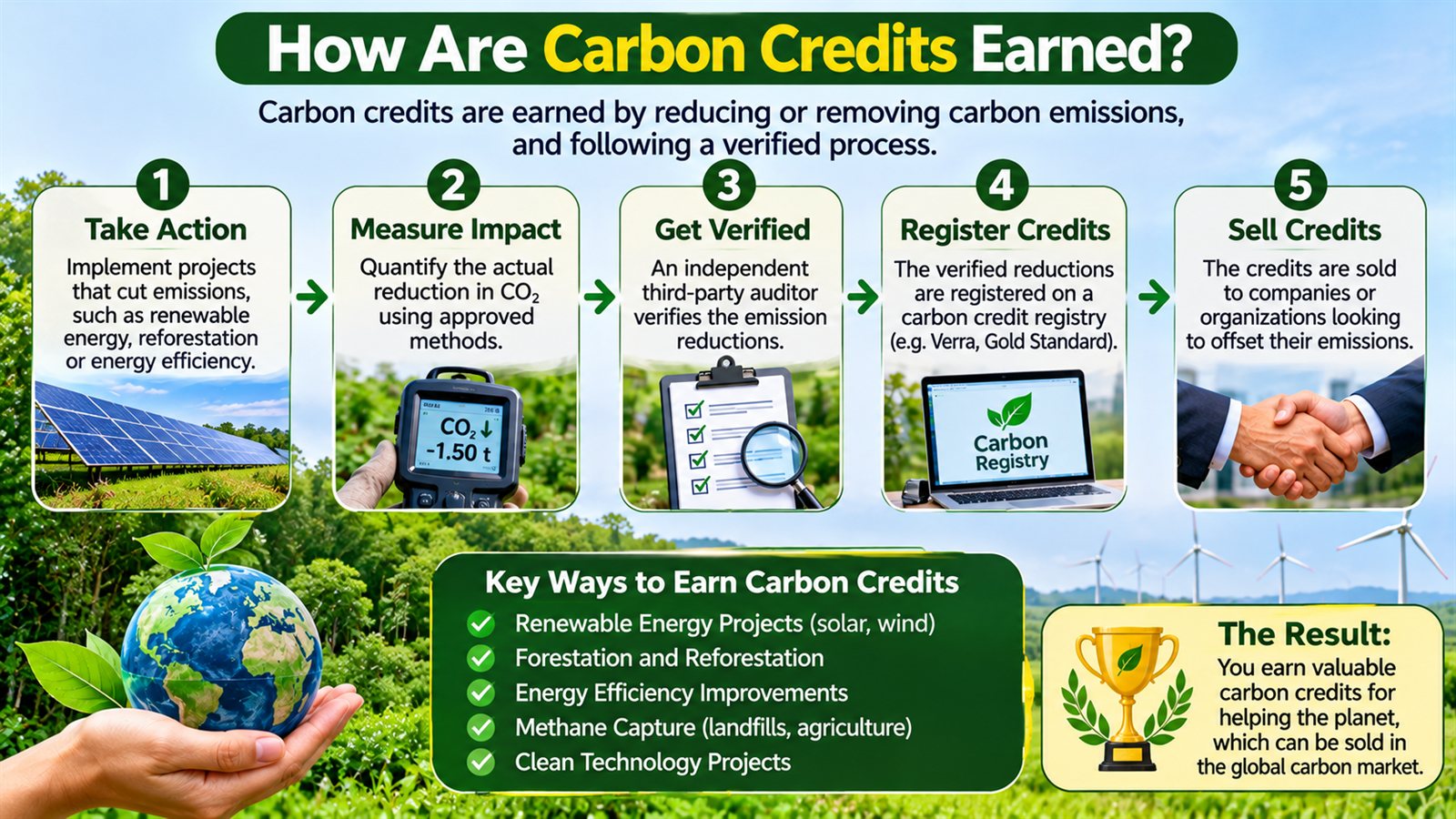
How are carbon credits earned? You earn carbon credits by running an eligible project that reduces or removes greenhouse gases, such as reforestation, methane capture or improved farming. The project follows an approved methodology, monitors its results and has them independently verified. The crediting programme then issues credits into a registry, generally one for each verified tonne of CO₂ equivalent. You earn money only when those credits are sold. For how credits are used in aviation, see our CORSIA Carbon Credits resources.
This guide focuses on the ways people and organisations earn credits: which activities can qualify, how farmers, landowners and businesses take part, and what turns credits into income.
What Does Earning Carbon Credits Mean?
Earning carbon credits means being issued credits for verified greenhouse gas reductions or removals that your project achieved.
- One carbon credit generally represents one metric tonne of CO₂e, subject to the issuing programme's rules.
- Reductions prevent emissions, for example by destroying methane or replacing diesel with solar power.
- Removals take CO₂ out of the atmosphere, for example by growing trees or producing biochar.
Three stages are often confused:
- Estimated reductions: what the project expects to achieve.
- Verified reductions: what an independent auditor confirms it achieved.
- Issued credits: units the programme formally creates in a registry.
Only issued credits are "earned". And earning credits is not the same as earning money: revenue comes later, when the credits are sold.
How Are Carbon Credits Earned?
In outline:
- Do an eligible activity that goes beyond business as usual.
- Follow an approved methodology that sets the baseline, boundary and calculations.
- Monitor results and keep records.
- Get independent verification by an accredited auditor.
- Receive issuance from the programme, such as Verra's Verified Carbon Standard or Gold Standard.
Our guide to how carbon credits are created explains each of these stages in depth, from validation to registry issuance.
Different Ways to Earn Carbon Credits
Not every activity automatically qualifies. Each route below depends on an applicable methodology, additionality, monitoring and the programme's rules.
1. Through Afforestation and Reforestation
Planting trees on land that was not forested (afforestation) or restoring lost forest (reforestation) can earn removal credits. Credits are based on measured tree growth, converted to stored CO₂.
These projects need:
- long commitments, often 30 years or more
- permanence safeguards, such as buffer pool contributions against fire, pests or logging
- regular monitoring, through sample plots and satellite imagery
Young trees store little carbon, so credits often build up slowly in the early years.
2. Through Agricultural Practices
Farmers may earn credits through practices such as:
- regenerative agriculture and improved soil management
- reduced or no tillage
- cover crops between main crops
- improved fertiliser management, which cuts nitrous oxide
- alternate wetting and drying in rice paddies, which cuts methane
- agroforestry, adding trees to farmland
Soil carbon is hard to measure and can be lost if practices stop, so methodologies require sampling or models, and buffers.
3. Through Renewable Energy Projects
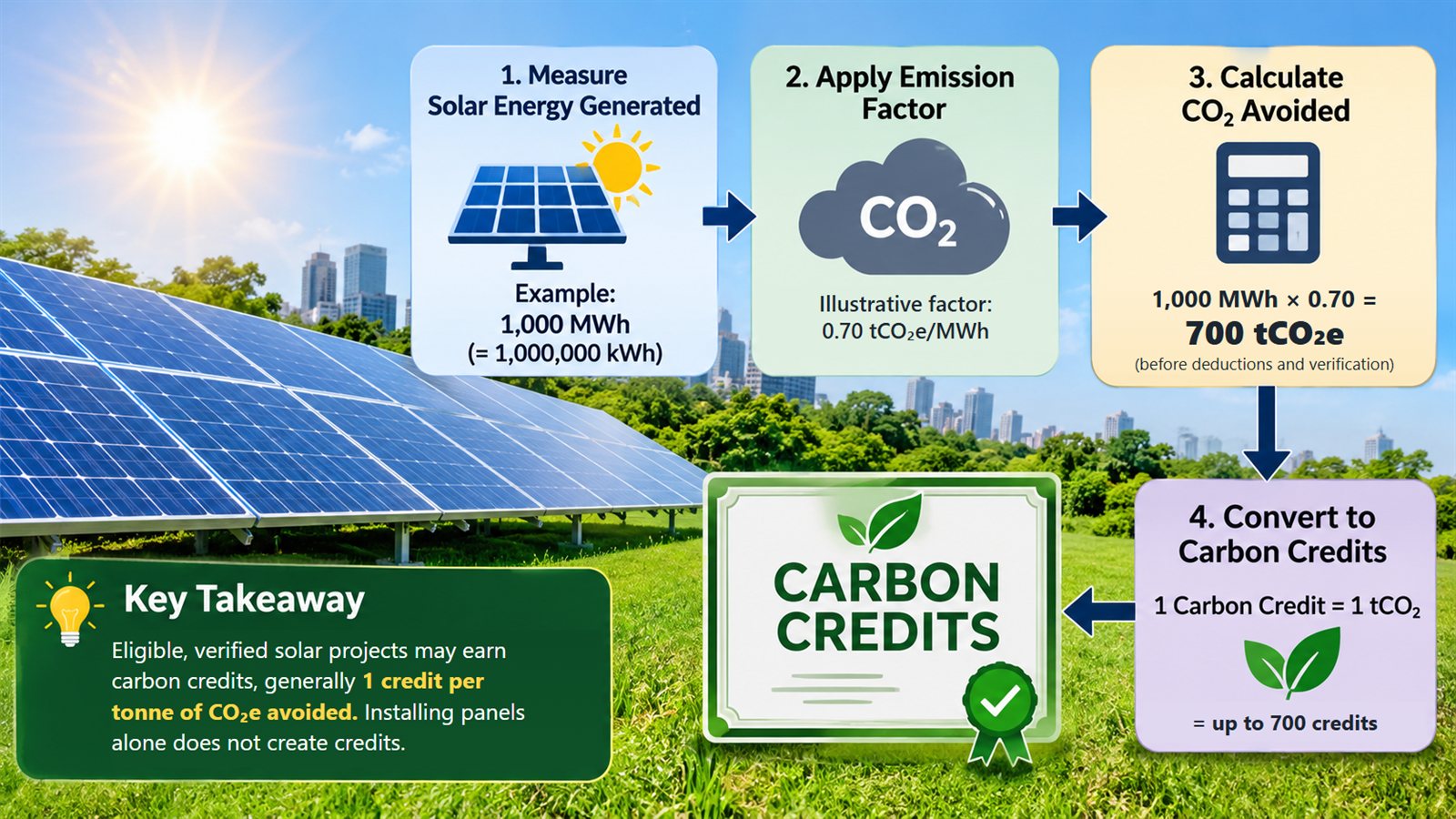
Solar, wind, small hydro and biogas projects can earn reduction credits by displacing fossil-fuel electricity compared with a baseline, such as the grid mix.
However, many programmes now restrict new credits for grid-connected renewables in countries where these projects are already commercially viable, because they may not be additional. Off-grid and smaller projects in less developed markets are more likely to qualify.
4. Through Methane Capture Projects
Capturing and destroying methane from landfills, livestock manure, wastewater or coal mines can earn credits. Methane traps far more heat than CO₂ over the short term, so each tonne destroyed counts as many tonnes of CO₂e. Accurate gas flow and destruction monitoring is essential.
5. Through Waste Management
Eligible waste projects include:
- organic waste treatment, such as anaerobic digestion
- composting, which avoids methane from landfill
- landfill gas recovery
- diverting waste from open dumping
Where capture is already required by local law, the project may not be additional.
6. Through Energy Efficiency
Projects that cut energy use can earn credits, for example:
- industrial upgrades, such as efficient motors, boilers or heat recovery
- commercial and building improvements, such as lighting and cooling
- household devices, such as efficient cookstoves
Credits depend on measured savings and on proving the upgrade would not have happened anyway.
7. Through Carbon Removal Technologies
- Biochar: biomass is heated without oxygen into a stable carbon that can be stored in soil.
- Direct air capture (DAC): machines pull CO₂ from the air for geological storage.
- Other methods, such as bioenergy with carbon capture and storage (BECCS) and enhanced rock weathering.
These need strict monitoring and durability evidence, showing how long carbon stays stored. They are costly to build but attract strong buyer interest.
How Can Farmers Earn Carbon Credits?
A typical route for farmers looks like this:
- Identify eligible activities that suit the farm, such as reduced tillage or rice water management.
- Understand the methodology a project developer uses.
- Establish the baseline, recording the farming practices used before the change.
- Implement eligible improvements.
- Maintain land and farm records, such as field maps, input purchases and practice dates.
- Monitor soil, inputs and activities, often with the developer's help.
- Complete verification when the auditor checks the project.
- Receive credits through the programme or developer, usually issued to the project rather than to each farm.
- Share revenue under an agreed contract.
Most farms are too small to cover certification costs alone. Farmer groups, cooperatives and project aggregators combine many farms into one project, sharing the costs of validation, monitoring and verification.
How Can Businesses Earn Carbon Credits?
Companies may develop eligible projects in:
- renewable energy, where methodologies allow it
- energy efficiency at plants or buildings
- methane reduction
- waste management
- carbon removal
Reducing a company's own emissions does not automatically create tradable credits. The activity must be registered under an applicable programme and methodology, be additional, and be verified. A company also cannot sell credits for reductions it counts in its own emissions reporting, because that would be a double claim.
Step-by-Step Process of Earning Carbon Credits
- Identify an eligible emission reduction or removal activity.
- Select a carbon credit programme and methodology.
- Establish the baseline and demonstrate additionality.
- Prepare project documentation, such as a Project Design Document.
- Complete validation by an independent body and register the project.
- Implement the project.
- Monitor emission reductions or removals.
- Obtain independent verification.
- Receive issuance of credits into the registry.
- Sell, transfer or retire the issued credits as applicable.
Steps 1–9 earn the credits. Step 10 is where money can be earned, and only if a buyer agrees to purchase them.
How Much Money Can You Earn from Carbon Credits?
Income depends on:
- the number of verified and issued credits
- project type and quality
- market demand and supply
- credit vintage, since newer credits are usually preferred
- certification and programme requirements
- buyer preferences, such as removals or particular regions
- brokerage and transaction costs
- revenue-sharing arrangements
Gross revenue = Number of credits sold × Agreed price per credit
Net profit = Gross revenue − Applicable project and transaction costs
Illustrative example (hypothetical figures, not market prices): an aggregated rice project covering 50 farms sells 2,000 credits at USD 10 each.
- Gross revenue: 2,000 × 10 = USD 20,000
- Project and transaction costs: USD 6,000
- Net profit: 20,000 − 6,000 = USD 14,000
- Farmers' share under the contract: 60%, or USD 8,400
- Per farm, if shared equally: USD 168
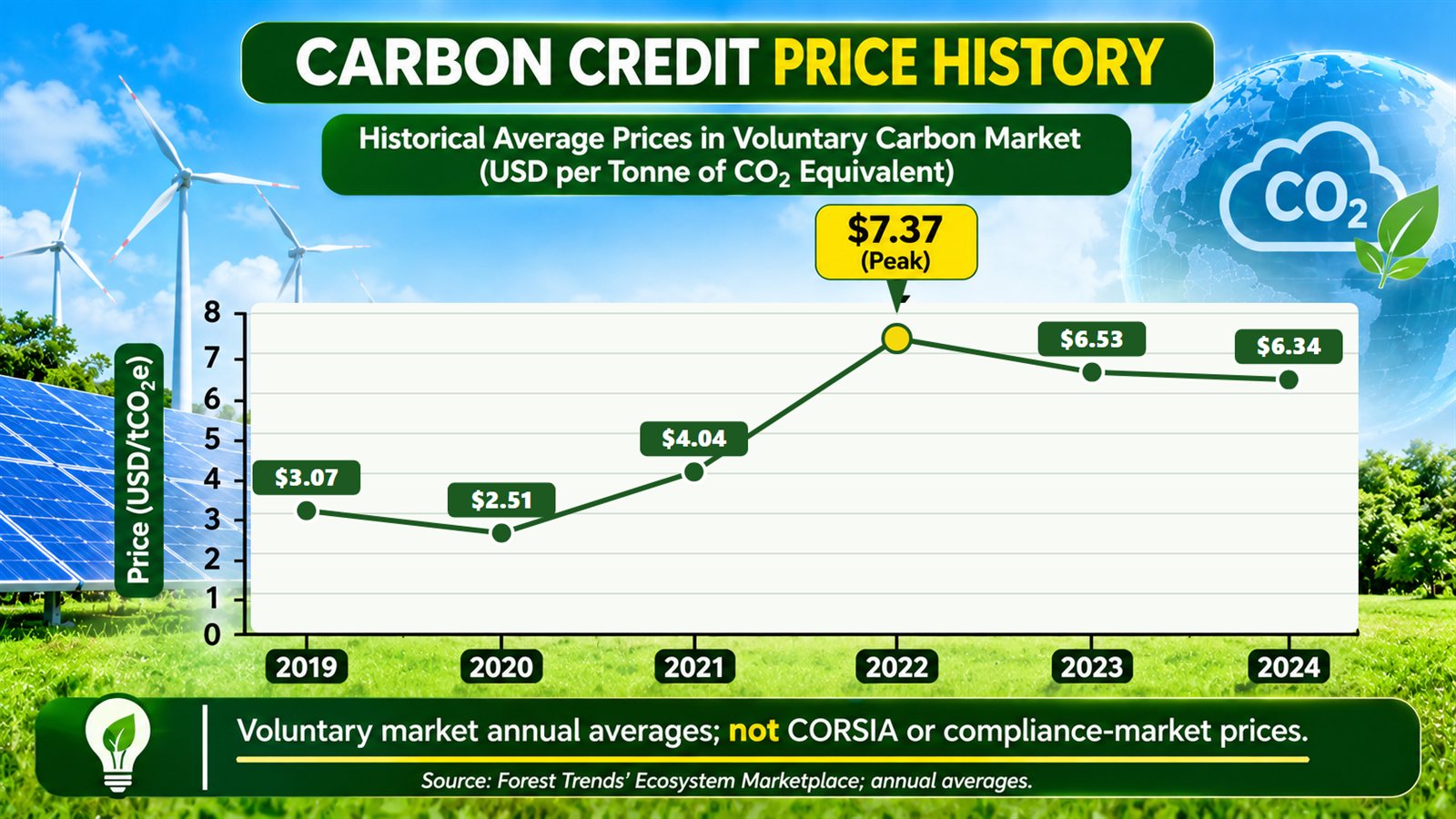
As a reference point, the average voluntary credit retired in Q3 2026 sold for about USD 6.92 per tonne (Sylvera data), but prices vary widely by project type. Our guide on how much you can earn from carbon credits covers prices and profit in more detail.
No price or income is guaranteed.
How Are Carbon Credits Sold and How Do You Get Paid?
- Finding buyers: companies with climate targets, airlines, traders and governments.
- Working with developers or aggregators: they often handle sales for small participants.
- Marketplaces and brokers: they connect sellers with buyers, usually for a fee or commission.
- Direct buyer agreements: negotiated one-to-one deals.
- Spot transactions: existing credits are sold now.
- Forward or offtake contracts: a buyer commits to purchase future credits, sometimes paying in advance.
- Registry transfer and retirement: credits are moved to the buyer's account or retired on their behalf.
- Payment terms and revenue distribution: payment follows the contract, then the developer distributes shares to participants.
Payment timing depends on the contract and on successful delivery of credits. Our guide on how to get paid for carbon credits explains contracts, payment and scam warning signs.
Can Individuals Earn Carbon Credits Without Owning a Large Project?
Individuals cannot earn credits from everyday actions, such as cycling or saving electricity at home. But smaller participants can take part through:
- project aggregation, which combines many small farms or plots
- farmer groups and cooperatives
- community-based projects, such as community forests or clean cooking programmes
- partnerships with carbon project developers
Before joining, check:
- land rights: who legally owns or leases the land
- carbon rights: who owns the emission reductions
- project ownership: who holds the registry account
- revenue-sharing agreements: the share, payment timing and exit terms
Land helps for forestry and farming routes, but it is not always required. For example, households can take part in cookstove or biogas programmes run by developers.
Are Carbon Credits Earned Through CORSIA Different?
CORSIA, the Carbon Offsetting and Reduction Scheme for International Aviation, is ICAO's global market-based measure for international aviation. Airlines with offsetting requirements must cancel CORSIA eligible emissions units.
Credits are not earned "through CORSIA" directly. They are earned under crediting programmes in the normal way, and must then meet extra requirements:
- Programme eligibility: the programme must be approved by the ICAO Council for the relevant compliance period.
- Unit-level eligibility: the unit must meet that period's conditions. For the first phase (2024–2026), these include activity start dates, vintages from 2021 to 2026, host-country authorisation with a corresponding adjustment, and CORSIA labelling in the registry.
Generating a carbon credit does not automatically make it CORSIA eligible, and most voluntary credits do not qualify. Our guide to CORSIA eligible carbon credits explains these checks.
India is also developing an offset mechanism under its Carbon Credit Trading Scheme (CCTS), under which non-obligated entities can register eligible projects to earn Carbon Credit Certificates. These are domestic instruments, separate from both voluntary and CORSIA units, and a November 2026 report quoted the Bureau of Energy Efficiency as saying trading would begin for most sectors by the end of 2027.
Common Mistakes to Avoid When Trying to Earn Carbon Credits
- Assuming every tree planted generates credits. Only trees in a registered, monitored project can.
- Expecting immediate income. Credits and payments can take years.
- Ignoring additionality requirements. Projects that would happen anyway may not qualify.
- Not checking carbon ownership rights. Unclear rights can block registration or payment.
- Choosing an unsuitable methodology. This can lead to rejection or fewer credits.
- Overlooking monitoring and verification costs. These recur for every monitoring period.
- Trusting guaranteed-income claims. Genuine developers cannot guarantee prices or issuance.
- Confusing estimated reductions with issued credits. Only issued credits can be sold.
Frequently Asked Questions
How can an individual earn carbon credits?
Not from everyday actions. Individuals can take part by joining an eligible registered project, such as an aggregated farming, forestry, cookstove or biogas programme run by a project developer, which shares revenue under a contract.
Can farmers earn money from carbon credits?
Yes, through eligible practices such as reduced tillage, cover crops, rice methane reduction or agroforestry, usually via an aggregator. Income depends on credits issued, prices, costs and the revenue share, and is not guaranteed.
How much can you earn from one carbon credit?
It depends on project type, quality and demand. The average voluntary credit retired in Q3 2026 sold for about USD 6.92 per tonne (Sylvera), while some removal credits sell for over USD 100. Costs and revenue sharing reduce what you keep.
Do you need land to earn carbon credits?
Not always. Forestry and soil carbon projects need land and clear land rights. Methane capture, energy efficiency, renewable energy and household cookstove programmes do not depend on owning land.
How long does it take to earn carbon credits?
There is no fixed timeline. Development, validation, registration, monitoring and verification often take a year or more before first issuance, and nature-based projects often take longer.
Can businesses generate and sell carbon credits?
Yes, if they develop a project that meets a programme's methodology and additionality rules and is verified. They cannot sell credits for reductions they also claim in their own emissions reporting.
Are carbon credits a guaranteed source of income?
No. Issuance depends on eligibility and verification, and income depends on market prices, buyer demand, costs and contract terms. Be wary of anyone promising guaranteed returns.
Conclusion
So, how are carbon credits earned? Through eligible emission reduction and carbon removal projects, such as reforestation, better farming practices, methane capture, waste management, energy efficiency, renewable energy and carbon removal technologies.
Earning credits requires an appropriate methodology, careful monitoring, independent verification and formal issuance by a crediting programme. Earning money then depends on selling those credits at a fair price under a clear contract.
To learn more about CORSIA carbon credits and carbon markets, explore the resources at CORSIA Carbon Credit.
Sources
- Verra – Verified Carbon Standard
- Gold Standard
- UNFCCC – Article 6 of the Paris Agreement
- World Bank – State and Trends of Carbon Pricing
- ICAO – CORSIA Eligible Emissions Units
- Carbon credit price tracker – Sylvera and Ecosystem Marketplace data (reviewed 5 October 2026)
- Bureau of Energy Efficiency – Indian Carbon Market