 DSTechnoverse company
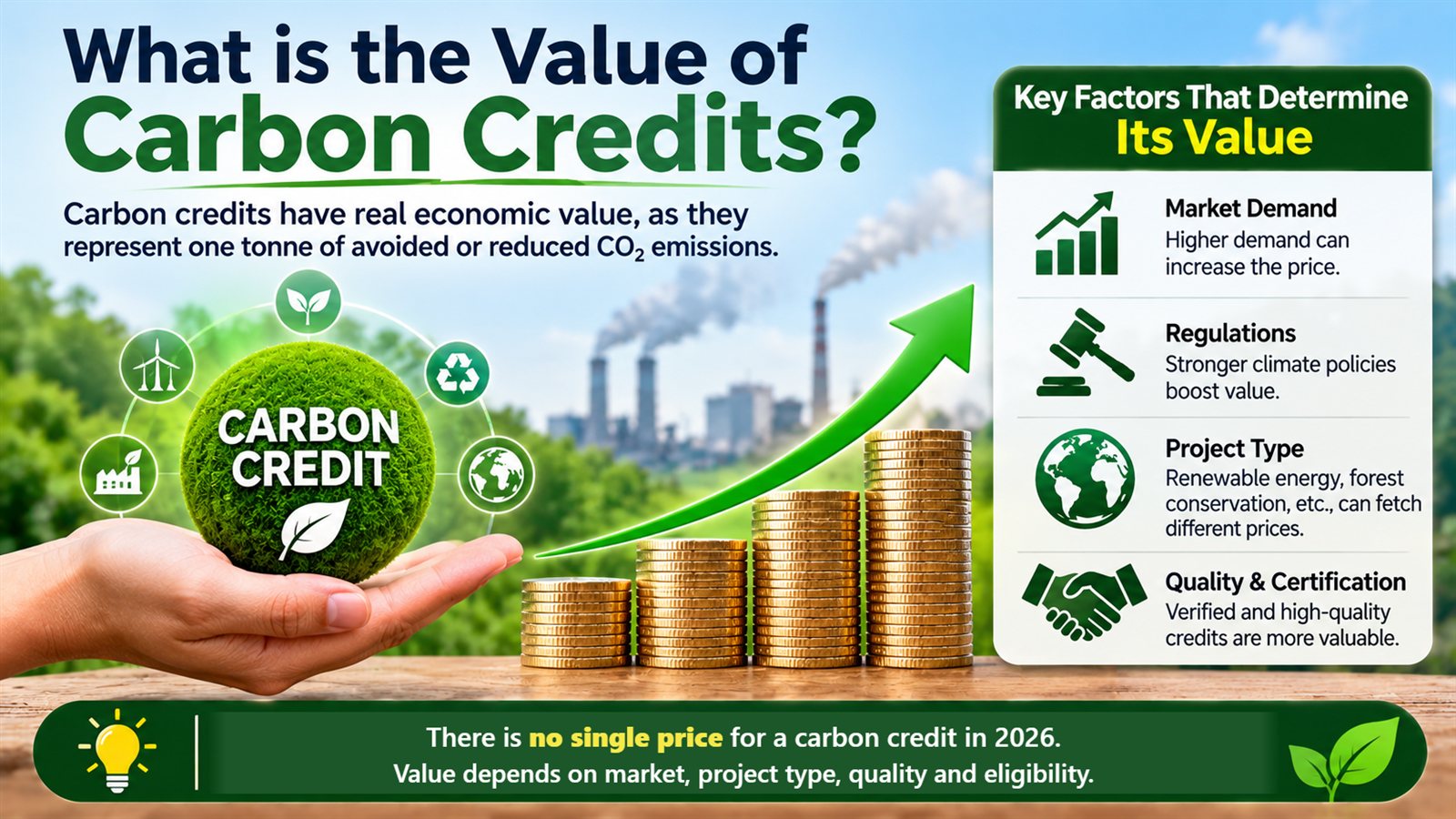
What is the value of carbon credits? A carbon credit represents one tonne of CO₂ equivalent reduced or removed. Its financial value is whatever a buyer pays for it, and there is no single price:
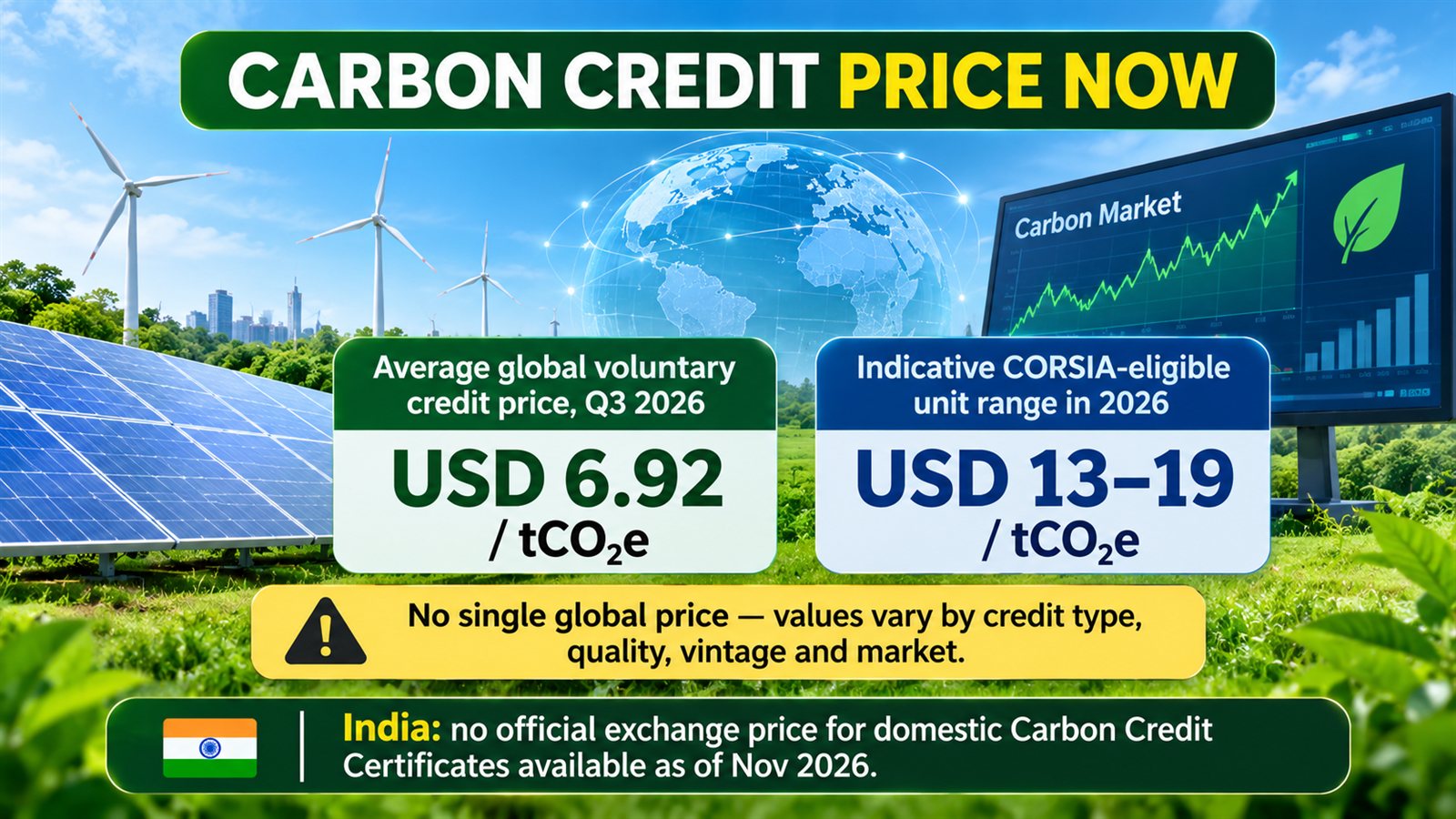
- Average voluntary credits retired in Q3 2026 sold for about USD 7 per tonne.
- CORSIA-eligible units were assessed at about USD 13–19 during 2026.
- Some carbon removal credits cost well over USD 100.
Its environmental value depends on whether the reduction is real, additional and lasting. Price and environmental quality are related, but they are not the same thing. For aviation-specific pricing, see our CORSIA Carbon Credits resources.
This guide explains what drives value, gives dated price figures and shows how buyers can judge value before purchasing. Figures reflect sources available in November 2026.
What Is the Value of a Carbon Credit?
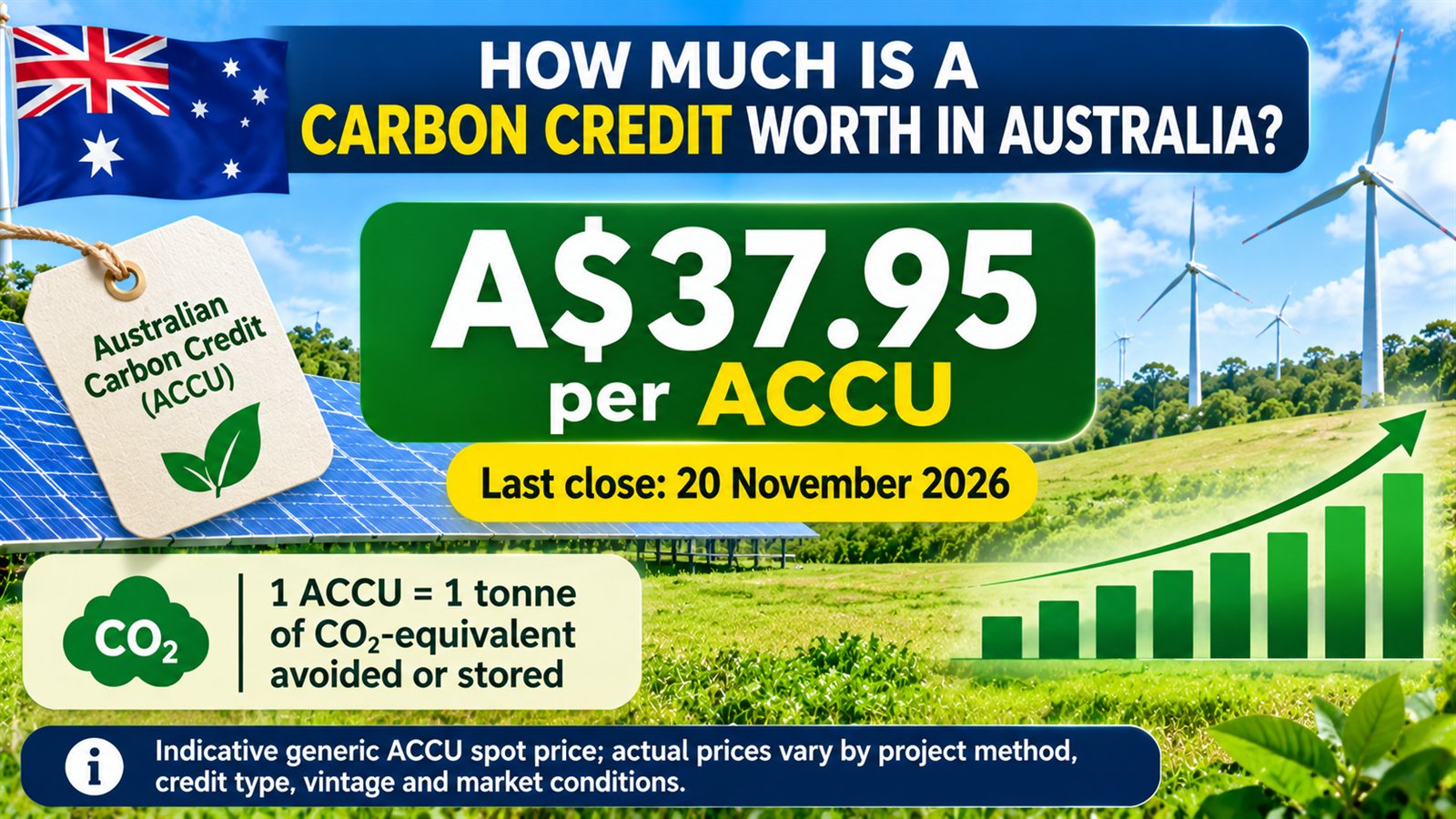
A carbon credit is a certificate showing that a project reduced or removed greenhouse gases. It is generally equal to one metric tonne of CO₂e under the issuing programme's rules.
A credit's monetary value depends on:
- project quality, including additionality, permanence and measurement
- methodology and programme, meaning whose rules it was issued under
- market type, voluntary or compliance
- vintage, the year the reduction happened
- eligibility for specific uses, such as CORSIA
- supply and demand at the time of sale
Every credit represents one tonne, but not every tonne sells for the same price. A tonne of avoided emissions from an old renewable energy project and a tonne of carbon permanently stored by biochar are both one credit, but buyers value them very differently.
How Is the Monetary Value of Carbon Credits Determined?
1. Project type
- Renewable energy: usually among the cheapest credits, partly because additionality is often questioned where renewables are already competitive.
- Forestry and reforestation: prices vary by type. Reforestation removes carbon, while forest protection (REDD+) avoids emissions.
- Methane capture: at landfills or farms, delivering large reductions.
- Energy efficiency and cookstoves: often valued for community co-benefits.
- Waste management: composting, recycling and biogas.
- Carbon removal: biochar, direct air capture and enhanced weathering. These cost more to develop and monitor, and are typically priced highest.
Nature-based and technology-based solutions differ in cost, risk and buyer demand, so their prices differ too.
2. Environmental integrity and quality
Buyers increasingly pay more for credits that score well on:
- additionality: would the project have happened anyway?
- permanence: how long the carbon stays stored, and what protects against reversal
- leakage: whether emissions simply moved elsewhere
- accurate measurement, with a conservative baseline and quantification
- independent validation and verification
- prevention of double counting
Independent ratings agencies assess these factors, and higher-rated credits often trade at a premium.
3. Standard and methodology
The programme, such as Verra, Gold Standard, ACR or the Climate Action Reserve, and the methodology version used, affect buyer confidence. So do monitoring requirements, registry transparency and how issuance is tracked.
4. Vintage and location
- Vintage is the year the reduction occurred. Newer vintages are often preferred, and some uses accept only certain vintages.
- Location matters to buyers who prefer certain regions, and to rules that require host-country authorisation.
- Eligibility restrictions, such as CORSIA's, narrow which credits can be used and raise their value.
5. Market supply and demand
Prices also depend on:
- how many credits of a given type are available
- the number of buyers and the strength of corporate climate commitments
- regulatory demand, such as from airlines under CORSIA
- liquidity and wider market conditions
What Is the Average Price of One Carbon Credit?
There is no meaningful single average. Different market segments behave very differently:
| Segment | Figure (USD per tCO₂e unless stated) | Date | Type of figure | Source |
|---|---|---|---|---|
| Voluntary credits, all types (retired) | about 6.92 average | Q3 2026 | Average of retired credits | Sylvera, via price tracker |
| Reforestation (ARR) | 12.80 (lower rated) to 23.47 (higher rated) | Q3 2026 | Average by rating | Sylvera |
| Forest protection (REDD+) | 3.56 (lower rated) to 7.75 (higher rated) | Q3 2026 | Average by rating | Sylvera |
| Renewable energy | about 2.67 | 2024 | Average reported deals | Ecosystem Marketplace |
| All removal credits | about 19.50 | 2024 | Average reported deals | Ecosystem Marketplace |
| Biochar removals | over 160 | 2024 | Reported deals | Ecosystem Marketplace |
| CORSIA first-phase units (spot) | 19.00 | 28 Jan 2026 | Price assessment | Fastmarkets |
| CORSIA first-phase units (Dec 2026 delivery) | 13.15 | Mid-Oct 2026 | Price assessment | green.earth |
| EU ETS allowances (compliance) | about €90 | 2–4 Nov 2026 | Exchange futures price | GMK Center |
These categories are not interchangeable:
- EU ETS allowances are permits to emit under a cap, not carbon credits, and voluntary credits cannot be used in their place.
- Voluntary averages mix many project types and qualities.
- Removal credits serve different claims from avoidance credits.
Averages and assessments are not quotes, so actual deals for a specific credit can be higher or lower. Our guide on how carbon credit prices are quoted explains the different types of price figure.
What Is the Difference Between Financial Value and Environmental Value?
Financial value covers:
- the market price
- the costs of developing and verifying the project
- buyer demand and liquidity
- eligibility for specific uses
- transaction and registry costs
Environmental value covers:
- verified greenhouse gas reductions or carbon removals
- the real contribution to climate mitigation
- biodiversity benefits, such as protected forests
- community and sustainable development co-benefits, such as health, jobs and clean water
- long-term impact, including permanence
| Financial value | Environmental value |
|---|---|
| Shown by the market price | Shown by climate and environmental outcomes |
| Driven by supply and demand | Driven by project performance and integrity |
| Changes over time | Depends on verified results and long-term impact |
| Matters to buyers and sellers | Matters to climate and sustainability goals |
Price is not proof of quality. A higher price does not guarantee better environmental outcomes, and a lower price does not automatically mean low quality. Some low-cost projects deliver real reductions. Buyers should check the evidence, not only the price tag.
How Does the CORSIA Carbon Market Affect Carbon Credit Value?
CORSIA, the Carbon Offsetting and Reduction Scheme for International Aviation, is ICAO's global market-based measure for international aviation's CO₂. Airlines with offsetting requirements on routes between participating States must cancel CORSIA eligible emissions units, which creates compliance demand for a narrow set of credits.
Eligibility restricts supply:
- Programme level: only programmes approved by the ICAO Council for the relevant compliance period count.
- Unit level: each unit must fall within the approved scope and meet date and vintage windows. For the first phase (2024–2026), that generally means activities starting on or after 1 January 2016 and vintages from 2021 to 2026. First-phase units also need host-country authorisation and a corresponding adjustment, and a CORSIA label in the registry.
Limited eligible supply against airline demand is why CORSIA-eligible units have traded above average voluntary credits. Their price also moves with supply news: first-phase assessments fell from about USD 19 in January 2026 to about USD 13 by October as more labelled units reached the market.
Not all voluntary credits are CORSIA eligible, and programme approval does not make every unit qualify. Eligibility must be checked against the latest ICAO rules, and buying a credit alone does not complete compliance. Units must be cancelled and reported. Our guide to the CORSIA carbon credit price in 2026 covers these prices in more detail. Our article on CORSIA eligible carbon credits explains the eligibility rules.
Why Do Carbon Credit Prices Change Over Time?
Prices change because of:
- supply changes, such as new issuances, newly labelled CORSIA units or project cancellations
- demand shifts, such as new corporate climate commitments or slowing commitments
- new regulations, such as compliance schemes or rules on environmental claims
- rising quality expectations and new integrity benchmarks
- new methodologies, which can expand or restrict supply
- vintage restrictions that exclude older credits
- host-country authorisations and corresponding adjustments
- market uncertainty and wider economic conditions
- international developments, such as Article 6 of the Paris Agreement
Illustrative example (hypothetical)
All figures are illustrative, not market data. Suppose a compliance scheme needs 100 eligible units by a deadline, but only 40 exist. Buyers compete, and sellers raise their asking price from 10 to 15. Then 50 more units are approved, so the pressure eases and prices fall back towards 12. If no new units are approved, prices may stay high until the deadline.
How Can Buyers Evaluate the Value of Carbon Credits?
- Define the purpose: voluntary offsetting, a removal claim or compliance such as CORSIA.
- Check the programme and its rules.
- Review the project type and methodology, including the version used.
- Examine validation and verification reports.
- Assess additionality and permanence, including buffer arrangements for nature-based credits.
- Check the vintage and registry records, including serial numbers and issuance.
- Evaluate double-counting risks.
- Confirm host-country authorisation where it is required.
- Check CORSIA eligibility against ICAO's current document if the credits are for aviation compliance.
- Compare prices on a like-for-like basis: the same category, date, currency and type of figure.
- Review documentation for the purchase, transfer and retirement.
The cheapest credit is not always the best value. A low-priced credit that fails quality checks, or is not eligible for your purpose, has little real value.
Example 1: A renewable energy credit (hypothetical)
This example is hypothetical. A grid-connected solar plant earns credits under an approved methodology. Its value depends on several things:
- whether additionality is convincing in a market where solar is already cheap
- how recent the vintage is
- the methodology and the programme's reputation
- how much buyer demand there is for renewable avoidance credits
It may sell at a low price if buyers doubt its additionality. It could command more if it qualifies for a compliance use.
Example 2: A carbon removal project (hypothetical)
This example is hypothetical. A biochar producer turns crop waste into stable carbon added to soil. It faces high equipment and monitoring costs and must show how long the carbon will last. Because buyers value durable removals for net-zero claims, its credits are priced much higher than avoidance credits. Its value still depends on verified measurement and permanence evidence.
Future Outlook of Carbon Credit Value and Pricing
Factors that may shape value include:
- corporate climate action, which has risen and fallen with economic conditions and scrutiny
- integrity standards, which are pushing demand towards higher-rated credits
- high-quality carbon removals, which are expanding but remain costly
- Article 6, which links some credits to national accounting and may set them apart
- CORSIA, whose second phase starts in 2027 and whose eligible supply depends on ICAO approvals and host-country authorisations
- more transparent registries and ratings, which help price quality differences
- demand for credible reductions and removals over low-quality credits
The trend so far is a widening price gap between low- and high-integrity credits, and between avoidance and removal credits. Future price levels cannot be predicted with certainty.
Frequently Asked Questions
What is the value of one carbon credit?
It represents one tonne of CO₂e reduced or removed. Its financial value varies widely: average voluntary credits sold for about USD 7 in Q3 2026, CORSIA-eligible units were assessed at about USD 13–19 in 2026, and some removals cost over USD 100.
How much is a carbon credit worth?
It depends on project type, quality, vintage, programme, eligibility and market conditions. There is no single price, so check dated figures for the specific category.
Why do carbon credit prices vary?
Because credits differ in project type, integrity, permanence, vintage and eligibility. They are also sold in different markets with different supply and demand.
What factors determine carbon credit value?
Project type, environmental integrity, the programme and methodology, vintage and location, eligibility for uses such as CORSIA, and the balance of supply and demand.
Do all carbon credits have the same market price?
No. Each credit represents one tonne, but prices range from a few dollars for some avoidance credits to well over USD 100 for some durable removals.
Are CORSIA eligible carbon credits more valuable?
They have typically traded above average voluntary credits because eligible supply is limited and airlines need them for compliance. Their price still changes as new eligible supply enters the market.
How can buyers check the value of a carbon credit?
Check the programme, methodology, verification, additionality, permanence, vintage, registry records and eligibility. Then compare prices with dated figures for the same category.
Key Takeaways
So, what is the value of carbon credits? Financially, it is the market price, which varies widely by segment. Environmentally, it is the verified, lasting climate benefit behind each tonne.
Value depends on:
- project quality and environmental integrity
- market demand
- vintage
- programme rules
- eligibility, such as for CORSIA
Buyers should weigh both price and credibility, rather than choosing credits on cost alone. To learn more about carbon credit prices, eligibility and aviation compliance, explore the resources at CORSIA Carbon Credit. Our guide to carbon credit use cases by industry shows how different buyers use credits in practice.
Sources
- Carbon credit price tracker – Sylvera and Ecosystem Marketplace data (reviewed 5 October 2026)
- Fastmarkets – CORSIA spot prices continue to slide (4 February 2026)
- green.earth – CORSIA activity builds across prices, airlines and supply (16 October 2026)
- GMK Center – European carbon prices exceeded €90/t in November (1 November 2026)
- ICAO – CORSIA Eligible Emissions Units
- World Bank – Carbon Pricing Dashboard
- Verra
- Gold Standard