 DSTechnoverse company
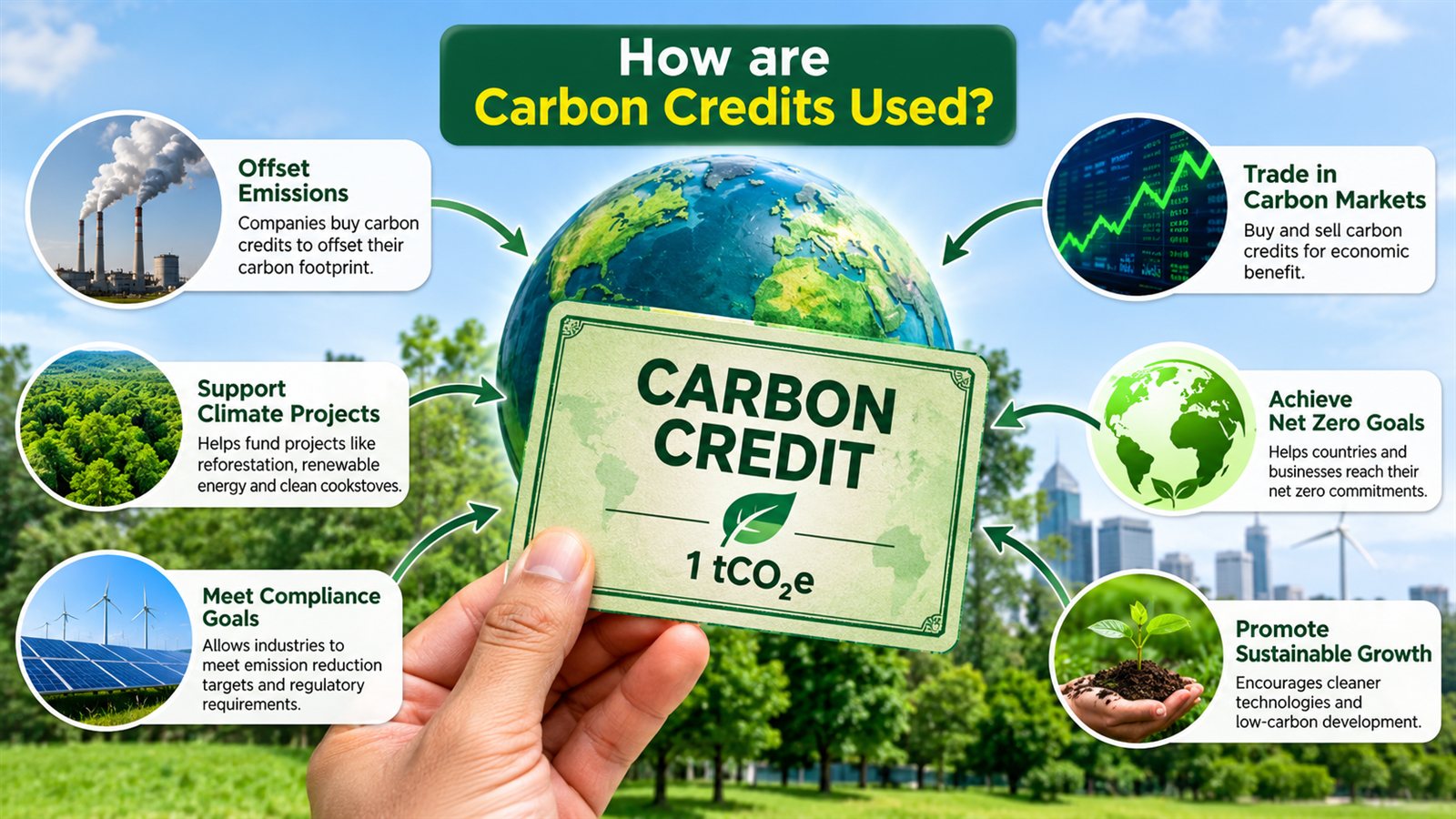
How are carbon credits used in practice? Organisations buy verified credits and retire them for three main purposes:
- to compensate for emissions they cannot yet cut
- to support voluntary climate goals
- to meet legal obligations in compliance schemes, such as airlines under CORSIA
Each credit generally represents one tonne of CO₂ equivalent reduced or removed by a project elsewhere. The most credible uses come after direct emission cuts, not instead of them. For aviation-specific guidance, see our CORSIA Carbon Credits resources.
This guide focuses on real-world use cases by sector, with worked examples. For a broader introduction to applications and benefits, see our overview of how carbon credits are used.
What Are Carbon Credits and How Do They Work?
A carbon credit is a tradable certificate showing that a project reduced or removed greenhouse gases, generally one metric tonne of CO₂e per credit under the issuing programme's rules.
Credits come from two kinds of projects:
- Reduction projects, such as wind farms replacing coal power, methane capture at landfills or efficient cookstoves. These prevent emissions that would otherwise happen.
- Removal projects, such as reforestation, biochar or direct air capture. These take CO₂ out of the air and store it.
A project earns credits through these steps:
- It follows an approved methodology.
- It sets a realistic baseline, meaning what would have happened without it.
- It shows additionality, meaning the reductions would not have happened anyway.
- Its results are verified by an accredited auditor.
- A programme such as Verra or Gold Standard then issues credits into a registry, each with a unique serial number.
The registry records who holds each credit and when it is retired, so it can never be used twice.
Simple example: a landfill captures methane equal to 1,000 tCO₂e in a year. After verification, it receives 1,000 credits, which it can sell to buyers who want to compensate for their own emissions.
How Are Carbon Credits Used by Businesses and Organisations?
1. Addressing residual emissions
Companies first measure their greenhouse gas emissions, then reduce what they can through efficiency, clean power and process changes. Credits are then used for the residual emissions that remain, which is the core of carbon offsetting.
2. Corporate climate commitments
Credits help companies act on emissions that are hard to eliminate quickly, such as business travel or heat-intensive processes, alongside long-term reduction targets. Claims must be transparent. Statements such as "carbon neutral" need a clear scope, the tonnes covered and retirement evidence, otherwise they risk being seen as greenwashing.
3. Supply chain emissions
Emissions are grouped into three scopes:
- Scope 1: direct emissions from the company's own operations, such as fuel burned on site
- Scope 2: emissions from the electricity and heat it buys
- Scope 3: everything else in its value chain, from suppliers to customers
Most of a company's footprint is often in Scope 3. Some companies support supplier reductions directly. Others consider credits as part of a wider supply chain strategy, but credits do not replace engaging suppliers to cut emissions.
4. Sustainability reporting
Companies document credit purchases, keep registry and retirement records, and report:
- reductions in their own emissions
- offsetting with credits
These must be reported separately. Mixing them up overstates progress.
Carbon credits should complement direct emissions reduction, never replace it.
How Are Carbon Credits Used in Different Industries?
1. Aviation
International airlines with obligations under CORSIA must acquire and cancel eligible emissions units to cover emissions growth on routes between participating States. Credits sit alongside sustainable aviation fuel, newer aircraft and operational efficiency.
2. Manufacturing
Manufacturers use credits for residual emissions after efficiency upgrades and fuel switching. In some countries, they also use credits or certificates in regulated schemes. India's Carbon Credit Trading Scheme, for example, uses its own Carbon Credit Certificates.
3. Energy
Renewable energy and energy transition projects have historically been a major source of credits. Energy companies may also buy credits for residual emissions or take part in compliance markets.
4. Transportation and logistics
Shipping, trucking and courier firms manage transport emissions through fleet efficiency and cleaner fuels. They may use credits for remaining emissions, sometimes offering "offset delivery" options to customers.
5. Agriculture and forestry
These sectors often generate credits through:
- reforestation and forest protection
- improved soil carbon practices
- methane reduction, for example from manure management or rice cultivation
6. Technology and services
These companies mainly emit through electricity use, travel and purchased goods. They often switch to renewable power and use credits for residual emissions to support voluntary climate targets.
Which credits each sector can use, and for what purpose, depends on the programme, the market and the applicable regulations.
How Are Carbon Credits Used for Carbon Offsetting?
Carbon offsetting means compensating for your emissions by retiring credits that represent reductions or removals elsewhere. The usual sequence is:
- Calculate the footprint across the relevant scopes.
- Reduce first, through efficiency, clean energy and process change.
- Identify remaining emissions to be compensated.
- Buy suitable verified credits from a reputable programme.
- Transfer them into your account, or have them retired on your behalf.
- Retire them in the registry, naming your organisation and the purpose.
- Keep evidence, such as retirement certificates and serial numbers.
Buying credits does not, by itself, make a company carbon neutral. Neutrality claims also depend on what emissions are covered, how they were measured, the quality of the credits and whether the claim follows recognised guidance. Our explainer on the difference between a carbon credit and a carbon offset covers this in more detail.
Example 1: A manufacturing company (hypothetical)
All figures are illustrative. A packaging manufacturer measures 20,000 tCO₂e a year. It installs efficient motors and switches to renewable electricity, cutting 8,000 tonnes. For 4,000 tonnes of hard-to-cut process heat emissions, it buys verified credits from a landfill gas project and retires them in its name. Its report shows the 8,000-tonne reduction and the 4,000-tonne offset separately, and states that the remaining 8,000 tonnes were not offset.
How Are Carbon Credits Traded and Purchased?
The market's participants are:
- Project developers, who run reduction or removal projects
- Programmes and standards, which set the rules and issue credits
- Buyers and sellers, such as companies, traders and airlines
- Brokers and intermediaries, who match buyers and sellers
- Exchanges and trading platforms, for standardised contracts
- Registry accounts, where credits are held and moved
The key steps are different from each other:
- Generation: the project achieves reductions.
- Issuance: the programme creates serial-numbered credits after verification.
- Purchase: a buyer and seller agree a deal.
- Transfer: the credits move between registry accounts.
- Retirement or cancellation: the credits are permanently removed for a stated purpose.
There are two kinds of market:
- Voluntary markets serve companies' own climate goals.
- Compliance markets serve legal obligations, and only accept units that meet the scheme's rules.
Not every credit is available on every platform or eligible for every scheme. Credits are also not Renewable Energy Certificates (RECs), which represent renewable electricity rather than emission reductions.
How Are Carbon Credits Used Under CORSIA in the Aviation Industry?
CORSIA, the Carbon Offsetting and Reduction Scheme for International Aviation, is ICAO's global market-based measure for international aviation's CO₂.
- Monitoring and reporting apply to operators emitting more than 10,000 tonnes of CO₂ a year from international flights with aeroplanes above 5,700 kg.
- Offsetting applies only to flights between participating States, with growth measured against a baseline of 85% of 2019 emissions from 2024.
- The airline's State calculates its offsetting requirement for each compliance period from verified emissions.
- The airline acquires CORSIA eligible emissions units: credits from programmes approved by the ICAO Council that meet unit-level conditions on scope, vintage, host-country authorisation and labelling.
- Units are tracked in programme registries by serial number.
- Cancellation for CORSIA, recording the operator and compliance period, completes compliance, and the airline then reports to its State.
ICAO does not sell credits or run an exchange. Ordinary voluntary credits are not automatically eligible. Our guide to CORSIA eligible carbon credits explains the conditions.
Example 2: An airline operator (hypothetical)
This example is hypothetical. An airline's State informs it of its offsetting requirement for the 2024–2026 compliance period. The airline checks ICAO's current eligibility document. It then buys first-phase units from an approved programme, after confirming their vintage, Letter of Authorization and CORSIA label in the registry. The units are cancelled for CORSIA in its name, and the airline submits an Emissions Unit Cancellation Report to its State.
Example 3: A forestry project (hypothetical)
This example is hypothetical. A community reforests degraded land under a programme methodology. It measures tree growth in sample plots, deducts a share of credits into a buffer pool against fire risk, and has the results verified. The programme then issues removal credits, which buyers can retire to compensate for their emissions. If the programme and units qualify, they may also be eligible for compliance uses.
Benefits and Limitations of Using Carbon Credits
Potential benefits
- channels finance to verified climate projects
- funds reduction and removal activities that might not happen otherwise
- supports corporate climate strategies for residual emissions
- enables carbon market participation and price signals
- supports community and environmental co-benefits in some projects
- helps airlines meet CORSIA obligations
Limitations and challenges
- Quality varies widely between projects and methodologies.
- Additionality: some projects would have happened anyway.
- Permanence: stored carbon can be released by fire or logging.
- Leakage: emissions can simply move elsewhere.
- Double counting: the same tonne can be claimed twice without proper safeguards.
- Verification challenges, especially for land-based projects.
- Prices vary widely, so cheap credits may carry more risk.
- Misleading claims can damage trust and attract regulatory action.
Credit quality, transparency and appropriate use are what make carbon credits a credible tool rather than a reputational risk.
How to Choose and Use Carbon Credits Responsibly
- Define the purpose: a voluntary claim, compliance, or supporting a specific project type
- Measure and document your emissions footprint
- Prioritise direct reductions before buying credits
- Evaluate the project type and methodology
- Check independent validation and verification
- Review programme and registry records, including serial numbers
- Assess additionality and permanence, including buffer arrangements for removals
- Check for double-counting risks, including host-country authorisation where relevant
- Confirm the eligibility rules for your intended use
- Keep records of purchase, transfer and retirement
- Make transparent, evidence-based claims
Organisations using credits for CORSIA must also check ICAO's latest eligibility conditions for the relevant compliance period. Our article on carbon market policy in India explains how India's domestic scheme uses its own certificates, which follow separate rules.
Frequently Asked Questions
How are carbon credits used?
Organisations retire verified carbon credits to compensate for residual emissions, support voluntary climate goals or meet compliance obligations, such as airlines under CORSIA. Each credit generally represents one tonne of CO₂e.
What are carbon credits mainly used for?
Mainly for voluntary corporate offsetting of residual emissions, and for compliance in regulated schemes. Their purchase also channels finance to reduction and removal projects.
How do businesses use carbon credits?
They measure emissions, reduce what they can, buy verified credits for some residual emissions, retire them in a registry, and report reductions and offsets separately.
How are carbon credits used for carbon offsetting?
A buyer retires credits equal to the tonnes it wants to compensate for. Retirement permanently removes the credits, and the buyer keeps the retirement record as evidence.
Which industries use carbon credits?
Aviation, manufacturing, energy, transport and logistics, technology and services all use credits. Agriculture and forestry often generate them.
How do airlines use carbon credits under CORSIA?
Airlines with offsetting requirements buy CORSIA eligible emissions units that meet ICAO's conditions. They cancel them in the registry for CORSIA and report the cancellation to their State.
What happens when a carbon credit is retired?
It is permanently removed from circulation in the registry, with the beneficiary and purpose recorded. It can never be sold or used again.
Key Takeaways
So, how are carbon credits used? Businesses retire them for residual emissions and climate goals. Industries from manufacturing to logistics use them alongside decarbonisation, and forestry and agriculture generate them. Compliance schemes accept only units that meet their rules, and airlines cancel eligible units under CORSIA.
Credits support climate action only when they represent credible, verified reductions or removals and are used transparently. Direct emissions reduction should always come first.
To learn more about carbon credits and aviation compliance, explore the resources at CORSIA Carbon Credit.