 DSTechnoverse company
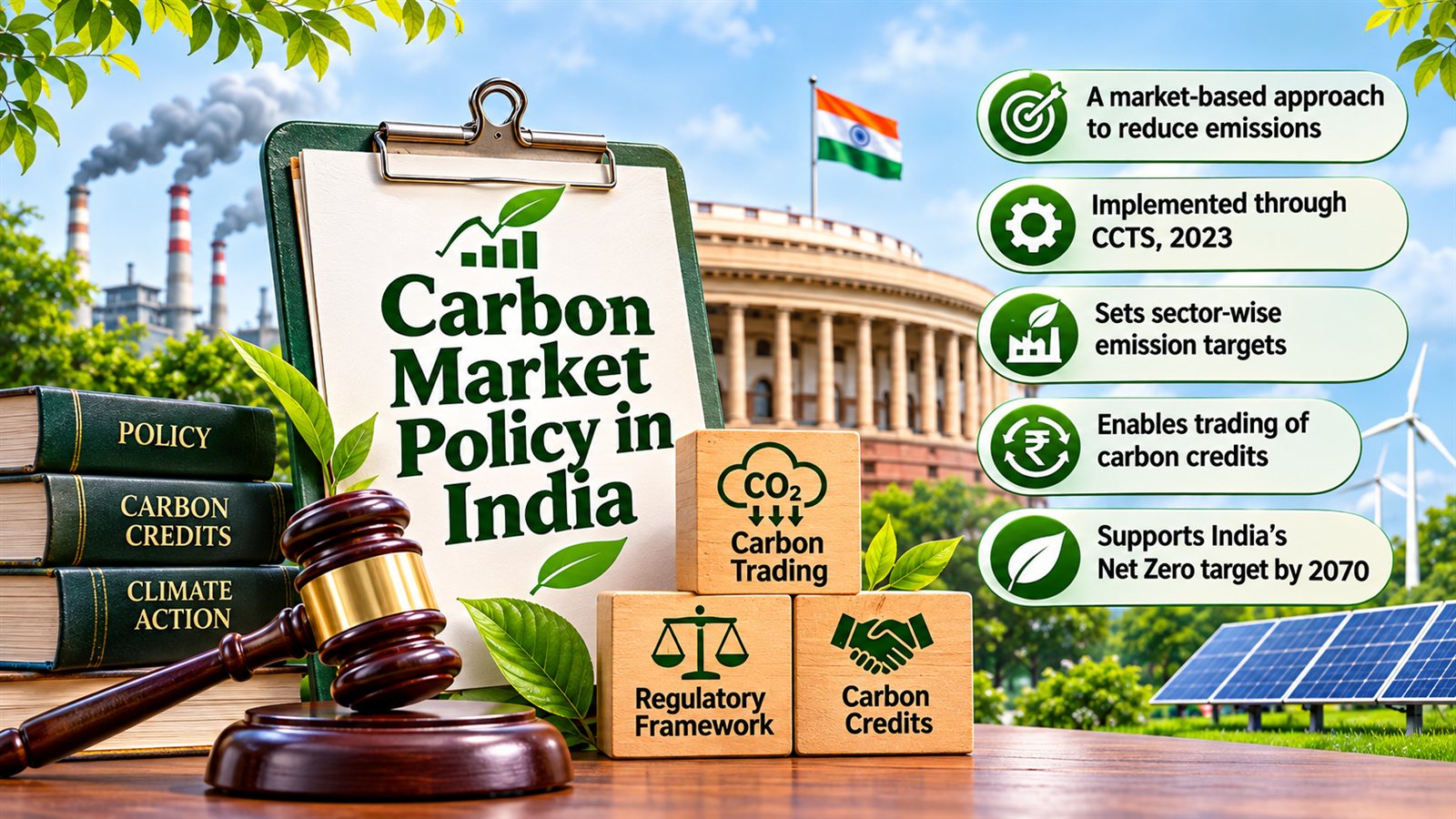
Carbon market policy in India is the government's strategy for cutting greenhouse gas emissions through a domestic carbon market rather than through a carbon tax. It is put into practice through the Carbon Credit Trading Scheme (CCTS), 2023, made under the Energy Conservation Act:
- Energy-intensive industries receive emission intensity targets for each sector.
- Other projects can earn credits through a voluntary offset mechanism.
- Carbon Credit Certificates (CCCs) are traded on regulated power exchanges.
The policy supports India's climate commitments, including its net-zero target for 2070. For international and aviation carbon markets, see our CORSIA Carbon Credits resources.
This guide explains why India chose this approach, how the policy evolved, what it aims to achieve and where it is heading. It is based on official notifications and reporting available in November 2026.
What Is Carbon Market Policy and Why Does India Need It?
Carbon market policy is the set of government decisions that create and shape a market for greenhouse gas reductions. It covers who must take part, what targets apply, how units are issued and traded, and who supervises the system.
Carbon markets create economic incentives. Companies that reduce emissions cheaply can sell surplus units, while those facing higher costs can buy them. Reductions therefore happen where they are cheapest, and a carbon price emerges that rewards cleaner investment.
India needs a structured market for several reasons:
- Growth with lower emissions: India's economy and energy demand are growing fast, so it needs tools that reduce emissions intensity without holding back development.
- Industrial decarbonisation: steel, cement, aluminium, refining and chemicals are large emitters, and a price signal encourages efficiency, fuel switching and cleaner technology.
- Climate commitments: India's updated NDC (2022) aims to reduce the emissions intensity of GDP by 45% by 2030 from 2005 levels, and India has announced net zero by 2070.
- A credible domestic system: a regulated market with strong MRV builds trust at home and abroad.
How it differs from other policies
- General environmental policy often sets fixed standards, such as emission limits for pollutants. A carbon market lets companies choose how to meet targets.
- A carbon tax fixes the price per tonne and lets emissions vary. India's market sets targets and lets the price be discovered through trading.
Evolution of India's Carbon Market Policy
Energy efficiency foundations
The Energy Conservation Act, 2001 created the Bureau of Energy Efficiency (BEE) and allowed energy consumption norms for energy-intensive "designated consumers".
Perform, Achieve and Trade (PAT)
Launched in 2012, PAT set energy efficiency targets for designated consumers. Those that beat their targets earned Energy Saving Certificates (ESCerts), which could be traded. PAT built India's experience in setting targets, measuring and verifying performance, and running certificate trading.
PAT is not the same as the CCTS. PAT targets energy consumption and trades ESCerts. The CCTS targets greenhouse gas emission intensity and trades Carbon Credit Certificates.
From energy to carbon
| Date | Development |
|---|---|
| 2001 | Energy Conservation Act creates BEE and energy norms |
| 2012 | PAT scheme begins |
| 2022 (in force 1 Jan 2023) | Energy Conservation (Amendment) Act empowers a carbon credit trading scheme. Section 14AA provides for Carbon Credit Certificates |
| 28 June 2023 | Ministry of Power notifies the Carbon Credit Trading Scheme, 2023, creating the Indian Carbon Market |
| 19 December 2023 | Amendment adds the offset mechanism |
| July 2024 | BEE issues detailed procedures for the compliance mechanism and for accrediting carbon verification agencies |
| 8 October 2025 | MoEFCC notifies the Greenhouse Gases Emission Intensity Target Rules, 2025 for the first four sectors |
| January 2026 | Targets reported for further sectors, including refining, petrochemicals and textiles |
| 27 February 2026 | CERC notifies regulations for trading Carbon Credit Certificates |
| 21 March 2026 | Indian Carbon Market portal launched |
The direction is clear: from energy efficiency to a greenhouse gas market, built step by step through law, scheme, rules, procedures and infrastructure.
Key Objectives of India's Carbon Market Policy
The policy aims to:
- reduce greenhouse gas emissions cost-effectively
- support industrial decarbonisation in hard-to-abate sectors
- create market-based incentives through a carbon price
- improve energy efficiency, building on PAT
- encourage investment in eligible climate projects through the offset mechanism
- strengthen MRV, meaning emissions monitoring, reporting and verification
- support India's long-term climate commitments, including the NDC and net zero by 2070
- build a transparent, credible domestic market with independent oversight
The intended benefits are:
- Industries gain flexibility in how they meet targets.
- Project developers gain a new revenue source.
- The wider economy gains a clear signal for low-carbon investment.
These are policy objectives. The legally binding requirements are those set out in the notified scheme, rules and regulations.
Carbon Credit Trading Scheme (CCTS) and Its Role in India's Carbon Market Policy
The CCTS is the legal instrument that turns policy into practice. It was made under the Energy Conservation Act, 2001, as amended in 2022.
- Compliance mechanism: obligated entities meet emission intensity targets, measured in emissions per unit of product.
- Offset mechanism: non-obligated entities register eligible projects using approved methodologies.
- Carbon Credit Certificates: one CCC equals one tCO₂e. CCCs are not Renewable Energy Certificates, which represent renewable electricity.
- Targets and benchmarks: set by sector and sub-sector in the 2025 target rules, against a 2023–24 baseline for the first compliance years (2025–26 and 2026–27).
- Eligible project activities: offset projects must use methodologies approved under the CCTS, and not every project qualifies.
- MRV: entities monitor and report under BEE procedures, and Accredited Carbon Verification Agencies verify.
- Issuance and registry: after BEE's review, CCCs are issued into Grid-India registry accounts.
Government Institutions Responsible for India's Carbon Market Policy
| Institution | Function |
|---|---|
| Ministry of Power (MoP) | Policy direction. Notifies and amends the CCTS |
| Bureau of Energy Efficiency (BEE) | Scheme administration: procedures, methodologies, accreditation and recommending issuance |
| National Steering Committee for the Indian Carbon Market | Governance and recommendations on rules and targets |
| Ministry of Environment, Forest and Climate Change (MoEFCC) | Notifies emission intensity target rules. Leads climate policy, NDC and Article 6 engagement |
| Central Electricity Regulatory Commission (CERC) | Regulatory oversight of CCC trading on power exchanges |
| Grid Controller of India (Grid-India) | Registry operations |
| Accredited Carbon Verification Agencies | Independent verification |
Responsibility is distributed. No single institution sets policy, runs the scheme, regulates trading, keeps the registry and verifies data.
Compliance and Offset Mechanisms Under India's Carbon Market Policy
Compliance mechanism
- Purpose: drive reductions in the most emission-intensive sectors.
- Obligated entities: named in the target rules. The first rules covered aluminium, cement, chlor-alkali, and pulp and paper. Refining, petrochemicals, textiles and secondary aluminium followed, and iron and steel and fertilisers were reported as pending in March 2026.
- Targets: emission intensity for each compliance year.
- Monitoring and reporting: under BEE procedures.
- Verification: by accredited agencies.
- Compliance: surplus earns CCCs. A shortfall requires surrendering CCCs, and the 2025 rules also provide for environmental compensation.
Offset mechanism
- Purpose: bring reductions from outside the obligated sectors into the market.
- Participants: non-obligated entities, such as project developers, smaller industries and others.
- Eligible activities: those covered by methodologies approved under the CCTS.
- Baseline and assessment: the methodology defines the baseline scenario and how reductions are calculated.
- Validation and verification: independent checks before issuance.
- Issuance: CCCs credited to the project's registry account.
Together, the two mechanisms create demand, from obligated entities with shortfalls, and supply, from over-performers and offset projects.
How India's Carbon Market Policy Affects Businesses and Industries
- Energy-intensive industries in notified sectors now have legally binding intensity targets. A cement or aluminium plant must plan how to meet its target or budget for buying CCCs.
- Measurement and reporting become core business functions, not side tasks.
- Eligible reduction projects, such as efficiency upgrades, cleaner fuels or other activities covered by approved methodologies, may earn CCCs under the offset mechanism.
- Clean energy and energy efficiency investments can pay off twice: lower energy bills and fewer certificates to buy, or more to sell.
- Preparedness means checking your regulatory status, building data systems, training staff and setting up registry access.
- Documentation matters, because every figure must be verifiable.
- Regulatory updates are frequent, so following BEE, MoEFCC and CERC notifications is essential.
Not every company has mandatory obligations. Only entities named in the target rules do. Others may choose to take part through offsets, or simply monitor developments.
Our article on carbon trading regulations in India explains how trading works in practice. Our guide to carbon credits law in India covers the legal instruments and penalties.
India's Carbon Market Policy and International Climate Frameworks
- Domestic market (CCTS): India's own system, under Indian law, for domestic compliance and trading.
- Paris Agreement and Article 6: let countries transfer mitigation outcomes internationally. That requires host-country authorisation and corresponding adjustments, so the same reduction is not counted twice. MoEFCC leads India's engagement.
- International cooperation: India can take part in bilateral Article 6 arrangements, separately from the domestic market.
- Voluntary carbon markets: Indian projects have long issued credits under programmes such as Verra and Gold Standard for international voluntary buyers.
- ICAO's CORSIA: a sector-specific scheme for international aviation, which accepts only units from ICAO-approved programmes that meet unit-level conditions.
These frameworks may interact in future, for example if some Indian reductions are authorised for international use. Indian CCCs and ordinary voluntary credits are not automatically eligible for CORSIA or international transfers. Our guide to CORSIA eligible carbon credits explains ICAO's conditions.
Challenges and Future Roadmap of India's Carbon Market Policy
Challenges
- Implementation: procedures, portals and exchanges are being rolled out in stages.
- Transparency: trading has yet to start at scale, so there is no public price yet.
- Reliable data: many plants are still upgrading their emissions measurement.
- MRV capacity: the pool of accredited verifiers needs to grow.
- Credit quality: offset methodologies must be robust to protect integrity.
- Industry participation and readiness, especially among smaller entities.
- Supply, demand and price discovery: these depend on how stringent targets are and on offset supply.
- Double counting: domestic CCCs, international credits and NDC accounting must stay separate.
- Digital infrastructure: registry and portal integration.
Officially announced or in progress
- targets for remaining sectors, such as iron and steel and fertilisers
- exchange trading under CERC's 2026 regulations
- the Indian Carbon Market portal and BEE procedures
Expectations, not confirmed decisions
- Timing of trading: earlier reports expected 2026, while a November 2026 report quoted BEE as saying trading would begin for most sectors by the end of 2027.
- Coverage: expansion to more sectors over time.
- Targets: tighter targets in later compliance cycles.
- Offsets: more methodologies.
- International links: possible links with Article 6.
The roadmap points to a broader, deeper domestic market. The pace will depend on future notifications.
Frequently Asked Questions
What is India's carbon market policy?
It is the government's strategy for reducing greenhouse gas emissions through a regulated domestic carbon market. It is put into practice mainly through the Carbon Credit Trading Scheme, 2023, made under the Energy Conservation Act.
What is the main objective of the Indian Carbon Market?
To reduce emissions cost-effectively by putting a price on carbon. It supports industrial decarbonisation, investment in reduction projects and India's climate commitments.
What is the Carbon Credit Trading Scheme (CCTS)?
It is the scheme notified by the Ministry of Power on 28 June 2023. It sets up the Indian Carbon Market, with a compliance mechanism for obligated entities and an offset mechanism for voluntary projects, both issuing Carbon Credit Certificates.
Which government authority is responsible for India's carbon market policy?
Responsibility is shared. The Ministry of Power sets the scheme, BEE administers it, MoEFCC notifies emission intensity targets, CERC regulates trading and Grid-India runs the registry.
How does India's carbon market support industries?
It gives industries flexibility to meet targets by cutting emissions or buying certificates. It rewards over-performers with tradable credits and offers offset revenue for eligible projects.
What is the difference between the compliance and offset mechanisms?
The compliance mechanism sets binding emission intensity targets for notified entities. The offset mechanism lets non-obligated entities earn certificates voluntarily from eligible reduction projects.
What is the future of the carbon market in India?
Officially, more sectors are to receive targets and trading is to run on CERC-approved exchanges. Expected, but not confirmed, are wider coverage, tighter targets, more offset methodologies and possible Article 6 links.
Key Takeaways
Carbon market policy in India marks a shift from energy efficiency schemes such as PAT to a full greenhouse gas market under the CCTS:
- the Energy Conservation Act provides the legal basis
- MoEFCC's target rules create binding obligations
- CERC regulates trading and Grid-India keeps the registry
- the compliance and offset mechanisms together create demand and supply
Several implementation details are still developing. Businesses should know their status, invest in reliable data and follow official updates.
For more on carbon credits, international markets and aviation compliance, explore the resources at CORSIA Carbon Credit.
Sources
- Ministry of Power
- Bureau of Energy Efficiency – Indian Carbon Market
- MoEFCC
- Central Electricity Regulatory Commission
- Grid Controller of India
- India Code – Energy Conservation Act, 2001
- World Bank – Carbon Pricing Dashboard
- ICAP – Compliance obligations under India's CCTS enter force for seven sectors (March 2026)
- UNFCCC – The Paris Agreement