 DSTechnoverse company
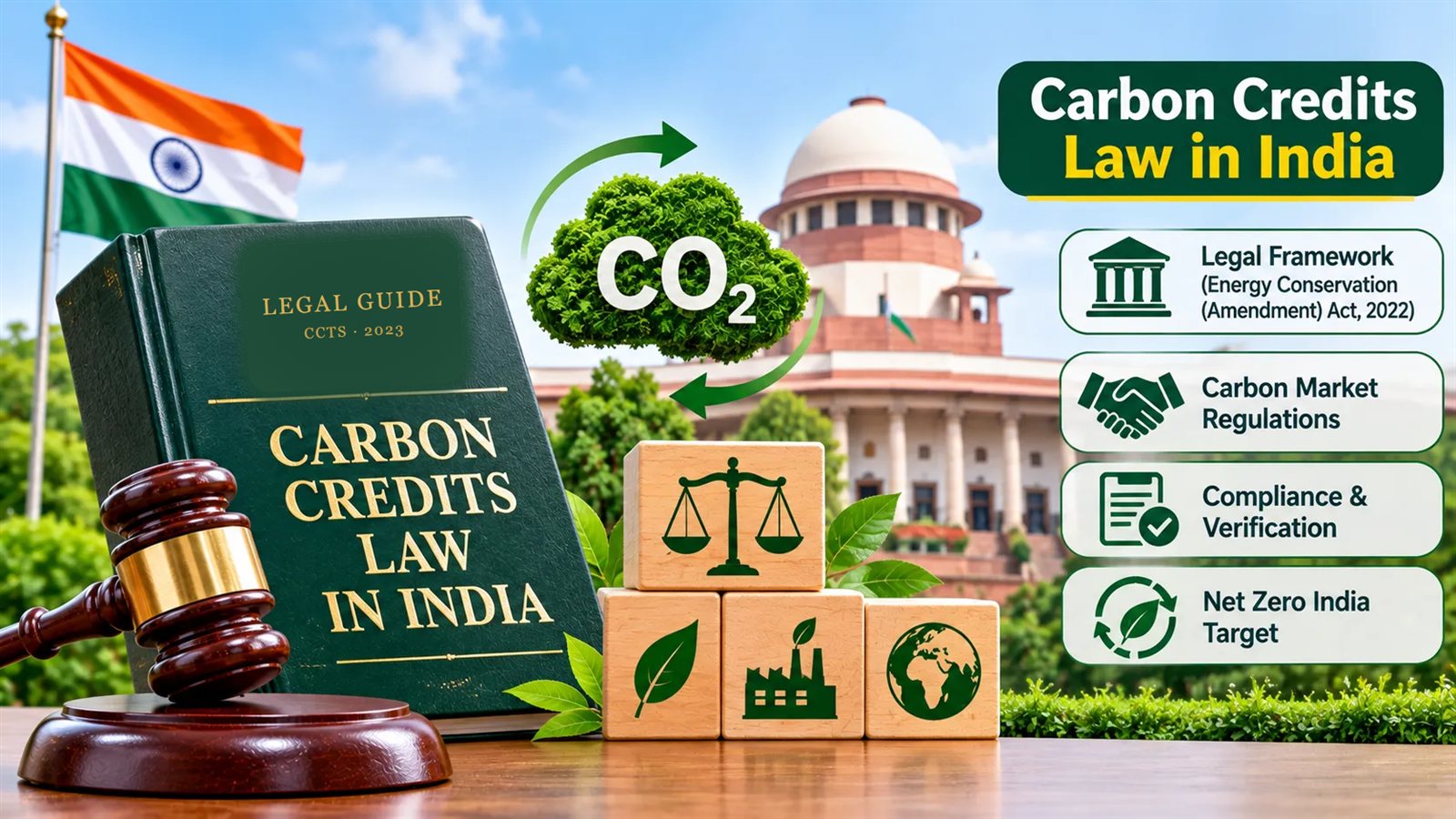
Carbon credits law in India is not a single statute. It is a layered framework:
- the Energy Conservation Act, 2001, amended in 2022 to empower a carbon credit trading scheme
- the Carbon Credit Trading Scheme (CCTS), 2023, notified by the Ministry of Power
- the Greenhouse Gases Emission Intensity Target Rules, 2025, notified by MoEFCC, which set targets for obligated industries
- CERC's 2026 regulations for trading Carbon Credit Certificates on power exchanges
Together, these create the Indian Carbon Market. For international and aviation carbon credit rules, see our CORSIA Carbon Credits resources.
This guide explains each legal instrument, who enforces it and what businesses must do. It is based on official notifications and reporting available in November 2026. It is general information, not legal advice.
What Is the Carbon Credit Law in India?
A carbon credit represents a verified reduction or removal of greenhouse gases, generally one tonne of CO₂ equivalent (tCO₂e). In India's regulated market, the unit is called a Carbon Credit Certificate (CCC).
A legal framework is necessary because carbon credits only have value if:
- emissions and reductions are measured and verified consistently
- certificates are issued by an authorised body and tracked in a registry
- obligations, trading and penalties are enforceable
- the same tonne is not counted twice
Government regulation provides the transparency and accountability that a private arrangement cannot. India's framework also supports its climate commitments, including its Nationally Determined Contribution under the Paris Agreement and its long-term net-zero goal.
India has no single "Carbon Credit Act". The market rests on:
- a parent statute
- a scheme made under that statute
- rules made under environmental law
- trading regulations
- operational procedures and notifications
Each layer does a different job.
Energy Conservation Act and Its Role in Carbon Credit Regulation
The original Act (2001)
The Energy Conservation Act, 2001 was passed to promote efficient use of energy. It:
- established the Bureau of Energy Efficiency (BEE)
- empowered the government to set energy consumption norms for "designated consumers", meaning energy-intensive industries
- supported the Perform, Achieve and Trade (PAT) scheme, under which industries traded Energy Saving Certificates
The original Act dealt with energy, not greenhouse gases. It did not by itself create a carbon market.
The 2022 amendment
The Energy Conservation (Amendment) Act, 2022 received presidential assent on 19 December 2022. It came into force on 1 January 2023. Among other changes, it:
- empowered the Central Government to specify a carbon credit trading scheme
- inserted section 14AA, which allows the Central Government, or an authorised agency, to issue Carbon Credit Certificates to registered entities that comply with the scheme, and lets them buy and sell those certificates
- broadened the Act's focus on energy transition and revised its penalty provisions
The amendment is the legal basis for the market. The detailed design came later, through the scheme and its rules.
Carbon Credit Trading Scheme (CCTS), 2023: India's Main Regulatory Framework
The Carbon Credit Trading Scheme, 2023 was notified by the Ministry of Power on 28 June 2023 under the amended Energy Conservation Act. It set up the Indian Carbon Market (ICM), its governance structure and its two mechanisms.
Compliance mechanism
- Obligated entities in notified sectors must meet greenhouse gas emission intensity targets, measured in emissions per unit of product.
- Entities that do better than their target receive CCCs.
- Entities that fall short must surrender CCCs to cover the gap.
Offset mechanism
- Added by an amendment notified on 19 December 2023.
- Non-obligated entities can register projects that reduce, remove or avoid emissions, using approved methodologies.
- After verification, these projects can earn CCCs.
Carbon Credit Certificates
A CCC represents one tCO₂e. CCCs are issued into accounts in the national registry, traded on approved exchanges, and surrendered or used under the rules. They are not Renewable Energy Certificates (RECs), which represent renewable electricity, and they are not Energy Saving Certificates under PAT.
The scheme is put into practice through subsequent notifications and procedures: target rules, BEE procedures, CERC regulations and registry arrangements.
Government Authorities Responsible for Carbon Credit Laws in India
| Authority | Legal and practical role |
|---|---|
| Ministry of Power (MoP) | Notifies and amends the CCTS under the Energy Conservation Act. Policy direction |
| Bureau of Energy Efficiency (BEE) | Administers the scheme: procedures, methodologies, accreditation of verifiers, recommending targets and CCC issuance |
| National Steering Committee for the Indian Carbon Market | Governance body that oversees the market and recommends rules and targets |
| Ministry of Environment, Forest and Climate Change (MoEFCC) | Notifies the emission intensity target rules under the Environment (Protection) Act, 1986. Leads climate policy and Article 6 |
| Central Pollution Control Board (CPCB) | Reported to be empowered to levy environmental compensation on entities that miss targets |
| Central Electricity Regulatory Commission (CERC) | Regulates CCC trading on power exchanges, market conduct and surveillance |
| Grid Controller of India (Grid-India) | Acts as the registry, keeping accounts and recording issuance, transfer and surrender |
| Accredited Carbon Verification Agencies | Independent verifiers accredited by BEE |
No single institution controls the whole market. Policy, administration, target-setting, trading regulation, registry and verification sit with different bodies.
Important Rules, Notifications and Legal Provisions for Carbon Credits
| Instrument | Type | Status and date |
|---|---|---|
| Energy Conservation Act, 2001 | Parent statute | In force |
| Energy Conservation (Amendment) Act, 2022 | Amending statute (including section 14AA) | In force from 1 January 2023 |
| Carbon Credit Trading Scheme, 2023 | Scheme under the Act | Notified 28 June 2023 |
| CCTS amendment | Amendment adding the offset mechanism | Notified 19 December 2023 |
| BEE detailed procedure for the compliance mechanism and accreditation procedure for carbon verification agencies | Operational procedures | Issued July 2024 |
| Offset mechanism procedures and methodologies | Operational procedures | Issued by BEE (check current versions) |
| Greenhouse Gases Emission Intensity Target Rules, 2025 | Rules under the Environment (Protection) Act, 1986 (MoEFCC) | Notified 8 October 2025. Amended to add sectors, with further targets reported in January 2026 |
| CERC (Terms and Conditions for Purchase and Sale of Carbon Credit Certificates) Regulations, 2026 | Trading regulations | Notified 27 February 2026 |
| Indian Carbon Market portal | Implementation | Launched 21 March 2026 |
How they fit together:
- The Act gives the power.
- The scheme creates the market.
- The target rules create binding obligations for specific entities.
- BEE procedures explain compliance and verification.
- CERC regulations govern trading.
- Grid-India keeps the records.
Always check the latest text on the official websites, because amendments continue.
Legal Requirements for Businesses to Participate in India's Carbon Market
Who is covered?
Only obligated entities named under the target rules. The first rules (October 2025) covered aluminium, cement, chlor-alkali, and pulp and paper. Petroleum refining, petrochemicals, textiles and secondary aluminium were added later. As of March 2026, iron and steel and fertilisers were reported as pending. Mandatory compliance does not apply to every company in India.
What do obligated entities have to do?
- Meet emission intensity targets for each compliance year. The first compliance years are 2025–26 and 2026–27, against a 2023–24 baseline.
- Monitor and report greenhouse gas emissions and production data according to BEE procedures.
- Have data verified by an Accredited Carbon Verification Agency.
- Hold registry accounts and surrender CCCs for any shortfall.
- Keep accurate records that can withstand audit.
Offset projects
Non-obligated entities can register projects under the offset mechanism. They must use approved methodologies, be independently verified, and receive CCCs through BEE and the registry.
Issuance and tracking
CCCs are issued after verification and BEE's review. They are held in Grid-India registry accounts, and every issuance, transfer and surrender is recorded.
Illustrative example (hypothetical)
This example is hypothetical. A pulp and paper mill named in the target rules finds that its verified emission intensity is above its target. It must cover the shortfall by surrendering CCCs, either bought on an approved exchange or banked from earlier surpluses. A textile exporter that is not obligated could instead register an efficiency project under the offset mechanism and, after verification, earn CCCs to sell.
Penalties, Non-Compliance and Legal Responsibilities
Under the Greenhouse Gases Emission Intensity Target Rules, 2025, as reported in official summaries and legal commentary:
- an obligated entity that misses its target must surrender CCCs equal to the shortfall
- it is also liable for environmental compensation set at twice the average trading price of CCCs for the relevant compliance year
- the CPCB is reported to be the authority that imposes it
- surplus CCCs can be banked for later use
Separately, the Energy Conservation Act's penalty provisions, revised in 2022, apply to breaches of obligations under that Act. This article does not state specific penalty amounts or payment deadlines. Check the current gazette text of the rules and the Act before relying on any figure.
Wider legal responsibilities include:
- accurate reporting, since false data can lead to enforcement action
- keeping documents that support every reported figure
- avoiding double counting, so the same reduction is not claimed both as a CCC and as an international credit without proper authorisation
- making correct claims, so CCCs are not presented as something they are not, such as CORSIA units
Difference Between India's Carbon Credit Law and International Carbon Market Frameworks
| Factor | India's CCTS | Voluntary standards (e.g. Verra, Gold Standard) | Article 6 of the Paris Agreement | ICAO CORSIA |
|---|---|---|---|---|
| Legal authority | Indian statute, scheme and rules | Private programme rules | International treaty and UN decisions | ICAO Standards, applied by States |
| Participation | Mandatory for obligated entities, voluntary for offsets | Voluntary | Countries, plus authorised entities | Aeroplane operators on covered international routes |
| Eligibility | Notified sectors and approved methodologies | Programme methodologies | Host-country authorisation and corresponding adjustments | ICAO-approved programmes and unit conditions |
| Verification | BEE-accredited verifiers | Programme-accredited VVBs | Depends on the mechanism | Programme verification plus State review |
| Intended use | Domestic compliance and trading | Voluntary claims | Countries' NDCs and other international purposes | Airline offsetting obligations |
Indian CCCs and voluntary credits from Indian projects are not automatically eligible for CORSIA or for international transfers. International use needs government authorisation and accounting under Article 6, and for CORSIA, ICAO approval of the programme and unit. Our guide to CORSIA eligible carbon credits explains ICAO's conditions. Our article on carbon credits regulations explains the international layers.
Future of Carbon Credit Legislation and the Indian Carbon Market
Announced or in progress
- targets for remaining sectors, such as iron and steel and fertilisers
- exchange-based trading under CERC's 2026 regulations
- continued BEE procedures and methodologies for the offset mechanism
Expectations, not confirmed law
- Trading start: reports differ. A November 2026 report quoted BEE as saying trading would begin for most sectors by the end of 2027.
- Tighter targets in later compliance cycles.
- More offset methodologies, opening opportunities for eligible reduction projects.
- Gradual alignment with Article 6, including authorised international transfers.
Across all of this, the importance of measurement, verification and transparent registries will grow. Businesses that build reliable emissions data now will find compliance easier later. Our article on carbon credits regulations in India covers how the market works in practice. Our explainer on India's Carbon Credit Trading Scheme gives a further overview.
Frequently Asked Questions
Is there a specific carbon credit law in India?
No single law. India's framework combines the Energy Conservation Act, 2001 (as amended in 2022), the Carbon Credit Trading Scheme, 2023, the Greenhouse Gases Emission Intensity Target Rules, 2025, and CERC's 2026 trading regulations.
Which Act governs carbon credit trading in India?
The Energy Conservation Act, 2001, as amended by the Energy Conservation (Amendment) Act, 2022. Section 14AA provides for issuing Carbon Credit Certificates under a notified trading scheme.
What is the Carbon Credit Trading Scheme, 2023?
It is the scheme notified by the Ministry of Power on 28 June 2023. It creates the Indian Carbon Market, with a compliance mechanism for obligated entities and an offset mechanism for voluntary projects.
Which government authority regulates carbon credits in India?
Several share the role. The Ministry of Power sets the scheme, BEE administers it, MoEFCC notifies emission intensity targets, CERC regulates trading and Grid-India runs the registry.
Is carbon credit trading mandatory for all companies in India?
No. Only obligated entities named in the target rules for notified sectors have mandatory obligations. Others can take part voluntarily through the offset mechanism.
What are the legal requirements for generating carbon credits in India?
Obligated entities must beat verified emission intensity targets. Offset projects must register, use approved methodologies and be verified by accredited agencies before CCCs are issued.
What happens if an obligated entity fails to meet carbon credit compliance requirements?
Under the 2025 target rules, it must surrender CCCs for the shortfall and is liable for environmental compensation, reported as twice the average CCC trading price for that compliance year. Check the current official text for details.
Key Takeaways
Carbon credits law in India is a layered framework, not one Act:
- the Energy Conservation Act and its 2022 amendment provide the legal power
- the CCTS creates the market
- MoEFCC's target rules create binding obligations and penalties
- CERC's regulations govern trading
- BEE and Grid-India run administration and the registry
Obligations apply only to notified entities, and several implementation details are still developing. Businesses should confirm their status, build reliable emissions data and follow official notifications closely.
To learn more about carbon credits, eligibility and aviation compliance, explore the resources at CORSIA Carbon Credit.
Sources
- India Code – Energy Conservation Act, 2001
- PRS India – The Energy Conservation (Amendment) Act, 2022
- Ministry of Power
- Bureau of Energy Efficiency – Indian Carbon Market
- MoEFCC
- ESG Broadcast – MoEFCC notifies GHG emission intensity target rules (October 2025)
- ICAP – Compliance obligations under India's CCTS enter force for seven sectors (March 2026)
- Sansa Legal – CERC Carbon Credit Certificate Trading Regulations 2026
- Grid Controller of India
- UNFCCC – Article 6 of the Paris Agreement