 DSTechnoverse company
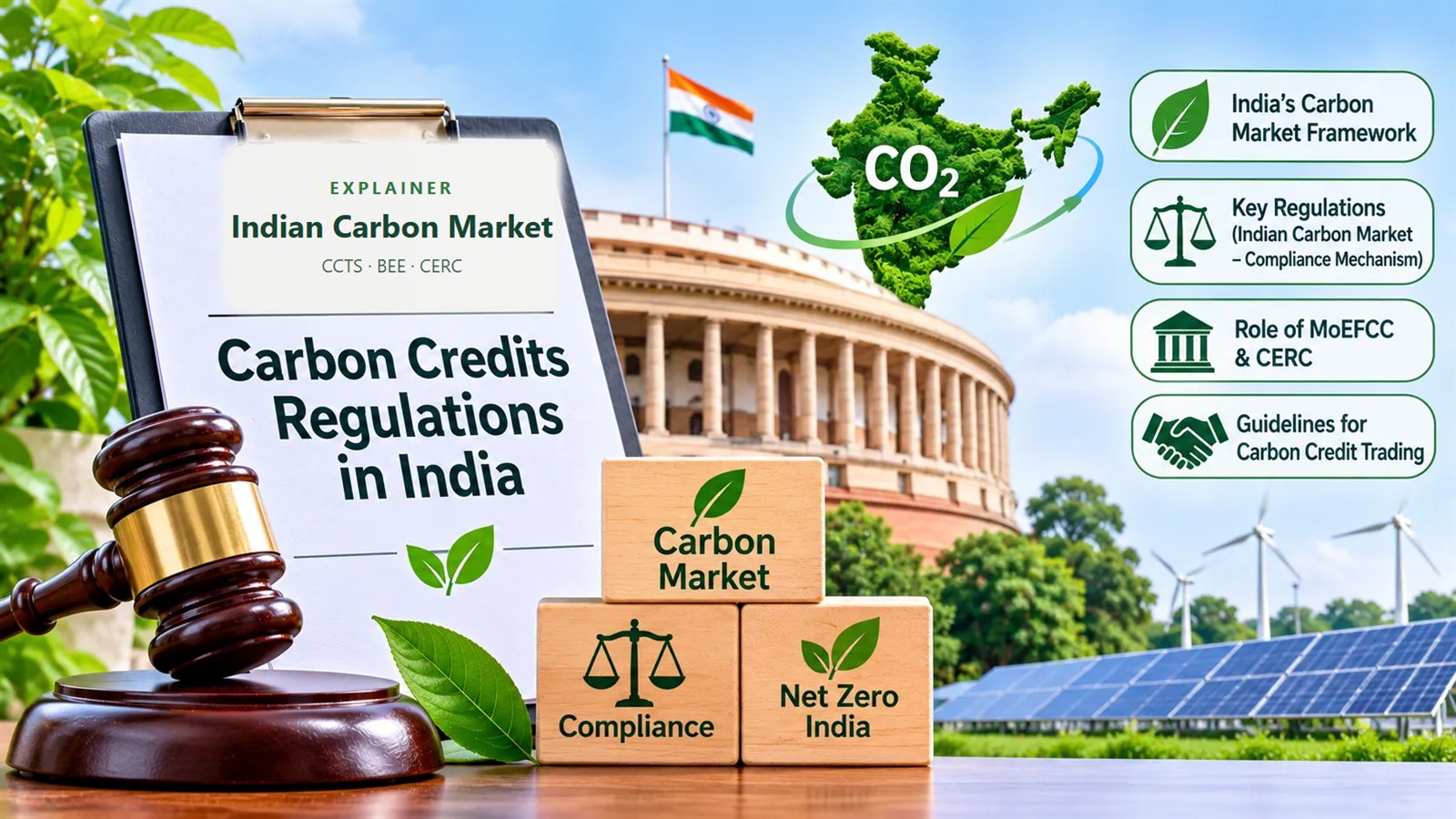
Carbon credits regulations in India are set mainly by the Carbon Credit Trading Scheme (CCTS), 2023. The scheme was made under the Energy Conservation Act, 2001, as amended in 2022, and it creates the Indian Carbon Market. It has two parts:
- a compliance mechanism, under which notified energy-intensive industries must meet greenhouse gas emission intensity targets
- a voluntary offset mechanism, under which other entities can earn credits for reduction projects
The Ministry of Power owns the scheme. The Bureau of Energy Efficiency (BEE) administers it, the Central Electricity Regulatory Commission (CERC) regulates trading, and Grid Controller of India (Grid-India) runs the registry. Both mechanisms issue Carbon Credit Certificates (CCCs), each worth one tonne of CO₂e. For international and aviation carbon markets, see our CORSIA Carbon Credits resources.
This guide explains the rules, the institutions and the trading process in plain language, based on official notifications and reporting available in November 2026.
What Are Carbon Credits and Why Are They Regulated in India?
A carbon credit represents a measured reduction or removal of greenhouse gases, generally one tonne of carbon dioxide equivalent (tCO₂e). CO₂e converts gases such as methane into the amount of CO₂ with the same warming effect.
Governments regulate carbon markets because a credit is only valuable if everyone trusts the tonne behind it. Rules on monitoring, reporting and verification (MRV), registries and trading make that trust possible. They also prevent fraud, double counting and market manipulation.
For India, a regulated market supports national climate goals. The country's updated Nationally Determined Contribution under the Paris Agreement aims to reduce the emissions intensity of GDP by 45% by 2030 from 2005 levels, and India has a net-zero target for 2070. A domestic carbon price gives industries a financial reason to cut emissions where it is cheapest to do so.
Overview of India's Carbon Credit Trading Scheme (CCTS)
The Carbon Credit Trading Scheme, 2023 was notified by the Ministry of Power on 28 June 2023. An amendment on 19 December 2023 added the offset mechanism. The scheme establishes the Indian Carbon Market (ICM), India's domestic carbon market.
Compliance mechanism
- Obligated entities, meaning companies in sectors notified by the government, receive greenhouse gas emission intensity targets. These are measured in emissions per unit of output, such as tonnes of CO₂e per tonne of cement.
- Entities that do better than their target earn CCCs.
- Entities that fall short must buy and surrender CCCs to cover the gap.
Offset mechanism
- Non-obligated entities can register projects that reduce, remove or avoid emissions, using approved methodologies.
- After verification, they can receive CCCs.
Only notified sectors and entities face compliance obligations, so not every business is covered. Other businesses can take part voluntarily through the offset mechanism.
CCCs are not RECs
Carbon Credit Certificates are different from Renewable Energy Certificates (RECs). RECs represent renewable electricity generation and are used to meet renewable purchase obligations. CCCs represent tonnes of greenhouse gas reduced. The two are separate instruments under different rules. They are also different from green credits under MoEFCC's Green Credit Programme, which reward environmental actions such as tree plantation. Our guide to the difference between green credits and carbon credits explains that distinction.
Government Authorities Responsible for Carbon Credit Regulations in India
Responsibility is shared, and no single body runs everything.
| Authority | Main role |
|---|---|
| Ministry of Power (MoP) | Notifies and amends the CCTS under the Energy Conservation Act. Owns the policy framework |
| Bureau of Energy Efficiency (BEE) | Administers the scheme: procedures, methodologies, accreditation of verifiers, and recommending issuance of CCCs |
| National Steering Committee for the Indian Carbon Market (NSCICM) | Oversees the market's governance and recommends rules and targets. Brings together relevant ministries |
| Ministry of Environment, Forest and Climate Change (MoEFCC) | Leads climate policy and Article 6 engagement. Involved in setting emission intensity targets |
| Central Electricity Regulatory Commission (CERC) | Regulates trading of CCCs on power exchanges and oversees market conduct |
| Grid Controller of India (Grid-India) | Acts as the registry, keeping accounts and tracking issuance, transfer and surrender of CCCs |
| Accredited Carbon Verification Agencies | Independent verifiers, accredited by BEE, who verify emissions and reductions |
Key Rules and Legal Framework Governing Carbon Credits in India
These instruments work together:
- Energy Conservation Act, 2001 is the parent law for energy efficiency, including the earlier Perform, Achieve and Trade (PAT) scheme.
- Energy Conservation (Amendment) Act, 2022 gave the government power to specify a carbon credit trading scheme.
- Carbon Credit Trading Scheme, 2023 (28 June 2023), amended on 19 December 2023, sets up the market, its two mechanisms and its institutions.
- BEE's detailed procedures (July 2024) cover the compliance mechanism and the accreditation of carbon verification agencies. Further procedures cover the offset mechanism.
- Emission intensity target notifications set targets for each sector:
- October 2025: aluminium, cement, chlor-alkali, and pulp and paper
- January 2026: petroleum refining, petrochemicals and textiles
- iron and steel and fertilisers were still pending as of March 2026
- CERC (Terms and Conditions for Purchase and Sale of Carbon Credit Certificates) Regulations, 2026, notified on 27 February 2026, set the trading rules: designated power exchanges, settlement, surveillance and bans on manipulation and insider trading.
- The Indian Carbon Market portal, launched on 21 March 2026, handles registration, issuance and accreditation workflows.
These instruments are of different kinds:
- Scheme notifications and amendments create the legal framework.
- Procedures explain how to comply in practice.
- Target notifications set obligations for each sector.
- Implementation updates, such as portal launches, put the rules into operation.
Always check the latest version on the BEE, Ministry of Power and CERC websites. Our article on how India's Carbon Credit Trading Scheme works gives a further overview of the scheme.
How Does Carbon Credit Trading Work in India?
- Identify participants. Obligated entities are named in sector notifications. Offset projects register voluntarily.
- Understand requirements. Obligated entities follow their sector's targets. Offset projects use approved methodologies.
- Set the baseline. For compliance, baseline emission intensity is based on a reference year, FY 2023–24 for the first sectors. For offsets, the methodology defines the baseline scenario.
- Monitor and measure emissions or reductions according to BEE's procedures.
- Report and verify. An Accredited Carbon Verification Agency checks the reported data.
- Issue CCCs. After BEE's review, CCCs are issued into accounts in the Grid-India registry.
- Trade on CERC-approved power exchanges under the 2026 regulations.
- Use or surrender. Obligated entities surrender CCCs to meet shortfalls, and other holders can retire them as the rules allow.
The exact process depends on the mechanism and the latest procedures.
Illustrative example: a cement plant (hypothetical)
All figures are hypothetical and are not notified targets. Suppose a cement plant's notified target for a compliance year were 0.60 tCO₂e per tonne of cement, and it produced 1,000,000 tonnes.
- If its verified intensity were 0.58, it would beat the target by 0.02 tCO₂e per tonne. Across 1,000,000 tonnes, that is 20,000 tCO₂e, which could become 20,000 CCCs to sell or bank, subject to the rules.
- If its verified intensity were 0.62, it would miss the target by 20,000 tCO₂e and would need to buy and surrender 20,000 CCCs.
Actual targets, calculation rules and treatment of surplus certificates are set by official notifications and BEE procedures.
From PAT to CCTS
India's earlier Perform, Achieve and Trade (PAT) scheme, also run by BEE under the Energy Conservation Act, set energy efficiency targets and traded Energy Saving Certificates. The CCTS moves to greenhouse gas intensity targets and Carbon Credit Certificates. Many PAT-covered industries are among the first CCTS sectors, so their existing energy data systems give them a head start.
Timing remains uncertain. Early reports expected first trades in 2026. A report from November 2026 quoted BEE as saying trading would begin for most sectors by the end of 2027. Check BEE and the power exchanges for the current status.
Compliance Requirements for Indian Businesses and Industries
Who is covered? Only entities in sectors notified under the compliance mechanism. As of March 2026, about 490 entities across seven sectors had obligations in force.
How are they identified? Through sector notifications that list obligated entities and their targets.
What are the obligations?
- meet the notified emission intensity target for each compliance year; the first compliance years are 2025–26 and 2026–27
- monitor greenhouse gas emissions and production data accurately
- report and have data verified by an accredited verifier
- surrender CCCs if emission intensity exceeds the target
What should businesses do now?
- check whether your sector and plant are notified
- build reliable emissions data systems
- understand how intensity is calculated for your product
- plan whether to invest in efficiency or buy CCCs
- track BEE procedures and CERC trading rules
Voluntary participants that are not obligated can use the offset mechanism, subject to its methodologies and procedures.
This article does not list penalty amounts or deadlines beyond those confirmed above. Refer to the latest official notifications for specific consequences and dates.
Voluntary Carbon Market vs Indian Compliance Carbon Market
| Factor | Indian compliance market (CCTS) | Voluntary carbon market |
|---|---|---|
| Regulatory oversight | MoP, BEE and CERC under Indian law | Independent programmes such as Verra and Gold Standard |
| Participation | Mandatory for notified obligated entities, plus voluntary offsets | Voluntary |
| Methodologies | Approved under the CCTS | Set by each programme |
| Verification | BEE-accredited carbon verification agencies | Programme-accredited validation and verification bodies |
| Issuance | CCCs in the Grid-India registry | Programme credits in programme registries |
| Intended use | Meeting Indian compliance obligations, domestic trading | Voluntary corporate claims and some international schemes |
Indian projects have long issued credits under international voluntary programmes. Those credits are not automatically accepted under the CCTS. Likewise, CCCs are not automatically eligible for international compliance schemes such as CORSIA, or for Article 6 transfers. International use requires government authorisation and accounting under Article 6, and, for CORSIA, ICAO approval of the programme and unit. Our guide to carbon credits regulations explains how these international rules work.
Challenges and Future of Carbon Credit Regulations in India
Current challenges
- Implementation: procedures, portals and exchanges are being put in place in stages.
- Reliable measurement: many plants need better emissions data systems.
- Verification quality: enough accredited verifiers with strong methods are needed.
- Price discovery: trading has yet to start at scale, so prices are untested.
- Avoiding double counting: domestic CCCs, international credits from Indian projects and India's NDC accounting must stay separate.
- Industry readiness, especially among smaller obligated entities.
Officially announced developments
- more sectors receiving targets, with iron and steel and fertilisers pending
- the CERC trading regulations (2026) and exchange-based trading
- the Indian Carbon Market portal
Expectations, not confirmed
- When trading starts in practice: reports range from 2026 to the end of 2027.
- Possible tighter targets in later compliance cycles.
- Gradual links between the domestic market and Article 6, such as authorised international transfers.
Indian rules may increasingly align with international frameworks. Any such links will depend on future government decisions.
Frequently Asked Questions
What are the carbon credit regulations in India?
They are mainly the Carbon Credit Trading Scheme, 2023, made under the Energy Conservation Act, 2001 (as amended in 2022). It is supported by BEE procedures, sector emission intensity target notifications and CERC's 2026 trading regulations.
What is the Carbon Credit Trading Scheme (CCTS) in India?
It is India's domestic carbon market. Notified energy-intensive entities must meet emission intensity targets under a compliance mechanism, and other entities can earn credits through an offset mechanism. Both issue Carbon Credit Certificates.
Which government authority regulates carbon credits in India?
Several share the role. The Ministry of Power owns the scheme, BEE administers it, MoEFCC leads climate policy and Article 6, CERC regulates trading, and Grid-India runs the registry.
Who is eligible to participate in India's carbon credit market?
Obligated entities in notified sectors must participate. Non-obligated entities can participate voluntarily through the offset mechanism by registering eligible projects.
How can companies earn carbon credits in India?
Obligated entities earn Carbon Credit Certificates by beating their emission intensity targets. Others can register reduction projects under the offset mechanism and earn certificates after verification.
Is carbon credit trading mandatory for all industries in India?
No. Only entities in sectors notified under the compliance mechanism have obligations. Other businesses can take part voluntarily.
What is the difference between voluntary carbon credits and Indian Carbon Credit Certificates?
Voluntary credits are issued by independent programmes such as Verra for voluntary claims. Carbon Credit Certificates are issued under India's government scheme for domestic compliance and trading. Neither is automatically accepted in the other system.
Key Takeaways
Carbon credits regulations in India are built around the Carbon Credit Trading Scheme. The Ministry of Power sets the framework, BEE runs the scheme, CERC regulates trading and Grid-India keeps the registry. Notified industries must meet emission intensity targets, while others can earn certificates through offsets. Obligations apply only to notified entities, and timelines for trading are still developing.
Businesses should check whether they are covered, invest in reliable emissions data and follow official updates closely. For more on international carbon credits, eligibility and aviation compliance, explore the resources at CORSIA Carbon Credit.
Sources
- Bureau of Energy Efficiency – Indian Carbon Market
- Ministry of Power
- MoEFCC
- Central Electricity Regulatory Commission
- Grid Controller of India
- India Code – Energy Conservation Act, 2001
- IEA – Carbon Credit Trading Scheme, 2023
- ICAP – Compliance obligations under India's CCTS enter force for seven sectors (March 2026)
- Sansa Legal – CERC Carbon Credit Certificate Trading Regulations 2026
- UNFCCC – India's NDC and the Paris Agreement