 DSTechnoverse company
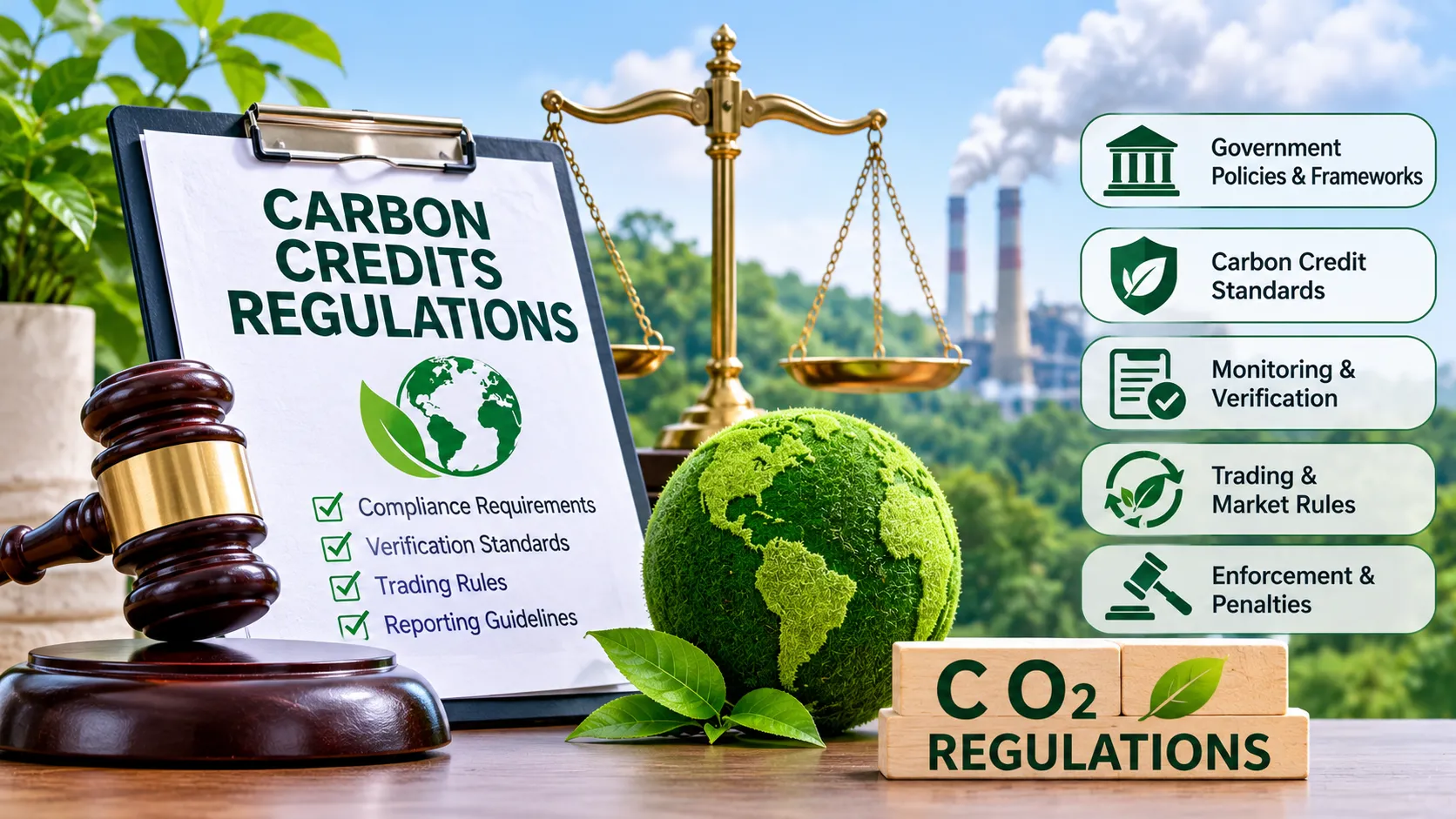
Carbon credits regulations are the rules that decide how carbon credits are created, verified, traded and used. They come from three sources:
- international agreements, such as the Paris Agreement and ICAO's CORSIA
- national laws, such as India's Carbon Credit Trading Scheme
- independent crediting programmes, such as Verra or Gold Standard, whose rulebooks govern the voluntary market
Which rules apply depends on the country, the market and how the credit will be used. For aviation-specific guidance, see our CORSIA Carbon Credits resources.
This guide explains each layer, how they fit together and why the differences matter for project developers, buyers and businesses. Time-sensitive information reflects official sources available in November 2026.
What Are Carbon Credits Regulations?
A carbon credit is a tradable unit representing a verified reduction or removal of greenhouse gases, generally one tonne of CO₂ equivalent (tCO₂e). Carbon credit regulations are the legal and programme rules that determine:
- which projects can earn credits
- how reductions are measured and verified
- how credits are issued, tracked and transferred
- how credits can be used and what claims can be made
Carbon markets need these rules because a credit represents something nobody can see: a tonne of emissions that did not happen. Rules on measurement, verification and registries give the unit its credibility.
There is an important difference between two kinds of rules:
- Government regulations are binding laws. They create obligations and penalties, for example in a national emissions trading scheme.
- Programme standards are rulebooks written by independent organisations such as Verra or Gold Standard. They bind only those who choose to use the programme.
These rules shape every participant:
- Developers must follow methodologies.
- Sellers must hold credits in registries.
- Buyers must retire credits correctly and make accurate claims.
- Regulated companies must meet legal obligations.
Why Are Carbon Credit Regulations Important?
Clear rules are what make a carbon market work. They:
- prevent double counting, so each tonne is claimed only once
- ensure genuine reductions and removals through additionality tests and realistic baselines
- improve credit quality through approved methodologies and safeguards
- require transparent measurement and reporting
- require independent validation and verification
- protect buyers from misleading environmental claims
- encourage responsible project development, including community consultation
- build trust among governments, businesses and investors
Where oversight is weak, credits can be issued for reductions that are overstated or would have happened anyway. Claims built on such credits damage buyers' reputations and the market as a whole.
International Carbon Credit Regulations and Climate Agreements
1. The Paris Agreement
The Paris Agreement, adopted in 2015 under the UN climate convention, aims to limit global warming to well below 2°C and to pursue efforts to limit it to 1.5°C. Each country sets a Nationally Determined Contribution (NDC), which is its own climate target and plan. Carbon markets can help countries meet NDCs at lower cost by trading reductions.
2. Article 6 of the Paris Agreement
Article 6 lets countries cooperate on climate action. It has three different parts:
- Article 6.2: cooperative approaches. Countries agree bilateral deals to transfer internationally transferred mitigation outcomes (ITMOs). Each deal is designed by the countries involved and follows UN reporting and accounting guidance.
- Article 6.4: the UN-supervised crediting mechanism. It is now known as the Paris Agreement Crediting Mechanism (PACM). A UN Supervisory Body approves methodologies and registers projects, and the mechanism issues credits centrally. It succeeds the Kyoto Protocol's Clean Development Mechanism.
- Article 6.8: non-market approaches. Cooperation through finance, technology and capacity building, with no trading of mitigation outcomes.
Key concepts:
- Host-country authorisation: the country where a project is located formally approves its mitigation outcomes for international use.
- Corresponding adjustment: the host country adds the transferred amount back to its own emissions accounts, while the buyer country or scheme subtracts it. This ensures only one party counts the reduction.
- Environmental integrity: transfers must not increase global emissions, and they must be real, verified and additional.
The detailed Article 6 rules were agreed at COP26 in Glasgow (2021), and further elements were finalised at COP29 in Baku (2024).
3. UNFCCC
The United Nations Framework Convention on Climate Change (UNFCCC) is the treaty, and its secretariat runs the annual climate negotiations (COPs). It supports the Article 6 bodies and registries and collects countries' reports on NDCs and transfers.
4. ICAO and CORSIA
The International Civil Aviation Organization (ICAO) created CORSIA, the Carbon Offsetting and Reduction Scheme for International Aviation, as the global market-based measure for international aviation's CO₂. Its main features are:
- MRV: operators emitting more than 10,000 tonnes of CO₂ a year from international flights must monitor, report and verify their emissions.
- Offsetting: applies to flights between participating States, settled in three-year compliance periods.
- Eligible emissions units: the ICAO Council, advised by its Technical Advisory Body, decides which programmes can supply units for each period. Units must also meet unit-level conditions.
CORSIA is sector-specific. It covers international aviation only and is not a general carbon law for all industries. Our guide to CORSIA eligible carbon credits explains the eligibility rules in detail.
Voluntary Carbon Market vs Compliance Carbon Market Regulations
Voluntary carbon market
- Companies and individuals buy credits by choice.
- Credits are issued under independent programmes.
- Programme methodologies set the project and crediting rules.
- Validation, verification and registries support credibility.
- Buyers' claims should be transparent and supported by retirement records. Integrity initiatives such as the Integrity Council for the Voluntary Carbon Market (ICVCM) publish quality benchmarks, but they are not government regulators.
Compliance carbon market
- Participation is required by law or regulation.
- Governments or regulators set the rules.
- Covered entities must surrender allowances or eligible units to meet obligations.
- MRV and surrender deadlines apply.
- Non-compliance has consequences under the relevant law.
| Factor | Voluntary carbon market | Compliance carbon market |
|---|---|---|
| Regulatory basis | Programme rules and voluntary guidance | National or international law |
| Participation | Optional | Mandatory for covered entities |
| Main participants | Companies, individuals, project developers | Regulated companies, governments, airlines (under CORSIA) |
| Unit requirements | Credits from the chosen programme | Allowances or units the scheme accepts |
| Verification | Under programme rules | Under programme rules plus the regulator's requirements |
| Reporting and compliance | Voluntary claims and disclosures | Mandatory reporting and surrender |
| Examples | Verra, Gold Standard credits for corporate goals | EU ETS, India's CCTS compliance mechanism, CORSIA |
Allowances are not the same as credits. An allowance is a permit to emit that a government issues under a cap. A credit represents a reduction or removal from a project. A voluntary credit and a compliance allowance are not interchangeable unless a scheme's rules expressly allow it.
Carbon Credit Certification, Verification and Registration Requirements
Most programmes follow similar stages:
- Project design. The developer writes a project description and defines the boundaries, the baseline scenario and the additionality case, and chooses an approved methodology.
- Validation. An independent validation and verification body (VVB) reviews the design against the programme's methodology and documentation requirements.
- Registration. The developer submits the documents and the programme reviews them before registering the project under its standard.
- Monitoring and reporting. The developer collects data, measures reductions or removals, and prepares monitoring reports with supporting evidence.
- Verification. A VVB reviews the monitored results and checks the calculations.
- Issuance and registry tracking. After approval, the programme issues credits with unique serial numbers into a registry. Credits can then be transferred, and finally retired or cancelled.
Exact requirements depend on the programme, methodology, project type and any applicable national law. Our guide to the carbon credit certification process covers each stage step by step. Our article on how carbon credits are measured explains the calculations behind them.
Major Carbon Credit Standards and Their Regulatory Roles
These are independent programmes, not government regulators. Their rules apply because participants choose to use them, or because a scheme such as CORSIA recognises them.
- Verra – Verified Carbon Standard (VCS). The largest voluntary programme. It approves methodologies, accredits VVBs and issues Verified Carbon Units in the Verra Registry.
- Gold Standard. It requires projects to show sustainable development benefits and to consult stakeholders, and records credits in its Impact Registry.
- American Carbon Registry (ACR). It approves methodologies, uses accredited verifiers and issues Emission Reduction Tonnes in its own registry. Its credits are also used in some US compliance programmes.
- Climate Action Reserve (CAR). It uses standardised protocols, mainly in North America, and issues Climate Reserve Tonnes.
- Global Carbon Council (GCC). A Qatar-based programme with its own standards, accredited verifiers and registry.
Each programme's rules are private standards. They differ from government regulation in how they are enforced. A programme can reject or cancel credits, but it cannot fine a company the way a regulator can. Rules change often, so check each programme's current documents.
Carbon Credit Regulations in India
India has built a domestic carbon market framework:
- Legal basis. The Energy Conservation (Amendment) Act, 2022 gave the central government power to set up a carbon credit trading scheme.
- Carbon Credit Trading Scheme (CCTS), 2023. This created the Indian Carbon Market under the Ministry of Power, with the Bureau of Energy Efficiency (BEE) as administrator. A national steering committee oversees it, with participation from the Ministry of Environment, Forest and Climate Change (MoEFCC).
- Compliance mechanism. Obligated entities in energy-intensive sectors receive greenhouse gas emission intensity targets. The first targets were notified in October 2025.
- Offset mechanism. Projects can register voluntarily to earn credits.
- Carbon Credit Certificates. Both mechanisms issue certificates, with one certificate representing one tCO₂e. Trading is planned on power exchanges, regulated by the Central Electricity Regulatory Commission (CERC). Reports in 2026 indicated trading was being prepared to start, so check BEE for the current status.
- International links. MoEFCC handles India's engagement under Article 6. Any international transfer of Indian reductions needs government authorisation and accounting under those rules.
Domestic rules are not the same as international programme rules. A certificate under the CCTS serves India's domestic market. A Verra or Gold Standard credit from an Indian project follows that programme's rules. Neither is automatically eligible for international compliance or CORSIA. Our article on India's Carbon Credit Trading Scheme explains the scheme in more depth.
How Do Carbon Credit Regulations Prevent Double Counting?
Double counting means the same tonne being counted more than once. It takes three forms:
- Double issuance: two credits are issued for the same reduction, for example by two programmes.
- Double use: the same credit is used twice, for example by being sold again after retirement.
- Double claiming: two parties claim the same reduction, typically a buyer and the host country's NDC.
Safeguards include:
- registries with unique serial numbers, which prevent double issuance and double use
- retirement or cancellation, which takes a credit out of circulation permanently
- host-country authorisation and corresponding adjustments, which prevent double claiming between a country and a foreign buyer
Illustrative example (hypothetical)
This example is hypothetical. A solar project in Country A reduces 1,000 tCO₂e. Country A counts those reductions towards its NDC. An airline in Country B buys 1,000 credits from the project and uses them for CORSIA. Without an adjustment, both Country A and the airline count the same 1,000 tonnes.
If Country A authorises the transfer and applies a corresponding adjustment, it adds 1,000 tonnes back to its own accounts. Only the airline then counts the reduction.
Retiring a voluntary credit stops it being reused, but it does not, on its own, adjust a country's national accounts. Corresponding adjustments are a separate, government-level accounting step under Article 6.
Challenges and Future Developments in Carbon Credit Regulations
Key challenges
- Different national frameworks, which make cross-border trading complex
- Inconsistent methodologies across programmes
- Double-counting risks, especially before Article 6 systems are fully running
- Credit quality concerns, such as over-crediting from inflated baselines
- Verification and monitoring difficulties, especially for land-based projects
- Slow host-country authorisation processes
- Limited market transparency on prices and transactions
- Unclear cross-border trading rules
- Changing climate policies
Developments under way
- Article 6 is being put into practice, including PACM methodologies and bilateral 6.2 deals
- Credit tracking is improving, with registries linked to Article 6 reporting
- Registries are becoming more transparent, with public records and labels
- Monitoring and reporting are becoming more consistent, including digital MRV
- Integrity requirements are getting stronger, through benchmarks such as the ICVCM's Core Carbon Principles
- Regulated markets are growing, including India's CCTS
- CORSIA eligibility is changing, with the second phase starting in 2027
- Buyers are focusing more on quality, in both removals and reductions
How fast these develop depends on future government and ICAO decisions.
Frequently Asked Questions
What are carbon credit regulations?
They are the rules governing how carbon credits are created, verified, issued, traded and used. They come from international agreements, national laws and independent programme standards.
Who regulates carbon credits internationally?
No single global regulator exists. The UNFCCC oversees Paris Agreement mechanisms such as Article 6.4. ICAO governs CORSIA for international aviation. National governments regulate their own markets, and independent programmes set voluntary market rules.
What is the difference between voluntary and compliance carbon markets?
In voluntary markets, buyers choose to buy credits under programme rules. In compliance markets, laws require covered entities to hold allowances or eligible units, with mandatory reporting and penalties.
What is Article 6 of the Paris Agreement?
It allows countries to cooperate on climate action. Article 6.2 covers bilateral transfers of mitigation outcomes (ITMOs), Article 6.4 creates a UN-supervised crediting mechanism, and Article 6.8 covers non-market cooperation.
What are the carbon credit regulations in India?
India's Carbon Credit Trading Scheme, under the Energy Conservation Act and administered by the Bureau of Energy Efficiency, sets emission intensity targets for obligated sectors and runs a voluntary offset mechanism. Both issue Carbon Credit Certificates.
How do carbon market regulations prevent double counting?
Through registries with unique serial numbers, retirement or cancellation of used credits, and, for international transfers, host-country authorisation with corresponding adjustments.
Are all certified carbon credits eligible for CORSIA?
No. Only units from ICAO-approved programmes that meet the scope, vintage, authorisation and labelling conditions for the relevant compliance period are eligible.
Key Takeaways
Carbon credits regulations keep carbon markets transparent, accountable and credible. They work in layers:
- International agreements, such as the Paris Agreement and Article 6
- National governments and regulators, such as India's BEE under the CCTS
- Independent programmes, such as Verra and Gold Standard
- Validation and verification bodies, which check projects
- Registries, which track every unit
- ICAO, which sets CORSIA's specific eligibility rules for aviation
Anyone buying, selling or developing credits should know which layer applies to their use.
To learn more about carbon credits and CORSIA requirements, explore the resources at CORSIA Carbon Credit.