 DSTechnoverse company
Carbon Credit Trading Scheme in India: How It Works, Benefits and Key Requirements
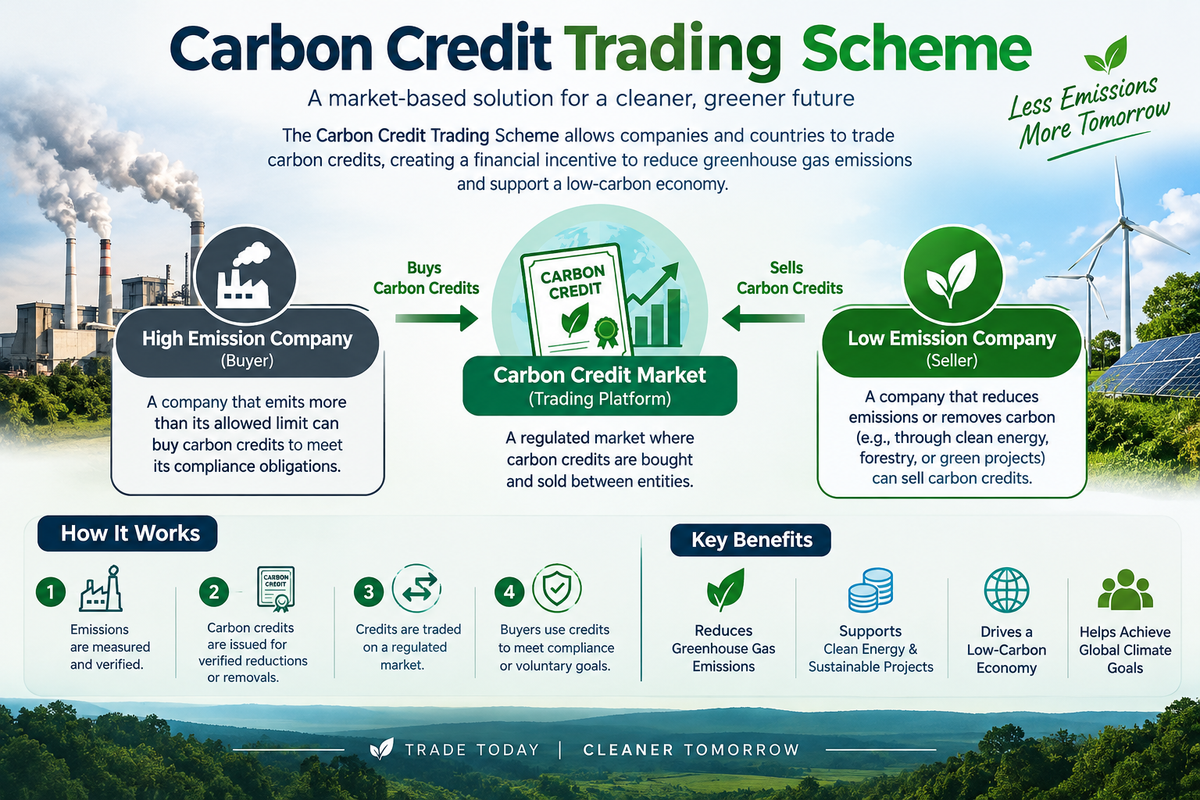
India’s Carbon Credit Trading Scheme (CCTS) is a government-run carbon market. Large industrial facilities that beat a greenhouse gas (GHG) emissions-intensity target earn tradable certificates, and those that miss it must buy certificates to cover the gap. Eligible projects outside those facilities can also earn certificates through a separate offset route.
This guide explains how the Carbon Credit Trading Scheme works, who it covers and how it differs from voluntary credits and CORSIA. Status information is stated as of 20 October 2026, and parts of the scheme are still being finalised.
What Is the Carbon Credit Trading Scheme in India?
The Carbon Credit Trading Scheme is India’s framework for pricing and trading greenhouse gas reductions through a regulated market. It gives industry a financial reason to cut emissions, in support of India’s climate commitments, including its 2070 net-zero target.
Legal and policy background
The Energy Conservation (Amendment) Act, 2022 added Section 14AA to the Energy Conservation Act, 2001, empowering the Central Government to specify a carbon credit trading scheme. The Ministry of Power notified the Carbon Credit Trading Scheme, 2023 on 28 June 2023 and amended it in December 2023 to add an offset mechanism.
Several bodies share the work. The Bureau of Energy Efficiency (BEE) administers the scheme and issues certificates. The Ministry of Environment, Forest and Climate Change (MoEFCC) notifies emissions-intensity targets. The Central Electricity Regulatory Commission (CERC) regulates trading on power exchanges.
What a carbon credit certificate represents
A carbon credit certificate (CCC) is a tradable instrument issued by BEE under this scheme and measured in tonnes of carbon dioxide equivalent (tCO₂e). It is not interchangeable with a voluntary credit issued by a private registry, or with a CORSIA-eligible emissions unit. Each sits under a different rulebook.
India’s domestic market is therefore separate from the voluntary carbon market and from ICAO’s aviation scheme, both covered below.
How Does the Carbon Credit Trading Scheme Work?
The steps below describe the compliance mechanism. The offset mechanism differs in its procedures, and details vary by sector, notified rules and approved methodology.
- Entity identification. The Ministry of Power, on BEE’s recommendation, determines target sectors and obligated entities.
- Target setting. MoEFCC notifies targets as emissions per unit of output (for example, tCO₂e per tonne of product) over a multi-year trajectory.
- Monitoring, reporting and verification (MRV). Entities track emissions and production, submit reports and have them verified by a BEE-accredited carbon verification agency.
- Assessment. BEE compares verified performance with the notified target.
- Issuance or shortfall. Entities that outperform the target receive certificates. Those that fall short must buy and surrender certificates.
- Trading. Certificates trade on CERC-regulated power exchanges. Banking of certificates is allowed, but borrowing is not.
Where implementation stands
Targets are notified for seven sectors: aluminium, cement, chlor-alkali, and pulp and paper (October 2025), then petroleum refining, petrochemicals and textiles (January 2026). Together they cover roughly 490 entities for compliance years 2025–26 and 2026–27, measured against a 2023–24 baseline.
Iron and steel and fertiliser targets were still pending in the sources reviewed, and a revised iron and steel draft was reported in June 2026. First certificate trading was expected around October 2026, so check CERC and power exchange notices for confirmed session dates.
An illustrative example
This is a hypothetical illustration, not a real transaction or an actual notified target. Suppose a cement plant has a target of 0.80 tCO₂e per tonne of product and produces 1,000,000 tonnes. If its verified intensity is 0.78, it has beaten the target by 0.02 tCO₂e per tonne, or 20,000 tCO₂e, and could be eligible for up to 20,000 certificates. If its intensity is 0.82, it faces a 20,000 tCO₂e shortfall to cover by purchasing and surrendering certificates. Real calculations follow BEE’s detailed procedures and sub-sector rules.
Compliance Mechanism vs Offset Mechanism in India’s Carbon Market
Compliance mechanism
The compliance mechanism is mandatory. Notified obligated entities, mostly energy-intensive facilities that were earlier covered by the Perform, Achieve and Trade (PAT) scheme, receive legally binding emissions-intensity targets.
BEE’s Detailed Procedure for Compliance Mechanism (version 1.0, July 2024) sets out the process. Because certificates and compliance outcomes depend on reported numbers, monitoring quality and independent verification sit at the centre of the system.
Offset mechanism
The offset mechanism is voluntary. It lets non-obligated entities and project developers earn certificates for projects that reduce or remove GHG emissions under BEE-approved methodologies.
A typical pathway involves:
- project registration and documentation
- a baseline assessment of what emissions would have been without the project
- a demonstration of additionality, where the methodology requires it (the reduction would not have happened without carbon revenue)
- validation and later verification by an accredited agency
- certificate issuance by BEE
BEE has released a first version of its Detailed Procedure for the Offset Mechanism and a list of accredited verification agencies. Eligibility depends on whether an approved methodology covers the activity. A sustainability project does not automatically generate tradable certificates.
Benefits, Challenges and Opportunities of Carbon Credit Trading in India
A well-designed carbon market can offer several advantages:
- a financial incentive for industrial emissions reductions
- support for investment in cleaner technologies
- better measurement and management of GHG emissions
- opportunities for qualifying emissions-reduction projects
The challenges are just as real. MRV adds cost, methodologies set strict boundaries on which projects qualify, and data quality affects every outcome. Market uncertainty is a factor too, since trading had not been confirmed as live at the time of writing, and implementation is complex. Misleading environmental claims are a further risk, because buying certificates does not by itself make a business carbon neutral.
Companies can match the pathway to their situation:
- Covered by a notified sector? The compliance market is the route, and planning starts with verified emissions data.
- Running an emissions-reduction project outside those sectors? Check whether an approved offset methodology fits before investing in documentation.
- Pursuing voluntary climate goals or international buyers? A voluntary carbon market pathway may suit better, with its own quality and claims considerations.
No outcome here is guaranteed, including financial returns, certificate prices, market liquidity or emissions reductions.
How Does India’s Carbon Credit Trading Scheme Relate to CORSIA Carbon Credits?
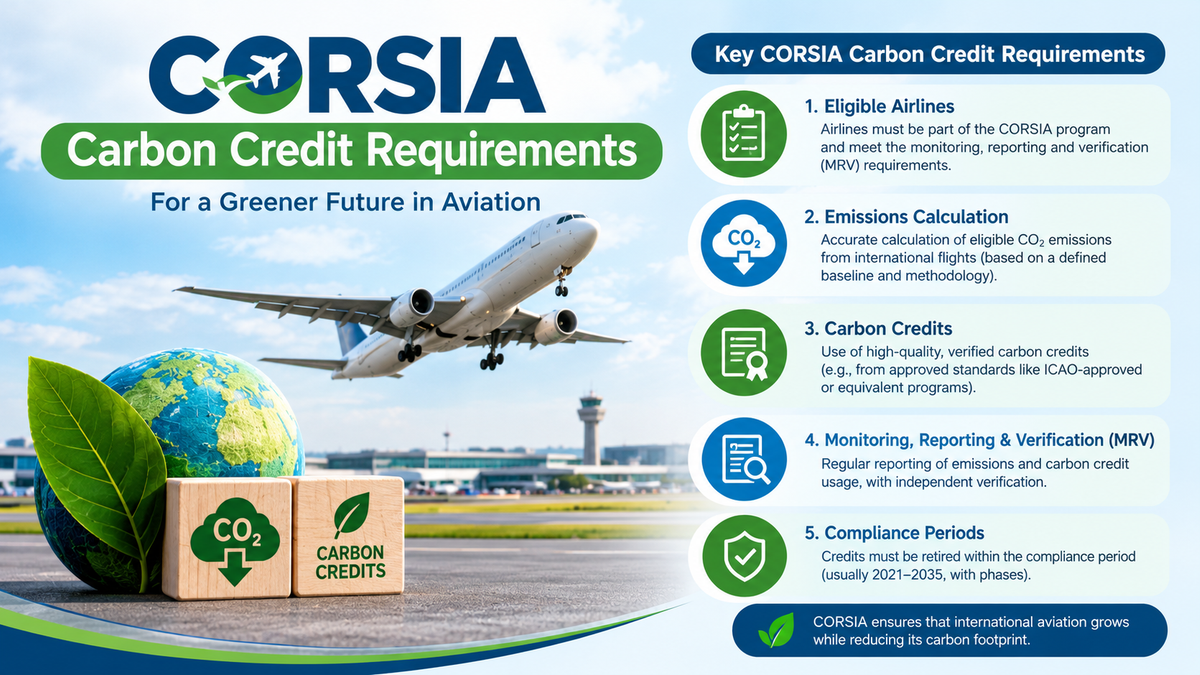
The Carbon Offsetting and Reduction Scheme for International Aviation (CORSIA) is an international scheme created by the International Civil Aviation Organization (ICAO). Airlines offset growth in international emissions above a baseline. Its first phase runs from 2024 to 2026, and a second phase is planned for 2027–2035.
India’s Carbon Credit Trading Scheme is a separate domestic system. A certificate issued under it is not automatically eligible for CORSIA. For the first phase, eligible units must come from an ICAO-approved programme, fall within the permitted vintage window (generally reductions between 1 January 2021 and 31 December 2026), and carry host-country authorisation with a corresponding adjustment. That adjustment ensures the same tonne is not counted twice. How the Indian scheme, Article 6 authorisation and CORSIA eligibility interact is still being worked out, so check ICAO’s current eligible emissions units document before any transaction.
How CORSIA Carbon Credit Can Help
CORSIA Carbon Credit is an independent marketplace and advisory desk operated by DSTechnoverse in Indore. It is not a regulator and is not affiliated with ICAO. Its CORSIA services cover emissions monitoring plans, annual reports and offsetting calculations for aircraft operators. They also cover sourcing eligible units, pre-purchase checks, and registry transfer and cancellation. For developers, the desk screens projects against ICAO-approved programmes and checks host-country authorisation.
Marketplace listings are indicative and subject to confirmation of availability, eligibility and registry status. Not every listed credit is CORSIA-eligible, and a purchase alone does not guarantee compliance. The eligible units checklist and the guide to corresponding adjustments explain the tests in more detail. You can also browse the carbon credit marketplace or contact the team to discuss your requirements.
Frequently Asked Questions
1. What is the Carbon Credit Trading Scheme in India? It is India’s regulated carbon market, notified in 2023 under the Energy Conservation Act. Obligated industrial entities receive emissions-intensity targets and earn or buy carbon credit certificates depending on performance. An offset route is available for eligible projects.
2. How does carbon credit trading work in India? Entities monitor and report emissions, and an accredited agency verifies the data. BEE then assesses performance against the target. Outperformers receive certificates, and shortfall entities must buy them. Certificates are to be traded on CERC-regulated power exchanges.
3. What is the difference between the compliance and offset mechanisms? The compliance mechanism is mandatory for notified entities with binding intensity targets. The offset mechanism is voluntary, and eligible projects earn certificates under BEE-approved methodologies.
4. Who can participate in India’s Carbon Credit Trading Scheme? Entities in notified sectors are obligated participants, and BEE designates them under the notified rules. Others can take part through the offset mechanism only if their project fits an approved methodology and procedure. Not every business or project qualifies.
5. Are Indian carbon credit certificates automatically eligible for CORSIA? No. CORSIA eligibility depends on ICAO-approved programmes, eligible vintages and host-country authorisation with a corresponding adjustment. A domestic certificate does not meet these conditions by default.