 DSTechnoverse company
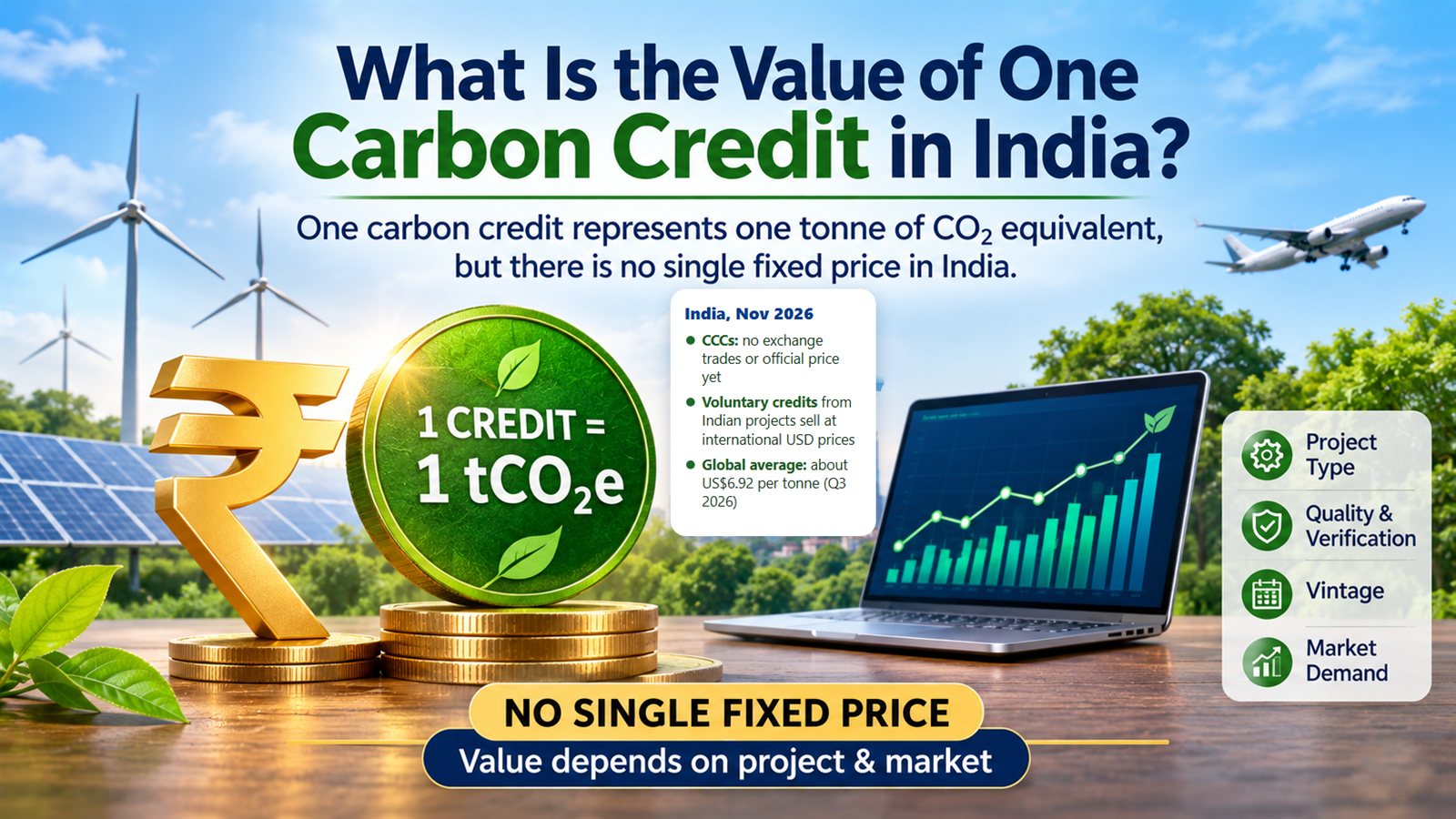
What is the value of one carbon credit in India? There is no single price. As of 24 November 2026:
- Indian Carbon Credit Certificates (CCCs), India's domestic credits under the Carbon Credit Trading Scheme (CCTS), had no exchange trades and no official price.
- Voluntary carbon credits from Indian projects, issued under programmes such as Verra or Gold Standard, sell at international prices in US dollars. The average voluntary credit retired worldwide sold for about US$6.92 per tonne in Q3 2026 (Sylvera), but Indian credits vary widely by project type and quality.
- CORSIA-eligible units were assessed at about US$13.00 per tonne on 18 November 2026 (Fastmarkets). Few Indian credits currently qualify.
Each credit generally represents one tonne of CO₂ equivalent (tCO₂e). For more background, see our CORSIA Carbon Credits resources.
This guide explains why prices differ, how India's domestic market works, what 1 to 1,000 credits could be worth, and where to check reliable prices.
Introduction to Carbon Credit Value in India
A carbon credit represents one metric tonne of CO₂e reduced or removed, under the rules of the programme that issues it.
Credits have monetary value because buyers need or want them:
- companies with climate targets
- airlines under CORSIA
- industries with compliance targets, such as obligated entities under India's CCTS
Carbon credits support emissions reduction by paying projects that cut or remove emissions, such as renewable energy, methane capture or improved cookstoves.
Indian businesses are increasingly interested because:
- India's domestic carbon market is being set up
- international buyers, such as European importers facing the EU's carbon border tax, are asking suppliers about emissions
- Indian projects have long supplied the international voluntary market
But prices differ across markets and credit types. A domestic CCC, a voluntary credit and a CORSIA unit are different products with different buyers.
What Is the Value of One Carbon Credit in India?
Indian Carbon Credit Certificates (CCCs)
- No CCC had traded on an Indian power exchange as of mid-November 2026, according to market reports.
- As of early October 2026, the Central Electricity Regulatory Commission (CERC) had not published a floor or ceiling price for CCC trading.
- A November 2026 report quoted the Bureau of Energy Efficiency (BEE) as saying trading would begin for most sectors by the end of 2027.
So there is no official CCC price yet. Some analysts have published projections ranging from a few hundred rupees to about ₹1,500 per tonne. These are estimates, not trade prices, and they vary widely.
Voluntary carbon credits from Indian projects
These trade internationally, usually in US dollars, through brokers, marketplaces and direct deals. Their value depends on project type and quality. Dated reference points include:
- all voluntary credits: about US$6.92 per tonne in Q3 2026 (Sylvera)
- renewable energy credits, common in India: about US$2.67 per tonne on average in 2024 (Ecosystem Marketplace)
- household devices including cookstoves: about US$7.30 in 2024 (Ecosystem Marketplace)
Types of price figures
- Exchange-traded price: a price from a regulated exchange, such as CCCs will have once trading starts.
- Indicative quote: what a broker or seller says they might accept, which is not a deal.
- Actual transaction price: what a buyer actually paid, often private.
Demand and supply set the price in each market. For CCCs, demand will come from obligated industries that miss their targets. Supply will come from those that beat them and from offset projects.
Understanding Carbon Credits in India
How credits are generated
- A project reduces or removes emissions, for example by replacing coal power or capturing methane.
- It follows an approved methodology that sets the baseline and calculations.
- Emissions reductions are measured against the baseline, using meters, sampling or surveys.
- An accredited body verifies the results.
- The programme issues credits into a registry.
Why credits have different values
Credits differ in project type, quality, vintage, programme and eligibility. A recent, high-quality methane credit with strong monitoring is a different product from an old renewable energy credit.
Registries and market mechanisms
- CCCs are held in the Grid Controller of India (Grid-India) registry and will trade on power exchanges.
- Voluntary credits are held in programme registries, such as Verra's or Gold Standard's.
India's Carbon Credit Trading Scheme (CCTS)
The CCTS, notified in June 2023 under the Energy Conservation Act, creates the Indian Carbon Market (ICM):
- Ministry of Power: the lead ministry.
- Bureau of Energy Efficiency (BEE): the scheme administrator.
- Central Electricity Regulatory Commission (CERC): regulates CCC trading. Its trading regulations were notified on 27 February 2026.
- Grid-India: the registry.
- Ministry of Environment, Forest and Climate Change: sets overall climate policy and oversees international authorisations under Article 6.
Compliance mechanism
Obligated entities in notified energy-intensive sectors receive greenhouse gas emissions intensity targets. The target rules for the first sectors were notified on 8 October 2025.
- Entities that beat their targets earn CCCs.
- Entities that miss their targets must buy and surrender CCCs.
Offset mechanism
Non-obligated entities can register eligible projects using BEE-approved methodologies, such as grid-connected renewable energy, green hydrogen, landfill methane recovery or mangrove afforestation, and earn CCCs. BEE approved an initial set of eight methodologies in March 2025.
Carbon Credit Certificates
One CCC equals one tCO₂e. CCCs are not Renewable Energy Certificates, which represent renewable electricity, and not Energy Saving Certificates, which represent energy saved under the older PAT scheme.
Trading and market development
CCCs will trade on CERC-approved power exchanges, such as the Indian Energy Exchange (IEX), Power Exchange India Limited (PXIL) and Hindustan Power Exchange. The ICM portal launched in March 2026. Our guide to carbon market policy in India explains the scheme's design and timeline.
How Is the Price of One Carbon Credit Determined in India?
- Supply and demand: how many CCCs are issued compared with how many obligated entities need.
- Market trading activity: prices are only meaningful once there is liquid trading.
- Project type and methodology: for voluntary credits, removals and newer technologies usually earn more than old renewables.
- Quality and integrity: ratings and verification strength.
- Verification and issuance costs: sellers need prices above their costs.
- Regulatory requirements: CERC price bands and CCTS rules.
- Buyer preferences: for example, CORSIA eligibility or co-benefits.
- Vintage and delivery conditions: newer vintages and spot delivery are usually preferred.
- Domestic and international developments: such as the EU's carbon border tax and CORSIA's second phase.
These factors explain why two credits representing one tonne each can have very different prices.
Different Types of Carbon Credits and Their Values
1. Indian Carbon Credit Certificates (CCCs)
Domestic compliance and offset units under the CCTS. No official price yet (November 2026). Their price will be set on power exchanges, within any CERC price band.
2. Voluntary Carbon Credits
Issued under independent standards, such as Verra's Verified Carbon Standard, Gold Standard or the Global Carbon Council, and bought for voluntary climate commitments. They are priced internationally in US dollars, typically from a few dollars to well over US$20 per tonne, depending on type.
3. International Compliance Carbon Credits
Credits accepted under other countries' compliance schemes, such as eligible international credits under Singapore's carbon tax, or Article 6 transfers between governments. They need host-country authorisation and meet specific rules.
4. CORSIA-Eligible Emissions Units
Units approved for airline offsetting under ICAO rules. They must come from approved programmes and, for the first phase, have host-country authorisation with a corresponding adjustment. Assessed at about US$13.00 on 18 November 2026.
These instruments are not interchangeable and do not have the same value. Our guide to CORSIA carbon credits trading in India explains why few Indian credits currently qualify for CORSIA.
How Much Are 10, 100, 500 and 1,000 Carbon Credits Worth in India?
Total gross value = Number of carbon credits × Price per credit
Illustrative only. ₹600 per credit is an assumed price, not a market price or quote, because no official CCC price exists yet.
- 1 credit: 1 × ₹600 = ₹600
- 10 credits: 10 × ₹600 = ₹6,000
- 100 credits: 100 × ₹600 = ₹60,000
- 500 credits: 500 × ₹600 = ₹3,00,000
- 1,000 credits: 1,000 × ₹600 = ₹6,00,000
For voluntary credits, the same formula applies in US dollars. For example, 1,000 credits at an assumed US$5 would be worth US$5,000 gross.
What a seller actually receives
The amount received may be lower because of:
- brokerage charges
- verification expenses, paid for each monitoring period
- registry fees, for accounts, issuance and transfers
- exchange transaction costs
- taxes, where applicable, so take professional advice
- revenue-sharing arrangements, for example with farmers or landowners in aggregated projects
Hypothetical example: a project sells 1,000 credits at ₹600, for gross revenue of ₹6,00,000. It pays an assumed ₹30,000 in brokerage and ₹1,00,000 in verification and registry costs. That leaves ₹4,70,000 before tax and any revenue sharing.
Historical Carbon Credit Price Trends in India
- Kyoto era (2005–2012): India was one of the largest hosts of Clean Development Mechanism projects. Indian CERs traded at international prices, which collapsed from about US$20 before the 2008 financial crisis to below €1 in late 2012.
- Voluntary market: many Indian projects moved to voluntary programmes. Prices followed global averages, which were about US$2.51 in 2020 and US$7.37 in 2022, the record (Ecosystem Marketplace).
- PAT scheme (from 2012): the Perform, Achieve and Trade scheme set energy-efficiency targets for industry. Energy Saving Certificates (ESCerts), each representing one tonne of oil equivalent saved, began trading on the Indian Energy Exchange on 26 September 2017. ESCert prices are not CCC prices, because they measure energy, not CO₂.
- CCTS (from 2023): notified in June 2023, with the offset mechanism added in December 2023. The scheme is replacing PAT for covered sectors.
- 2025–2026: target rules, methodologies, CERC trading regulations and the ICM portal arrived, but CCC trading has not yet started.
How Does India's Carbon Credit Price Compare with International Markets?
| Instrument | Latest price | Date | Currency | Market type |
|---|---|---|---|---|
| Indian CCCs | No official price | Nov 2026 | INR | Domestic compliance and offsets, power exchanges |
| Voluntary credits (global average) | 6.92 | Q3 2026 | US$ | Voluntary, mostly over the counter |
| CORSIA Phase 1 units | 13.00 | 18 Nov 2026 | US$ | International aviation compliance |
| Australian ACCUs | 37.95 | 20 Nov 2026 | A$ | Australian compliance and voluntary |
| EU ETS allowances | about 90 | mid-Nov 2026 | € | EU cap-and-trade allowances |
Sources: market reports, Sylvera, Fastmarkets, CORE Markets, GMK Center.
Key differences:
- Market structure: CCCs will trade on regulated Indian exchanges. Voluntary credits trade mostly over the counter.
- Regulatory framework: CCCs are regulated by BEE and CERC. ACCUs by Australia's Clean Energy Regulator. EU allowances by the EU. Voluntary credits by independent programmes.
- Eligibility: each scheme has its own rules. A CCC cannot be used for CORSIA or in the EU ETS.
- Currency: INR, US$, A$ and €.
- Credit quality and demand: compliance demand tends to support higher prices than voluntary demand.
These are not identical products, so their prices should not be compared directly. Our guide on how much a carbon credit is worth in Australia shows how another national compliance market works.
Can Individuals and Businesses Earn Money from Carbon Credits in India?
Yes, through eligible projects:
- Renewable energy: mainly where linked to storage or other activities eligible under current rules.
- Methane reduction: for example, biogas or landfill gas.
- Waste management: composting and waste-to-energy.
- Agricultural practices: such as improved rice cultivation or fertiliser management, usually through aggregators.
- Forestry and land use: such as mangrove afforestation, where eligible.
The process involves:
- project registration, under the CCTS offset mechanism or an international programme
- monitoring under an approved methodology
- independent verification
- credit issuance
- selling to buyers, through exchanges, brokers or direct deals
Ordinary environmental activities do not automatically create tradable carbon credits. Projects must meet programme and methodology requirements, and income is not guaranteed.
Where Can You Check Carbon Credit Prices in India?
- Bureau of Energy Efficiency: official ICM announcements and registry information.
- Central Electricity Regulatory Commission: trading regulations and any price bands.
- Ministry of Power: policy notifications.
- Indian Carbon Market portal: official scheme information.
- Power exchanges such as IEX, PXIL and HPX: CCC trading prices once trading begins.
- Carbon market data providers: such as Sylvera and Ecosystem Marketplace for voluntary prices, and Fastmarkets or S&P Global for CORSIA units.
Official regulatory announcements set the rules. Exchange prices show what CCCs actually trade at. Indicative quotes are offers, not deals. Completed transactions are what was paid. Our carbon credit price now guide tracks dated international prices.
Future of Carbon Credit Value in India
Confirmed developments:
- CCTS target rules, methodologies, CERC regulations and the ICM portal are in place.
- Indian airlines face CORSIA offsetting requirements from 2027.
- India has an Article 6.2 activity list for international transfers.
Possible influences, not forecasts:
- start of CCC trading, which will create India's first official carbon price
- more sectors and offset projects joining the CCTS
- industrial decarbonisation and exporters' needs under the EU carbon border tax
- corporate climate commitments
- international participation, through Article 6 and CORSIA
- market transparency as exchange data becomes available
- regulatory changes, such as price bands and target tightening
Prices could rise or fall once trading begins. No price or return is guaranteed.
Frequently Asked Questions
What is the value of one carbon credit in India?
It depends on the type. India's domestic CCCs had no official price as of November 2026 because trading had not started. Voluntary credits from Indian projects sell at international prices, averaging about US$6.92 per tonne globally in Q3 2026.
How much does one tonne of carbon credit cost in India?
One credit generally equals one tonne of CO₂e. For voluntary credits, prices range from a few US dollars to well over US$20 depending on type. No official CCC price exists yet.
What is the current carbon credit price in India?
As of November 2026, there is no official exchange price for CCCs. Analyst projections vary widely and are not trade prices.
Who determines carbon credit prices in India?
For CCCs, trading on CERC-approved power exchanges will set prices, within any price band CERC sets. For voluntary credits, buyers and sellers negotiate prices internationally.
Are all carbon credits worth the same amount?
No. CCCs, voluntary credits, CORSIA units and other compliance units differ in rules, buyers and quality, and so in price.
How can I buy carbon credits in India?
CCCs will be available on power exchanges once trading starts, mainly for obligated entities. Voluntary credits can be bought through brokers, marketplaces or project developers.
Can individuals sell carbon credits in India?
Individuals can only sell credits they own from registered projects. Farmers and landowners usually take part through aggregators, who handle registration, verification and sales.
What is the difference between CCCs and voluntary carbon credits?
CCCs are domestic certificates under India's CCTS, regulated by BEE and CERC. Voluntary credits are issued by independent programmes such as Verra and sold internationally for voluntary claims.
Where can I check Indian carbon credit market prices?
Check BEE, CERC and the Indian Carbon Market portal for official information, power exchanges for CCC prices once trading begins, and data providers for voluntary and CORSIA prices.
Can Indian carbon credits be sold in international markets?
Voluntary credits from Indian projects already are. Credits for international compliance, such as CORSIA, need Indian government authorisation with a corresponding adjustment. CCCs are domestic instruments.
Conclusion
So, what is the value of one carbon credit in India? In November 2026, India's domestic CCCs have no official price yet, because exchange trading has not begun. Voluntary credits from Indian projects sell at international US dollar prices, and CORSIA-eligible units are priced higher but are scarce.
Value depends on the instrument, project type, quality, vintage, eligibility and market. Use dated, official and clearly labelled data, and treat projections and quotes with caution.
Our guide to CORSIA carbon credits insurance explains how buyers manage risks in the aviation market. To learn more about CORSIA carbon credits and carbon markets, explore the resources at CORSIA Carbon Credit.
Sources
- Bureau of Energy Efficiency – Indian Carbon Market
- Bureau of Energy Efficiency – Approved methodologies under the offset mechanism
- Central Electricity Regulatory Commission
- Ministry of Power, Government of India
- Saur Energy – India's carbon market edges toward its first trade (2026)
- Reclimatize – How CCC trading works on exchanges (October 2026)
- Sylvera – Carbon Market Data Snapshot Q3 2026
- Ecosystem Marketplace – State of the Voluntary Carbon Market reports
- Fastmarkets – CORSIA prices (November 2026)
- CORE Markets – Australian market prices
- GMK Center – European carbon prices exceeded €90/t in November (2026)
- Business Standard / PTI – Trading in ESCerts on IEX to start (25 September 2017)
- World Bank – Carbon Pricing Dashboard
- UNFCCC – Article 6 of the Paris Agreement
- ICAO – CORSIA Eligible Emissions Units