 DSTechnoverse company

What is CORSIA carbon credits insurance? It is insurance that protects carbon market participants against specified risks in CORSIA-related carbon credit projects and transactions. The best-known product covers the risk that a host country fails to apply a promised corresponding adjustment. If that happens, the policy provides a replacement unit, or money to buy one.
Under CORSIA's first-phase rules, programmes must deal with this risk, and some programmes, including Gold Standard and the Climate Action Reserve, accept approved insurance as one way to do so. However:
- Insurance is not a general ICAO requirement for every CORSIA unit.
- Insurance cannot make an ineligible credit eligible.
For more background, see our CORSIA Carbon Credits resources.
Introduction to CORSIA Carbon Credits Insurance
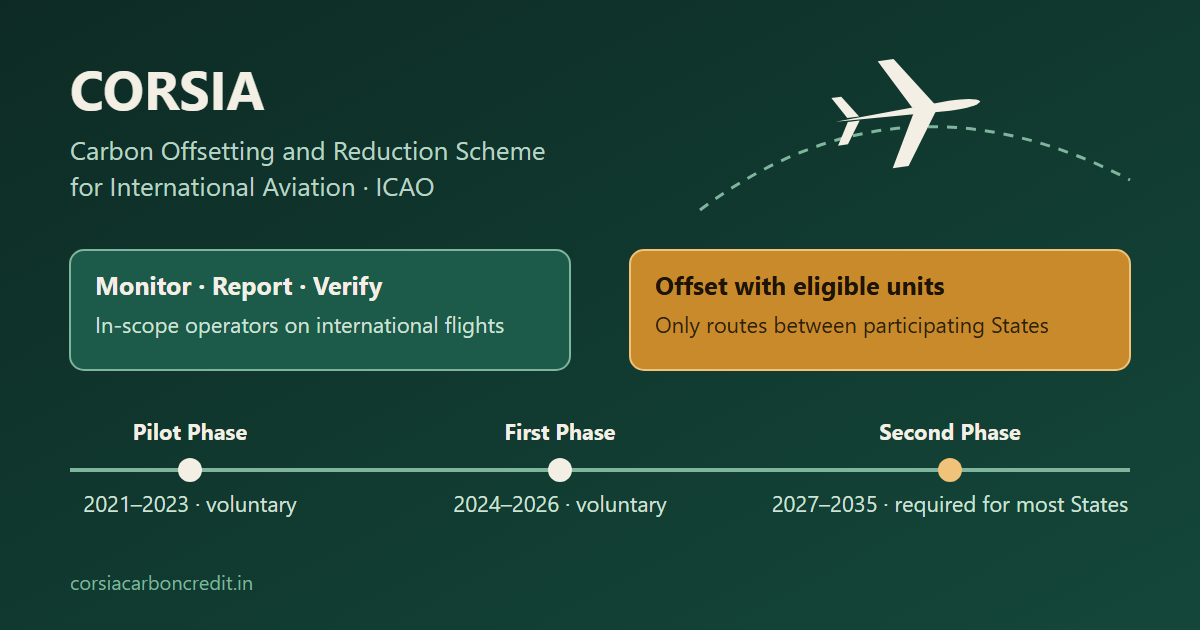
CORSIA, the Carbon Offsetting and Reduction Scheme for International Aviation, is ICAO's global market-based measure for international aviation. Airlines with offsetting requirements must cancel eligible emissions units. That makes carbon credits a compliance tool for aviation, not just a voluntary choice.
Compliance raises the stakes. If an airline cancels a unit that later proves ineligible or double-counted, it may not meet its obligation. Buyers, sellers and project developers therefore need risk management.
Carbon credit insurance is one part of that toolkit. It transfers specified financial risks to an insurer in exchange for a premium.
Insurance is a risk-management tool, not a CORSIA eligibility requirement in itself, unless a specific programme rule, contract or regulation requires it for a particular unit or transaction. The most important example is the corresponding adjustment rule explained below.
What Is Carbon Credit Insurance?
Carbon credit insurance is a policy that pays out, or provides replacement credits, when a defined event affects carbon credits or a carbon project, subject to its terms, limits and exclusions.
It helps participants because carbon projects and transactions carry:
- financial risks, such as paying in advance for credits that are never delivered
- operational risks, such as project underperformance or fire
- regulatory and political risks, such as a government not honouring an authorisation
Insurance is often confused with other protections:
- Insurance: a contract with a third-party insurer that pays for covered losses.
- Contractual warranties: promises by a seller, such as "these credits are eligible", which give a claim against the seller if untrue.
- Guarantees: a third party, such as a bank or parent company, promises to pay if the seller does not.
- Buffer mechanisms: credits set aside by a programme to cover reversals across many projects.
Insurance can improve confidence by putting a financially strong insurer behind the risk, especially where the seller alone could not cover a large loss.
Why Do CORSIA Carbon Credit Transactions Need Risk Management?
- Eligibility uncertainty: credits must meet programme, vintage and unit-level rules for the specific compliance period.
- Verification risks: verification may find fewer reductions than expected.
- Delivery delays: forward deals depend on future issuance.
- Registry and ownership issues: the seller must actually hold the units, and labelling must be correct.
- Regulatory changes: programme or ICAO rules can be updated.
- Host-country authorisation: a Letter of Authorisation (LoA) is needed for first-phase units.
- Corresponding adjustment risk: the host country might not apply the adjustment it promised.
- Project underperformance: fewer credits than contracted.
- Invalidation or reversal: credits may be cancelled for errors or fraud, or stored carbon released.
Due diligence is essential before buying for CORSIA compliance, because insurance only covers what the policy says.
Types of Insurance Relevant to Carbon Credit Projects
Availability and terms vary by insurer, jurisdiction and transaction. Not every category below is a standard or widely available CORSIA-specific product.
1. Carbon Credit Invalidation Insurance
This covers specified circumstances in which credits become invalid or unusable. For CORSIA, the most established version is corresponding adjustment insurance, which pays out if a host country does not apply the adjustment it authorised.
Some insurers also offer cover for invalidation caused by fraud, negligence or errors in project data, depending on policy wording.
2. Carbon Project Performance Insurance
This may cover specified delivery risks, such as a project producing fewer credits than contracted because of a defined event. It is often linked to offtake agreements and project finance.
3. Environmental Liability Insurance
This is traditional cover that may protect a project against third-party claims for environmental damage, such as pollution from a waste facility. It protects the project, not the credits themselves.
4. Professional Indemnity Insurance
This covers consultants, validators, verifiers and other service providers against claims of professional negligence, such as an error in a validation report.
5. Business Interruption Insurance
This may cover lost income when a covered event, such as fire or flood, halts project operations, subject to the policy.
6. Political Risk Insurance
This covers losses caused by government action, such as expropriation, breach of contract or failure to honour commitments. It is directly relevant to CORSIA, because host-country authorisation is a government act. Providers include the World Bank Group's Multilateral Investment Guarantee Agency (MIGA) and private political risk insurers.
7. Transaction and Contractual Risk Protection
Insurance usually works alongside:
- warranties and indemnities in sales contracts
- escrow, where payment is held until delivery
- delivery guarantees and replacement obligations, where the seller must replace undelivered or invalid units
How Does Insurance Relate to CORSIA's Corresponding Adjustment Rules?
For CORSIA's first phase (2024–2026), units must be backed by host-country authorisation, with the host country committing to a corresponding adjustment under Article 6 of the Paris Agreement. Programmes must have measures in place in case the adjustment is not applied.
According to industry guidance:
- Insurance mechanisms can provide replacement eligible units, or funds to buy them, if the host country does not apply the adjustment.
- If a programme finds that the adjustment was not applied, it can issue a demand notice, and the developer must replace or compensate for the double-counted unit, supported by the policy.
- Insurance requirements may not apply where the host country has already confirmed the adjustment in its official Paris Agreement reporting.
- Once units are labelled CORSIA eligible in a registry, that label generally is not changed, even if an adjustment later fails. That is why compensation arrangements matter.
Approved insurance providers (as published by programmes):
- Gold Standard has approved CORSIA insurance policies from MIGA, Artio MGA Services, CFC Underwriting and Oka. In July 2026, it added Blenheim, its first traditional political risk insurer. Gold Standard appointed broker Howden to assess products against its criteria.
- The Climate Action Reserve published Criteria for Approved Insurance Mechanisms under CORSIA in August 2026. They require, for example, that a policy specifies a compensation trigger date and can respond when a host country does not apply the required adjustment.
Each programme sets its own rules. Check the programme's current requirements and approved lists before relying on a policy.
What Risks Can Carbon Credit Insurance Cover?
Depending on the policy, potential covered risks include:
- Corresponding adjustment failure by a host country
- Specified project failure, such as a defined catastrophic event
- Certain delivery failures under forward contracts
- Defined invalidation events, such as cancellation for specified errors or fraud
- Environmental liability claims against a project
- Professional negligence by service providers
- Covered political risks, such as breach of contract or expropriation
- Certain business interruption events
Coverage always depends on the actual policy wording, including:
- exclusions
- limits, the maximum the policy will pay
- deductibles, the part of the loss the insured bears
- insured events, exactly what triggers a claim
Example (hypothetical): a trader sells 100,000 first-phase CORSIA units from a project in Country X, which issued an LoA. The developer bought corresponding adjustment insurance. Country X later fails to apply the adjustment in its reporting. The programme issues a demand notice, and the insurer funds 100,000 replacement units, up to the policy limit. Without insurance, the developer would have to find and pay for replacements itself.
What Risks May Not Be Covered by Carbon Credit Insurance?
Risks that policies often exclude, depending on terms, include:
- General market price fluctuations, such as CORSIA prices falling after purchase
- Normal investment losses
- Unspecified regulatory changes
- Known or undisclosed project defects
- Fraud or intentional misconduct by the insured, where excluded
- Credits that were never eligible under the relevant scheme
- Failure to meet CORSIA requirements that the policy does not cover
- Unauthorised or improperly documented transactions
These are not universal exclusions. Insurers decide coverage through individual policy terms, so read the policy carefully.
How Does Carbon Credit Insurance Work?
- Identify the project or transaction to be insured.
- Assess project and credit risks, such as authorisation, delivery and reversal.
- Carry out technical and legal due diligence.
- Identify insurable risks.
- Approach an appropriate insurer, often through a specialist broker.
- Review policy conditions and exclusions.
- Agree coverage limits and premiums.
- Finalise the policy documents.
- Monitor the project or transaction, and report material changes to the insurer.
- Follow the insurer's claims procedure if a covered event occurs.
Insurance can apply at different levels:
- A carbon project: covering the project's operations or delivery.
- A credit portfolio: covering a holder's credits from several projects.
- A specific transaction: covering one sale or offtake agreement.
Is Insurance Mandatory for CORSIA Carbon Credits?
No, not as a general ICAO condition. ICAO sets eligibility through:
- Approved emissions unit programmes, chosen by the ICAO Council
- Unit-level conditions for each compliance period, such as vintage and scope
- Host-country authorisation and corresponding adjustments for first-phase units
The ICAO rules require programmes to address the risk that a corresponding adjustment is not applied. Some programmes accept approved insurance as one way to meet that requirement for units whose adjustment is not yet confirmed. In those cases, insurance can be required in practice for a unit to be labelled.
Two points are clear:
- Commercial insurance and CORSIA eligibility are different things. A delivery or performance policy does not affect eligibility.
- Insurance cannot make an otherwise ineligible credit CORSIA eligible. A credit with the wrong vintage or an unapproved methodology stays ineligible, insured or not.
Always check ICAO's latest CORSIA Eligible Emissions Units document and the programme's current rules. Our guide to CORSIA eligible carbon credits explains the eligibility checks.
Carbon Credit Insurance for Buyers and Sellers
For buyers
- Eligibility due diligence: confirm the programme, vintage, label and LoA.
- Delivery risk assessment: especially for forward deals.
- Registry ownership checks: confirm the seller holds the units.
- Contractual protection: warranties, replacement obligations and escrow.
- Insurance options: ask whether units carry approved corresponding adjustment cover, and who the insured party is.
For sellers
- Delivery risk: whether the project can produce the contracted volume.
- Liability exposure: environmental and third-party claims.
- Contractual obligations: replacement duties if units fail.
- Professional service protection: for consultants and verifiers working on the project.
- Risk allocation: agreeing with buyers who bears which risk, and who pays for insurance.
Both parties should review insurance coverage alongside the sales contract, because gaps between the two leave risk uncovered. Our guide to CORSIA carbon credits trading in India explains the authorisation steps that make these risks especially relevant for Indian suppliers.
How Much Does Carbon Credit Insurance Cost?
There is no standard premium rate. We have not found reliable public premium figures to quote. Premiums depend on:
- project size and credit volume
- project location, including host-country political risk
- project methodology
- project maturity and historical performance
- the insured risks
- coverage limits and deductibles
- policy duration
- the insurer's risk assessment
For example, cover for a country with a clear, tested authorisation process is likely to be priced differently from cover for a country with no track record. Buyers should factor premiums into the total cost of CORSIA units.
How to Choose the Right Carbon Credit Insurance Provider
Check:
- Credentials: the insurer should be licensed and regulated in the relevant jurisdiction. In India, insurance is regulated by the Insurance Regulatory and Development Authority of India (IRDAI).
- Underwriting experience in carbon or political risk.
- Policy coverage and exclusions.
- Claims process: how claims are made and paid.
- Financial strength: ratings and capacity to pay large claims.
- Jurisdiction and governing law.
- Carbon market expertise.
- Contractual compatibility with your sales agreement.
- Programme approval: whether the policy appears on the relevant programme's approved list, if CORSIA labelling depends on it.
Different market roles:
- Insurer: takes on risk and pays covered claims.
- Carbon credit supplier: sells the credits.
- Broker: arranges insurance or credit deals for clients.
- Registry: records credits and their status.
Our guide to registry management for CORSIA eligible credits explains the registry's role.
Carbon Credit Insurance vs Carbon Credit Buffer Mechanisms
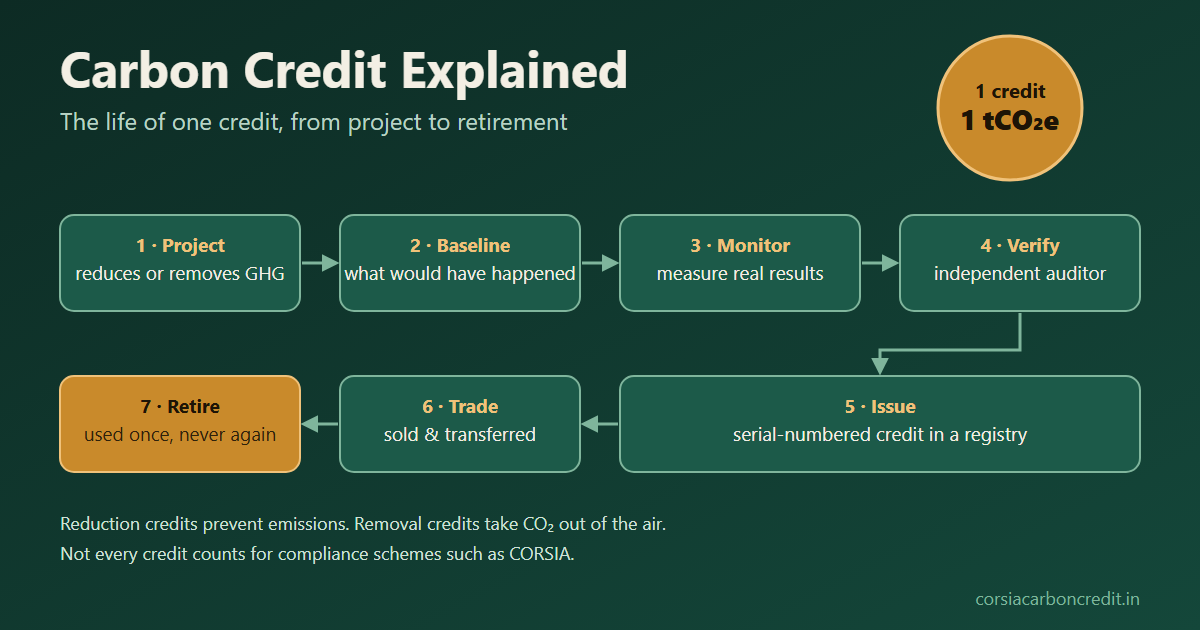
A buffer pool is a reserve of credits that a programme holds back from projects. For example, forestry projects contribute a share of their credits based on their reversal risk. If carbon is lost through fire or logging, the programme cancels buffer credits to compensate.
| Buffer pool | Insurance | |
|---|---|---|
| Who provides it | The crediting programme, using credits from many projects | A third-party insurer |
| What it covers | Mainly reversals of stored carbon | Risks defined in the policy, such as corresponding adjustment failure or delivery |
| How it pays | Cancels buffer credits | Pays money or provides replacement credits |
| Who it protects | The integrity of the programme's credits overall | The insured party |
A buffer contribution is not an insurance policy. Programme rules decide which safeguards apply. Some projects have both. Our guide to how carbon credits are created explains where buffer contributions fit in the issuance process.
Future of Carbon Credit Insurance in the CORSIA Market
Current developments:
- Programmes such as Gold Standard and the Climate Action Reserve have published insurance criteria or approved lists for CORSIA.
- Political risk insurers and specialist carbon insurers have entered the market.
- Supply of authorised units remains short of demand. IATA estimated first-phase demand at 200–250 million units against about 72 million authorised in August 2026.
Possible developments, not predictions:
- clearer rules for the second phase (2027–2035)
- more transparent underwriting and standard policy wording
- wider use of insurance in offtake and project finance
- more host countries confirming adjustments, which could reduce the need for corresponding adjustment insurance
Research groups have also published discussion papers on whether insurance can address reversal risk more broadly, which remains an open question.
Frequently Asked Questions
What is CORSIA carbon credits insurance?
Insurance that protects buyers, sellers or developers against specified risks in CORSIA-related credits, most notably the risk that a host country fails to apply a corresponding adjustment.
Is insurance mandatory for CORSIA carbon credits?
Not as a general ICAO requirement. But some programmes accept or require approved insurance for first-phase units whose corresponding adjustment is not yet confirmed.
Can carbon credits be insured against invalidation?
Yes, for specified events. Corresponding adjustment insurance is the main CORSIA example, and some policies cover invalidation from defined errors or fraud. Coverage depends on policy wording.
What does carbon credit insurance cover?
It depends on the policy. Possible cover includes corresponding adjustment failure, delivery shortfalls, defined invalidation events, political risks, environmental liability and professional negligence.
Does carbon credit insurance protect against price fluctuations?
Generally no. Market price movements and normal investment losses are usually excluded. Buyers manage price risk through contracts and procurement strategy.
How much does carbon credit insurance cost?
There is no standard rate. Premiums depend on project location, methodology, volume, risks covered, limits, deductibles and the insurer's assessment.
Can carbon project developers purchase insurance?
Yes. Developers can buy corresponding adjustment, performance, political risk, environmental liability and business interruption cover, depending on availability in their market.
What is the difference between carbon credit insurance and buffer pools?
A buffer pool is credits held back by a programme to cover reversals across many projects. Insurance is a contract with a third-party insurer that pays for specified losses.
Can insurance make a carbon credit CORSIA-eligible?
No. Insurance cannot fix an unapproved programme, wrong vintage or ineligible methodology. It can only support compensation where a programme accepts it, such as for corresponding adjustment risk.
How can buyers protect themselves when purchasing CORSIA carbon credits?
Check ICAO's eligible units list, the CORSIA label, the Letter of Authorisation and registry records. Use strong contracts with replacement obligations, and confirm any approved insurance and who it protects.
Conclusion
Insurance has become an important part of the CORSIA market, mainly because of corresponding adjustment risk. Programmes such as Gold Standard and the Climate Action Reserve accept approved insurance as a way to compensate if a host country does not deliver the adjustment it promised. Other policies, such as political risk, performance and liability cover, help manage project and transaction risks.
But insurance is not a general ICAO requirement, cannot make an ineligible credit eligible, and usually does not cover price risk. It works best alongside thorough due diligence, clear contracts and correct registry records.
To learn more about CORSIA carbon credits and carbon markets, explore the resources at CORSIA Carbon Credit.
Sources
- ICAO – CORSIA Eligible Emissions Units
- ICAO TAB – programme change notification form (ISFL, 2024)
- Climate Action Reserve – Criteria for Approved Insurance Mechanisms under CORSIA (August 2026)
- Gold Standard – Article 6 and CORSIA labelling step-by-step guide
- Carbon Herald – Gold Standard adds first traditional political risk insurer to CORSIA-approved list (2026)
- Carbon Herald – Gold Standard adds CFC, Oka insurance policies for CORSIA compliance
- Abatable – How does CORSIA insurance work?
- Verra – The VCS under CORSIA
- Perspectives Climate Group – Can insurance successfully address reversal risk in carbon markets? (April 2026)
- Sylvera – Carbon credit insurance: what it is and when it makes sense
- MIGA – Multilateral Investment Guarantee Agency
- UNFCCC – Article 6 of the Paris Agreement
- IRDAI – Insurance Regulatory and Development Authority of India
- IATA / EuropaWire – ICAO joins alliance to address CORSIA supply shortfall (13 October 2026)