 DSTechnoverse company
Carbon credit explained in one sentence: a carbon credit is a certificate, issued by a carbon-crediting programme, that represents one metric tonne of carbon dioxide equivalent (1 tCO₂e) reduced or removed from the atmosphere by a specific, verified project, under that programme's rules. Companies, governments and airlines buy credits to finance those projects and to compensate for emissions they cannot yet cut. For how credits are used in aviation, see our CORSIA Carbon Credits resources.
Carbon credits have become part of climate action because cutting emissions everywhere at once is impossible. They put a price on avoided or removed tonnes and channel money to projects that deliver them. This guide explains carbon credits by following one credit through its whole life, from a project idea to its final retirement. For a shorter overview, see our explainer on what carbon credits are and how they work.
What Is a Carbon Credit?
A carbon credit is a tradable unit that proves a tonne of greenhouse gas was kept out of the atmosphere, or taken out of it.
- One credit generally equals 1 tCO₂e. CO₂e is a common unit that includes other greenhouse gases converted to CO₂ terms.
- Credits are generated by projects that reduce or remove emissions compared with what would otherwise have happened.
- They support climate action by turning those reductions into something that can be sold, giving projects a source of income.
Simple example: a town's landfill releases methane, a powerful greenhouse gas. A developer installs equipment to capture and burn that methane. The emissions avoided are measured and checked, and the project receives one credit for each tonne of CO₂e avoided. A company that cannot yet eliminate its business-travel emissions buys some of those credits and retires them. The landfill project earns money, and the methane stays out of the atmosphere.
We will follow one of that landfill's credits through the rest of this guide. We will call it Credit #001.
How Do Carbon Credits Work?
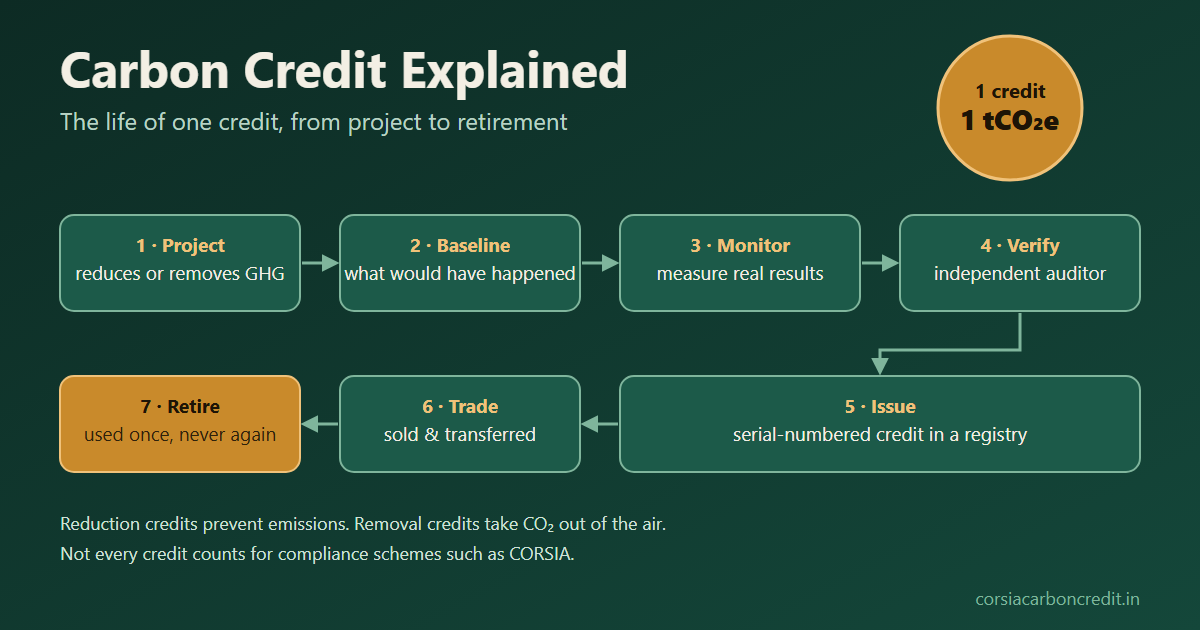
Credit #001's journey has eight steps:
- Project development. A developer designs the landfill gas project.
- Baseline. It establishes what would have happened without the project: methane venting into the air.
- Methodology. It follows an approved landfill gas methodology from a programme such as Verra or Gold Standard.
- Monitoring. Meters record how much methane is captured and destroyed.
- Validation and verification. An independent auditor checks the design first, then the measured results.
- Issuance. The programme issues credits into its registry. Credit #001 receives a unique serial number.
- Transfer or sale. The developer sells Credit #001 to a buyer, and it moves to the buyer's registry account.
- Retirement. The buyer retires Credit #001 against its own emissions. It can never be used again.
The participants in this journey are:
- Project developers, who create and run projects
- Validation and verification bodies (VVBs), the independent auditors
- Registries, which record each credit's serial number, owner and status
- Buyers and sellers, including companies, traders and airlines
- Brokers and platforms, which connect them
How Is a Carbon Credit Generated?
- Project planning and design: the developer chooses an activity and an approved methodology.
- Baseline emissions assessment: the developer estimates realistic without-project emissions, using historical data and reference scenarios.
- Additionality: the developer shows the project would not have happened without carbon finance.
- Monitoring: the developer measures actual performance with calibrated equipment and keeps records.
- Emission reduction calculation: baseline minus project emissions, minus leakage and other required deductions.
- Leakage and permanence: emissions that shift elsewhere are deducted, and for stored carbon, reversal risk is covered by buffer credits.
- Independent verification: an accredited auditor checks the numbers and evidence.
- Issuance and registry tracking: credits are issued with serial numbers and tracked until retirement.
Not every environmental activity qualifies. A project that would have happened anyway, has no applicable methodology, or cannot be measured reliably will not earn credits. Our guide to the carbon credit certification process explains each stage.
What Are the Different Types of Carbon Credits?
1. Avoidance or reduction credits
These prevent emissions that would otherwise happen:
- Renewable energy, such as wind or solar replacing fossil power
- Energy efficiency in factories, buildings or appliances
- Methane capture at landfills, farms or coal mines
- Improved cookstoves that burn less wood or charcoal
- Industrial emission reductions, such as destroying potent industrial gases
Credit #001 is a reduction credit.
2. Carbon removal credits
These take CO₂ out of the atmosphere and store it:
- Afforestation and reforestation, as trees absorb CO₂ while they grow
- Soil carbon, where farming practices store carbon in soil
- Biochar, plant material turned into stable carbon added to soil
- Direct air capture, where machines pull CO₂ from the air for storage underground
- Other recognised approaches, such as enhanced rock weathering
Reductions stop new emissions. Removals deal with CO₂ that is already in the air.
Nature-based and technology-based credits
- Nature-based credits come from forests, soils and wetlands. They are often cheaper and bring biodiversity benefits, but they carry reversal risk.
- Technology-based credits come from biochar, direct air capture and similar methods. They offer durable storage but at much higher cost.
What Is the Difference Between Carbon Credits and Carbon Offsets?
- A carbon credit is the unit: Credit #001 with its serial number.
- A carbon offset is the use: retiring Credit #001 to compensate for one tonne of the buyer's emissions.
Buying a credit is not the same as offsetting. Until it is retired, the credit can still be resold. Offsetting is also not the same as reducing your own emissions. Credible climate strategies cut their own emissions first and use credits only for what remains.
A third related term is the emissions allowance, which is a government-issued permit to emit under a cap. It is not a project-based credit. Credits, allowances and offsets are related, but they are not interchangeable in every context.
What Are Voluntary and Compliance Carbon Markets?
Voluntary carbon market
- Businesses and individuals buy credits by choice.
- They are used in corporate climate strategies and for offsetting claims.
- Credits are project-based, issued under independent standards such as Verra or Gold Standard and tracked in their registries.
Compliance carbon market
- These markets are created by law or regulation.
- Covered entities have mandatory obligations.
- Emissions trading systems, such as the EU ETS, mainly use allowances. Some systems accept limited eligible credits.
| Factor | Voluntary market | Compliance market |
|---|---|---|
| Why people buy | Voluntary climate goals | Legal obligations |
| Main unit | Project-based credits | Allowances, plus eligible credits in some systems |
| Who sets the rules | Programmes and buyers | Governments or international bodies |
| Eligibility | Buyer chooses within programme rules | Only units the scheme accepts |
Voluntary credits cannot automatically be used for regulatory compliance.
How Are Carbon Credits Bought and Sold?
- Developers generate credits and the programme issues them into a registry.
- Buyers identify suitable projects and credit types.
- Buyers check quality: methodology, vintage (the year of the reduction), verification reports and registry records.
- Buyers purchase directly from developers or through brokers, exchanges and marketplaces.
- The credits are transferred to the buyer's registry account, or retired on the buyer's behalf.
- The buyer retires or cancels them for a stated purpose.
Purchasing and retiring are different actions. A company that buys Credit #001 but never retires it has not offset anything.
How Much CO₂ Does One Carbon Credit Represent?
One credit generally represents one metric tonne of CO₂e. Other gases are converted using their global warming potential (GWP), which measures how much more warming a gas causes than CO₂ over a set period, usually 100 years.
Hypothetical example
Figures are illustrative. Suppose the landfill project captures and destroys 50 tonnes of methane in a year. Using a GWP of 28 for methane (the IPCC Fifth Assessment Report's 100-year value):
50 × 28 = 1,400 tCO₂e
After subtracting the project's own emissions and any required deductions, suppose the verified result is 1,300 tCO₂e. The programme could then issue up to 1,300 credits, one of which is Credit #001.
Not every estimated tonne becomes an issued credit. Results must be measured, verified and approved first, and some programmes take further deductions.
What Makes a Carbon Credit High Quality?
- Additionality: the project would not have happened without carbon finance.
- Accurate measurement: a realistic baseline and conservative calculations.
- Independent verification: checked by an accredited auditor.
- Permanence: stored carbon is protected against reversal.
- Leakage prevention: emissions do not simply move elsewhere.
- Transparency: project documents are public.
- Traceability and registry tracking: a unique serial number with a visible history.
- No double counting: the same tonne is not claimed twice.
Buyers should judge the underlying project, not only the price or the label. A cheap credit may be weak, and an expensive one is not guaranteed to be strong.
What Are the Benefits of Carbon Credits?
- They finance emission reduction projects that might not happen otherwise.
- They support renewable energy, especially in developing economies.
- They help protect forests and ecosystems by giving standing forests economic value.
- They encourage climate innovation, including new carbon removal technologies.
- They support sustainable development: clean cooking, health, jobs and community income.
- They help businesses address residual emissions after direct cuts.
- They create opportunities for project developers and carbon market professionals.
- They support carbon market growth, which in turn creates price signals for emissions.
These benefits depend on credit quality. Offsetting complements direct emission cuts. It does not replace them.
What Are the Challenges and Criticisms of Carbon Credits?
- Additionality concerns: some credited projects would have happened anyway.
- Over-crediting: inflated baselines have led to more credits than real reductions, notably in some forest projects.
- Permanence risks: fires or logging can release stored carbon.
- Greenwashing: companies may overstate what their credits achieve.
- Double counting: the same reduction can be claimed by a buyer and a country without proper safeguards.
- Inconsistent methodologies across programmes.
- Limited price transparency: many deals are private.
- Varying quality between projects with the same label.
Credible standards, transparent registries and independent verification are the main safeguards. Integrity benchmarks such as the Integrity Council for the Voluntary Carbon Market's Core Carbon Principles also aim to raise standards across the market.
What Is the Connection Between Carbon Credits and CORSIA?
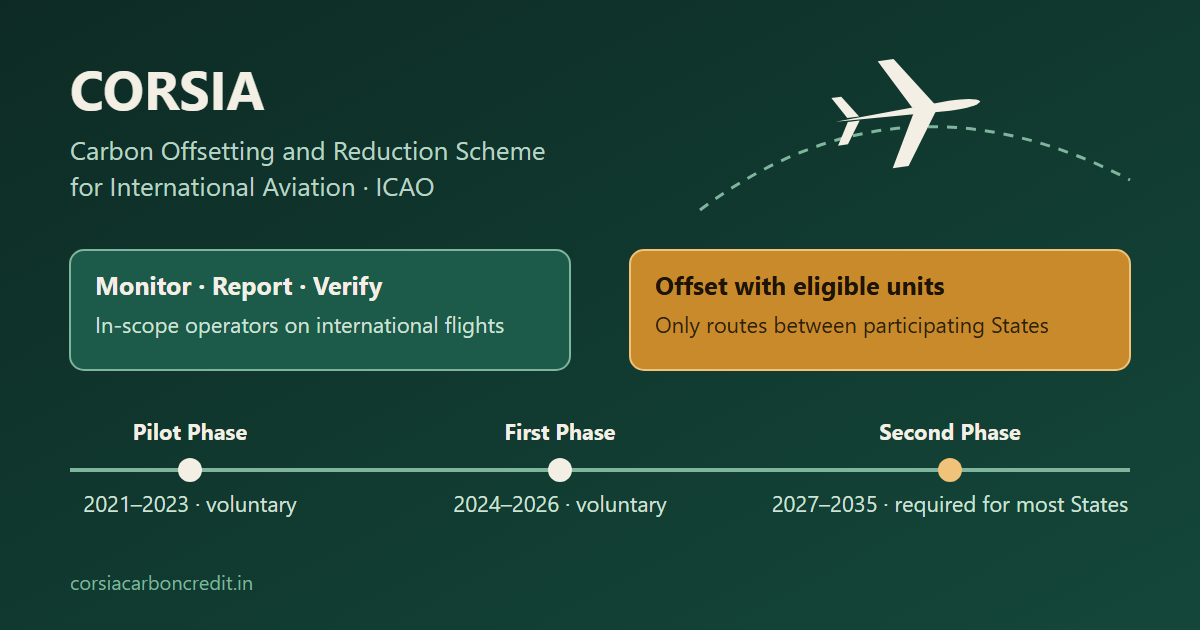
CORSIA stands for the Carbon Offsetting and Reduction Scheme for International Aviation. ICAO, the UN's civil aviation agency, introduced it because international aviation emissions cross borders and are hard to cut quickly. Airlines with offsetting requirements on routes between participating States must cancel CORSIA eligible emissions units, a specific group of carbon credits.
Ordinary voluntary credits do not automatically qualify:
- Programme eligibility: the credit's programme must be approved by the ICAO Council for the relevant compliance period.
- Unit eligibility: each credit must also fall within the approved scope and meet the vintage window. For the first phase (2024–2026), that generally means activities starting on or after 1 January 2016 and vintages from 2021 to 2026. First-phase units also need host-country authorisation with a corresponding adjustment, and a CORSIA label in the registry.
Credit #001 could only be used by an airline if all of those conditions applied to it. Always check the latest ICAO CORSIA Eligible Emissions Units document. Our guide to CORSIA eligible carbon credits explains these checks. Our analysis of the CORSIA carbon credit supply gap shows why eligible units are currently scarce.
The Future of the Global Carbon Credit Market
Confirmed developments
- Article 6 of the Paris Agreement is being put into practice, including the UN-supervised Paris Agreement Crediting Mechanism and bilateral transfers with corresponding adjustments.
- National carbon markets are expanding, such as India's Carbon Credit Trading Scheme.
- CORSIA's second phase begins in 2027, with participation required for most large aviation States.
Trends and expectations, not certainties
- more demand for high-integrity and removal credits
- more transparency, through ratings, public registries and price reporting
- growth in carbon removal technologies
- corporate climate strategies that keep changing under scrutiny
How fast these develop cannot be predicted with confidence.
Frequently Asked Questions About Carbon Credits
What is a carbon credit in simple words?
It is a certificate showing that one tonne of CO₂ equivalent was kept out of, or taken out of, the atmosphere by a verified project.
How does a carbon credit work?
A project reduces or removes emissions against a baseline. Its results are measured and verified, and the programme then issues credits into a registry. Buyers purchase them and retire them against their own emissions.
How much CO₂ does one carbon credit represent?
Generally one metric tonne of CO₂ equivalent (tCO₂e), which can include other greenhouse gases converted to CO₂ terms, under the issuing programme's rules.
Who generates and verifies carbon credits?
Project developers generate them, accredited independent auditors verify them, and carbon-crediting programmes such as Verra or Gold Standard issue them into registries.
What is the difference between a carbon credit and a carbon offset?
A carbon credit is the unit. A carbon offset is the act of retiring that unit to compensate for emissions.
Can individuals and businesses buy carbon credits?
Yes. Both can buy credits through brokers, marketplaces or directly from developers. Businesses should reduce their own emissions first and retire credits with clear, honest claims.
Are all carbon credits eligible for CORSIA?
No. Only units from ICAO-approved programmes that meet the scope, vintage, authorisation and labelling conditions for the relevant compliance period are eligible.
Key Takeaways
With carbon credits explained, the key points are:
- A carbon credit represents one verified tonne of CO₂e reduced or removed.
- It is created through a baseline, an approved methodology, monitoring and independent verification, then issued with a serial number.
- It can be traded, and it is retired when used.
- Quality matters: additionality, accurate measurement, permanence and transparent registries decide whether a credit really delivers what it claims.
Carbon credits can support climate action when they represent credible, measurable and verified reductions or removals, and when buyers use them alongside, not instead of, cutting their own emissions.
To learn more about CORSIA, carbon credits and developments in the global carbon market, explore the resources at CORSIA Carbon Credit.