 DSTechnoverse company
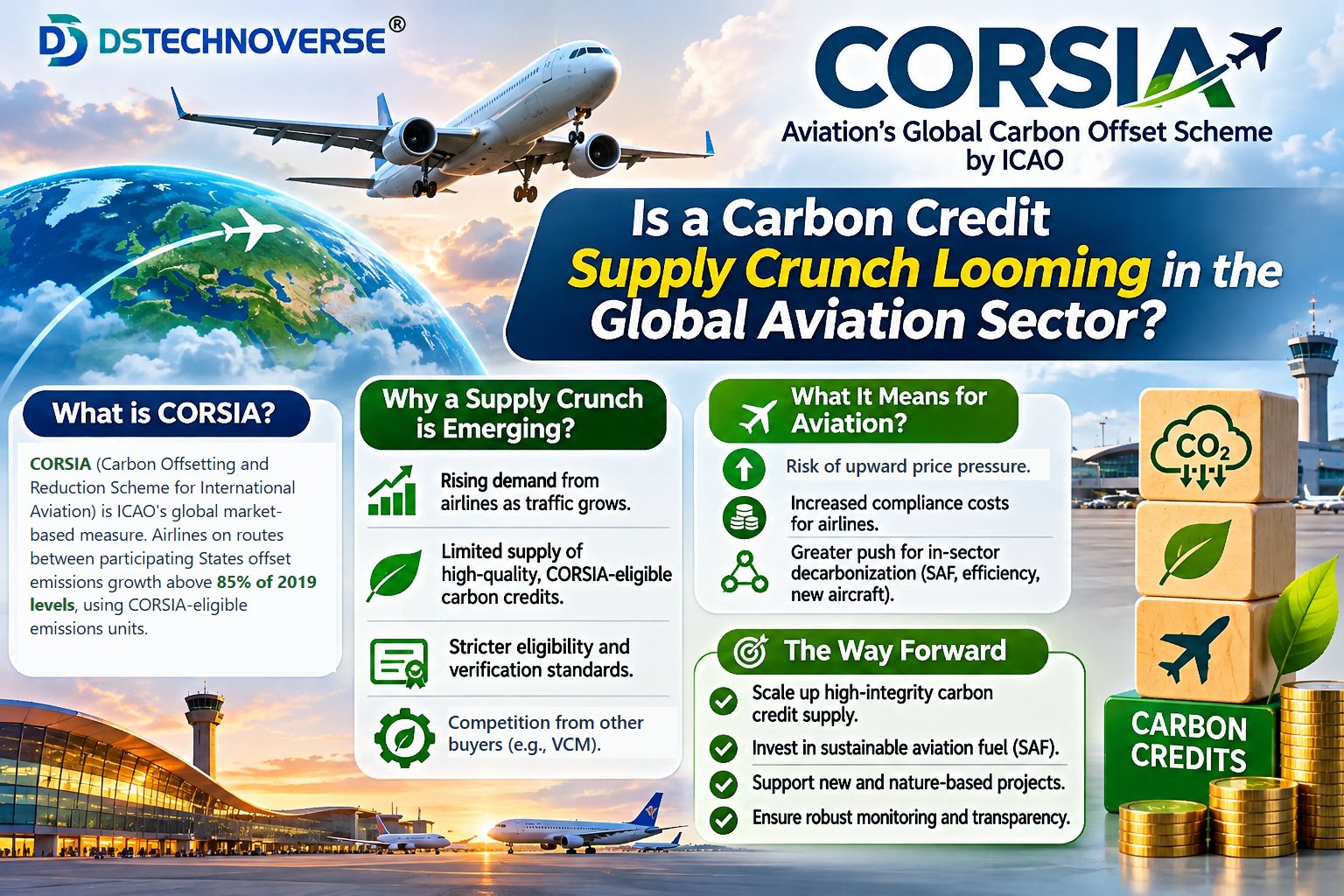
Is a CORSIA carbon credit supply crunch looming? The data points to a large, real gap:
- IATA estimates airlines will need 200–250 million CORSIA eligible emissions units (EEUs) for the first compliance period (2024–2026).
- As of August 2026, CORSIA-compatible host-country authorisations covered only about 72 million units (IATA, October 2026).
The shortage is not about carbon credits in general. The voluntary market holds far more. It is about credits that meet ICAO's eligibility rules, carry host-country authorisation and are available in time for airlines to cancel. For background on how CORSIA credits work, see our CORSIA Carbon Credits resources.
The central question is whether the market can deliver enough eligible units before the first-phase cancellation deadline. This analysis looks at the numbers, the causes, the effects on airlines and prices, and what could close the gap. Figures reflect information available in November 2026.
What Is CORSIA and Why Does It Matter to Global Aviation?
CORSIA stands for the Carbon Offsetting and Reduction Scheme for International Aviation. It was created by the International Civil Aviation Organization (ICAO), the UN agency for civil aviation, as the single global market-based measure for CO₂ from international flights. It exists because international aviation emissions cross borders and are hard to cut quickly. Sustainable aviation fuel (SAF) and new aircraft take time to scale.
CORSIA involves two distinct duties:
- Monitoring, reporting and verification (MRV): operators emitting more than 10,000 tonnes of CO₂ a year from international flights with aeroplanes above 5,700 kg must report verified emissions every year.
- Offsetting: applies only to flights between participating States. Operators compensate for emissions growth above a baseline, which from 2024 is 85% of 2019 emissions, by cancelling eligible emissions units.
| Phase | Years | Participation |
|---|---|---|
| Pilot phase | 2021–2023 | Voluntary for States |
| First phase | 2024–2026 | Voluntary for States (130 States in 2026) |
| Second phase | 2027–2035 | Required for most large aviation States, with exemptions |
Offsetting is settled in three-year compliance periods. The first period of the second phase is 2027–2029. Obligations differ between airlines depending on their routes, the States involved and their emissions. Not every airline or flight carries the same requirement.
Why Is the Aviation Sector Facing a Potential Carbon Credit Supply Crunch?
1. Growing demand from airlines
Traffic has recovered and grown beyond 2019 levels, while the baseline is set at 85% of 2019. That combination makes offsetting requirements substantial.
2. Limited availability of CORSIA-eligible credits
Hundreds of millions of voluntary credits exist, but most fail at least one CORSIA condition. The voluntary market's size says little about CORSIA supply.
3. Strict eligibility requirements
For the first phase, a unit must meet all of these:
- come from a programme approved by the ICAO Council
- fall within that programme's approved scope
- come from an activity that started on or after 1 January 2016
- have a vintage from 2021 to 2026
- be labelled CORSIA eligible in the registry
4. Delays in host-country authorisation
First-phase units need a Letter of Authorization (LoA) from the country where the project is located. Many governments are still building the processes to issue them.
5. Corresponding adjustments
The host country must also apply a corresponding adjustment under Article 6 of the Paris Agreement, adding the tonnes back to its own emissions accounts. This prevents double counting, but it means the country gives up those reductions for its own climate target.
6. Long project and issuance timelines
New projects take years to develop, validate, monitor, verify and issue. Even authorised units may not be issued and labelled in time.
7. Competition for high-integrity credits
The same authorised, high-quality credits are also sought by countries buying under Article 6 and by voluntary buyers looking for the strongest claims.
How Much CORSIA Carbon Credit Supply Is Available Compared With Demand?
| Measure | Figure | Date | Source |
|---|---|---|---|
| First-phase demand (airline requirement) | 200–250 million EEUs | Estimate published 13 Oct 2026 | IATA |
| Earlier first-phase demand estimate | 146–236 million EEUs | Sept 2025 | IATA |
| Units covered by CORSIA-compatible LoAs | about 72 million (42 LoAs) | Aug 2026 | IATA |
| Units covered by LoAs, start of 2026 | about 40 million | Jan 2026 | IATA |
| Units issued and labelled CORSIA eligible | about 44 million | Aug–Sep 2026 | ICAO CORSIA newsletter |
| Eligible supply reported by IATA a year earlier | 15.8 million (Guyana only) | Sept 2025 | IATA |
Implied gap: comparing IATA's demand range with the 72 million units covered by LoAs gives a shortfall of about 128–178 million units. This is our calculation from IATA's figures, not a number IATA published. The gap is larger if measured against the 44 million units already labelled.
These figures measure different stages of the credit life cycle, so they should not be added together or treated as the same thing:
- All carbon credits in the global market: by far the largest pool, mostly not CORSIA eligible.
- Credits from approved programmes: a smaller pool, still including ineligible vintages and activity types.
- Credits meeting CORSIA's unit conditions: smaller again.
- Credits covered by an LoA and corresponding-adjustment arrangements: the 72 million figure.
- Credits issued, labelled and available to buy and cancel: the 44 million figure, of which some may already be committed to buyers.
Analysts disagree on how much supply will exist by early 2028, depending on which stage they count. Expected demand for the 2027–2029 period depends on traffic growth, the wider participation required from 2027 and ICAO's growth factors. We found no verified public estimate for it, so we do not quote one.
Airlines must cancel first-phase units by early 2028. Industry reporting cites 31 January 2028, and IATA refers to the "2027 compliance deadline".
Why Are CORSIA-Eligible Carbon Credits Different From Ordinary Voluntary Credits?
ICAO's Technical Advisory Body (TAB) assesses carbon-crediting programmes against the Emissions Unit Eligibility Criteria. These cover programme governance, registries and verification, plus credit integrity: additionality, credible baselines, permanence, leakage and counting units only once. The ICAO Council then approves programmes for specific compliance periods.
Even within an approved programme, each unit must meet the conditions:
- unit dates and vintage for the relevant phase
- methodology and activity-type limits set in the approval
- registry requirements, including the CORSIA eligible label
- host-country authorisation and corresponding adjustment, where required
A credit that sells freely in the voluntary market is therefore not automatically usable for CORSIA. Programme lists change after each Council decision, so readers should use the latest ICAO CORSIA Eligible Emissions Units document. Our guide to CORSIA eligible carbon credits explains these checks.
How Could a Carbon Credit Shortage Affect Airlines?
A shortage could lead to:
- more competition for the same eligible units
- higher procurement costs, at least for units that are fully authorised and labelled
- uncertainty in compliance planning if supply arrives late
- pressure on sustainability budgets
- more forward and long-term purchase agreements to secure supply
- greater need for supply-chain transparency, such as tracing LoAs and labels
- compliance and reputational risk if an airline cannot cancel enough units on time
Larger airline groups may have more capacity to sign forward deals or fund projects directly. Smaller carriers may rely more on the spot market and intermediaries. However, scarcity will not affect every airline in the same way. Requirements, timing and procurement strategies differ widely.
Could CORSIA Carbon Credit Prices Increase Due to Limited Supply?
Basic economics suggests that scarce supply against fixed deadlines adds upward price pressure. Fully authorised, labelled units already trade above the average voluntary credit. Prices in 2026 have nonetheless been more complex than a simple shortage story suggests:
| Date | CORSIA first-phase price | Type | Source |
|---|---|---|---|
| 28 Jan 2026 | USD 19.00 per tCO₂e | Spot price assessment | Fastmarkets |
| Mid-Oct 2026 | USD 13.15 per tCO₂e | Assessment, Dec-2026 delivery | green.earth market report |
Analysis, not confirmed fact: the fall during 2026 may reflect several things:
- new authorised and labelled supply entering the market
- buyers waiting until closer to the deadline
- expectations of more LoAs and programme approvals
Prices also differ by authorisation status, vintage, project type and delivery date. There is no single CORSIA price, and future prices cannot be forecast with confidence. Our guide to the CORSIA carbon credit price in 2026 covers these figures in more depth.
What Role Do Governments Play in Solving the CORSIA Supply Problem?
Host countries hold the key to supply. They can:
- issue Letters of Authorization for international use, including CORSIA
- set up clear Article 6 authorisation procedures with predictable timelines
- manage corresponding adjustments in their national accounts
- protect their own NDCs by deciding which reductions to keep and which to export
- build domestic carbon market infrastructure, such as registries and approval bodies
- improve registry and approval processes to cut delays
- support high-integrity projects with clear national rules
Governments are often cautious for good reasons. Authorising a credit for export means giving up that reduction towards their own climate target. Selling too many cheap reductions could leave them facing more expensive cuts later. These are policy choices, not simply administrative delays.
Opportunities for Carbon Project Developers and Credit Suppliers
Rising aviation demand creates opportunities for developers who plan for CORSIA from the start. That means:
- developing projects under recognised standards with approved methodologies
- checking CORSIA eligibility for the relevant compliance period before investing
- working with ICAO-approved programmes and understanding their scope limits
- securing host-country authorisation early where it is required
- keeping accurate monitoring and verification records
- ensuring transparency and traceability in registries
- planning for second-phase requirements, which may differ from the first phase
Developing a project does not guarantee CORSIA eligibility or credit issuance. Approvals, authorisations and verification can each fail or be delayed.
What Can the Aviation Industry Do to Address the Supply Crunch?
- Build a pipeline of high-integrity projects that meet ICAO's criteria.
- Speed up transparent host-country authorisations. IATA's Supporting Alliance for CORSIA EEU Supply, which ICAO joined in October 2026 and which has more than 80 stakeholders, is working on this.
- Strengthen cooperation between airlines and project developers, for example through offtake agreements.
- Improve access to market information on authorisations, labels and prices.
- Plan procurement responsibly, avoiding a last-minute rush before deadlines.
- Support robust registries and verification systems.
- Keep investing in SAF, aircraft efficiency and operations. CORSIA eligible fuels reduce the offsetting requirement itself.
Offsetting is only one part of aviation's decarbonisation strategy. It cannot replace cleaner fuels and technology.
What Does the Future Hold for the CORSIA Carbon Credit Market?
Confirmed rules and facts:
- first-phase units must be cancelled after the 2024–2026 period ends, with industry reporting citing 31 January 2028
- the second phase starts on 1 January 2027, with participation required for most large aviation States and 134 States listed for 2027
- the ICAO Council has approved programmes for the 2027–2029 period and conditionally approved the Paris Agreement Crediting Mechanism (PACM)
- authorised supply grew from about 40 million to 72 million units during 2026, according to IATA
Forecasts and expectations:
- whether authorised supply can close a gap of over 100 million units in time
- whether prices rise as the deadline nears
- how demand develops in the second phase
What matters throughout: environmental integrity. Closing the gap with weak credits would undermine the scheme.
The evidence supports a significant risk of a first-phase shortfall. It does not make a crisis inevitable. More LoAs, faster labelling and new programme approvals could still narrow the gap. Our article on the CORSIA carbon market explains how supply reaches airlines.
Frequently Asked Questions About the CORSIA Carbon Credit Supply Crunch
Why is CORSIA facing a carbon credit supply shortage?
Because few credits meet every ICAO condition. They must come from an approved programme, fall within its scope and vintage window, have a host-country Letter of Authorization and corresponding adjustment, and carry a CORSIA label. Meanwhile airline demand is large.
How many carbon credits will airlines need for CORSIA compliance?
IATA estimated in October 2026 that the first compliance period (2024–2026) will require about 200–250 million eligible emissions units.
What are CORSIA Eligible Emissions Units (EEUs)?
They are carbon credits from ICAO-approved programmes that meet unit-level conditions for a compliance period. Airlines cancel them to meet their CORSIA offsetting requirements.
Why are ordinary voluntary carbon credits not automatically eligible for CORSIA?
Most fail at least one condition: an unapproved programme, out-of-scope methodology, wrong vintage, no host-country authorisation, or no CORSIA label in the registry.
Can a shortage of CORSIA credits increase carbon credit prices?
It can add upward pressure, especially near deadlines. But first-phase assessments actually fell during 2026, from USD 19.00 in January to USD 13.15 in October, as new supply arrived. Future prices are uncertain.
What role do host countries play in supplying CORSIA-eligible credits?
They issue Letters of Authorization and apply corresponding adjustments. Without these, first-phase units cannot be used for CORSIA. By August 2026, 42 CORSIA-compatible LoAs covered about 72 million units.
Will the CORSIA carbon credit supply problem continue during the 2027–2029 phase?
It depends on new authorisations, programme approvals and project issuance, as well as on demand from wider participation. No verified public estimate of the 2027–2029 gap was available in November 2026.
Key Takeaways
The CORSIA carbon credit supply challenge is not about the total number of carbon credits in the world. It is about whether enough units can:
- meet ICAO's eligibility rules
- obtain host-country authorisation and corresponding adjustments
- be issued and labelled in time for airlines to cancel them
With demand estimated at 200–250 million units and authorised supply around 72 million in August 2026, the first-phase gap is large. However, supply is growing, and government and industry action could still narrow it.
Our guide on how to calculate carbon credits explains how the supply side's credits are quantified. For more on CORSIA carbon credits, eligibility requirements and the global carbon market, explore the resources at CORSIA Carbon Credit.
Sources
- IATA / EuropaWire – ICAO joins IATA-backed alliance to address CORSIA emissions-unit supply shortfall (13 October 2026)
- IATA – Industry urges governments to expedite release of CORSIA eligible emissions units (29 September 2025)
- ICAO – CORSIA Newsletter, August–September 2026
- ICAO – CORSIA Eligible Emissions Units
- Fastmarkets – CORSIA spot prices continue to slide (4 February 2026)
- green.earth – CORSIA activity builds across prices, airlines and supply (16 October 2026)
- UNFCCC – Article 6 of the Paris Agreement
- World Bank – State and Trends of Carbon Pricing