 DSTechnoverse company
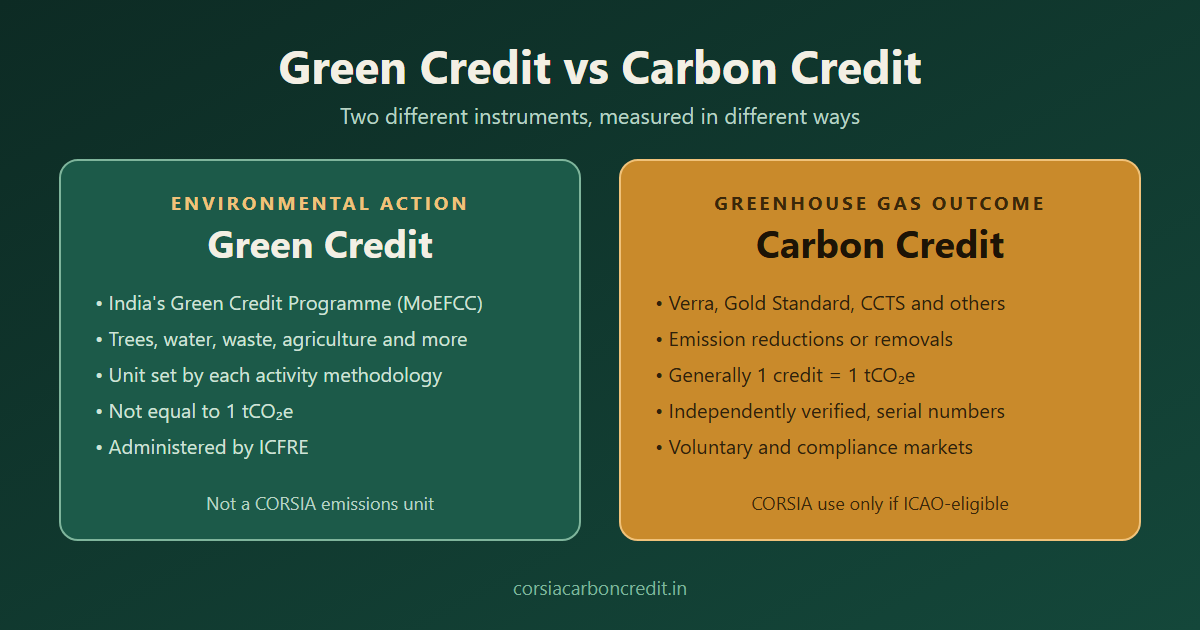
What is the difference between green credit and carbon credit? A green credit is an incentive issued under India's Green Credit Programme for carrying out a specified environmental activity, such as tree plantation or water conservation, measured using that activity's own methodology. A carbon credit represents a quantified reduction or removal of greenhouse gases, generally one tonne of CO₂ equivalent (tCO₂e), verified and issued under a carbon-crediting programme or scheme.
Green credits reward broader environmental actions. Carbon credits measure climate outcomes in tonnes. One green credit is not equal to one tonne of CO₂e, and the two cannot be swapped for each other.
This guide explains both instruments, compares them side by side and covers how India's Green Credit Programme differs from the Carbon Credit Trading Scheme. It also explains why neither automatically counts for CORSIA.
What Is a Green Credit?
A green credit is a unit of incentive for a specified activity that has a positive effect on the environment. In India, green credits are defined and issued under the Green Credit Rules, 2023, notified by the Ministry of Environment, Forest and Climate Change (MoEFCC) under the Environment (Protection) Act, 1986.
The aim is to encourage individuals, communities, companies and other organisations to take voluntary environmental actions and to recognise those actions in a measurable, recorded way. The Green Credit Rules list eight activity categories:
- Tree plantation, including afforestation on degraded land
- Water management, such as water conservation, water harvesting and restoration of water bodies
- Sustainable agriculture, such as natural and regenerative farming practices
- Waste management, including collection, segregation and treatment
- Air pollution reduction
- Mangrove conservation and restoration
- Ecomark label development
- Sustainable building and infrastructure
An activity earns green credits only when an approved methodology exists for it. The methodology sets out how the activity is assessed and how many credits it earns.
Not every environmental activity qualifies. Methodologies are notified category by category, and the rules are revised over time.
What Is a Carbon Credit?
A carbon credit is a tradable unit representing a measured reduction or removal of greenhouse gases, generally equal to one metric tonne of CO₂e. CO₂e converts gases such as methane and nitrous oxide into the amount of CO₂ with the same warming effect.
Carbon credits come from projects such as:
- Renewable energy replacing fossil-fuel power
- Methane capture at landfills or wastewater plants
- Forestry and reforestation
- Energy efficiency in industry or households, such as clean cooking
- Carbon removal, such as biochar or direct air capture
To earn credits, a project generally follows these steps:
- Apply an approved methodology.
- Establish a baseline, meaning what would have happened without the project.
- Show additionality, meaning the reductions would not have happened anyway.
- Monitor the results and have them validated and verified by an accredited independent auditor.
- Receive credits from the programme, which issues them into a registry with unique serial numbers.
Programmes include Verra, Gold Standard and the Global Carbon Council, as well as government schemes such as India's Carbon Credit Trading Scheme (CCTS). Exact rules depend on the programme and methodology. Our guide to the carbon credit certification process explains each step.
Buyers acquire credits to trade, to meet compliance obligations, or to retire them against a climate claim. Our explainer on the difference between a carbon credit and a carbon offset covers how retirement turns a credit into an offset.
What Is the Difference Between Green Credit and Carbon Credit?
The two are different instruments. Some activities, such as tree planting, can produce benefits relevant to both. The main differences are:
- Objective. Green credits encourage specified environmental actions. Carbon credits represent climate mitigation.
- Outcome measured. Green credits can cover water, vegetation, waste, soil and more. Carbon credits measure greenhouse gases only.
- Unit. A green credit's value comes from the activity's methodology. A carbon credit generally equals 1 tCO₂e.
- Eligible activities. Green credits cover the categories notified under the Green Credit Rules. Carbon credits cover activities with an approved GHG methodology.
- Verification. Green credits are assessed under the Green Credit Programme's procedures. Carbon credits are verified under each crediting programme's MRV rules.
- Issuer. Green credits are issued by the Green Credit Programme administrator. Carbon credits are issued by carbon-crediting programmes or government schemes.
- Market and use. Green credit use and transfer are limited by programme rules. Carbon credits trade in voluntary and compliance carbon markets.
- Claims. A green credit supports a claim about an environmental action. A carbon credit supports a claim about tonnes of CO₂e.
| Comparison factor | Green credit | Carbon credit |
|---|---|---|
| Main purpose | Recognises specified environmental activities and outcomes | Represents quantified greenhouse gas reductions or removals |
| Environmental focus | Water, vegetation, waste, agriculture and other notified activities | Greenhouse gas emissions |
| Measurement | Set by the applicable activity methodology | Generally tonnes of CO₂ equivalent |
| Issuing framework | India's Green Credit Programme | Carbon-crediting programmes or compliance schemes |
| Project examples | Water conservation, tree plantation, waste management | Methane capture, renewable energy, carbon removal |
| Main benefit | Encourages broader environmental improvement | Supports quantified climate mitigation |
| Use | Limited by Green Credit Programme rules | Set by voluntary or compliance market rules |
A green credit does not automatically equal one tonne of CO₂e. The two units measure different things.
Green Credit Programme in India: How Does It Work?
The Green Credit Programme (GCP) was set up by the Government of India through the Green Credit Rules notified on 12 October 2023. The MoEFCC oversees it, and the Indian Council of Forestry Research and Education (ICFRE) acts as the programme administrator. The programme is designed as a market-based incentive for environmental action, separate from India's carbon market.
The general process is:
- Registration. An individual or entity registers the proposed activity on the programme's portal.
- Implementation. The activity is carried out according to the notified methodology.
- Verification and assessment. A designated agency checks the results.
- Issuance. The administrator issues green credits.
- Recording. Credits are recorded in the green credit registry.
Tree plantation has been the most developed activity so far. Plantation takes place on degraded land parcels identified by state forest departments. The methodology first notified in February 2024 was revised on 29 August 2025. Under the revised method:
- credits are issued only for trees older than five years
- the land parcel must reach a minimum canopy density of 40%
- credits from tree plantation are non-tradable and non-transferable, except between a holding company and its subsidiaries
Uses of green credits depend on the rules and later notifications. They have been linked to meeting certain environmental obligations, such as compensatory afforestation, and to voluntary environmental and sustainability reporting.
The programme's rules, activity categories and methodologies keep changing. Always check the latest MoEFCC notifications before relying on any specific requirement.
Carbon Credit Trading and Carbon Markets
Carbon credits move through two kinds of markets:
- Voluntary carbon markets. Companies buy credits from programmes such as Verra or Gold Standard for their own climate goals.
- Compliance carbon markets. Governments or international bodies require regulated entities to meet targets or hold credits.
In both, project developers generate credits and programmes set the rules. Independent auditors validate and verify projects, and registries issue credits, record transfers and retire them. Buyers include companies, traders and regulated entities. Prices depend on supply, demand, project type, quality and eligibility for specific schemes.
India's Carbon Credit Trading Scheme (CCTS)
The Carbon Credit Trading Scheme, 2023 was notified on 28 June 2023 under the Energy Conservation Act, 2001. It is administered by the Bureau of Energy Efficiency (BEE), and the Grid Controller of India acts as its registry. It has two parts:
- Compliance mechanism. Obligated entities in energy-intensive sectors receive greenhouse gas emission intensity targets. The first targets were notified in October 2025.
- Offset mechanism. Projects can register voluntarily to earn credits.
Both parts issue Carbon Credit Certificates, with one certificate representing one tCO₂e. Trading is planned on power exchanges under CERC regulation. Reports in 2026 indicated that trading was being prepared to start, so check BEE's portal for the current status.
The CCTS is a carbon market. The Green Credit Programme is an environmental incentive programme. They have different laws, administrators, units and rules. Our article on India's Carbon Credit Trading Scheme explains the scheme in more detail.
Benefits of Green Credits and Carbon Credits
Green credit benefits
- Encourages environmental conservation beyond climate change alone
- Supports water conservation and restoration of water bodies
- Promotes tree plantation and ecosystem restoration on degraded land
- Encourages responsible waste management
- Records environmental actions in a measurable, recognised way
- Supports wider sustainable development and community participation
Carbon credit benefits
- Encourages measurable greenhouse gas reductions
- Supports carbon removal activities
- Creates financial incentives for climate mitigation projects
- Provides funding routes for eligible projects, including in developing countries
- Helps organisations deal with residual emissions through credible offsetting
- Supports the growth of carbon markets and price signals
All of these benefits depend on project quality, measurement, verification and programme integrity. A poorly designed project delivers little, whatever credit it earns.
Can Green Credits and Carbon Credits Be Used Interchangeably?
No. They have:
- different environmental outcomes: broad environmental action versus tonnes of greenhouse gas
- different measurement systems: activity-specific methods versus tCO₂e accounting
- different methodologies and issuing frameworks
- different registries and market rules
- different compliance uses
A green credit does not prove a quantified carbon reduction. A carbon credit does not prove water conservation, biodiversity gains or other outcomes that green credits recognise.
Example 1: A green credit (hypothetical)
This example is hypothetical. A company funds the restoration of a village pond under a notified water management methodology. The activity is registered, implemented to the methodology's requirements, and assessed and verified by the designated agency. If it meets the requirements, the administrator issues green credits for the activity. The quantity is set by the methodology, not by tonnes of CO₂.
Example 2: A carbon credit (hypothetical)
This example is hypothetical. A municipal landfill installs methane capture equipment under a carbon programme's landfill gas methodology. It monitors captured gas with calibrated meters, and an accredited auditor verifies the results. The programme then issues carbon credits equal to the verified tonnes of CO₂e reduced, each with a serial number.
When one activity touches both
A tree plantation may qualify under a green credit methodology for its ecological benefits. It may also be able to generate carbon credits, but only if it separately meets a carbon methodology's baseline, additionality, monitoring and verification requirements. Even then, the same environmental outcome cannot simply be claimed twice. Any overlapping claims must follow the accounting rules of both programmes.
Green Credits vs Carbon Credits: Which Is Better for Businesses?
The answer depends on what the organisation wants to achieve:
- Water conservation: green credit activities under water management fit directly.
- Afforestation and restoration: the Green Credit Programme's tree plantation route may suit, depending on its current rules.
- Waste management improvements: green credit methodologies for waste may apply as they are notified.
- Measurable GHG reductions or offsetting: carbon credits are the relevant instrument.
- Carbon market participation: carbon credits under voluntary programmes or the CCTS are relevant.
- ESG strategies: both can play a part, as long as each claim matches what the credit actually represents.
Neither is a substitute for the other. Many organisations will reduce their own emissions first, use carbon credits for residual emissions, and support green credit activities for wider environmental goals.
Relationship Between Carbon Credits, Green Credits and CORSIA
CORSIA, the Carbon Offsetting and Reduction Scheme for International Aviation, is ICAO's global market-based measure for international flights. Airlines meet their offsetting requirements by cancelling CORSIA eligible emissions units.
CORSIA has strict eligibility rules:
- The ICAO Council approves specific carbon-crediting programmes for each compliance period.
- Each unit must fall within the approved scope and vintage window.
- For the first phase, units need host-country authorisation and corresponding adjustments.
- Units must be labelled CORSIA eligible in the registry.
Ordinary carbon credits are not automatically eligible. Green credits issued under India's Green Credit Programme are not CORSIA eligible emissions units. They do not represent tonnes of CO₂e, and the Green Credit Programme is not an ICAO-approved emissions unit programme.
CORSIA compliance depends on current ICAO rules and unit-level conditions, not on whether some environmental credit has been issued. Our guide to CORSIA eligible emissions units explains these rules. Our article on the CORSIA carbon market covers how airlines obtain eligible units.
Frequently Asked Questions
What is the difference between green credit and carbon credit?
A green credit rewards a specified environmental activity under India's Green Credit Programme, measured by that activity's methodology. A carbon credit represents a verified greenhouse gas reduction or removal, generally one tonne of CO₂e.
Is one green credit equal to one carbon credit?
No. A green credit is calculated using its activity methodology and does not represent one tonne of CO₂e. A carbon credit generally represents one tonne of CO₂e.
What is India's Green Credit Programme?
It is a Government of India programme under the Green Credit Rules, 2023, overseen by MoEFCC and administered by ICFRE. It issues green credits for specified voluntary environmental activities.
What activities qualify for green credits in India?
The rules list tree plantation, water management, sustainable agriculture, waste management, air pollution reduction, mangrove conservation, ecomark label development and sustainable buildings. An activity qualifies only once a methodology for it has been notified.
How are carbon credits generated and verified?
A project applies an approved methodology, establishes a baseline and additionality, and monitors its results. An accredited auditor verifies them, and the programme then issues serial-numbered credits in a registry.
Can green credits be traded like carbon credits?
Not in the same way. Tradability depends on Green Credit Programme rules. Under the 2025 tree plantation methodology, credits are non-tradable and non-transferable except within a corporate group.
Are green credits eligible for CORSIA compliance?
No. CORSIA only accepts eligible emissions units from ICAO-approved carbon-crediting programmes that meet unit-level conditions. Green credits are not such units.
Key Takeaways
So, what is the difference between green credit and carbon credit?
- Green credits recognise specified environmental activities and outcomes under India's Green Credit Programme rules.
- Carbon credits generally represent quantified greenhouse gas reductions or removals of one tonne of CO₂e each.
- Their measurement systems, methodologies, issuers and uses are different.
- Both can support sustainability when implemented with transparency and credible verification.
- Check the current programme rules before buying or claiming either kind of credit.
To learn more about carbon credits, carbon markets and CORSIA requirements, explore the resources at CORSIA Carbon Credit.
Sources
- MoEFCC – Ministry of Environment, Forest and Climate Change
- Bureau of Energy Efficiency – Indian Carbon Market
- ICAO – CORSIA Eligible Emissions Units
- ICAP – India notifies emission intensity targets under the CCTS
- UNFCCC – Article 6 of the Paris Agreement
- IPCC – Sixth Assessment Report, Working Group III (Mitigation)
