 DSTechnoverse company

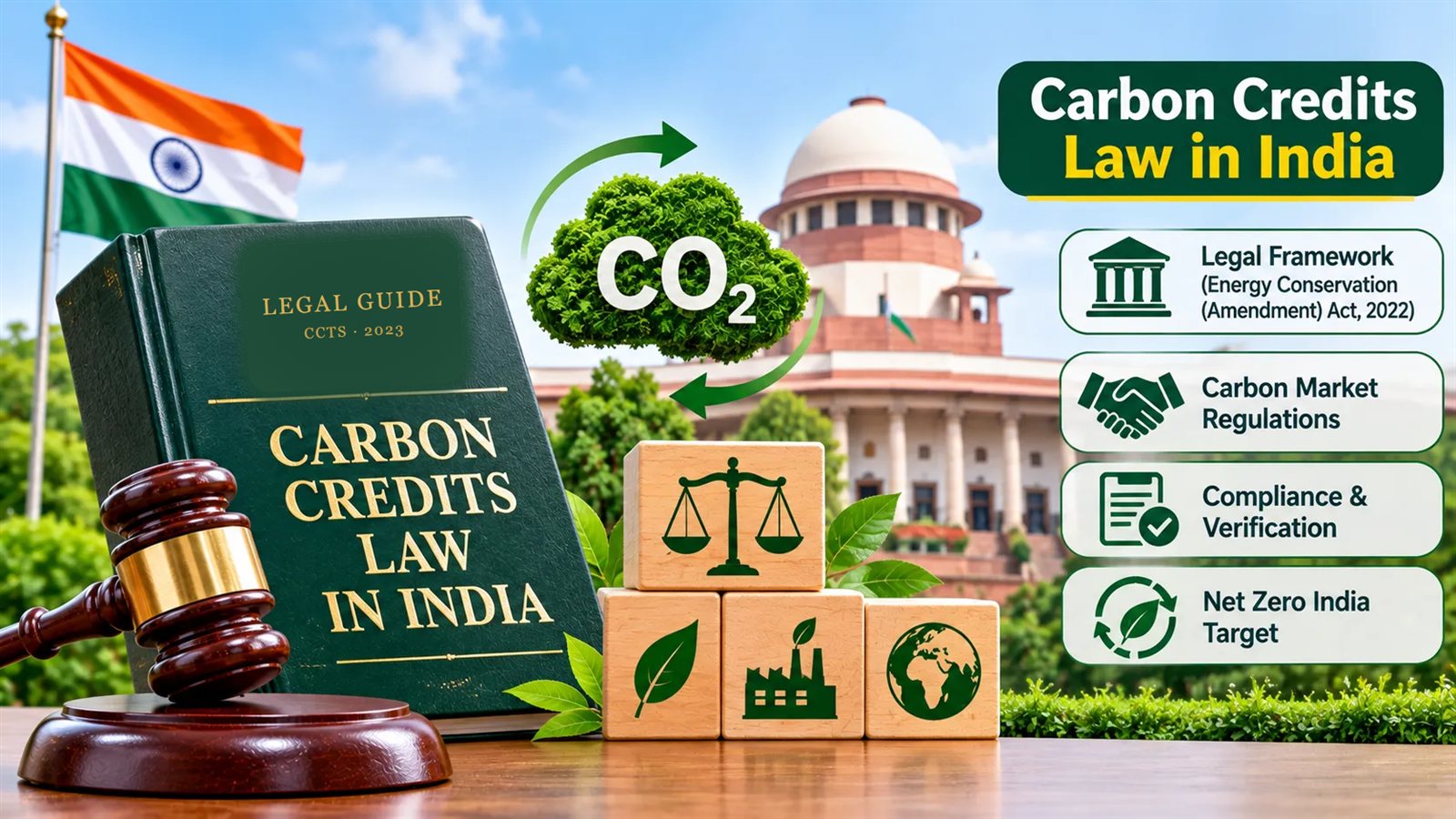
Carbon trading regulations in India come from the Carbon Credit Trading Scheme (CCTS), 2023, which was made under the Energy Conservation Act and creates the Indian Carbon Market. In this market, Carbon Credit Certificates (CCCs), each worth one tonne of CO₂e, are earned and traded:
- Obligated industries earn CCCs by beating government-notified emission intensity targets, or must buy them if they fall short.
- Voluntary offset projects can also earn CCCs.
Trading takes place only on CERC-approved power exchanges, and Grid-India keeps the registry. It is not an open, unrestricted carbon exchange. For international and aviation carbon markets, see our CORSIA Carbon Credits resources.
This guide explains how trading works, who regulates it and what businesses must do. It is based on official notifications and reporting available in November 2026.
What Is Carbon Trading and How Does It Work?
Carbon trading is a market mechanism in which units representing greenhouse gas emissions or reductions are bought and sold. A carbon credit represents a verified reduction or removal of one tonne of CO₂ equivalent (tCO₂e).
Trading creates an economic incentive. A company that cuts emissions cheaply can sell its surplus. A company that would find cutting emissions expensive can buy credits instead. Overall, reductions happen where they cost least.
- Sellers are participants that beat their targets or run eligible reduction projects.
- Buyers are participants that need certificates to meet obligations, or that want to support reductions.
Carbon trading is different from a carbon tax:
- A tax sets a fixed price per tonne and lets the quantity of emissions vary.
- Trading sets targets or limits and lets the market find the price.
India's CCTS is a trading system. It is not a carbon tax.
Illustrative example (hypothetical)
All figures are hypothetical.
- Company A, a cement plant, upgrades its kilns and beats its emission intensity target by 5,000 tCO₂e. After verification, it receives 5,000 CCCs.
- Company B, a paper mill, misses its target by 3,000 tCO₂e.
- Company B buys 3,000 CCCs on an approved power exchange and surrenders them.
Company A earns money from its efficiency investment, Company B meets its legal obligation, and the target is achieved across both plants.
Overview of Carbon Trading Regulations in India
India's first market-based efficiency scheme was Perform, Achieve and Trade (PAT), which traded Energy Saving Certificates. To move from energy to greenhouse gases, Parliament passed the Energy Conservation (Amendment) Act, 2022. It empowered the government to specify a carbon credit trading scheme and inserted section 14AA on issuing Carbon Credit Certificates.
Building on that, the main instruments are:
- CCTS, 2023, notified by the Ministry of Power on 28 June 2023. It created the Indian Carbon Market and its governance.
- The amendment of 19 December 2023, which added the offset mechanism.
- BEE's detailed procedures, issued in July 2024, for the compliance mechanism and for accrediting carbon verification agencies.
- The Greenhouse Gases Emission Intensity Target Rules, 2025, notified by MoEFCC on 8 October 2025 and later amended to add sectors.
- The CERC (Terms and Conditions for Purchase and Sale of Carbon Credit Certificates) Regulations, 2026, notified on 27 February 2026, which set the trading rules.
- The Indian Carbon Market portal, launched on 21 March 2026.
India introduced the framework to support its climate commitments under the Paris Agreement, give industry a carbon price signal, and build a domestic market under national oversight.
One important design point is that the CCTS is intensity-based. Targets limit emissions per unit of output, such as per tonne of cement, rather than setting an absolute cap on total emissions. This makes it a baseline-and-credit system, unlike cap-and-trade schemes such as the EU's.
Key Government Authorities Regulating Carbon Trading in India
| Authority | Role in carbon trading |
|---|---|
| Ministry of Power (MoP) | Notifies and amends the CCTS. Sets policy direction |
| Bureau of Energy Efficiency (BEE) | Administers the scheme: procedures, methodologies, accreditation of verifiers, and recommending targets and CCC issuance |
| National Steering Committee for the Indian Carbon Market | Oversees market governance and recommends rules and targets |
| Ministry of Environment, Forest and Climate Change (MoEFCC) | Notifies emission intensity target rules under the Environment (Protection) Act, 1986. Leads climate policy and Article 6 |
| Central Electricity Regulatory Commission (CERC) | Regulates CCC trading: approves exchanges and oversees surveillance, settlement and market conduct |
| Grid Controller of India (Grid-India) | Registry: holds accounts and records issuance, transfer, surrender and cancellation |
| Accredited Carbon Verification Agencies | Independent verifiers, accredited by BEE |
| Central Pollution Control Board (CPCB) | Reported to levy environmental compensation on entities that miss targets |
No single authority controls the whole market. Policy, administration, targets, trading regulation, registry and verification are shared among these bodies.
Carbon Credit Trading Scheme (CCTS): Rules and Trading Framework
Purpose and foundation
The CCTS aims to reduce greenhouse gas emissions cost-effectively by putting a price on them. Its legal foundation is the Energy Conservation Act, 2001, as amended in 2022.
Compliance mechanism
- Who: obligated entities named in the target rules. The first sectors (October 2025) were aluminium, cement, chlor-alkali, and pulp and paper. Petroleum refining, petrochemicals, textiles and secondary aluminium followed. Iron and steel and fertilisers were reported as pending in March 2026.
- What: meet emission intensity targets for each compliance year, starting with 2025–26 and 2026–27, against a 2023–24 baseline.
- Outcome: surplus earns CCCs, which can be banked. A shortfall requires surrendering CCCs and, under the 2025 rules, paying environmental compensation reported at twice the average CCC price.
Offset mechanism
- Who: non-obligated entities, such as project developers and businesses outside the notified sectors.
- What: register projects that reduce, remove or avoid emissions, using methodologies approved under the CCTS.
- Outcome: CCCs after verification and BEE's review.
Carbon Credit Certificates
One CCC equals one tCO₂e. CCCs are not Renewable Energy Certificates (RECs), which represent renewable electricity, and they are not PAT Energy Saving Certificates.
MRV and registry
Entities monitor emissions and production, report them under BEE procedures, and have them verified by accredited agencies. CCCs are then issued into Grid-India registry accounts, which record every movement.
How Does Carbon Credit Trading Work in India?
- Identify participants. Obligated entities are named in the target rules. Offset projects apply to register.
- Understand requirements: targets for obligated entities, approved methodologies for offset projects.
- Monitor emissions, production or project reductions.
- Report data in the required formats.
- Verify through an Accredited Carbon Verification Agency.
- Issue CCCs into registry accounts after BEE's review.
- Trade on CERC-approved power exchanges under the 2026 regulations. Reports indicate trading in scheduled sessions on exchanges such as IEX, PXIL and HPX, with over-the-counter trading not permitted. Confirm current arrangements with CERC and the exchanges.
- Surrender or use CCCs as the rules require. Obligated entities surrender them to cover shortfalls.
CERC's regulations require exchanges to run market surveillance, price transparency, approved clearing and settlement, and dispute resolution. They also prohibit insider trading, price manipulation and fraud.
Timing is still uncertain. Earlier reports expected first trades in 2026, while a November 2026 report quoted BEE as saying trading would begin for most sectors by the end of 2027. This article does not quote prices, volumes or fees, because none has been officially established.
Who Can Participate in India's Carbon Trading Market?
- Obligated industrial entities: mandatory participants in notified sectors.
- Eligible non-obligated entities: voluntary participants under the offset mechanism.
- Project developers: running registered offset projects that use approved methodologies.
- Businesses funding reduction projects, within the offset mechanism's rules.
- Trading participants, as permitted under CERC's regulations and exchange rules.
- Accredited verification agencies, which verify emissions and reductions but do not trade on their own account in that capacity.
There is an important difference:
- Mandatory participation applies only to obligated entities.
- Voluntary participation is through the offset mechanism.
Eligibility depends on current scheme provisions, approved methodologies and notifications.
Carbon Trading Compliance Requirements for Indian Businesses
If your entity is obligated, the key requirements are:
- Targets: meet the emission intensity target notified for your plant.
- Data: collect accurate greenhouse gas and production data.
- Monitoring and reporting: follow BEE's procedures and formats.
- Verification: use an Accredited Carbon Verification Agency.
- Records: keep documents that support every reported figure.
- Registry: hold an account to receive or surrender CCCs.
- Compliance assessment: BEE assesses performance against the target.
- Shortfalls: surrender CCCs and pay any environmental compensation due under the 2025 rules.
Not every company in India must buy carbon credits. First check whether your sector and plant are notified. Your regulatory status determines whether you need to plan for compliance, look for offset opportunities or simply monitor developments.
Our article on carbon credits law in India explains the legal instruments and penalties in more detail. Our guide to carbon credits regulations in India covers the market's institutions and timeline.
Difference Between Carbon Trading, Carbon Credits and Carbon Offsets
- Carbon trading is the mechanism: the market where units are bought and sold.
- Carbon credits are the units, each representing a verified reduction or removal.
- Carbon offsets are the use: retiring credits to compensate for emissions elsewhere.
- Carbon Credit Certificates are India's domestic unit under the CCTS, used for compliance and trading in the Indian Carbon Market.
- Voluntary carbon credits are issued by independent programmes such as Verra or Gold Standard, often from Indian projects, for voluntary claims.
Example: an Indian wind project may hold Verra credits that a European company buys and retires as an offset. That is voluntary carbon trading. The same project's credits are not automatically CCCs and cannot be surrendered under the CCTS. A cement plant's CCCs serve Indian compliance, but they are not automatically eligible for international schemes such as CORSIA or Article 6 transfers. Our explainer on the difference between a carbon credit and a carbon offset covers these terms in more depth.
Challenges and Future Opportunities in India's Carbon Trading Market
Challenges
- Market transparency: trading has yet to start at scale.
- Reliable measurement: many plants are still building emissions data systems.
- Verification quality: the pool of accredited verifiers is still growing.
- Supply and demand: the balance will depend on how stringent targets are and on offset supply.
- Price discovery: there is no market price yet.
- Implementation: procedures, exchanges and portals are being put in place in stages.
- Industry participation and readiness, especially among smaller obligated entities.
- Double counting: domestic CCCs, international voluntary credits and India's NDC accounting must be kept separate.
- Technology: digital MRV and registry integration.
Officially announced
- remaining sectors' targets, such as iron and steel and fertilisers
- CERC's 2026 trading regulations
- the Indian Carbon Market portal
Expectations, not confirmed
- when exchange trading begins in practice
- tighter targets in later cycles
- more offset methodologies and eligible projects
- possible links with Article 6 for authorised international transfers
For eligible reduction projects, a functioning domestic market could provide a new source of revenue, but the details will depend on future notifications. Our explainer on India's Carbon Credit Trading Scheme gives a further overview.
Frequently Asked Questions
What are carbon trading regulations in India?
They are the rules of the Carbon Credit Trading Scheme, 2023, made under the Energy Conservation Act. They are supported by the 2025 emission intensity target rules, BEE procedures, and CERC's 2026 trading regulations.
What is the Carbon Credit Trading Scheme in India?
It is India's domestic carbon market. Obligated entities must meet emission intensity targets under a compliance mechanism, and others can earn credits through an offset mechanism. Both issue Carbon Credit Certificates.
Which authority regulates carbon trading in India?
CERC regulates trading on power exchanges. The Ministry of Power sets the scheme, BEE administers it, MoEFCC notifies targets and Grid-India runs the registry.
How does carbon credit trading work in India?
Entities monitor and report emissions, have them verified, and receive CCCs for surpluses. CCCs are then traded on CERC-approved power exchanges and surrendered to cover shortfalls.
Who can participate in India's carbon trading market?
Obligated entities in notified sectors, and non-obligated entities with registered offset projects. Other participants are permitted under CERC's trading regulations.
Is carbon trading mandatory for all Indian businesses?
No. Only obligated entities named in the target rules have mandatory obligations. Other businesses can take part voluntarily through the offset mechanism.
How are carbon credits traded in India?
Carbon Credit Certificates are traded on CERC-approved power exchanges, with settlement through approved clearing arrangements. Ownership is recorded in the Grid-India registry. Trading start dates are still being confirmed.
Key Takeaways
Carbon trading regulations in India create a structured, government-supervised market rather than an open exchange:
- Obligated industries trade CCCs to meet intensity targets.
- Offset projects add voluntary supply.
- CERC-approved exchanges host trading.
- Grid-India records every certificate.
Responsibility is shared between MoP, BEE, MoEFCC, CERC and Grid-India, and several implementation details, including when trading starts, are still developing. Businesses should confirm their regulatory status, strengthen their emissions data and follow official updates.
For more on carbon credits, international markets and aviation compliance, explore the resources at CORSIA Carbon Credit.
Sources
- Bureau of Energy Efficiency – Indian Carbon Market
- Ministry of Power
- MoEFCC
- Central Electricity Regulatory Commission
- Grid Controller of India
- India Code – Energy Conservation Act, 2001
- ICAP – Compliance obligations under India's CCTS enter force for seven sectors (March 2026)
- Sansa Legal – CERC Carbon Credit Certificate Trading Regulations 2026
- ESG Broadcast – MoEFCC notifies GHG emission intensity target rules (October 2025)
- UNFCCC – Article 6 of the Paris Agreement