 DSTechnoverse company

CORSIA Approved Carbon Credits: Eligible Programmes, Requirements and Verification
CORSIA approved carbon credits are emissions units that airlines can cancel to meet offsetting obligations under the Carbon Offsetting and Reduction Scheme for International Aviation (CORSIA). They must come from a programme approved by the ICAO Council and meet that programme’s eligibility conditions. Approval is not a blanket label. It depends on the programme, the unit type, the vintage and the compliance period.
What Are CORSIA Approved Carbon Credits?
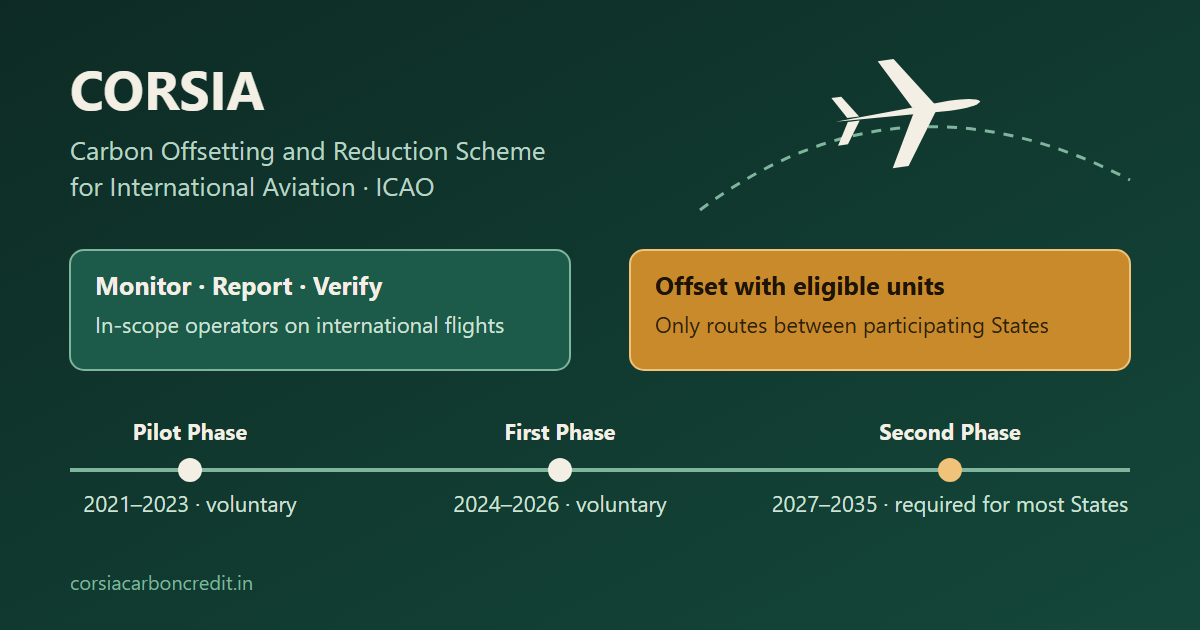
CORSIA is a global market-based measure that addresses CO₂ emissions from international aviation. The International Civil Aviation Organization (ICAO) sets the framework, including which emissions units airlines may use. Under the scheme, aeroplane operators above a certain emissions threshold must offset part of their international emissions growth by cancelling eligible units.
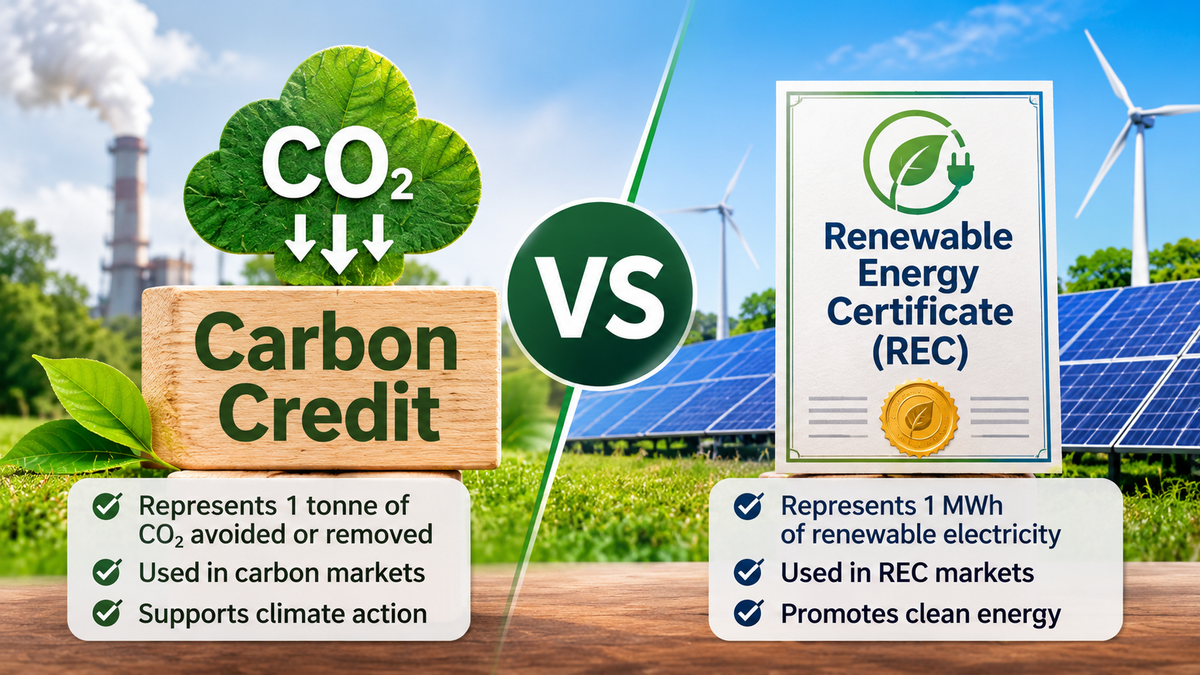
A carbon credit, or emissions unit, represents one tonne of CO₂-equivalent that was reduced, avoided or removed by a project and recorded in a registry.
ICAO’s official term is CORSIA Eligible Emissions Units (CEEUs). “CORSIA approved carbon credits” is how many people search for them. The phrase is useful, but it can mislead. No credit is approved just because it exists in a carbon market.
The ICAO Council decides which programmes can supply CEEUs. It acts on recommendations from its Technical Advisory Body (TAB), which assesses programmes against the CORSIA Emissions Unit Eligibility Criteria. These rules exist so that units used for compliance are real, measurable and not counted twice.
The key distinction is this:
- A general carbon credit may be well verified and still not qualify for CORSIA.
- A CORSIA-eligible emissions unit comes from an approved programme, falls within that programme’s scope, and meets the date and authorisation conditions for the relevant compliance period.
Which Carbon Credit Programmes Are Eligible Under CORSIA?
ICAO separates two questions: is the programme eligible, and is the individual unit eligible? Eligibility is also approved period by period: the 2021–2023 pilot phase, the 2024–2026 first phase and the 2027–2029 compliance period.
Each approved programme has a “scope of eligibility” in ICAO’s document CORSIA Eligible Emissions Units. That scope can exclude certain project types, methodologies, unit categories or programme elements. ICAO is explicit that not all units from an approved programme qualify.
According to the 14th edition of the ICAO document (1 April 2026), ten programmes are approved for the first phase (2024–2026), and four of them are also approved for 2027–2029. In its 2026 cycle, TAB assessed further programmes for 2027–2029, and the Council will consider those recommendations, so this list can change. ICAO’s summary tables also flag some programmes as conditionally eligible. Treat any programme not listed below as requires verification.
Approved for 2024–2026 and also for 2027–2029
- American Carbon Registry (ACR): ERT units only. Excludes California and Washington offset credits, certain large REDD+-country land-use activities and units without host-country authorisation.
- Architecture for REDD+ Transactions (ART): Excludes units without host-country authorisation. The 2027–2029 scope adds a condition on baseline demonstration.
- Gold Standard: Requires host authorisation and a corresponding adjustment (or an approved guarantee). Several exclusions apply, including Planned Emission Reductions and engineered removals.
- Verra Verified Carbon Standard (VCS): Requires host authorisation and a corresponding adjustment (or guarantee). Exclusions apply to some methodologies and to large REDD+ project-level activities.
Approved for 2024–2026 only
- BioCarbon Fund ISFL: Requires host authorisation, a corresponding adjustment or guarantee, and a reversal-management mechanism. Cancellation for CORSIA goes through the Verra Registry.
- Climate Action Reserve (CAR): Excludes several categories, including units without sustainable-development reporting and units without a verified corresponding adjustment.
- Forest Carbon Partnership Facility (FCPF): Requires host authorisation, a corresponding adjustment or guarantee, and a reversal-management mechanism. Cancellation goes through the ART Registry.
- Global Carbon Council (GCC): Excludes certain project types (such as REDD, afforestation and CCS), units without host authorisation and large grid-connected renewable projects.
- Isometric: Requires host authorisation. Restrictions apply by protocol category.
- Premium T-VER (Thailand): Premium T-VER Standard units only, with host authorisation and a verified corresponding adjustment.
Source for all of the above: ICAO, CORSIA Eligible Emissions Units, 14th edition, April 2026. These are summaries, so always read the full scope in ICAO’s document before relying on them.
What Are the Requirements for CORSIA Eligible Carbon Credits?
Exact requirements depend on the programme, the unit type and the compliance period. Under ICAO’s current document, these are the main conditions to check:
- Approved programme and registry. Units must be issued and held in the programme-designated registry listed by ICAO, and labelled as CORSIA eligible where the registry supports it. ICAO notes that eligibility is not transferable between programmes or registries.
- Eligible unit dates. For the first phase, the project’s first crediting period must have started on or after 1 January 2016. The emission reductions or removals must have occurred between 1 January 2021 and 31 December 2026. For 2027–2029 the end date extends to 31 December 2029.
- Scope of eligibility. Each programme’s unit type must match ICAO’s description, such as VCUs, ERTs or CRTs. Excluded project types, methodologies and size thresholds also apply.
- Host-country authorisation and corresponding adjustment. For 2021-onward reductions, ICAO’s current document generally requires the host country to authorise use in CORSIA. It also requires that a corresponding adjustment has been applied and verified by the programme, or that an approved guarantee covers the units. This is how double counting is avoided. See this plain guide to corresponding adjustments.
- Quantification, monitoring and verification. Units must come from activities validated and verified under the programme’s rules.
- Safeguards. Some programmes carry conditions on permanence or reversal management, and some require sustainable-development reporting.
- Registry traceability. Cancellations for CORSIA use must be publicly identifiable.
General quality principles such as additionality and permanence are assessed at programme level by TAB. The unit-level conditions above come from ICAO’s document, and they differ between programmes.
How Can You Verify Whether a Carbon Credit Is CORSIA Eligible?
Follow these steps in order:
- Identify the compliance period the units will be used for.
- Open the latest ICAO document CORSIA Eligible Emissions Units on the ICAO website and check its edition date.
- Confirm the programme and read its full scope of eligibility.
- Check the project’s activity type and methodology against the exclusions.
- Verify the vintage and the project’s first crediting period start date.
- Review the registry record and the unique serial numbers.
- Confirm the specific units carry the required label, host authorisation and corresponding-adjustment evidence.
- Keep the evidence for due diligence, verification and audit.
A seller’s website or brochure is not enough. Marketing copy may be out of date, may refer to the programme rather than the unit, or may confuse general quality with formal eligibility. The registry record and ICAO’s document are the reference points.
Hypothetical example (illustrative only): A buyer is offered two lots.
- Lot A: voluntary credits from a well-run project, vintage 2019, from an ICAO-approved programme. They may be high quality, but a 2019 vintage falls outside the 2021–2026 window for the first phase, so they do not meet that period’s conditions.
- Lot B: credits from an approved programme, vintage 2024, from a project whose crediting period began in 2018. The registry shows the CORSIA label, a host-country authorisation and evidence of a corresponding adjustment. The project type is not on the programme’s exclusion list.
Only Lot B passes the checks, and only after the buyer has confirmed each point on the registry and against ICAO’s current document. For a practical tool, see this buyer’s checklist for CORSIA-eligible units and the guide to registries and serial numbers.
What Is the Difference Between CORSIA Approved and Voluntary Carbon Credits?
The two groups overlap. Many CORSIA-eligible units come from programmes that also serve the voluntary market. A voluntary credit is not automatically eligible for CORSIA, but it can qualify if it meets ICAO’s conditions. Not all voluntary credits are low quality, and CORSIA-eligible units are not all identical.
Here is how they compare on the main points.
Intended use
- CORSIA-eligible units: offsetting obligations of airlines under CORSIA.
- General voluntary credits: voluntary climate claims, corporate targets and other uses.
Eligibility framework
- CORSIA-eligible units: ICAO Council decisions and ICAO’s eligibility document.
- General voluntary credits: programme rules and the buyer’s own criteria.
Programme requirements
- CORSIA-eligible units: the programme must be approved for the compliance period, and its scope and exclusions apply.
- General voluntary credits: any recognised or private programme may be used.
Vintage and unit restrictions
- CORSIA-eligible units: defined activity start dates and reduction dates, plus host-authorisation conditions.
- General voluntary credits: vintage limits are set by the buyer or programme, if any.
Verification and traceability
- CORSIA-eligible units: registry label, serial numbers and public cancellation records.
- General voluntary credits: registry records and serial numbers, without CORSIA labelling.
Compliance relevance
- CORSIA-eligible units: can count toward CORSIA offsetting if all conditions are met.
- General voluntary credits: not counted for CORSIA unless they also meet ICAO’s conditions.
How Can Airlines Source and Purchase CORSIA Approved Carbon Credits?
Sourcing starts with the requirement. Define the compliance period, the volume and the delivery timeline, then work through these considerations:
- Check ICAO’s current information before every purchase, since approvals and scopes are updated by edition.
- Evaluate programmes, projects and registry records against the verification steps above.
- Review vintage and availability. Supply of units that meet all conditions, especially host authorisation, can be limited.
- Compare quotations and fees on a like-for-like basis, including what the price includes.
- Check delivery terms and documents: transfer or cancellation mechanics, authorisation evidence and remedies if a unit turns out ineligible.
- Understand cancellation. Units must be cancelled in the programme’s designated registry, and for some programmes this differs from the issuance registry.
- Keep records for reporting, verification and audit.
Buying credits does not complete a CORSIA obligation on its own. Operators must still cancel the units, report the cancellation to their State authority, and have the reports verified. See the CORSIA compliance calendar for the yearly rhythm.
Readers researching eligible units can also use CORSIA Carbon Credit and its advisory services for guides and sourcing support. The site states that it is independent and not affiliated with or endorsed by ICAO, so every unit should still be verified against ICAO’s document and the registry.
In short, CORSIA approved carbon credits are defined by ICAO’s rules, not by marketing. Check the programme, the unit and the period, and keep the evidence.
Frequently Asked Questions
1. What are CORSIA approved carbon credits? They are emissions units from ICAO-approved programmes that meet the scope, date and authorisation conditions set by ICAO. ICAO’s official term is CORSIA Eligible Emissions Units. A credit is not eligible just because it is sold in a carbon market.
2. Which carbon credit programmes are eligible under CORSIA? Under ICAO’s April 2026 document, ten programmes are approved for 2024–2026: ACR, ART, ISFL, CAR, FCPF, GCC, Gold Standard, Isometric, Premium T-VER and Verra VCS. Four are approved for 2027–2029: ACR, ART, Gold Standard and Verra VCS. The list can change, so check ICAO’s latest edition.
3. Are all voluntary carbon credits approved for CORSIA? No. A voluntary credit qualifies only if its programme is approved for the relevant period and the unit meets ICAO’s conditions, including scope, dates and host-country authorisation where required.
4. How can I check whether a carbon credit is CORSIA eligible? Check the latest ICAO document, confirm the programme and its exclusions, then verify the vintage, serial numbers, registry label and authorisation evidence for the specific units. Keep the records.
5. Do CORSIA approved carbon credits have specific vintage requirements? Yes. For 2024–2026, the project’s first crediting period must start on or after 1 January 2016, and the reductions must fall between 1 January 2021 and 31 December 2026. For 2027–2029 the end date is 31 December 2029.