 DSTechnoverse company
CORSIA Carbon Credit Market: How It Works and Who Takes Part
Aviation is one of the harder sectors to decarbonise. Sustainable fuels, better aircraft and operational efficiency are all progressing, but none of them can remove international aviation’s emissions growth on their own. That is where the CORSIA carbon credit market comes in. It connects airlines that have offsetting obligations with suppliers of emissions units that meet strict international criteria.
This article explains how that market works, who participates, what eligibility means in practice, and where the opportunities and challenges lie.
What Is the CORSIA Carbon Credit Market?
CORSIA stands for the Carbon Offsetting and Reduction Scheme for International Aviation. It was developed by the International Civil Aviation Organization (ICAO) and is the first global market-based measure for any single sector. It applies only to international flights. Domestic aviation is covered by national policies.
CORSIA does not set a cap on any individual airline. Instead, it asks airlines to offset the portion of their international CO₂ emissions that exceeds an agreed baseline. They can do this by cancelling eligible emissions units or by using eligible fuels, depending on the rules in force.
The “CORSIA carbon credit market” is the commercial activity that grows around this requirement: the buying, selling and brokering of units that qualify under ICAO’s rules. Because the demand comes from a regulatory framework, the market is much narrower and more tightly defined than carbon trading in general.
How Does the Market Work?
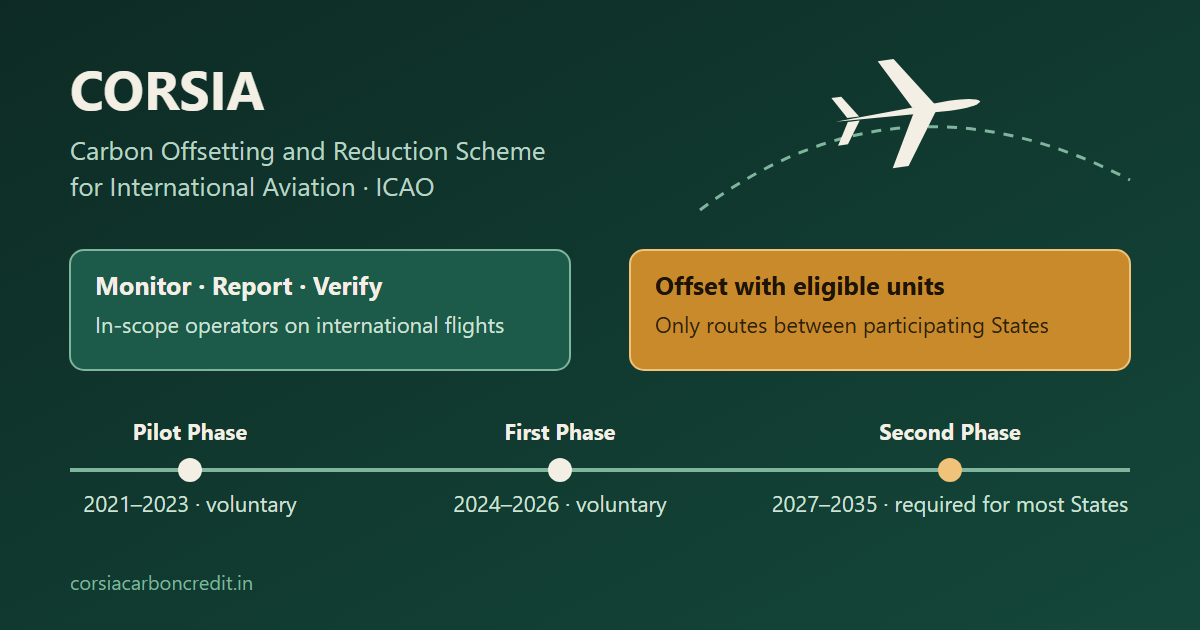
CORSIA runs in phases:
- Pilot phase (2021–2023): voluntary participation by States.
- First phase (2024–2026): still voluntary for States, with offsetting requirements applying to flights between participating States. ICAO reports that well over 100 States have signed up.
- Second phase (2027–2035): participation becomes mandatory for most States, with exemptions for certain groups such as least developed countries and small island developing States.
Each year, an airline’s offsetting requirement is calculated from its international emissions on covered routes and a sector growth factor published by ICAO. For the first phase, the baseline is set relative to 2019 emissions. At the end of a compliance period, airlines must cancel enough eligible units to cover their requirement. For the 2024–2026 period, the cancellation deadline falls in early 2028.
It is worth separating what is regulatory from what is market practice. The offsetting obligation, the eligibility criteria and the cancellation requirement are set by ICAO and the participating States. How airlines buy, whether through spot purchases, forward contracts, exchange-traded products or long-term agreements, is a commercial decision.
Key Participants in the CORSIA Carbon Market
- Airlines and aircraft operators: the source of demand. Their obligations depend on their routes, their State’s participation and ICAO’s annual calculations.
- Project developers: the organisations that design and run mitigation projects, such as forest protection, clean cooking or renewable energy.
- Emissions unit programmes and registries: the programmes that issue, label and track units. ICAO does not approve individual projects. It approves programmes.
- Host-country governments: under CORSIA, units generally need a Letter of Authorization from the host country and a corresponding adjustment, which prevents the same reduction being counted twice.
- Intermediaries: brokers, traders, exchanges and advisers who help match supply with demand and manage delivery and documentation.
- Verifiers and auditors: independent bodies that check emissions reports and project claims.
- ICAO and its Technical Advisory Body (TAB): TAB assesses programmes against the CORSIA criteria and recommends outcomes to the ICAO Council, which makes the final decision.
How Airlines Source Eligible Emissions Units
In practice, an airline typically estimates its likely obligation, then builds a sourcing strategy. This might include buying units directly from a project developer, purchasing through a broker, or using standardised contracts offered by exchanges. Some airlines combine approaches to spread price and delivery risk.
A practical example: an airline with a significant international network in participating States may secure a portion of its expected need through forward agreements, then top up closer to the compliance deadline. Whether such a strategy is suitable depends entirely on the airline’s circumstances and risk appetite, and nothing about it is guaranteed.
Eligibility, Quality and Compliance Considerations
This is the most important point for anyone entering the market: not every carbon credit is CORSIA-eligible.
For a unit to count, several things must be true:
- It must come from a programme approved by the ICAO Council for the relevant compliance period.
- It must meet the CORSIA emissions unit criteria, which address matters such as additionality, permanence, avoidance of double counting and safeguards.
- It must fall within the eligible vintages and project categories listed in ICAO’s document on CORSIA Eligible Emissions Units.
- It must carry the appropriate CORSIA label in the programme’s registry, along with the required host-country authorisation and corresponding adjustment.
Eligibility can also differ between compliance periods, and ICAO updates its list over time. Anyone evaluating a unit should check the latest ICAO document directly rather than relying on summaries, including this one.
Opportunities for Carbon Credit Suppliers and Project Developers
For suppliers, CORSIA offers a clearly defined source of demand tied to a regulatory process. Developers whose projects can meet programme requirements, secure host-country authorisation and achieve labelling may find a route to this market. Transparent registries and standardised contracts also make it easier for buyers to compare and verify units.
Project developers in emerging economies may find this particularly relevant, because host-country involvement creates opportunities for closer collaboration with national authorities. That said, meeting the criteria is demanding, and nothing guarantees volumes, prices or buyer interest.
Challenges Affecting Market Growth
- Supply constraints: the process of programme approval, host-country authorisation, corresponding adjustments and labelling takes time, and eligible supply has been limited in the early phase.
- Regulatory complexity: rules vary by compliance period, and procedures continue to develop.
- Integrity concerns: buyers and observers expect rigorous standards, so credibility is a constant requirement.
- Price and delivery uncertainty: these depend on market conditions and policy decisions that cannot be predicted reliably.
- Registry and reporting coordination: consistent tracking across registries and national systems remains an ongoing task.
CORSIA Carbon Market vs. the Voluntary Carbon Market
The voluntary carbon market is driven by companies and individuals who choose to buy credits, often to support climate claims or internal targets. A wide range of standards and project types can be used.
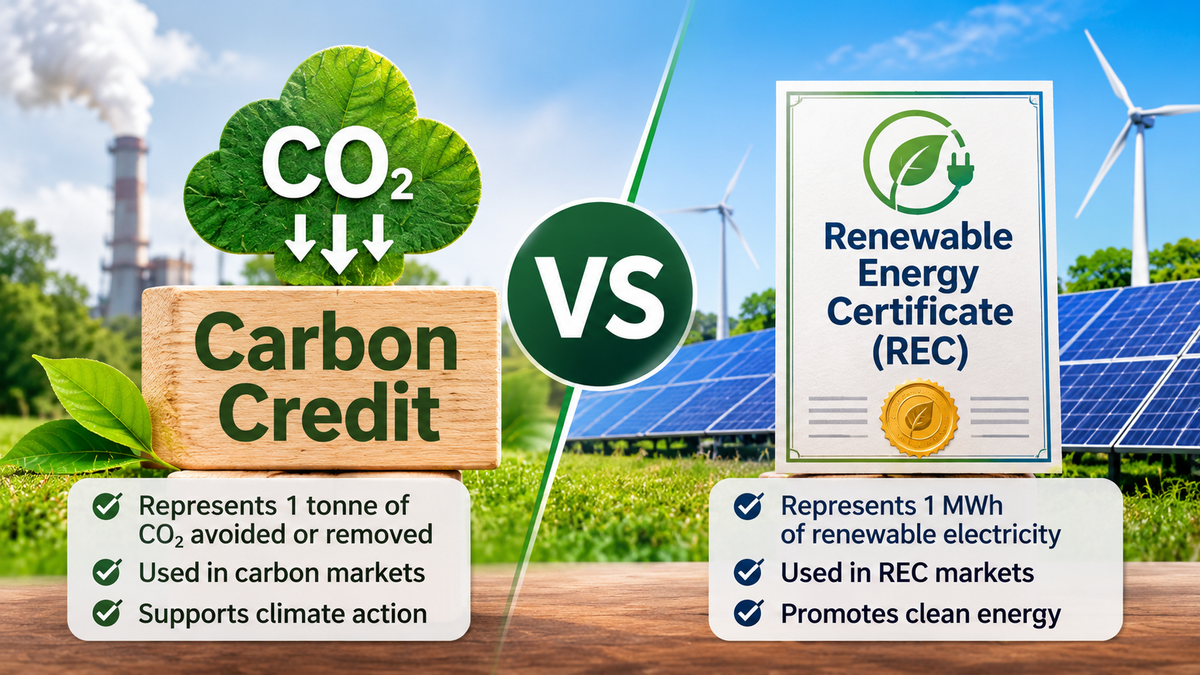
The CORSIA framework is different. Its demand is created by an international regulatory scheme, and only a subset of units qualifies. A credit that is perfectly legitimate in the voluntary market may still be ineligible for CORSIA, for example because its programme isn’t approved for the relevant period, its vintage falls outside the permitted range, or it lacks the required authorisation. Treating the two markets as interchangeable is a common mistake.
How to Evaluate CORSIA-Related Opportunities
Before buying, selling or partnering, it helps to ask a few practical questions:
- Is the programme approved by the ICAO Council for the relevant compliance period?
- Does the specific unit match the vintage and project category rules in ICAO’s current document?
- Are the host-country Letter of Authorization and corresponding adjustment in place?
- Is the unit labelled in the registry, and can its status be verified independently?
- Who is the counterparty, and how transparent are their delivery terms?
Readers who want a CORSIA-focused starting point for exploring suppliers and market information can visit this CORSIA carbon credit market resource. As with any marketplace, it should be used alongside official ICAO publications and independent due diligence.
The Future of Carbon Credits in International Aviation
The market will keep evolving as the first phase progresses and the second phase approaches. More States are expected to participate, programme approvals and eligible supply may change, and registries and standardised contracts are likely to continue maturing. Carbon credits will most likely sit alongside sustainable aviation fuels, fleet renewal and operational improvements as one part of a wider toolkit, not a replacement for direct emissions reductions.
Conclusion
The CORSIA carbon credit market links a regulatory obligation to a specialised set of eligible emissions units. For airlines, understanding eligibility and compliance timelines is essential. For suppliers and developers, success depends on meeting rigorous programme and host-country requirements. For everyone, the safest approach is to rely on official ICAO information and treat eligibility as something to confirm, never to assume.
Frequently Asked Questions
1. Are all carbon credits eligible for CORSIA? No. Only units issued under programmes approved by the ICAO Council for the relevant compliance period, and meeting the CORSIA criteria and labelling requirements, are eligible.
2. Who has to comply with CORSIA? Airlines and aircraft operators with international flights between participating States have offsetting obligations. State participation is voluntary in the first phase (2024–2026) and mandatory for most States from 2027, with certain exemptions.
3. How is CORSIA different from the voluntary carbon market? CORSIA demand comes from an international regulatory scheme and only accepts a restricted set of eligible units. The voluntary market is driven by voluntary climate commitments and accepts a much wider range of credits.