 DSTechnoverse company
CORSIA Carbon Pulse: Understanding Aviation Emissions and Carbon Market Trends
“CORSIA Carbon Pulse” is an informational way of describing how aviation emissions, airline compliance, and eligible carbon credit supply interact under ICAO’s CORSIA framework. It is not an official ICAO programme or certification. Following this “pulse” means tracking verified regulatory updates, emissions data, and market signals separately. This article summarises what is confirmed, what is market commentary, and what remains analysis.
What Is CORSIA Carbon Pulse and Why Is It Relevant to Aviation?
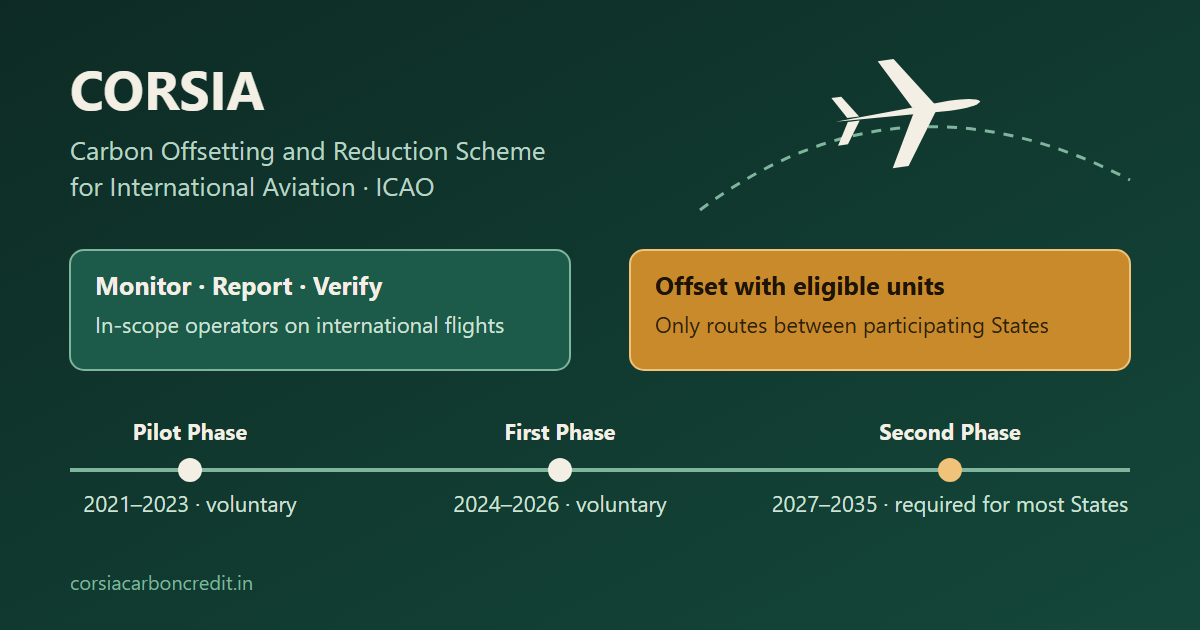
CORSIA, the Carbon Offsetting and Reduction Scheme for International Aviation, is a global measure developed by the International Civil Aviation Organization (ICAO). It requires operators to monitor and report CO₂ from international flights, and, where offsetting applies, to cancel eligible emissions units or use eligible fuels. CORSIA is a compliance framework, not a carbon trading exchange. Units are bought and sold between private parties through brokers, suppliers, and trading venues.
The “pulse” idea links four areas: aviation emissions trends, climate policy decisions, airline compliance planning, and carbon credit developments. A change in one, such as a new ICAO eligibility decision, can affect the others. Note that “Carbon Pulse” is also the name of an independent carbon news publication, and this article is not affiliated with it.
How Are Aviation Emissions Influencing the Global Carbon Market?
Traffic growth is pushing emissions back to, and above, pre-pandemic levels. Several dated data points illustrate this, though they use different scopes and are not directly comparable:
- International aviation, 2023: About 545 MtCO₂, roughly 1.5% of global greenhouse gas emissions, based on IEA data compiled by Climate Action Tracker. Total aviation (international and domestic) was about 2.5% of global CO₂ emissions that year.
- Global estimate, 2025: An analysis by consultancy IBA, reported by Aviation International News on 19 May 2026, put 2025 CO₂ emissions at 960 million tonnes, 2.7% above 2019.
- Flights departing Europe, 2025: Transport & Environment reported on 8 May 2026 that emissions reached 195 million tonnes, 2% above 2019.
Airlines respond through sustainability commitments, efficiency improvements, sustainable aviation fuel (SAF), and carbon management strategies. CORSIA’s role is to address emissions from international aviation above an agreed baseline. That creates demand for eligible emissions units, linking aviation growth to the carbon market.
How Do Carbon Credit Supply and Demand Affect CORSIA?
Demand comes mainly from airline offsetting obligations, which depend on emissions, the applicable compliance period, and covered routes. Some operators may also reduce requirements with eligible fuels.
Supply is narrower than the general carbon market. Key factors include:
- Availability of eligible emissions units: Only units from ICAO-approved programmes, issued and labelled under the relevant registry, qualify.
- Programme and vintage restrictions: ICAO documents specify eligible vintages (2021–2026 for the first phase) and project conditions.
- Host-country authorisation: Letters of authorization are needed for units to be eligible, which can slow supply.
- Carbon credit quality: Buyers weigh integrity and methodology alongside eligibility.
- Procurement strategy and price conditions: Timing, volume, and delivery terms affect transactions. Prices should only be cited with a source and date, such as the Fastmarkets assessment above, and are not a universal market rate.
General voluntary credit supply cannot automatically be treated as CORSIA-eligible. ICAO states that only units from approved programmes, issued and labelled as eligible, can be used. For readers exploring how CORSIA Carbon Credits fit into aviation’s carbon market, the practical rule is to verify each unit against ICAO’s current “CORSIA Eligible Emissions Units” document and the registry record.
How Are Airlines Preparing for a Changing CORSIA Environment?
- Emissions monitoring and reporting: Maintaining an approved monitoring plan and clean fuel-use records for annual reporting.
- Independent verification: Booking accredited verifiers early.
- Compliance planning: Estimating offsetting requirements per compliance period and tracking national deadlines.
- Eligible unit procurement: Comparing sources, confirming programme and vintage eligibility, and sequencing purchases ahead of cancellation deadlines.
- Registry documentation: Keeping serial numbers, ownership records, and cancellation confirmations.
- SAF adoption: Using eligible fuels where available, although IATA data show SAF is still under 1% of jet fuel.
- Long-term reduction strategies: Fleet renewal, operational efficiency, and fuel strategy that reduce exposure over time.
What Could Shape the Future of CORSIA and Aviation Carbon Markets?
The points below are analysis, not confirmed outcomes.
- International aviation growth: Continued traffic growth would increase covered emissions and, potentially, offsetting requirements.
- Credit quality and integrity: Debate over credit quality may keep influencing which units buyers prefer and how regulators treat additional criteria.
- ICAO eligibility decisions: New programme approvals or scope changes could widen or narrow eligible supply. ICAO’s Technical Advisory Body continues to review programmes.
- SAF availability: Slower SAF growth would leave airlines more reliant on other compliance routes, while faster growth could reduce reliance on units.
- Market transparency: Better registry data and clearer pricing benchmarks could help buyers, though transaction-level data remains limited.
- Airline decarbonisation strategies: Operators’ own targets may influence procurement beyond minimum compliance.
None of these points is a price or demand forecast, and readers should rely on dated sources for any figures.
Frequently Asked Questions
1. What does CORSIA Carbon Pulse mean? It is an informational concept for tracking developments in the CORSIA ecosystem: aviation emissions, ICAO decisions, airline compliance, and eligible emissions unit supply. It is not an official ICAO programme or certification.
2. How does CORSIA influence the aviation carbon market? CORSIA sets compliance obligations for international aviation, which creates demand for eligible emissions units. It is not an exchange and does not set prices. Units are traded between market participants.
3. What factors affect demand for CORSIA-eligible carbon credits? Airline offsetting requirements, emissions growth, covered routes, the compliance period, SAF use, and procurement timing. IATA’s June 2026 central scenario estimated a first-phase requirement of 213 MtCO₂, but that is an industry scenario, not an ICAO figure.
4. How do airlines monitor their CORSIA compliance requirements? They use an approved emissions monitoring plan, monitor fuel use, prepare annual emissions reports, obtain independent verification, and submit verified reports to their State. Where offsetting applies, they also track eligible unit procurement and cancellation.
5. What developments could influence the future of CORSIA carbon credits? Possible influences include ICAO eligibility decisions, host-country authorisations, regulatory proposals such as the European Commission’s, SAF availability, and traffic growth. These are areas to watch rather than confirmed outcomes.