 DSTechnoverse company

What Does It Mean to Offset Carbon Emissions?
To offset carbon emissions means to finance emissions reductions or carbon removals elsewhere to compensate for emissions your own activities produce. The compensation is usually made with carbon credits, which are retired so they cannot be used again.
Your carbon footprint is the total greenhouse gas release from your activities, expressed in carbon dioxide equivalent (CO₂e). One carbon credit commonly represents one metric tonne of CO₂e reduced or removed under a defined crediting framework, subject to that programme’s rules.
Offsetting is different from cutting emissions at source. Installing efficient equipment lowers what you emit. An offset leaves your own emissions unchanged and funds a reduction or removal somewhere else. For this reason, offsetting is best treated as a complement to direct reductions, not a replacement.
Credit quality also varies. The credibility of an offset depends on the underlying project, the methodology used to calculate its impact, independent verification, and the requirements of the programme that issued it. Two credits with the same tonnage can differ greatly in integrity.
How Does Carbon Emissions Offsetting Work?
Offsetting follows a sequence. The credit purchase comes near the end, not the start.
The Step-by-Step Process
- Measure your emissions. Use a recognised method such as the Greenhouse Gas Protocol, which groups emissions into Scope 1 (direct), Scope 2 (purchased energy) and Scope 3 (value chain).
- Identify the main sources. Find the activities that account for most of your footprint, such as electricity, fuel, freight or flights.
- Reduce what you can. Efficiency upgrades, cleaner energy and operational changes come first.
- Calculate remaining emissions. Use consistent data and clear boundaries.
- Select suitable projects or programmes. Match the project type to your goals and the intended use of the credits.
- Check documentation and eligibility. Review project records, verification reports and any rules for your specific purpose.
- Purchase and retire credits. Retirement is recorded in the relevant registry, which prevents reuse.
- Keep records and report transparently. Describe what you did and what you did not do.
Emissions inventories and offset purchases are separate activities. Buying credits does not measure your emissions, and it does not reduce your direct emissions.
An Illustrative Business Example
Consider a hypothetical manufacturer in India. The figures below are illustrative only and are not real company data.
The company measures 5,000 tCO₂e in a year. Through efficiency upgrades and a switch to renewable electricity, it plans to cut 3,000 tCO₂e over time. The remaining 2,000 tCO₂e come from processes it cannot yet change. It may then choose to retire verified credits for part or all of that remainder, while continuing to look for further reductions and reporting the split openly.
What Are the Main Methods to Offset Carbon Emissions?
Carbon offsetting methods fall into several project categories. Each can generate credits when it is well designed, measured and verified:
- Renewable energy: Wind, solar or hydro projects that displace fossil-based power, where the programme’s rules allow them.
- Methane capture and destruction: Capturing methane from landfills, livestock waste or similar sources and destroying or using it.
- Forest conservation and improved forest management: Protecting existing forests or managing them to retain more carbon.
- Afforestation and reforestation: Establishing new forest cover to absorb CO₂ as trees grow.
- Industrial and energy efficiency: Waste-heat recovery, fuel switching or process improvements that lower emissions.
- Agricultural emissions reduction: Practices such as improved rice management or cleaner cooking that cut emissions.
- Carbon removal: Technological approaches, such as direct air capture with storage, and eligible nature-based removals such as mangrove restoration.
Avoided Emissions, Reductions and Removals
These terms are not interchangeable. Avoided emissions prevent a release that would otherwise have occurred, such as protecting a forest from clearing. Emissions reductions lower emissions from an ongoing activity, such as capturing landfill methane. Carbon dioxide removal takes CO₂ out of the atmosphere and stores it.
Not every solar installation, tree-planting drive or sustainability initiative automatically produces eligible credits. A project must follow an approved methodology and be registered, verified and issued under a crediting programme.
When comparing options, consider the methodology, additionality, measurement, permanence where relevant, leakage, independent verification and the intended use of the credits.
Benefits, Limitations and Best Practices for Carbon Offsetting
Potential Benefits
Offsetting can direct finance to climate projects that might struggle to find funding. It gives organisations a way to address residual emissions that cannot yet be eliminated. Airlines, manufacturers, logistics firms and companies managing supply chain emissions may use credits in different ways, while individuals can use them to address unavoidable personal emissions such as travel.
Limitations to Understand
Offsetting has real constraints:
- Baseline uncertainty: Estimating what would have happened without the project is difficult.
- Additionality: A project may have gone ahead without credit revenue.
- Permanence: Stored carbon in forests can be released by fire, disease or land-use change.
- Leakage: Reductions in one place may shift emissions to another.
- Double counting: The same reduction must not be claimed by more than one party.
- Variable quality: Credits suit different purposes, and not all are equal.
- Misleading claims: Offsetting does not automatically make a product, organisation or individual carbon neutral.
A Responsible Approach
Measure emissions, prioritise feasible direct reductions, set credible reduction targets, and consider high-integrity credits for residual emissions. Report transparently, including how much you reduced directly and how many credits you retired.
In India, businesses should also watch the Carbon Credit Trading Scheme. The Ministry of Power notified it in June 2023 under the Energy Conservation Act, 2001, and an amendment in December 2023 added an offset mechanism for non-obligated entities. Voluntary credits and scheme-specific certificates follow different rules, so they should not be treated as interchangeable. mondaq
How to Choose Carbon Credits and How CORSIA Carbon Credit Can Help
Before buying, evaluate each credit against a consistent set of checks:
- A credible crediting programme and an appropriate methodology.
- Project documentation and independent verification.
- Additionality and accurate emissions accounting.
- Vintage and registry information, including serial numbers.
- Permanence and reversal safeguards where applicable.
- Leakage and double-counting controls.
- Retirement records that support transparent claims.
- Eligibility rules for your intended purpose.
The last point matters most. A credit that works well for a voluntary climate commitment may not satisfy a compliance scheme. You can learn more in our guide on what a carbon credit is and how it works.
Understanding CORSIA Carbon Offsetting
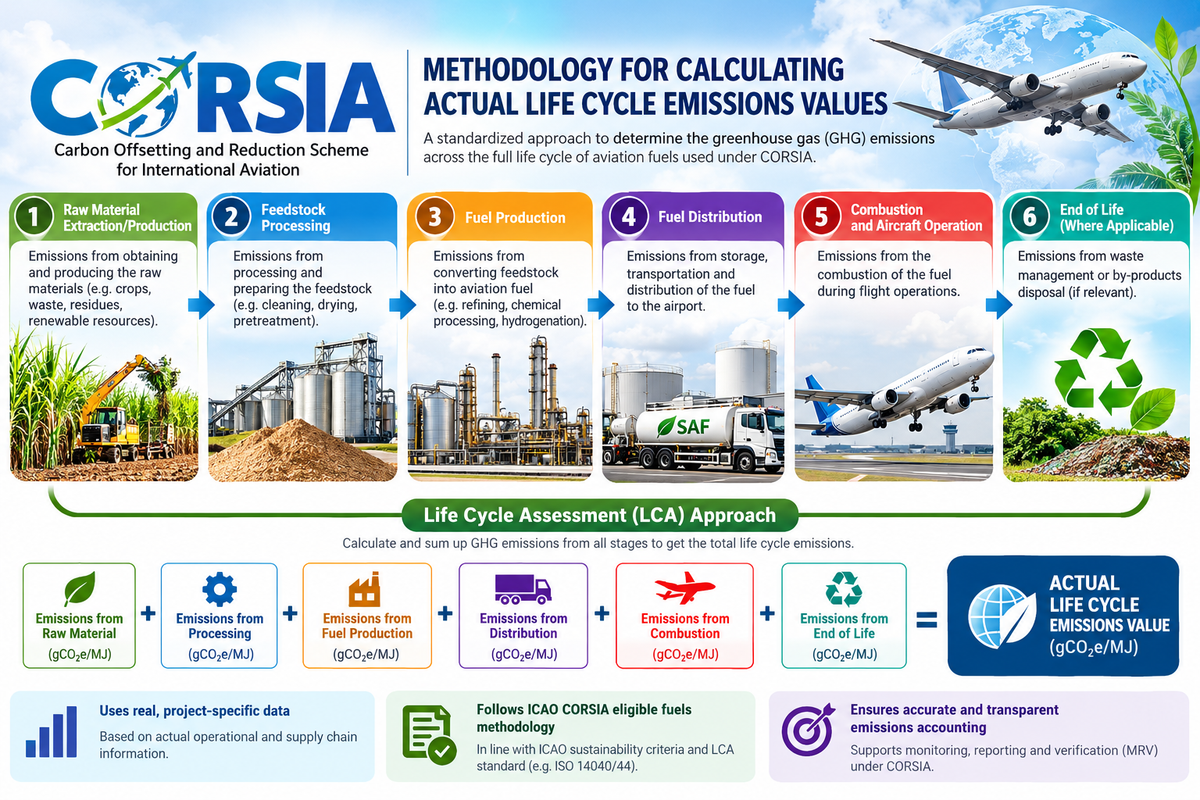
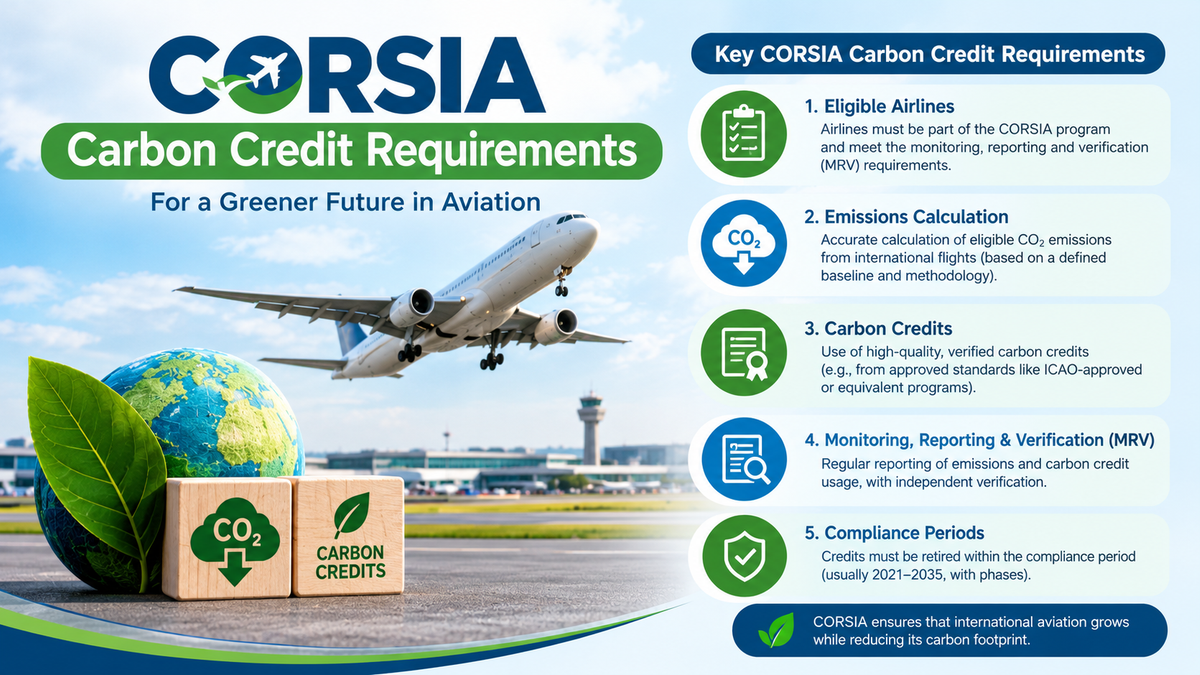
CORSIA is the Carbon Offsetting and Reduction Scheme for International Aviation, established by the International Civil Aviation Organization (ICAO). Aircraft operators covered by the scheme must follow its requirements, and not all carbon credits qualify for CORSIA compliance.
Eligibility depends on several factors. The units must come from a programme that ICAO has approved for the relevant compliance period and must meet its published conditions. For the first phase, eligible units generally represent reductions generated between 1 January 2021 and 31 December 2026, from projects whose first crediting period began on or after 1 January 2016. Host-country authorisation and a corresponding adjustment are also required where the applicable framework calls for them, so the same tonne is not counted twice. ICAO updates its list of eligible units, so always check the latest edition before purchasing. normecgroup
How CORSIA Carbon Credit Can Help
CORSIA Carbon Credit is a marketplace and advisory desk operated from Indore. Its CORSIA services cover offsetting requirement calculation, eligible unit sourcing and pre-purchase due diligence, registry transfer and cancellation, and support with emissions monitoring plans and annual reports. Its carbon credit marketplace lists projects with registry, vintage and project-type details, and the site notes that listings remain subject to confirmation of availability, eligibility and registry status.
Not every listed credit is CORSIA-eligible, and a purchase does not by itself guarantee compliance. Before sourcing units for aviation, review the CORSIA-eligible units checklist and confirm each unit against ICAO’s current requirements.
If you are planning to offset carbon emissions or need to understand your CORSIA obligations, explore the resources above or talk to the CORSIA Carbon Credit team about your requirements.
Frequently Asked Questions
1. What does it mean to offset carbon emissions?
It means funding emissions reductions or carbon removals elsewhere, usually through retired carbon credits, to compensate for emissions you cannot yet eliminate. It works alongside direct reductions, not in place of them.
2. How can a business offset its carbon emissions?
A business should measure its footprint, reduce avoidable emissions, and calculate what remains. It can then select verified credits from credible programmes, retire them in a registry, and report the approach transparently.
3. What is the difference between carbon reduction and carbon offsetting?
Carbon reduction lowers emissions from your own operations. Carbon offsetting finances reductions or removals outside your operations to compensate for emissions you still produce.
4. Are all carbon credits suitable for offsetting emissions?
No. Quality depends on the methodology, additionality, verification, permanence, leakage controls and registry records. Suitability also depends on the purpose, since voluntary and compliance uses have different rules.
5. Can any carbon credit be used for CORSIA compliance?
No. CORSIA accepts only eligible emissions units that meet ICAO’s requirements on programme, vintage and host-country authorisation, including a corresponding adjustment where required.