 DSTechnoverse company

What is the current price of carbon credits in the UK? There is no single UK carbon price. The latest dated figures are:
- UK ETS allowances (UKAs): about £64.40 per tonne on 16 November 2026, an approximate settlement reported by the Energy Insider newsletter, down from £66.94 on 12 November.
- Woodland Carbon Code Pending Issuance Units (PIUs): an average of £28.32 per unit in 2025 (UK Carbon Price Index).
- Peatland Code PIUs: an average of £39.57 per unit in 2025 (UK Carbon Price Index).
UKAs are not carbon credits. A UKA is a government permit to emit one tonne of CO₂e under the UK Emissions Trading Scheme. A carbon credit represents one tonne of CO₂e reduced or removed by a project. For aviation-specific guidance, see our CORSIA Carbon Credits resources.
This guide explains each price, how the UK carbon market works, recent trends, worked costs, and how UK prices compare with other markets.
Introduction to Carbon Credit Prices in the UK
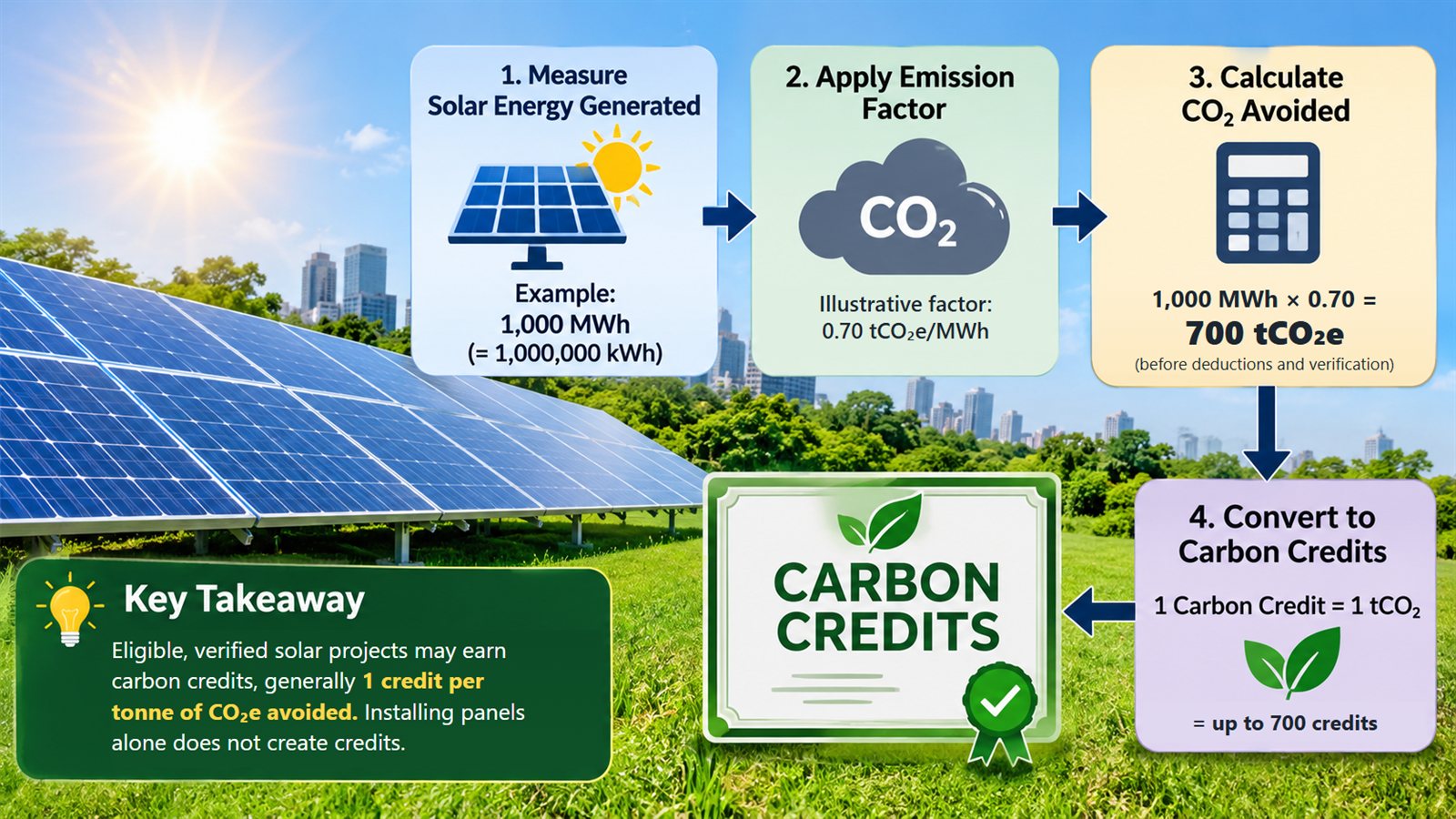
A carbon credit represents one metric tonne of CO₂ equivalent (tCO₂e) reduced or removed by a project, such as planting woodland or restoring peatland.
Carbon prices have monetary value because:
- companies covered by the UK ETS must hold allowances for their emissions
- companies with net-zero targets buy credits voluntarily
- airlines must meet CORSIA obligations on some international routes
The UK carbon market has two main parts:
- Compliance: the UK Emissions Trading Scheme (UK ETS), where covered companies trade UK Allowances (UKAs).
- Voluntary: UK Woodland Carbon Code and Peatland Code units, as well as international voluntary credits bought by UK companies.
These instruments have different prices because they serve different purposes and buyers.
What Is the Current Price of Carbon Credits in the UK?
UK ETS allowance (UKA) price
- Latest figure found: about £64.40 per allowance (tCO₂e) on 16 November 2026
- Previous: £66.94 on 12 November 2026
- Type: approximate daily settlement, as reported by the Energy Insider newsletter
- Earlier reference: the December 2026 UKA futures contract settled at £60.46 on 6 October 2026 (ClearBlue Markets)
UKAs trade daily as futures on ICE Futures Europe, so prices move constantly. We could not verify a settlement after 16 November at the time of writing.
UK voluntary carbon credit prices
The UK Carbon Price Index, published by the IUCN UK Peatland Programme with the Woodland Carbon Code, gives average transaction prices:
| Unit | 2025 average | 2024 average | Type of figure |
|---|---|---|---|
| Woodland Carbon Code PIU | £28.32 | £26.85 | Average transaction price |
| Peatland Code PIU | £39.57 | £25.04 | Average transaction price |
Woodland Carbon Code unit prices
There is not yet enough data to price verified Woodland Carbon Units (WCUs), because over 99% of transactions are PIUs.
Peatland Code unit prices
Verified Peatland Carbon Units (PCUs) cannot yet be priced, because none had been verified.
These figures should not be averaged into one "UK carbon credit price". A UKA, a woodland PIU and a peatland PIU are different products.
Understanding the UK Emissions Trading Scheme (UK ETS)
What it is and why it was introduced
The UK ETS began on 1 January 2021, replacing the UK's participation in the EU Emissions Trading System after Brexit. It is run by the UK ETS Authority: the UK Government, Scottish Government, Welsh Government and Northern Ireland's Department of Agriculture, Environment and Rural Affairs.
How cap-and-trade works
- The Authority sets a cap on total emissions from covered sectors, which falls over time.
- It creates UK Allowances (UKAs) up to the cap, each allowing one tonne of CO₂e.
- Some UKAs are given free to industries at risk of moving production abroad. The rest are auctioned.
- Covered companies must surrender enough UKAs each year to cover their emissions.
- Companies that cut emissions can sell spare allowances. Those that need more must buy them.
Auctions and secondary trading
- Auctions are held regularly on ICE Futures Europe. The first auction, on 19 May 2021, cleared at £43.99.
- An auction reserve price of £28 sets a minimum for auctions.
- After auction, UKAs trade on the secondary market, mainly as futures.
Who is covered
The UK ETS covers:
- power generation
- energy-intensive industries
- aviation, including domestic UK flights and flights from the UK to the European Economic Area
The government has announced plans to expand it to domestic maritime and waste.
UKAs vs project-based offset credits
- A UKA is a permit to emit, created by the government under the cap.
- An offset credit represents a reduction or removal achieved by a project.
UK ETS participants cannot use Woodland Carbon Code or other offset credits instead of UKAs for compliance.
UK Carbon Credit Price History and Market Trends
UKA prices in £ per allowance. Sources: ICAP and S&P Global for 2021, ClearBlue Markets for October 2026, the Energy Insider newsletter for November 2026, and the UK ETS Authority for the civil penalty price.
- May 2021: the first auction cleared at £43.99, and secondary trading opened at £45–50.
- Autumn 2021: prices rose quickly, and the 6 October 2021 auction partially cleared at £60, the first time an auction had not sold all its allowances.
- 2022–2024: UKAs were volatile and for long periods traded below EU allowance prices, reflecting concerns about UK supply and the UK's separate market. We have not found reliable year-by-year figures to quote.
- 2025: in May 2025, the UK and EU agreed to work towards linking their emissions trading systems. This narrowed the gap between UK and EU prices.
- 12-month average to November 2025: £49.41, the price the UK ETS Authority set for civil penalties in the 2026 reporting year, based on average daily settlement prices.
- October 2026: UK–EU linking reports pushed UKAs higher. The December 2026 futures contract settled at £60.46 on 6 October and traded as high as £62.90 intraday on 7 October.
- November 2026: about £66.94 on 12 November and £64.40 on 16 November. On 13 November, UKAs were about £8.60 below EU allowances.
The cover image shows these latest values next to UK voluntary unit averages, presented separately.
Voluntary Carbon Credit Prices in the UK
What voluntary credits are
Voluntary carbon credits are bought by choice, usually by companies for net-zero or climate claims. UK companies buy either UK-based units, from the Woodland Carbon Code or Peatland Code, or international credits from programmes such as Verra and Gold Standard.
How UK companies buy them
- directly from project developers or landowners
- through brokers and marketplaces
- via the UK Land Carbon Registry, which records UK woodland and peatland units
How project quality affects prices
Buyers pay more for verified units, domestic projects, strong permanence and co-benefits such as biodiversity and flood protection.
The Woodland Carbon Code
The Woodland Carbon Code (WCC) is the UK standard for woodland creation projects that remove CO₂. It issues:
- Pending Issuance Units (PIUs): a promise of future carbon removal, based on the predicted growth of trees. A PIU becomes a WCU only after verification.
- Woodland Carbon Units (WCUs): verified units, issued after an independent check confirms the carbon has actually been removed.
The Peatland Code
The Peatland Code, run by the IUCN UK Peatland Programme, covers peatland restoration, which reduces emissions from damaged peat. It issues:
- PIUs: predicted future emission reductions.
- Peatland Carbon Units (PCUs): verified reductions.
Why a PIU is not the same as a verified unit
A PIU is not a verified carbon credit. It is a promise that may or may not be fully delivered. Under the codes' rules, companies should not use PIUs to claim they have offset current emissions. They can only report them as future planned reductions. This is one reason PIUs and international verified credits should not be compared directly.
Factors Affecting Carbon Credit Prices in the UK
- Supply and demand: for UKAs, the cap and auction volumes against industrial demand. For voluntary units, project supply against corporate demand.
- UK government climate policies: carbon budgets and net-zero targets.
- The UK ETS cap and allowance supply: a tighter cap supports higher prices.
- Industrial emissions: higher output increases demand for UKAs.
- Corporate net-zero commitments: drive voluntary demand.
- Project quality: verified, well-documented units are worth more.
- Methodology: each code sets its own rules for calculating removals.
- Permanence and additionality: buyers value long-term storage and projects that need carbon finance.
- Credit vintage: the timing of delivery, which matters especially for PIUs.
- Market confidence: policy uncertainty can cause sharp moves.
- Regulatory changes: such as UK–EU linking or ETS expansion.
- International developments: EU carbon prices strongly influence UKAs.
How Much Does One Tonne of Carbon Cost in the UK?
- UK ETS allowance: about £64.40 per tonne (16 November 2026)
- Woodland PIU: £28.32 average per unit (2025)
- Peatland PIU: £39.57 average per unit (2025)
Prices are quoted in pounds sterling (£) per tonne of CO₂e or per unit. Actual transaction prices can differ from published averages, depending on project, volume, delivery date and contract terms.
Total cost = Number of tonnes × Price per tonne
Illustrative calculations, using the figures above. These are not quotes.
| Tonnes | UKAs at ~£64.40 | Woodland PIUs at £28.32 | Peatland PIUs at £39.57 |
|---|---|---|---|
| 1 | £64.40 | £28.32 | £39.57 |
| 10 | £644 | £283.20 | £395.70 |
| 100 | £6,440 | £2,832 | £3,957 |
| 500 | £32,200 | £14,160 | £19,785 |
| 1,000 | £64,400 | £28,320 | £39,570 |
Additional costs may include brokerage, registry fees, retirement fees and VAT where applicable. UKA and PIU costs are not comparable because they serve different purposes: compliance versus voluntary future claims.
UK Carbon Credit Prices Compared with International Markets
| Instrument | Latest price | Date | Currency | Type |
|---|---|---|---|---|
| UK ETS allowance | about 64.40 | 16 Nov 2026 | £ | Compliance allowance |
| EU ETS allowance | about 90 | mid-Nov 2026 | € | Compliance allowance |
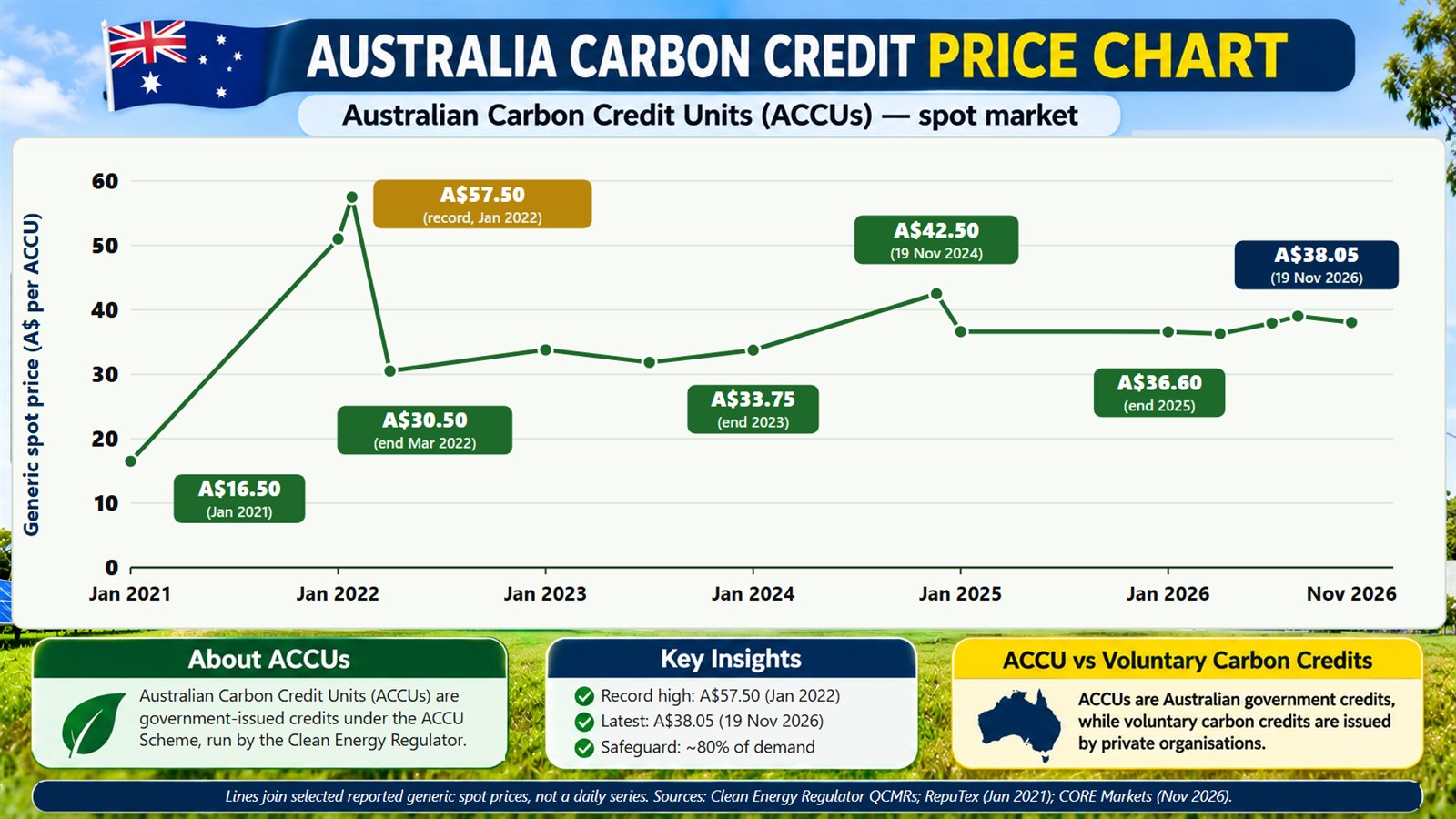
| Australian ACCU | 37.95 | 20 Nov 2026 | A$ | Government-issued credit |
| India CCC | No official price | Nov 2026 | ₹ | Domestic credit certificate |
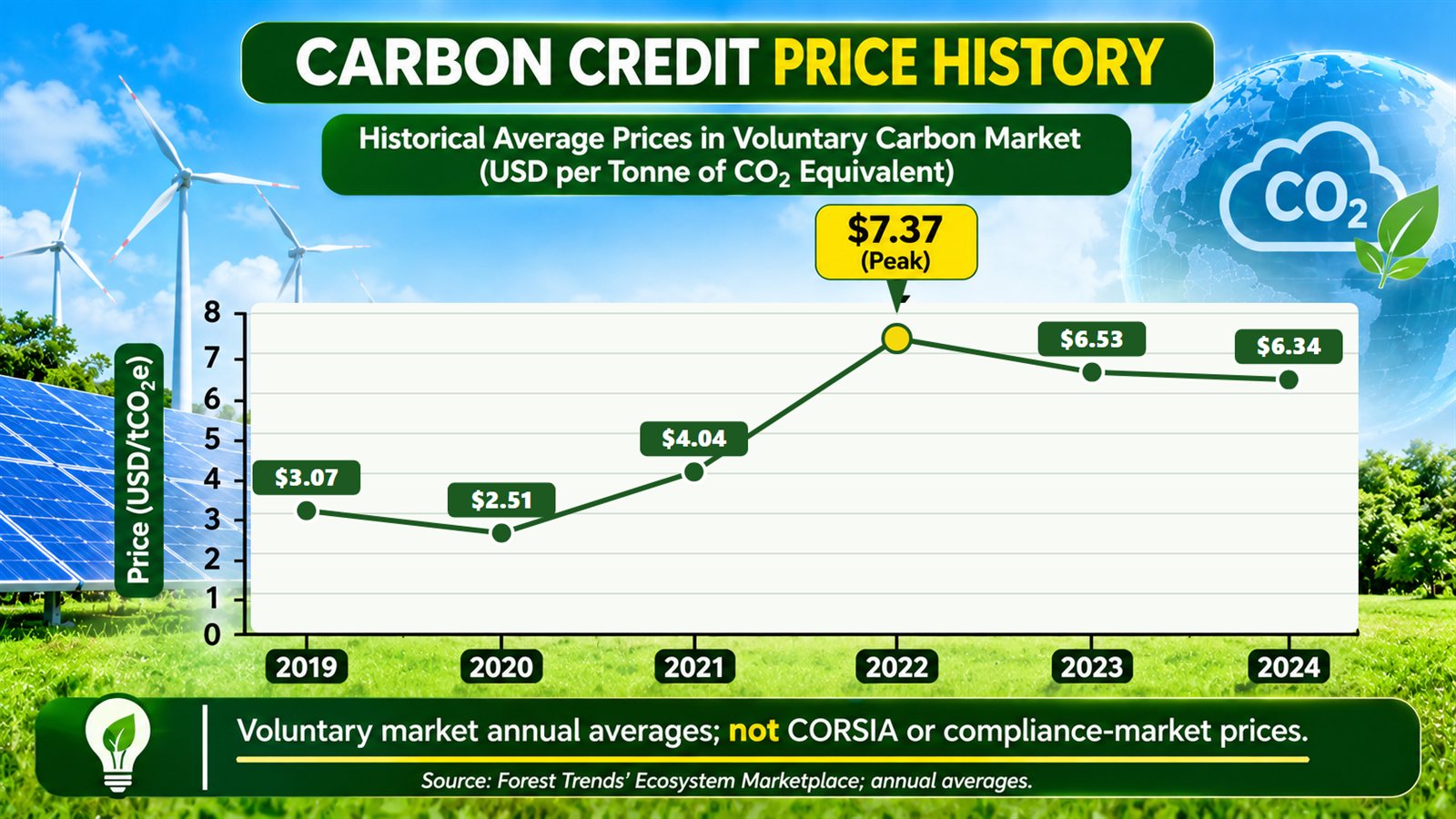
| Global voluntary credits (average) | 6.92 | Q3 2026 | US$ | Project-based credits |
| CORSIA Phase 1 units | 13.00 | 18 Nov 2026 | US$ | Aviation compliance units |
Sources: Energy Insider, GMK Center, CORE Markets, market reports, Sylvera, Fastmarkets.
Key differences:
- Regulatory frameworks: the UK and EU ETS are government cap-and-trade schemes. ACCUs and Indian CCCs are government-issued credits. Voluntary credits come from independent programmes. CORSIA units follow ICAO rules.
- Market instruments: allowances are permits to emit, while credits represent reductions or removals.
- Eligibility: each scheme accepts only its own instruments.
- Currency: £, €, A$, ₹ and US$.
- Trading: UKAs and EUAs trade on exchanges. Voluntary credits trade mostly over the counter.
- Price formation: compliance demand generally supports higher prices.
Allowances and project credits are not interchangeable. Our guide to the carbon credit price now gives more dated international prices, and our guide on how much a carbon credit is worth in Australia covers ACCUs in detail.
How Can Businesses Buy Carbon Credits in the UK?
- Identify the requirement: compliance under the UK ETS, or a voluntary climate target.
- Understand compliance versus voluntary demand:
- UK ETS participants need UKAs, obtained through auctions, free allocation or the secondary market, usually via a broker or exchange member.
- Voluntary buyers choose credits that support their claims.
- Select appropriate credits: UK woodland or peatland units, or international verified credits.
- Check project documentation: design, validation and verification reports.
- Verify registry information: for example, on the UK Land Carbon Registry.
- Assess quality: whether units are verified or PIUs, and their permanence and co-benefits.
- Understand transaction costs: brokerage, registry and retirement fees.
- Complete the purchase and retirement or surrender:
- UKAs are surrendered in the UK ETS registry for compliance.
- Voluntary credits are retired in the relevant registry, in the buyer's name.
Where Can You Check Current UK Carbon Prices?
- UK ETS Authority and UK Government: policy papers, auction calendars and civil penalty prices on GOV.UK.
- ICE Futures Europe: UKA futures prices and auction results, some behind a paywall.
- IUCN UK Peatland Programme: the UK Carbon Price Index for woodland and peatland units.
- Woodland Carbon Code and Peatland Code: project and registry information.
- Market data providers and brokers: such as ClearBlue Markets and other carbon brokers, with daily reports.
- ICAP and the World Bank Carbon Pricing Dashboard: comparisons of compliance carbon prices.
The four types of figures differ:
- Official government data: sets the rules and publishes administrative prices, such as civil penalty prices.
- Exchange prices: show daily UKA trading.
- Auction results: show clearing prices on specific dates.
- Voluntary transaction averages: show what woodland and peatland units sold for over a year.
Future Outlook for UK Carbon Credit Prices
Current developments:
- UK–EU linking: the UK and EU agreed in May 2025 to work towards linking their emissions trading systems, and aimed to conclude negotiations at the UK–EU summit on 20 November 2026. Reports around the summit indicated a target to apply the link from 1 January 2028, subject to ratification. Check the official UK Government and European Commission statements for the final terms.
- ETS expansion to new sectors, such as maritime and waste.
- UK climate policy: legally binding carbon budgets and net zero by 2050.
Possible influences, not forecasts:
- price convergence between UKAs and EU allowances if linking goes ahead
- corporate decarbonisation demand for voluntary units
- integrity scrutiny of voluntary markets, which could favour verified units
- growth in nature-based projects such as woodland and peatland
- future supply of verified WCUs and PCUs
Prices could rise or fall. No price increase or return is guaranteed.
Frequently Asked Questions
What is the current price of carbon credits in the UK?
There is no single price. UK ETS allowances were about £64.40 on 16 November 2026. Woodland Carbon Code PIUs averaged £28.32 and Peatland Code PIUs £39.57 in 2025 (UK Carbon Price Index).
How much does one carbon credit cost in the UK?
A UK woodland PIU averaged £28.32 and a peatland PIU £39.57 in 2025. International voluntary credits bought by UK companies averaged about US$6.92 globally in Q3 2026.
What is the current UK ETS allowance price?
About £64.40 per allowance on 16 November 2026, an approximate settlement, down from £66.94 on 12 November. Check ICE Futures Europe or a broker for the live price.
Are UK carbon credits and UK ETS allowances the same?
No. A UKA is a government permit to emit one tonne under the UK ETS. A carbon credit represents a tonne reduced or removed by a project. Offset credits cannot replace UKAs for compliance.
How much does one tonne of CO₂ cost in the UK?
Under the UK ETS, about £64.40 per tonne in mid-November 2026. Voluntary UK units cost less on average, but they are a different product.
What is the average voluntary carbon credit price in the UK?
For UK-based units, Woodland Carbon Code PIUs averaged £28.32 and Peatland Code PIUs £39.57 in 2025. There is not yet enough data to price verified WCUs or PCUs.
Where can I check UK carbon credit prices?
GOV.UK and the UK ETS Authority for official information, ICE Futures Europe for UKA prices, and the IUCN UK Carbon Price Index for woodland and peatland unit prices.
Why do UK carbon prices fluctuate?
Because of the UK ETS cap, industrial demand, EU carbon prices, UK–EU linking news, energy prices and policy changes. Voluntary prices depend on project supply and corporate demand.
Can businesses buy carbon credits in the UK?
Yes. UK ETS participants buy UKAs at auction or on the secondary market. Any business can buy voluntary credits, such as Woodland Carbon Code units, from developers, brokers or registries.
Are UK carbon credits eligible for CORSIA?
Not automatically. UKAs are allowances, not offset credits. UK woodland and peatland units would need to come from an ICAO-approved programme and meet unit-level rules, so check ICAO's current eligible units list.
Conclusion
The current price of carbon credits in the UK depends on what you are buying. In November 2026, UK ETS allowances traded at about £64.40 per tonne, while UK woodland and peatland PIUs averaged £28.32 and £39.57 in 2025. Verified UK units are too rare to price.
UKAs are compliance permits. Woodland and Peatland Code units are voluntary, project-based units, and PIUs are promises rather than verified credits. The prices should be read separately, with dates and sources.
With UK–EU linking on the horizon and growing interest in nature-based projects, UK carbon prices will keep changing. Always check the latest official and market data.
Our guide to the value of one carbon credit in India shows how another country's market is developing. To learn more about CORSIA carbon credits and international carbon markets, explore the resources at CORSIA Carbon Credit.
Sources
- GOV.UK – UK Emissions Trading Scheme markets
- Swan Energy – UK ETS civil penalty carbon price for 2026 (December 2025)
- Energy Insider – Weekly briefing, week of 20 November 2026
- ClearBlue Markets – UKAs rally 4% on reports of a UK–EU ETS linkage deal (October 2026)
- ICAP – UK ETS holds first auction (May 2021)
- S&P Global – UK's first carbon auction clears at £43.99/mt (May 2021)
- IUCN UK Peatland Programme – UK Carbon Price Index
- Woodland Carbon Code – UK carbon prices
- IUCN UK Peatland Programme – Peatland Code for buyers
- IUCN UK Peatland Programme – UK Land Carbon Registry
- Purely Energy – UK ETS carbon price and linking status
- GMK Center – European carbon prices exceeded €90/t in November (2026)
- World Bank – Carbon Pricing Dashboard
- ICAO – CORSIA Eligible Emissions Units