 DSTechnoverse company
Types of Carbon Credit: Categories, Sources, Benefits and Key Differences
The main types of carbon credit are grouped by the activity that creates them: renewable energy, forestry, methane capture, energy efficiency, industrial reductions and carbon removal. They are also split by market, voluntary or compliance, and by whether they reduce, avoid or remove emissions. These groups overlap and are not interchangeable, so a credit that suits one buyer or scheme may not suit another. This guide explains each category in plain language.
What Are Carbon Credits and How Do They Work?
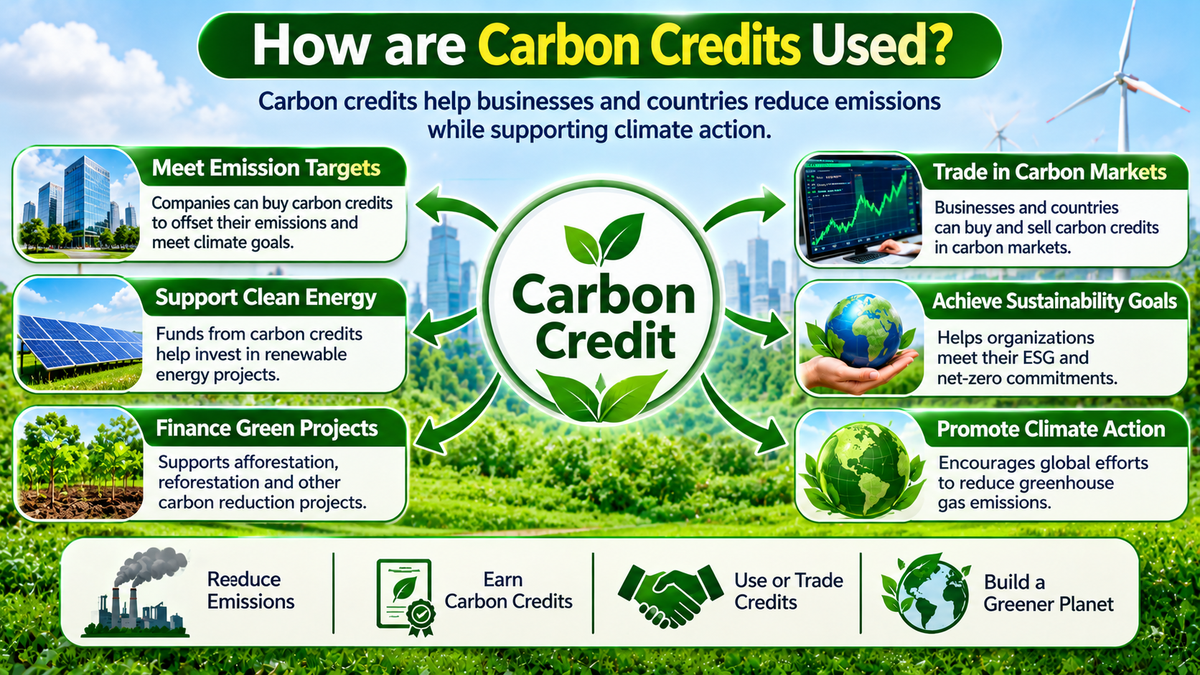
A carbon credit is a tradable unit that represents a measured climate benefit. Usually, one credit equals one metric tonne of carbon dioxide equivalent (tCO₂e). That is one tonne of CO₂, or the amount of another greenhouse gas, such as methane, that has the same warming effect.
A project creates credits by cutting, avoiding or removing emissions compared with a realistic baseline. Independent auditors check the claim. A registry then issues the credits with unique serial numbers. When a buyer uses a credit, it is retired, which means it can never be sold or used again.
A credit does not make emissions disappear. It shows that a verified amount of mitigation happened somewhere else, and the buyer or a regulated scheme uses it for a defined purpose.
What Are the Main Types of Carbon Credit?
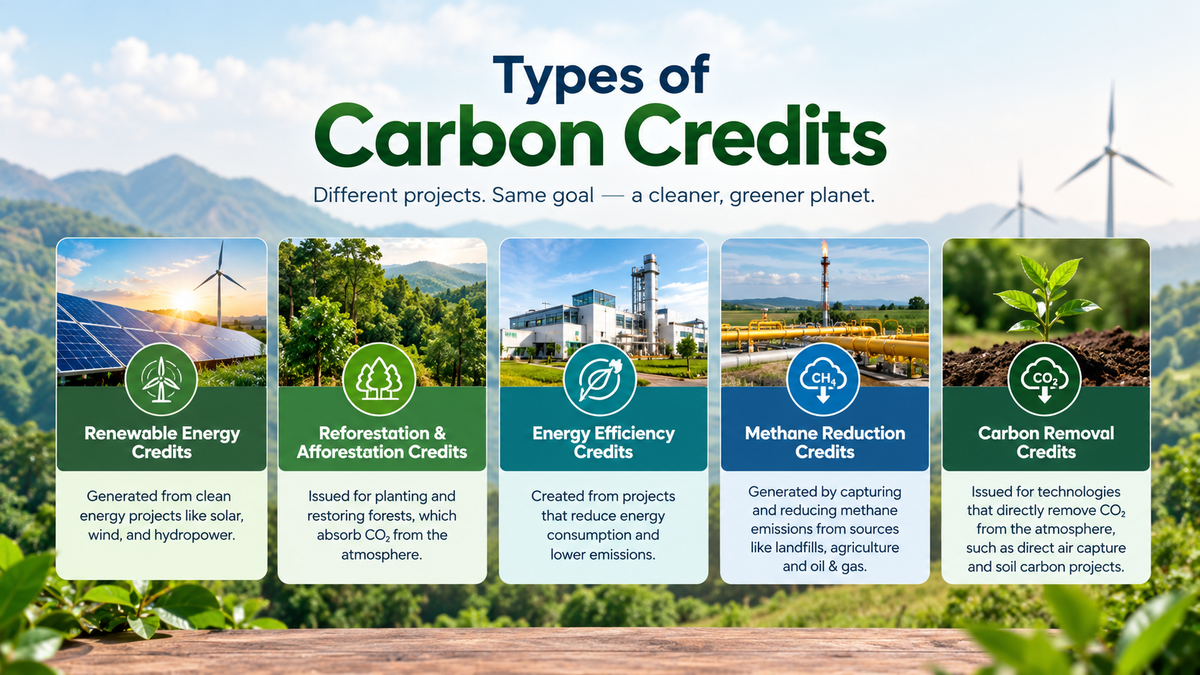
These are project or activity categories, not formal market classifications. Registries and programmes group projects in their own ways. The categories below are the ones most buyers meet:
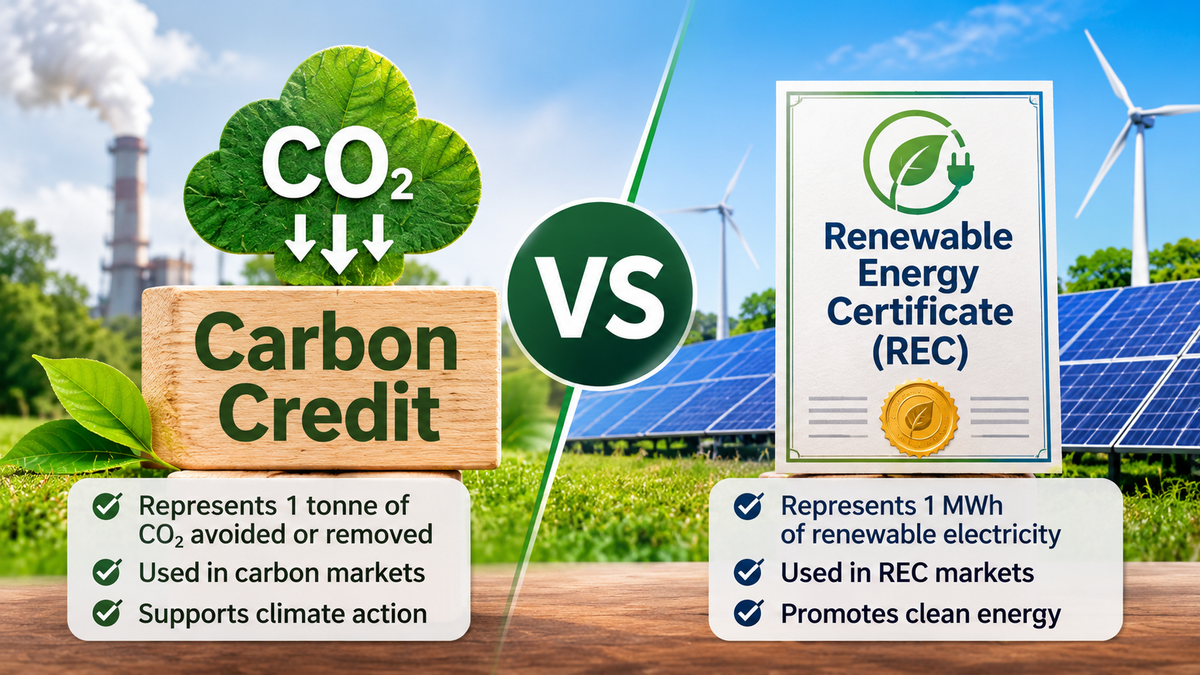
- Renewable energy credits from carbon projects. Wind, solar, small hydro and similar projects displace fossil-fuel electricity. Programmes now apply tighter rules to these projects, and some restrict large grid-connected ones. Do not confuse these with renewable energy certificates (RECs), which are a different instrument.
- Forestry and afforestation credits. Planting trees on land that was not forested creates new carbon storage.
- Reforestation credits. Restoring forest on recently cleared or degraded land recovers lost carbon stocks.
- Forest conservation credits. Protecting forest that is under threat avoids emissions from deforestation. These are often called REDD+ credits.
- Methane capture and destruction credits. Landfill gas, livestock manure digesters and coal mine methane projects stop a potent greenhouse gas from reaching the atmosphere.
- Energy efficiency credits. Efficient cookstoves, lighting, industrial equipment and building upgrades reduce energy use and associated emissions.
- Industrial emissions reduction credits. Waste-heat recovery, fuel switching and the destruction of certain industrial gases lower process emissions.
- Carbon removal credits. These come from activities that take CO₂ out of the air and store it, such as tree planting, soil carbon, biochar and direct air capture.
What Is the Difference Between Carbon Reduction, Avoidance and Removal Credits?
The labels describe what the project does to the atmosphere. They matter because they affect how credits are judged.
- Emissions reduction. The project lowers emissions that would have occurred. A factory that recovers waste heat and burns less fuel is a simple example.
- Avoided emissions. The project prevents emissions that were likely to happen, such as protecting a forest that was due to be cleared. The benefit rests on a counterfactual, a judgement about what would have happened without the project.
- Carbon dioxide removal. The project takes CO₂ out of the atmosphere and stores it. The atmosphere ends up with less CO₂ than before.
- Nature-based removal. Forests, mangroves and soils absorb CO₂ through biological processes. These are generally lower cost, but the carbon can be released again by fire, drought or land-use change.
- Technology-based removal. Direct air capture with geological storage, biochar and enhanced weathering are examples. Storage can be more durable, but costs are usually higher and methods vary in maturity.
Reduction and avoidance credits slow the growth of emissions. Removal credits reduce the stock of CO₂ already in the air. Buyers who want to claim they have balanced residual emissions often look closely at removals, while others use reduction and avoidance credits to support mitigation now. Neither group is automatically better. Quality depends on how well each project is designed and verified.
What Are Voluntary and Compliance Carbon Credits?
The two markets serve different purposes and follow different rules.
Voluntary carbon market
- Purpose: supports climate goals that organisations set for themselves, such as corporate climate targets.
- Participants: companies, individuals, project developers, brokers and standards bodies.
- Governing rules: private or independent programmes, such as Verra’s VCS, Gold Standard or the Climate Action Reserve, plus the buyer’s own policies.
- Common uses: voluntary offsetting, corporate sustainability claims and financing early-stage projects.
Compliance carbon market
- Purpose: helps meet legal obligations on emissions.
- Participants: regulated companies, governments and national or regional authorities.
- Governing rules: laws and regulations of each scheme. Some schemes issue allowances, while others also accept a limited set of project-based credits.
- Common uses: emissions trading systems, carbon pricing programmes and international schemes such as CORSIA.
Two terms are often mixed up. A carbon allowance is a permit issued by a regulator under a cap-and-trade system. A project-based credit is generated by a specific activity. Some compliance schemes accept credits, and many do not.
The UN-supervised Article 6.4 mechanism under the Paris Agreement adds another category. It issues its own units, called A6.4ERs, and host countries can authorise their use. The World Bank tracks how these different instruments fit into carbon pricing around the world.
How Are Carbon Credits Verified and What Determines Their Quality?
Most credible programmes follow a similar process. A project is validated against the programme’s rules. Independent auditors then verify the actual results. Credits are issued in a registry, tracked by serial number and retired when used.
Several concepts decide quality:
- Additionality. Would the reduction have happened without carbon finance? If so, the credit adds little.
- Permanence. How long will the stored carbon stay out of the atmosphere? Forests face reversal risk, so programmes often hold back a buffer of credits.
- Leakage. Does the project simply move emissions elsewhere, for example by pushing logging to a nearby forest?
- Monitoring and reporting. Projects must measure results and report them regularly.
- Registry tracking. Public records help prevent double counting and show whether a credit has been retired.
Not every credit has the same environmental quality, and not every credit is eligible for every programme. Each programme and compliance scheme sets its own conditions on project types, dates and authorisation. A credit accepted by one scheme may be rejected by another.
How Are Different Types of Carbon Credit Used in Aviation and CORSIA?
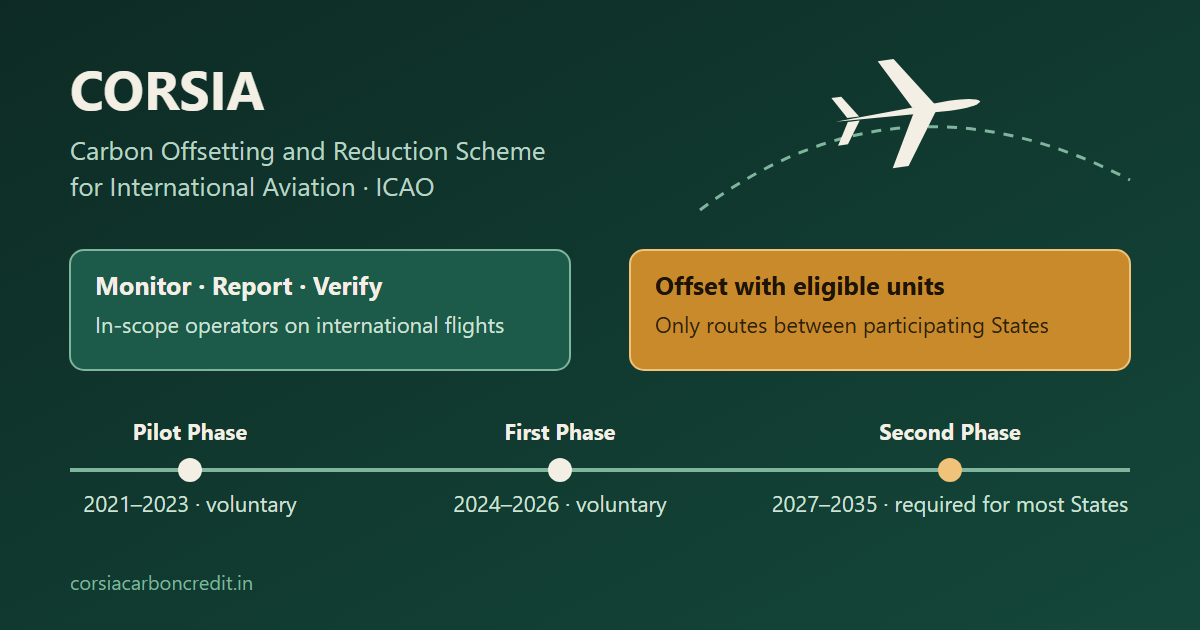
Aviation produces emissions that are hard to eliminate quickly, so international aviation uses a global scheme. The Carbon Offsetting and Reduction Scheme for International Aviation (CORSIA), set up by the International Civil Aviation Organization (ICAO), requires airlines above a threshold to offset part of their international emissions growth by cancelling eligible emissions units.
ICAO calls the units that qualify CORSIA Eligible Emissions Units. The ICAO Council approves programmes to supply them, based on advice from its Technical Advisory Body, and the approvals apply to specific compliance periods. Each approved programme also has a scope of eligibility that can exclude certain project types, dates or unit categories. ICAO has stated that not all units from an approved programme are eligible.
This is why ordinary voluntary credits cannot automatically be treated as CORSIA-eligible. A voluntary credit may be well verified and still fall outside ICAO’s rules on programme, vintage or host-country authorisation. Credits from the activity types described above, whether renewable, forestry or removal, qualify only if they meet the conditions for the relevant period.
Readers who want to see how eligible units are sourced and checked in practice can explore CORSIA Carbon Credits. Whatever source you use, confirm eligibility against ICAO’s current document and the registry record before relying on any unit.
The types of carbon credit described here differ in how they work, who buys them and what rules apply. Knowing those differences makes it easier to judge quality and to match a credit to its intended use.
Frequently Asked Questions
1. What are the main types of carbon credits? They are commonly grouped by activity: renewable energy, forestry and afforestation, reforestation and forest conservation, methane capture, energy efficiency, industrial reductions and carbon removal. They are also classed by market (voluntary or compliance) and by approach (reduction, avoidance or removal).
2. What is the difference between carbon reduction and carbon removal credits? Reduction credits come from projects that lower emissions that would otherwise occur. Removal credits come from activities that take CO₂ out of the atmosphere and store it, through nature-based or technology-based methods.
3. Are voluntary carbon credits different from compliance carbon credits? Yes. Voluntary credits are bought to support self-set climate goals under private or independent programmes. Compliance credits and allowances are used to meet legal obligations under a regulated scheme. A credit from one market is not automatically accepted in the other.
4. Which types of carbon credits are used in aviation? Airlines under CORSIA use CORSIA Eligible Emissions Units. These are credits from ICAO-approved programmes that meet the scope, date and authorisation conditions for the relevant compliance period. Airlines may also have voluntary offsetting programmes, which follow separate rules.
5. Are all carbon credits eligible under CORSIA? No. Eligibility depends on ICAO’s approvals and each programme’s scope of eligibility, which can exclude certain project types, dates and unit categories. Always check ICAO’s current document and the registry record for the specific units.