 DSTechnoverse company
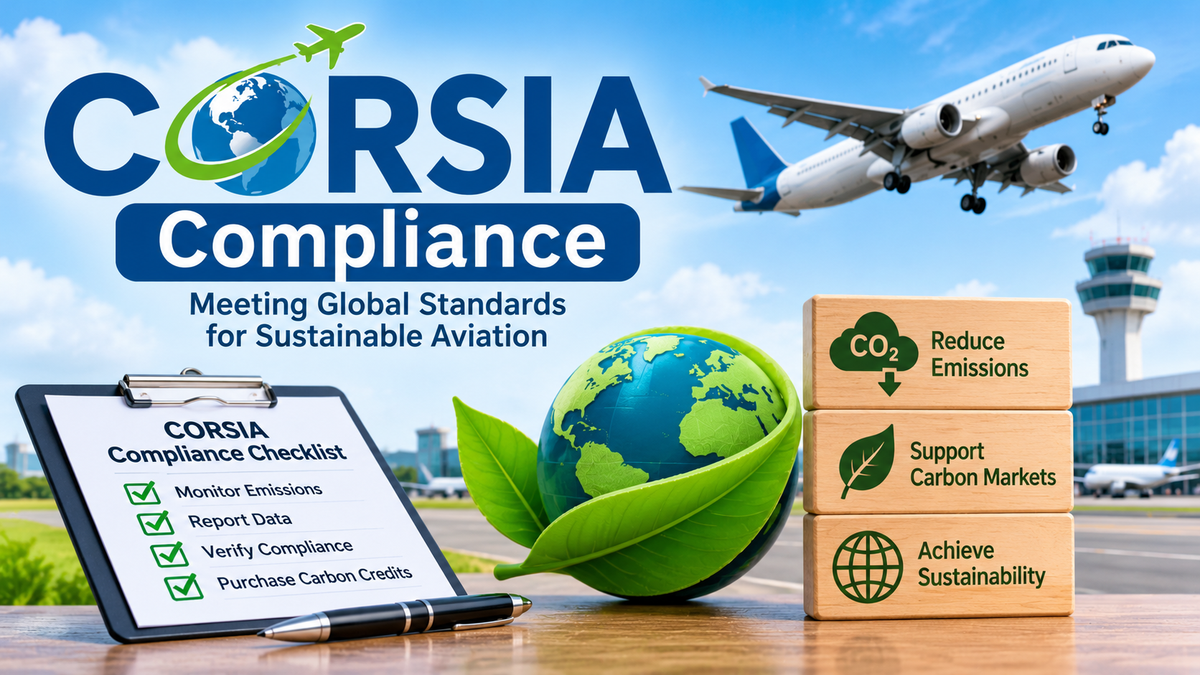
CORSIA Compliance: Requirements, Reporting Process and Airline Obligations
CORSIA compliance means that an aeroplane operator with qualifying international flights monitors its CO₂ emissions, reports them annually, has them independently verified, and, where offsetting applies, cancels enough eligible emissions units or uses eligible fuels to cover its requirement. Not every airline or flight has identical obligations. What applies depends on the operator’s emissions, the routes flown, the States involved, and the compliance period. This guide explains the process, using ICAO’s CORSIA framework.
What Is CORSIA Compliance and Why Is It Important?
CORSIA is the Carbon Offsetting and Reduction Scheme for International Aviation, developed by the International Civil Aviation Organization (ICAO). Its purpose is to address CO₂ emissions from international aviation that exceed an agreed baseline. The rules are set out in ICAO Annex 16, Volume IV, supported by ICAO implementation documents.
Compliance matters for several groups:
- Airlines need accurate data and procurement plans to meet their obligations.
- Aviation regulators approve monitoring plans, review reports, and report to ICAO.
- The carbon market is affected because CORSIA creates demand for eligible emissions units.
ICAO describes monitoring, reporting and verification (MRV) as the backbone of the scheme, since reliable emissions data underpins everything else.
Which Airlines and International Flights Are Covered Under CORSIA?
CORSIA applies to qualifying international aviation activities, not automatically to every operator or flight.
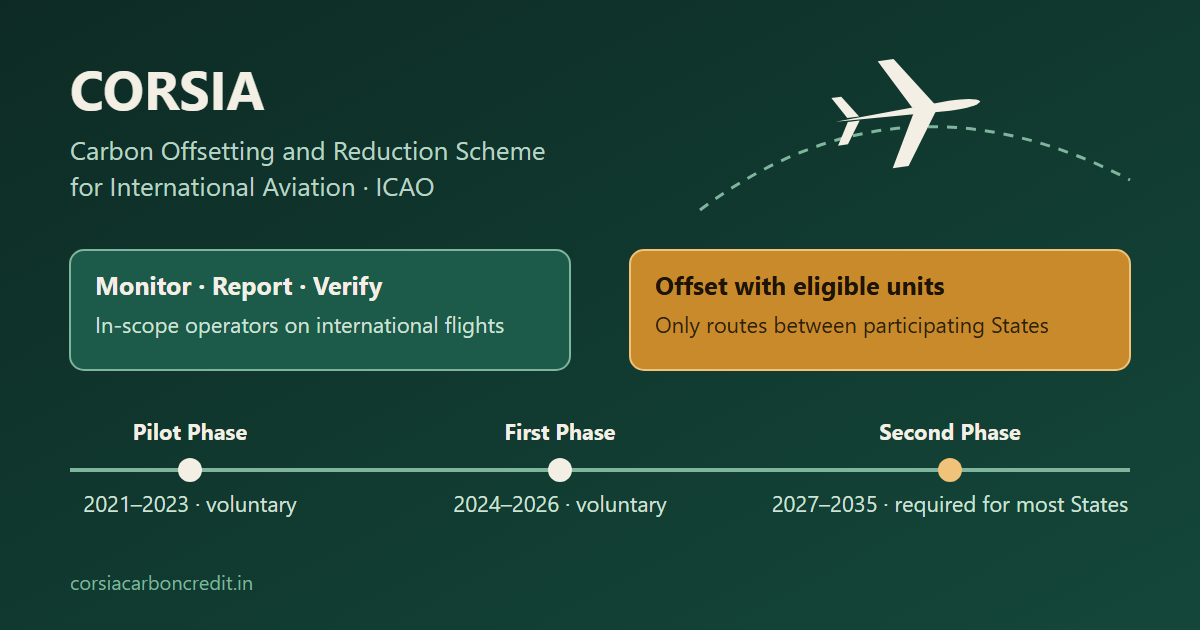
Participating States. CORSIA’s offsetting requirements apply to routes between States that participate in the scheme. Participation was voluntary in the early phases. For the second phase (2027–2035), ICAO’s participation criteria include a cumulative 90% of global 2018 revenue tonne kilometres and an individual 0.5% threshold, with exemptions for least developed countries, landlocked developing countries, and small island developing States unless they join voluntarily. Check ICAO’s current list of participating States.
International routes. Under the route-based approach, offsetting requirements relate to international flights on routes between participating States. Flights on other routes may still be subject to MRV only.
Aircraft operator responsibilities. Each operator is attributed to a State, which administers its obligations. The operator prepares the monitoring plan, monitors emissions, and arranges verification.
Exemptions and exceptions. ICAO’s framework includes technical exemptions, such as for operators below the emissions and aircraft-weight thresholds, certain humanitarian, medical and firefighting flights, and new entrants for a limited period. Because thresholds and conditions are set in ICAO documents and national regulations, operators should confirm them in the current Annex 16, Volume IV and with their State’s civil aviation authority.
What Are the Main CORSIA Compliance Requirements?
CORSIA has two kinds of obligations that should not be confused: MRV obligations (annual) and offsetting obligations (assessed per compliance period, typically three years).
Reporting-related requirements:
- CO₂ emissions monitoring: Operators monitor fuel use using an approved method, or use the ICAO CORSIA Emissions and Reporting Tool (CERT) where eligible.
- Emissions Monitoring Plan (EMP): A document that sets out how the operator will monitor and report emissions. The State reviews and approves it, and the operator updates it when material changes occur.
- Annual emissions reporting: The operator prepares an Emissions Report each year.
- Independent verification: An accredited verification body checks the report. ICAO guidance refers to ISO 14064-3 and CORSIA-specific verification requirements in Annex 16, Volume IV, Appendix 6.
- Submission of verified reports: The operator submits the Emissions Report and the verification report to the State.
Offsetting-related requirements:
- Applicable offsetting requirements: Where they apply, the State calculates them using the operator’s emissions, a baseline, and a sector growth factor, subject to the rules for the relevant period.
- Use of eligible emissions units: Operators cancel eligible units, or may reduce requirements through CORSIA eligible fuels where applicable.
An operator can have reporting duties without an offsetting requirement, for example on routes not covered by offsetting.
How Does the CORSIA Monitoring, Reporting and Verification Process Work?
The MRV cycle runs every year:
- Prepare and implement an emissions monitoring plan. Submit it to the State for approval.
- Monitor fuel use and calculate CO₂ emissions. Follow the approved method and fill any data gaps as the rules allow.
- Prepare the annual emissions report.
- Arrange independent verification. Engage an accredited verification body.
- Submit verified reports to the appropriate authority. Deadlines are set by the State’s regulations.
- Complete any applicable compliance obligations. This includes cancelling eligible units where offsetting applies.
What Role Do CORSIA Eligible Emissions Units Play in Compliance?
Eligible emissions units are how operators meet offsetting requirements where they apply. Only units that satisfy ICAO’s requirements for the relevant compliance period count.
Programme and unit eligibility. ICAO approves emissions unit programmes for specific compliance periods, and the eligible units must meet the conditions in ICAO’s published documents. These can include unit type, vintage range, and host-country authorisation arrangements. For the first phase (2024–2026), ICAO documents define the applicable programmes and rules. Programme-level approval does not guarantee that every individual unit is eligible, so unit-level checks matter.
Registry tracking and cancellation. Units are tracked in registries. Operators cancel the required units, and the cancellation is reported through the State to ICAO. Market sources indicate that the first-phase cancellation deadline falls in January 2028, but operators should confirm exact dates with their State and ICAO documents.
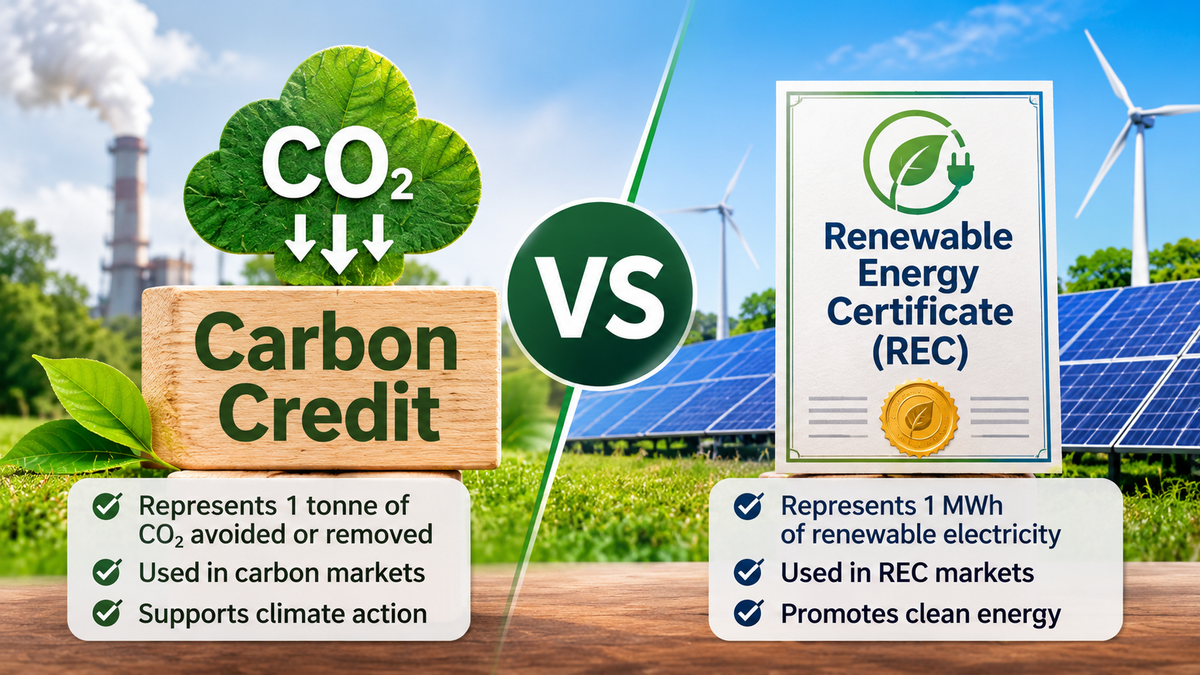
Documentation and due diligence. Keep serial numbers, registry records, ownership evidence, and cancellation confirmations. Ordinary voluntary carbon credits are not automatically eligible under CORSIA.
For readers who want background on how CORSIA Carbon Credits are sourced for aviation procurement, it is best to compare several independent sources and always verify eligibility against ICAO documentation before buying.
What Challenges Do Airlines Face in Maintaining CORSIA Compliance?
- Accurate emissions data collection: Data must be consistent across flights, aircraft, and fuel suppliers.
- Fuel monitoring and record keeping: Records must support the approved monitoring method and withstand verification.
- Reporting deadlines: National deadlines vary, so operators must track their State’s requirements.
- Independent verification: Verifiers must be accredited, and booking them early avoids bottlenecks.
- Changing regulatory requirements: ICAO documents and national rules are updated, so operators should monitor changes.
- Eligible unit sourcing and procurement: Supply, eligibility conditions, and market prices can shift.
- Documentation and compliance planning: Obligations span several years, so planning needs to start early.
Practical steps:
- Confirm which flights and States are covered for your operations.
- Keep an up-to-date, approved emissions monitoring plan.
- Build a clean, auditable fuel-use data trail.
- Book verification early and consider pre-verification.
- Track ICAO and State updates.
- Plan eligible unit procurement ahead of cancellation deadlines.
- Store registry and ownership documents centrally.
Strong CORSIA compliance comes down to accurate data, clear ownership of tasks, and early planning for offsetting.
Frequently Asked Questions
1. What does CORSIA compliance mean? It means meeting the obligations that apply to an aeroplane operator under ICAO’s CORSIA framework: monitoring CO₂ emissions, reporting them annually, having them verified, and, where offsetting applies, cancelling eligible emissions units or using eligible fuels.
2. Which airlines need to comply with CORSIA? Aeroplane operators conducting qualifying international flights, subject to ICAO rules, State participation, and exemptions. Obligations are not identical for every airline, so operators should check ICAO documents and their State’s regulations.
3. What are the main CORSIA reporting requirements? Operators need an approved emissions monitoring plan, annual CO₂ emissions monitoring, an annual emissions report, independent verification by an accredited body, and submission of the verified reports to their State.
4. Are carbon credits mandatory for every airline under CORSIA? No. Offsetting requirements apply only where CORSIA’s rules say so for the operator, routes, and compliance period. Reporting obligations are separate from offsetting, and eligible fuels can also reduce offsetting requirements where applicable.
5. What happens if an airline does not meet its CORSIA obligations? ICAO’s framework is implemented through national regulations, so consequences are set by each State’s laws and aviation authority. Operators should check their State’s rules rather than assume a standard penalty.